
 English
 usheenthermal

What is the molding and curing process of thermal silicone pad?
Date:2020-03-16
What is the process of forming and curing the thermal silicone pad? A variety of auxiliary materials such as metal oxides are added. A thermally conductive medium material synthesized through a special process can play the role of insulation, shock absorption, sealing, etc., and can meet the miniaturization of equipment and The ultra-thin design requirements are extremely processable and usable, and the thickness can be used in a wide range. An excellent thermally conductive filling material.
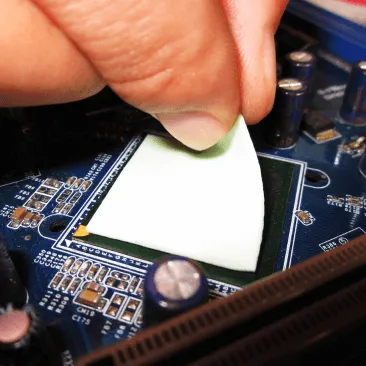
Generally, a silicone rubber that has undergone secondary vulcanization is needed to make a soft, elastic and tensile heat-resistant silicone gel sheet. Vulcanization can also be called curing.
After the liquid thermal silica gel is heated and formed in the first stage, its crosslink density is not enough. It is necessary to further vulcanize it to increase the tensile strength, resilience, hardness, swelling degree, density, and thermal stability of the thermal silicone pad.
If the secondary vulcanization is not performed, the performance of the thermal silicone pad produced may be affected to some extent, and a product with better performance may not be obtained. The parameters of the product after primary vulcanization are different from those of secondary vulcanization, which is also related to the actual operation process and steps.
Generally, a silicone rubber that has undergone secondary vulcanization is needed to make a soft, elastic and tensile heat-resistant silicone gel sheet. Vulcanization can also be called curing.
After the liquid thermal silica gel is heated and formed in the first stage, its crosslink density is not enough. It is necessary to further vulcanize it to increase the tensile strength, resilience, hardness, swelling degree, density, and thermal stability of the thermal silicone pad.
If the secondary vulcanization is not performed, the performance of the thermal silicone pad produced may be affected to some extent, and a product with better performance may not be obtained. The parameters of the product after primary vulcanization are different from those of secondary vulcanization, which is also related to the actual operation process and steps.
Sheen Thermal
Dongguan Sheen Electronic Technology Co., Ltd · Founded in 2008
Manufacturer of thermal interface materials and silicone foam for automotive electronics, energy storage, power electronics, communications and consumer electronics.
Certified
- ISO 9001:2015
- ISO 14001:2015
- IATF 16949:2016
What we supply
- Thermal conductivity Up to 90 W/m·K
- Thickness 0.3–10.0 mm
- Custom & samples Die-cut to drawing, 3–7 days