
 English
 usheenthermal

A brief description of thermally conductive gap filler material-silicon-free thermal pad
Date:2026-08-22
Power consumption electronic components are the main body of heat generation in electronic equipment. The higher the power of electronic components, the more heat they will generate. However, the development trend of science and technology in today's society is based on high performance, high integration and light weight. Mainly, the performance of electronic components is getting stronger and stronger, which also means that their power is also rising, so the heat dissipation must keep up with the pace.
As electronic components increase in power density, thermal interface materials (TIMs) must dissipate heat without introducing secondary reliability risks. Conventional silicone-oil-based thermal pads release low-molecular-weight siloxanes over time — these volatile compounds condense on optical surfaces, increase connector contact resistance, and degrade wire bonds. Silicone-free thermal pads replace the silicone oil matrix with a specialized polymer resin, eliminating siloxane outgassing while maintaining thermal performance.
What Is a Silicone-Free Thermal Pad
Silicone-free thermal pad is a gap-filling thermal pad based on special resin instead of silicone oil. It has the characteristics of high resilience, high flexibility, high thermal conductivity, low thermal resistance, etc. It is easy to operate and easy to rework , and under the condition of continuous pressure and heat, there is no precipitation of small siloxane molecules, so as to avoid the precipitation of small siloxane molecules in heat-conducting products containing silicone oil under long-term working conditions, which will lead to the degradation of the performance of electronic components and prolong their working life.

Sheen Technology Silicone-free thermal pad Key Properties:
| Properties | Color | Thermal Conductivity | Thermal Impedance (1mm,@30psi) | Thickness | Standard Hardness |
| Unit | - | W/m·K | ℃*in2/W | mm | Shore 00 |
| AF100 | White | 1.0 | 1.1 | 0.25 ~ 5.0 | 50/70±5 |
| AF300 | White | 2.0 | 0.8 | 0.25 ~ 5.0 | 50/70±5 |
| AF500 | White | 3.0 | 0.6 | 0.25 ~ 5.0 | 50/70±5 |
| AF600 | White | 5.0 | 0.3 | 0.5 ~ 5.0 | 50/70±5 |
| AF600G | White | 6.0 | 0.25 | 0.5 ~ 5.0 | 50/70±5 |
| AF800 | White | 8.0 | 0.2 | 0.5 ~ 5.0 | 50/70±5 |
| AF1000 | Grey | 10.0 | ≤0.13 | 1.0 ~ 2.0 | 50 ~ 65 |
| Test Method | Visual | ASTM D5470 | ASTM D5470 | ASTM D374 | ASTM D2240 |
Silicone-Free vs. Silicone-Oil Pads
Thermally conductive gap filling material is a general term for a material that is coated between the heat sink device and the heat sink device and reduces the contact thermal resistance between the two. The widely used thermal conductive silicone sheet and thermal paste are one of the thermally conductive gap filling materials. At present, many thermal conductive gap fillers are made of silicone oil, so small molecules of siloxane will be precipitated during use and pollute the surrounding devices, which is not allowed for some electronic devices that have high environmental requirements.
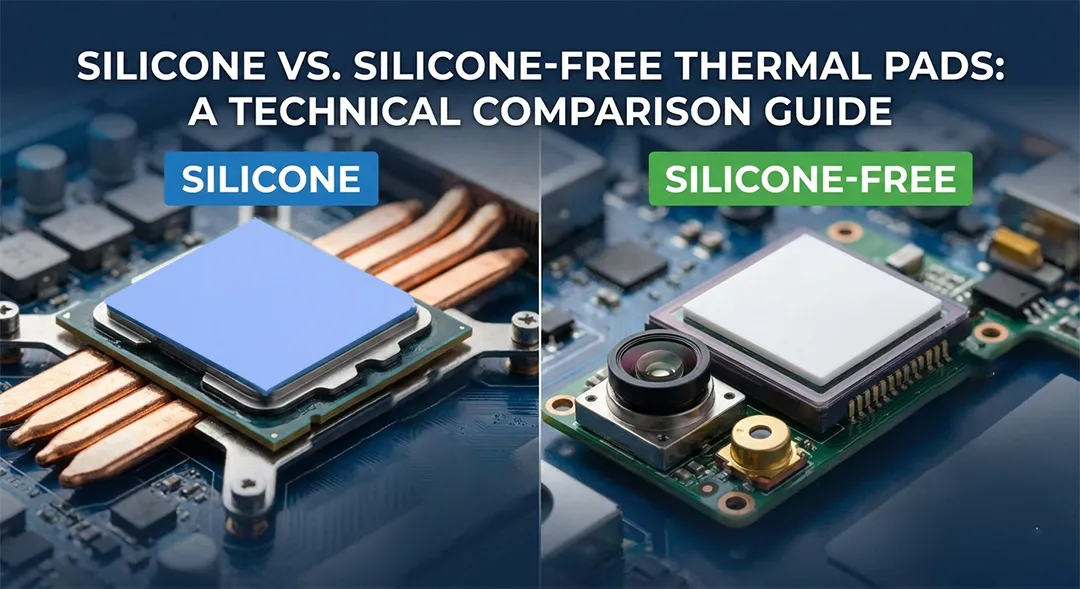
| Property | Silicone-Free Pad | Silicone-Oil Pad | Engineering Impact |
| Siloxane Outgassing | None (no silicone oil) | Low-molecular-weight siloxanes released | Silicone-free: contamination-free |
| Thermal Conductivity (W/m·K) | 1–10 | 1–15 | Comparable; silicone-oil may reach higher via loading |
| Compressibility | 20–40% | 20–40% | Similar gap-filling |
| Reworkability | Clean removal, no residue | May leave oil residue | Silicone-free: cleaner rework |
| Outgassing (ASTM E595) | <0.1% TML | 0.1–0.5% TML | Silicone-free: low outgassing for sealed/optical apps |
| Best Application | Optical, cleanroom, automotive sensors | General electronics | Selection = contamination sensitivity |
Note: The values above apply to specific product models; actual specifications vary by model. Sheen Technology can provide technical data sheets for specific products.
Silicone-Free Thermal Pad Applications
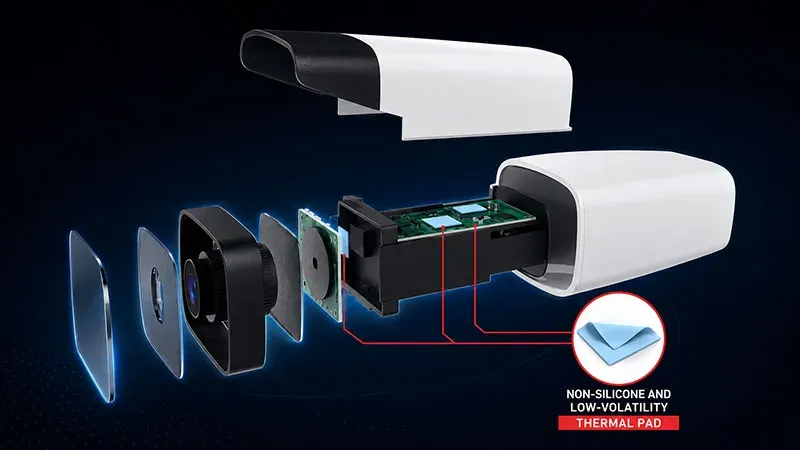
- Optical Modules / Transceivers: siloxane condensation on lenses degrades signal — silicone‑free pads eliminate this risk.
- Automotive Sensors & ADAS: cameras and LiDAR require contamination‑free, long‑lifetime thermal interfaces.
- Cleanroom Electronics: semiconductor equipment and precision instruments demand low‑outgassing materials.
- LED Lighting: optical clarity and long lumen maintenance benefit from silicone‑free TIMs.
- Data Center / Telecom: high‑reliability equipment where connector contamination is a field failure mode.
→ View Silicone-Free Thermal Pad Application Page
FAQ
Q: What is a silicone-free thermal pad?
A: A silicone-free thermal pad is a gap-filling TIM that uses a polyurethane, acrylic, or epoxy polymer matrix instead of silicone oil. It eliminates siloxane outgassing, making it suitable for contamination-sensitive applications (optical, automotive, cleanroom) where conventional silicone pads pose a reliability risk.
Q: Why does siloxane contamination matter in electronics?
A: Low-molecular-weight siloxanes released from silicone-oil TIMs condense on optical surfaces (causing haze), increase connector contact resistance, and interfere with wire bonds. ASTM E595 quantifies outgassing; silicone-free pads achieve <0.1% TML vs. 0.1–0.5% for silicone pads.
Q: Does a silicone-free pad sacrifice thermal performance?
A: Slightly. Silicone-free pads typically achieve 1–10 W/m·K vs. silicone-oil pads at 1–15 W/m·K. For most applications the difference is minor, and the contamination-elimination benefit outweighs the small conductivity gap. High-conductivity BN-filled silicone-free grades (up to 16 W/m·K) are available(data from Sheen Technology).
Q: Can silicone-free thermal pads be reworked?
A: Yes. Silicone-free pads offer clean removal without oil residue, making them ideal for field-serviceable and reworkable assemblies. Reworkability is a key advantage over both silicone pads and thermal grease.
Silicone-free thermal pads resolve the fundamental reliability conflict between thermal performance and contamination control. By eliminating siloxane outgassing while maintaining adequate thermal conductivity and reworkability, they are the preferred TIM for optical, automotive, and cleanroom electronics where siloxane contamination is unacceptable. Sheen Technology provides silicone-free pad products with ASTM-referenced data and application engineering support.
→ Request Silicone-Free Thermal Pad Samples + Outgassing Data
Sheen Thermal
Dongguan Sheen Electronic Technology Co., Ltd · Founded in 2008
Manufacturer of thermal interface materials and silicone foam for automotive electronics, energy storage, power electronics, communications and consumer electronics.
Certified
- ISO 9001:2015
- ISO 14001:2015
- IATF 16949:2016
What we supply
- Thermal conductivity Up to 90 W/m·K
- Thickness 0.3–10.0 mm
- Custom & samples Die-cut to drawing, 3–7 days