
 English
 usheenthermal

Graphene vs Graphite Thermal Pads: What You Need to Know
Date:2026-10-15
Heat is the silent troublemaker in electronics. Graphene vs Graphite Thermal Pads presents a tricky choice: chase better cooling performance or keep production costs under control? For manufacturers, every degree and dollar counts.
Graphene promises impressive heat dissipation, while graphite offers proven reliability at lower costs. But which delivers better value for bulk orders?
Melodic Key Points: Graphene vs Graphite Thermal Pads
➔ Graphene delivers unmatched in-plane thermal conductivity and EMI shielding via low electrical resistivity, reducing hotspots in high-power semiconductors.
➔ Graphite offers reliable heat spreading at lower cost, with anisotropic conductivity and simple roll-stock die-cutting for bulk production.
➔ Engineered graphene pads boast superior compressibility and thickness tolerance to bridge uneven CPU surfaces, cutting thermal contact resistance.
➔ ASTM D5470 tests confirm graphene’s lower thermal impedance; graphite remains a cost-effective choice for less demanding applications.
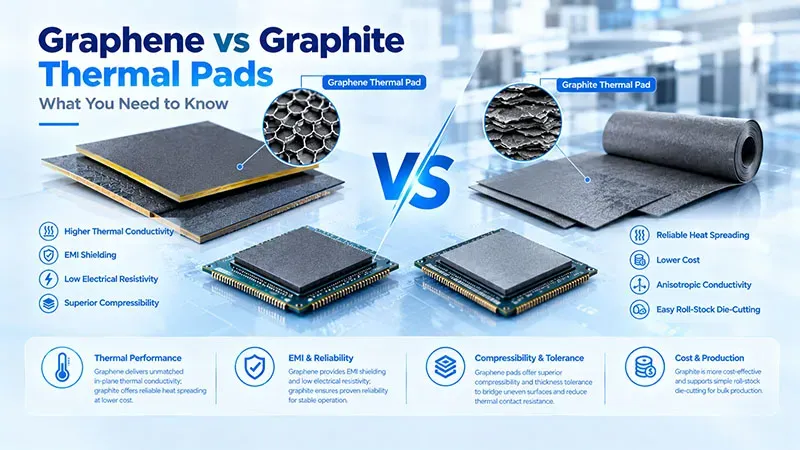
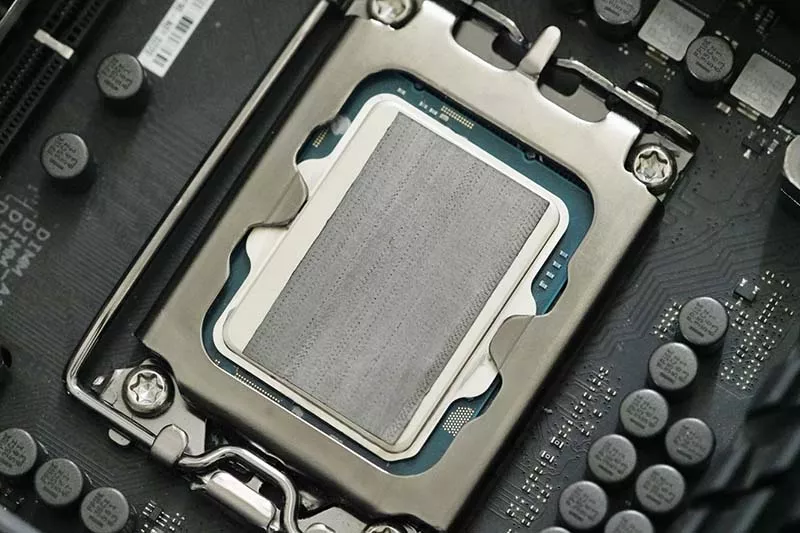
This image was generated with the assistance of AI; it is not a real photograph and is for reference only.
Graphene Vs Graphite Thermal Pads: Key Differences
Choosing between Graphene vs Graphite Thermal Pads comes down to heat transfer, material structure, and budget. Both carbon-based cooling materials help electronics manage rising temperatures, but their performance differs. Understanding these differences makes selecting suitable thermal solutions for compact devices and power electronics much easier.
Graphene Thermal Pads
Graphene thermal pads use an ultra-thin, two-dimensional atomic structure made from carbon atoms arranged in a hexagonal lattice. This arrangement supports exceptional in-plane thermal conductivity, allowing heat to spread rapidly across the material.
Their real advantage lies in efficient heat movement without adding much thickness.
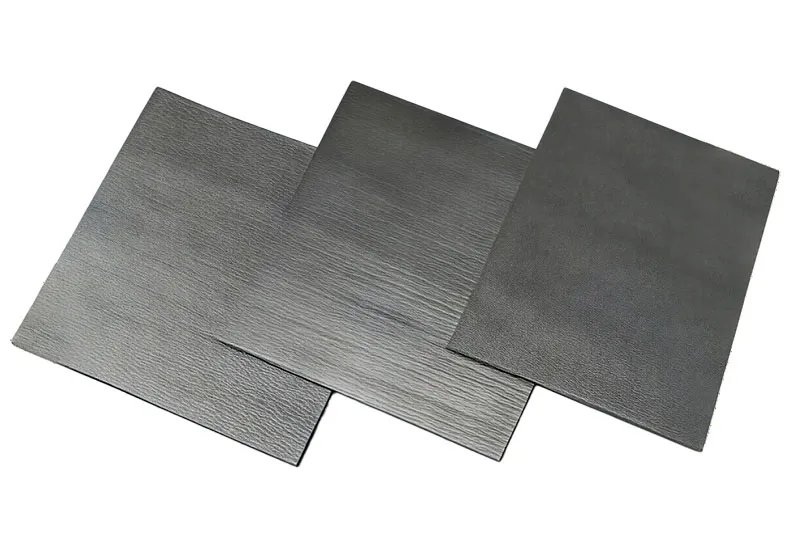
Heat Transfer and Material Performance
- Phonon Transport: Graphene transfers thermal energy efficiently through lattice vibrations called phonons, supporting effective heat dissipation.
Mechanical Properties:
- High flexibility helps graphene-based sheets fit compact electronic designs.
- Strong carbon bonds contribute to mechanical durability.
- Excellent electron mobility supports graphene's broader electronic applications.
Practical Cooling Applications
- Electronic Devices: Graphene composites help spread heat in smartphones, processors, and compact circuit assemblies.
- Power Semiconductors: Graphene-enhanced interface material can improve thermal management when designed with suitable contact properties.
However, graphene's impressive in-plane conductivity does not automatically guarantee low through-thickness thermal resistance.
To address this limitation, Sheen Technology has introduced vertically oriented graphene thermal pads, which achieve a thermal conductivity of up to 130 W/m·K and a thermal resistance as low as 0.06 K·cm²/W.
| GSF130-030 Graphene Pad Technical Specifications | ||||
|---|---|---|---|---|
| Performance | Properties | Unit | GSF130-030 | Test Method |
| Thermal Properties | Thermal Conductivity | W/m·K | 130 | ASTM E1461 |
| Thermal Resistance (@50psi) | ℃*cm²/W | ≤0.06 | ASTM D5470 | |
| Application Temperature | ℃ | -40~150 | / | |
| Physical Properties | Rebound Rate | % | ≥90 | / |
| Tensile Strength | Mpa | ≥0.05 | ASTM D412 | |
| Color | - | Black | Visual | |
| Thickness | mm | 0.2~2.0 | ASTM D374 | |
| Density | g/cm³ | 0.3~0.7 | ASTM D792 | |
| Oil Bleeding Rate | % | ≤3 | / | |
| Flame Retardancy | Flame rating | - | V-0 | UL 94 |
When comparing Graphene vs Graphite Thermal Pads, Sheen Technology emphasizes matching material properties to actual operating conditions.
Graphite Thermal Pads
Graphite thermal pads contain stacked carbon layers held together by relatively weak interlayer bonding. This layered structure creates strong thermal anisotropy, meaning heat travels much faster along the layers than through their thickness.
Natural graphite also offers practical cost advantages.
| Property | Graphene | Graphite | Unit |
| In-plane thermal conductivity | 2000–5000 | 200–1500 | W/m·K |
| Through-plane thermal conductivity | 130 | 5–20 | W/m·K |
| Typical sheet thickness | 10–100 | 25–100 | μm |
| Carbon layer count | 1 | Multiple | Layers |
| Material density | ~2.2 | 2.0–2.3 | g/cm³ |
* Values are illustrative material-level ranges; commercial composites and finished pads can differ substantially.
Graphite cooling materials offer several practical benefits:
- Natural flake graphite provides an economical starting material for heat-spreading sheets.
- High electrical conductivity requires insulation near exposed circuitry.
- Limited compression and surface conformity can increase contact thermal resistance.
- Pairing graphite sheets with a suitable heatsink improves overall cooling performance.
Graphene vs Graphite Thermal Pads ultimately involves balancing conductivity, thickness, installation requirements, and cost. Graphite often makes sense for affordable lateral heat spreading, while graphene-based composites offer additional design possibilities where thin, flexible cooling materials are needed.
3 Benefits Of Graphene Vs Graphite Thermal Pads
Choosing between Graphene vs Graphite Thermal Pads can make a real difference in electronic cooling performance. Both materials spread heat, but graphene-based designs offer potential advantages in thermal conductivity, surface flexibility, and electrical performance. Understanding these differences helps engineers reduce overheating, improve device reliability, and control electromagnetic interference without adding unnecessary bulk.
Superior Thermal Conductivity Minimizes Temperature Gradient
Graphene's carbon structure supports efficient phonon transport, allowing heat to travel rapidly across its surface.
Compared with conventional graphite, properly engineered graphene thermal pads can improve lateral heat dissipation and reduce the temperature gradient around high-power components.
Key advantages include:
Faster heat spreading
- High in-plane thermal conductivity distributes heat across wider areas.
- Reduced localized hotspot formation protects sensitive components.
Improved cooling performance
- Lower effective thermal resistance supports efficient heat transfer.
- Better temperature uniformity improves overall cooling efficiency.
However, actual performance depends on graphene loading, material alignment, and pad construction.
Enhanced Compressibility Factor for Irregular Surfaces
Real electronic surfaces aren't perfectly flat. Tiny gaps can trap air and weaken thermal performance.
Engineered graphene composite pads improve surface contact through controlled compressibility and flexibility.
Their advantages include:
Better surface adaptation
- Flexible structures conform to a rough surface.
- Controlled deformation reduces each microscopic micro-gap.
Reliable thermal connections
- Optimized mounting pressure improves contact.
- Consistent thickness helps maintain interface performance.
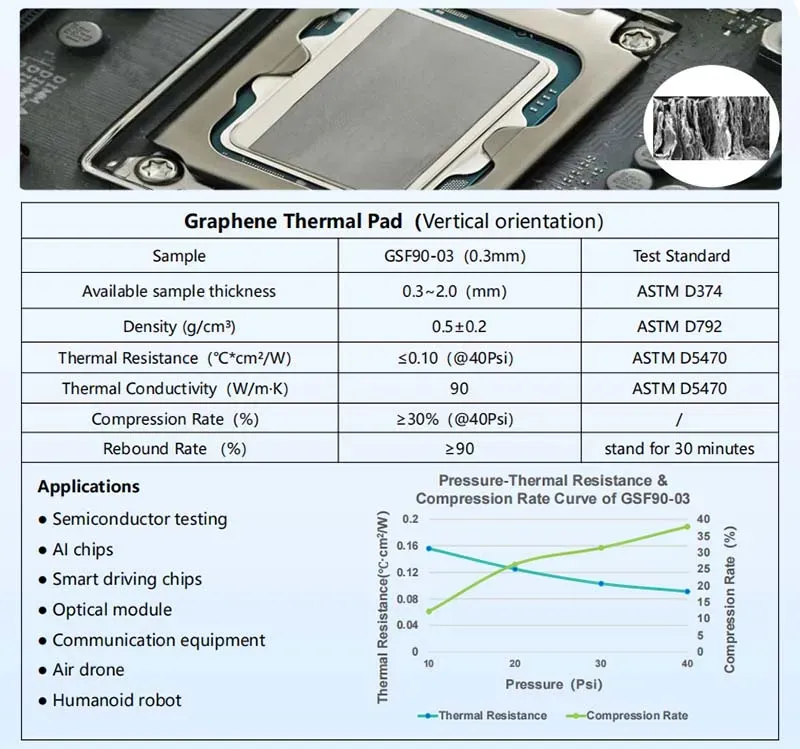
As tested by the Sheen laboratory, the GSF90-030 graphene thermal pad exhibits a 30% compression rate and a rebound rate of over 90% under a pressure of 40 psi. Sheen Technology offers thermal management solutions designed to support demanding electronic applications.
Lower Electrical Resistivity Enables EMI Shielding
Conductive graphene formulations can combine thermal management with EMI shielding, helping reduce unwanted electronic noise.
Their electrical resistivity and shielding performance depend heavily on material composition and orientation.
| Material | In-Plane Thermal Conductivity (W/m·K) | Electrical Conductivity (S/m) | EMI Shielding |
| Monolayer graphene | 2,000–5,000 | 10⁵–10⁶ | Design-dependent |
| Bulk graphite | 100–500 | 10⁴–10⁵ | Design-dependent |
| Graphene composite | 5–100 | 10²–10⁵ | Formulation-dependent |
* Values are illustrative literature-scale ranges, not specifications for finished thermal pads. Monolayer graphene values describe intrinsic material properties.
Graphene's adjustable conductivity can reduce surface impedance, supporting shielding effectiveness against electromagnetic interference.
Unlike conventional graphite pads, graphene composites can be engineered for specific conductivity directions, potentially improving signal integrity.
In Graphene vs Graphite Thermal Pads comparisons, actual EMI attenuation must be verified through frequency-specific testing.
CPU Cooling: Graphene Vs Graphite Pads
Choosing between Graphene vs Graphite Thermal Pads involves more than checking thermal conductivity ratings. Heat movement, pad thickness, electrical safety, and mounting pressure all affect how efficiently your CPU stays cool under heavy workloads.
Phonon Transport Efficiency in a Graphene Lattice
Graphene's hexagonal atomic structure allows heat to travel efficiently through lattice vibration, where energy moves through the material as phonons.
Heat Transfer Mechanisms
- Phonon scattering: Defects, wrinkles, and boundaries interrupt heat flow.
- Mean free path: Longer phonon travel distances generally improve thermal conductivity.
- Ballistic transport: At sufficiently small scales, phonons can move with limited scattering.
Graphene's molecular orientation favors sideways heat spreading. However, graphene thermal pads don't automatically outperform graphite because layer bonding and interface quality matter.
Thickness Tolerance and Compressibility Factor Trade-Offs
In Graphene vs Graphite Thermal Pads, thickness and flexibility can matter more than impressive conductivity numbers.
Thickness Control
- Pad thickness, measured in micrometers, affects the heat transfer distance.
- Poor tolerances increase thermal resistance.
Mechanical Response
- Interface pressure improves surface contact.
- Elastic modulus influences stiffness and deformation.
- Effective gap filling reduces trapped air.
Graphite pads may conform differently depending on their construction. Too little pressure creates gaps; excessive force risks damaging components.
Dielectric Breakdown and Conductivity Anisotropy Considerations
Both materials require careful electrical handling.
Electrical Behavior: High in-plane conductivity allows electrical current to travel along conductive layers, while through-plane resistance is typically higher.
Safety Considerations: Bare conductive pads provide no dependable electrical insulation. Their anisotropic ratio describes directional conductivity differences.
Unlike insulating thermal pads, conductive graphene and graphite products lack a useful insulating dielectric strength or safe dielectric voltage threshold. Keep exposed contacts protected.
ASTM D5470 Testing for Thermal Impedance in CPU Environments
ASTM D5470 uses a steady-state method to evaluate thermal interface material performance under controlled conditions.
Measurement Conditions
- Applied heat flux establishes heat transfer.
- The temperature gradient reveals thermal resistance.
- Controlled pressure helps assess contact resistance.
Performance Comparison
- Apparent conductivity reflects measured behavior under specified conditions.
- Bond-line thickness influences overall thermal impedance.
For Graphene vs Graphite Thermal Pads, compare measurements at identical temperatures, pressures, and thicknesses. That's how you separate genuine cooling improvements from marketing hype.
Cost Vs Performance Analysis
Choosing between graphene and graphite thermal pads involves balancing material costs, cooling efficiency, and long-term reliability. This Graphene vs Graphite Thermal Pads comparison highlights practical differences that affect purchasing decisions and real-world performance.
Cost Analysis
In the Graphene vs Graphite Thermal Pads cost comparison, graphite generally offers lower manufacturing expense, while graphene-based alternatives may require greater production investment due to specialized processing.
Key purchasing considerations include:
Material Pricing and Production
- Graphite thermal pads: Established manufacturing processes help control material overhead and support competitive bulk pricing.
- Graphene thermal pads: Advanced material processing, coating, and quality control can increase resource expenditure.
Supply and Customization
- Roll stock availability: Graphite sheets typically offer broader commercial availability.
- Die-cut dimensions: Both materials support custom shapes, although cutting complexity depends on thickness and construction.
- Adhesive backing: Optional adhesive layers increase assembly convenience but add material costs.
Long-Term Purchasing Value
- Batch homogeneity: Consistent thickness and thermal properties reduce rejected parts.
- Economic viability: Graphite suits cost-sensitive, high-volume applications.
- Financial efficiency: Graphene may justify higher budget allocation when space and weight restrictions demand specialized cooling.
Performance Assessment
Graphene vs Graphite Thermal Pads performance depends heavily on material construction, contact pressure, and heat-flow direction.
The following values represent illustrative ranges for selected commercial material categories, not universal specifications.
| Performance Metric | Graphene-Based Sheets | Graphite Sheets |
| In-plane thermal conductivity (W/m·K) | 500–2,000 | 300–1,500 |
| Typical thickness (mm) | 0.017–0.10 | 0.025–0.20 |
| Operating temperature (°C) | Product-dependent | Product-dependent |
| Relative material cost | Generally higher | Generally lower |
* Values are illustrative literature-scale ranges, not specifications for finished thermal pads.
Application-specific advantages:
- CPU cooling: Contact quality and through-plane thermal resistance matter more than headline conductivity figures.
- Battery modules: Graphite provides economical lateral heat dissipation, while electrical insulation may be necessary.
- Automotive ECUs: Mechanical durability, vibration resistance, and long-term material degradation determine reliability.
- LED assemblies: Thin graphene-based heat spreaders can improve localized temperature regulation where installation space is limited.
Both materials conduct electricity, making electrical resistivity and insulation requirements important safety considerations.
Ultimately, Graphene vs Graphite Thermal Pads selection should prioritize measured cooling performance, installation compatibility, and total ownership cost rather than conductivity claims alone.
【Request a Custom Quote】Torn between lower cost and lower thermal impedance, or dealing with uneven CPU surfaces, thickness tolerance, or EMI shielding requirements? Send us your heat load, interface gap and flatness data, mounting pressure, insulation and shielding needs, operating temperature, and bulk volume, and our engineers can recommend the graphene or graphite thermal pad grade, thickness, and format that fits your performance and cost targets.
Sheen Thermal
Dongguan Sheen Electronic Technology Co., Ltd · Founded in 2008
Manufacturer of thermal interface materials and silicone foam for automotive electronics, energy storage, power electronics, communications and consumer electronics.
Certified
- ISO 9001:2015
- ISO 14001:2015
- IATF 16949:2016
What we supply
- Thermal conductivity Up to 90 W/m·K
- Thickness 0.3–10.0 mm
- Custom & samples Die-cut to drawing, 3–7 days