
 English
 usheenthermal

Thermal Paste vs Thermal Pad: Which Thermal Material is Better Suited for Your Application?
Heat poses an invisible threat to electronic devices, its damage far exceeding expectations. This article provides a free, practical guide to selecting thermal interface materials by analyzing the working principles and physical parameters of thermal paste and thermal pads.
What is thermal paste?
Thermal paste is essentially a viscous thermal interface material that exists between solid and liquid states. Its core function is to effectively fill microscopic pits at the interface between heat sinks and heat-generating chips, thereby enabling efficient heat dissipation from thermal modules. Common types of thermal paste include:
-
Ceramic-filled (non-conductive).
-
Metal-filled (silver/copper).
-
Liquid metal.
-
Graphene-enhanced.
Key Measurable Parameters
-
Thermal conductivity (k).
-
Bonded layer thickness (BLT).
-
Thermal resistance per unit area (R″ = t / k).
According to Sheen Lab testing observations, the actual performance of thermal paste is highly dependent on our application methods—factors like quantity, spreading technique, pressure, and operating temperature. Even a 0.01mm difference in BLT thickness or installation torque can cause system temperatures to fluctuate by 2-3 degrees Celsius. This is precisely why we insist on using torque screwdrivers rather than manual installation for precision equipment.
Comparison of Thermal paste and Thermal Pads in CPU and GPU Applications
Thermal paste forms an extremely thin adhesive layer, typically only 30–100 micrometers thick. In contrast, thermal pads usually measure 0.3–5 millimeters in thickness. Even though thermal pads may exhibit a slightly higher thermal conductivity than thermal paste, their greater overall thickness typically results in higher thermal resistance.
Short comparative table (for quick reference)
|
Property |
Thermal Paste |
Thermal Pad |
|
Thermal conductivity (k) |
4–13 W/m·K |
1–12 W/m·K |
|
Typical BLT |
30–100 μm (0.03–0.10 mm) |
0.3–5 mm |
|
Effective R″ (example) |
≈ 1.0×10⁻⁵ K·m²/W (t=0.05mm, k=5) |
≈ 8.33×10⁻⁵ K·m²/W (t=0.5mm, k=6) |
|
Best for |
Tight gaps, high-power chips |
Large gaps, insulation, automated assembly |
|
Application |
Manual/dispense, careful torque |
Peel-and-place, faster assembly |
|
Rework |
Requires cleaning |
Easier swap |
|
Risks |
Pump-out, dry-out, electrical conductivity (if metal) |
Compression set, brittleness over cycles |
Using the thermal resistance coefficient formula:
-
Thermal paste: Thickness t = 0.05 mm (0.00005 m); Thermal conductivity k = 5 W/m·K → Thermal resistance R″ = 1.0×10⁻⁵ K·m²/W.
-
Thermal pad: Thickness t = 0.5 mm (0.0005 m); Thermal conductivity k = 6 W/m·K → R″ ≈ 8.33×10⁻⁵ K·m²/W.
At a heat flux density of 100,000 W/m² (100 kW/m²):
-
Thermal paste interface temperature rise: ΔT = 1.0 °C.
-
Thermal pad interface temperature rise: ΔT = 8.33 °C.
The temperature difference between the two is approximately 7.33 °C, which is not a theoretical value. In a recent series of tests conducted by Sheen Labs, we observed that under identical thermal conditions, electronic devices using thermal paste exhibited temperatures 6.8°C lower than those using a 1.0 mm thick thermal pad. For temperature-sensitive components like high-power CPUs/GPUs, this 7°C difference translates to a 10% performance boost or a 30% extension in lifespan.
Thermal paste is suitable for applications with gaps less than 0.2-0.3mm, such as high-end CPUs/GPUs.
Thermal pads are suitable for applications with larger or irregular gaps (>0.3mm), commonly found in power adapters, LED lighting modules, and consumer electronics.
How to Properly Select and Apply Thermal Paste?
Before Apply
-
Measure gap dimensions with a plug gauge or micrometer: Prioritize thermal compound when gaps ≤0.2 mm.
-
Inspect PCB layout: Use non-conductive ceramic thermal paste near exposed traces.
-
Pre-assess operating conditions and stability.
-
Test material compatibility with the product.
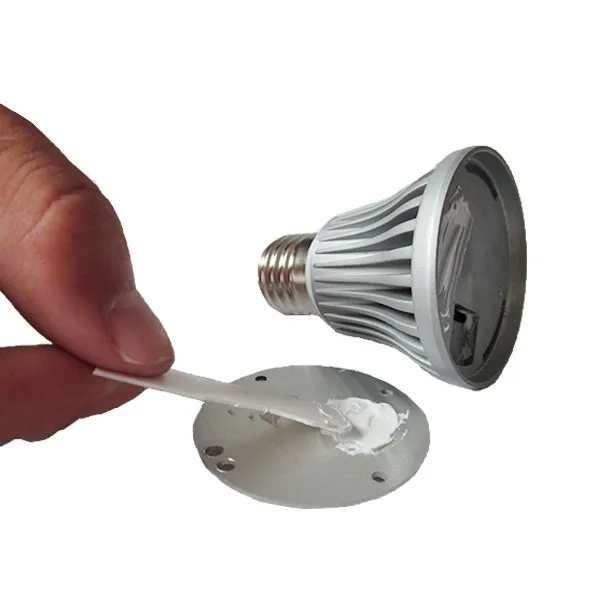
.webp "How to Apply Thermal Paste")
During Apply
-
Thoroughly clean chip and heat sink surfaces. Omitting this step increases thermal resistance by over 30%.
-
Apply thermal paste according to chip size and shape.
-
Install with uniform pressure, preferably using tools, ensuring contact gap compliance (approx. 30-100 microns). Strictly adhere to torque specifications if applicable.
-
Conduct a 30-minute full-load test to verify contact effectiveness.

Common Errors to Avoid
-
Excessive thermal paste application → Increases BLT value and reduces cooling efficienc.
-
Applying thermal paste near exposed pads → Poses short-circuit risk.
-
Relying solely on manual pressure → Uneven torque causes BLT value fluctuations.
When Not to Use Thermal Paste—Thermal Pad Alternatives and Hybrid Solutions
Identify Conditions Where Thermal Paste Is Inadequate
-
Large or variable gaps (>0.3–0.5 mm): Thickened paste increases R″ values.
-
High-volume automated assembly: Pre-cut pads reduce cycle times and variability.
-
Strict electrical insulation requirements: Pads provide stable dielectric isolation.
-
Frequent field maintenance: Pads allow easy replacement without cleaning.
Alternative Solutions Overview
-
Thermal pads: Thermal conductivity 1–12 W/m·K; easy positioning; suitable for gap filling.
-
Phase change materials (PCM): Solid at room temperature; flow and fill gaps at operating temperatures. Combines pad convenience with thermal paste performance.
-
Graphite sheets: Exceptional lateral diffusion; suitable for scenarios requiring hotspot dispersion.
-
Liquid metals: Top-tier thermal conductivity; corrosion and conductivity risks must be considered.
Hybrid Strategy (Practical Solution)
-
Apply thermal paste to hotspot areas (small chips) while using gaskets for gap filling across larger surfaces. This maintains hotspot cooling efficiency while simplifying assembly processes.
Frequently Asked Questions — Common User Queries About Thermal Paste
Q1: Is thermal paste better than thermal pads for CPUs?
In most CPU applications, properly applied thermal paste delivers superior performance, reducing operating temperatures by 5-8°C. However, thermal pads may be more practical if there are uneven gaps between the CPU cap and heatsink, or if frequent disassembly is required.
Q2: How often should thermal paste be replaced?
This depends on the operating environment and load conditions. Replacement is recommended when temperatures rise more than 5°C above the initial value. In industrial settings, establishing a regular thermal imaging monitoring schedule is advisable.
Q3: Does thermal paste expire?
Unopened thermal paste typically lasts 2-5 years. Once opened, it's best used within 6 months. Check the production date when purchasing; smaller packages are often more practical than large containers.
Q4: What BLT value should be targeted when applying thermal paste?
The optimal range is 30-100 microns. Practically, you can measure with a plug gauge or control it using standard application volume combined with specified torque. On our production line, for CPUs in LGA1700 sockets, we typically use 0.6g of thermal paste with an installation torque of 8.5 in-lb to achieve the ideal BLT value.
As a specialized thermal interface material R&D and application company, Sheen Technology believes: Choosing between thermal paste and thermal pads should not rely solely on thermal conductivity. Three key factors must be considered holistically—gap size (BLT), power density, and manufacturing/maintenance requirements. For compact, high-power interfaces (e.g., CPUs, GPUs), premium thermal prase typically delivers the lowest thermal resistance. However, thermal pads or phase-change materials may be more suitable for scenarios involving large gaps, stringent insulation requirements, or rapid assembly. The most complex systems often require hybrid solutions to balance performance and cost.
When designing thermal solutions for clients, we typically conduct rapid BLT analysis before recommending the optimal thermal interface material for each specific application. If you require expert advice on product thermal management, Contact our engineering team offers complimentary consultations. We deliver tailored thermal solutions for both consumer electronics and industrial equipment, including customized testing and validation services.



