
 English
 usheenthermal

Optimizing Heat Transfer with an Adhesive-backed Thermally Conductive Insulating Pad
Date:2026-03-27
Optimizing Heat Transfer with an Adhesive-backed Thermally Conductive Insulating Pad
In factories humming past midnight, the Adhesive-backed thermally conductive insulating pad plays bouncer for heat, shoving it toward the exit so chips don’t melt down. When boxes fail early, warranties pile up, temp spikes steal sleep, and budgets start to bleed.
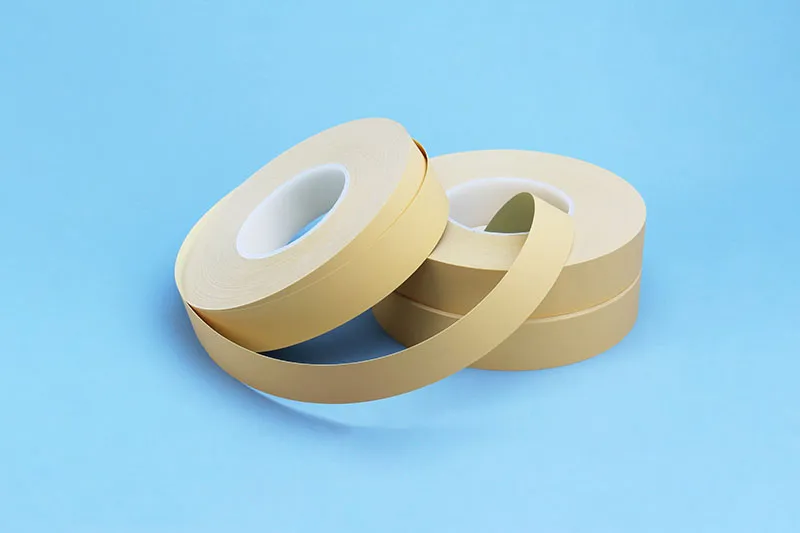
Heat kills margins faster than a bad quarter.
Engineers crave steady temps; buyers want sane costs. Sticky-backed pads hustle on the line, trim rework, and keep volts behaving. Choose the right format at scale, and uptime sticks around like a good habit—quiet, reliable, and worth every penny.
How 75% Better Heat Dissipation Is Achieved by a Thermally Conductive Pad
Modern electronics run hot, and nobody likes fried chips or dim LEDs. An Adhesive-backed thermally conductive insulating pad keeps heat moving while blocking stray current. This smart mix of insulation and cooling is exactly where smart material science meets real-world hustle.
Combining thermal conductivity and dielectric strength for peak performance
An Adhesive-backed thermally conductive insulating pad works because it balances two core properties:
Material Foundation
thermal conductivity
· Polymer base forms the heat path.
· Ceramic loading increases heat transfer efficiency.
dielectric strength
· High breakdown voltage protects PCB traces.
· Stable insulation properties prevent short circuits.
Performance Optimization Layers
· Matrix tuning in material science
· Adjust filler ratio to control W/m·K rating.
· Maintain flexibility for tight assemblies.
Interface control
· Reduce air gaps.
· Improve surface wet-out.
Real-World Output
· Better chip stability.
· Longer service life.
· Cleaner signal reliability.
An Adhesive-backed thermally conductive insulating pad from Sheen Technology aligns conductivity and insulation so power modules stay cool without risking leakage.
How ceramic fillers and fiberglass reinforcement cut thermal impedance
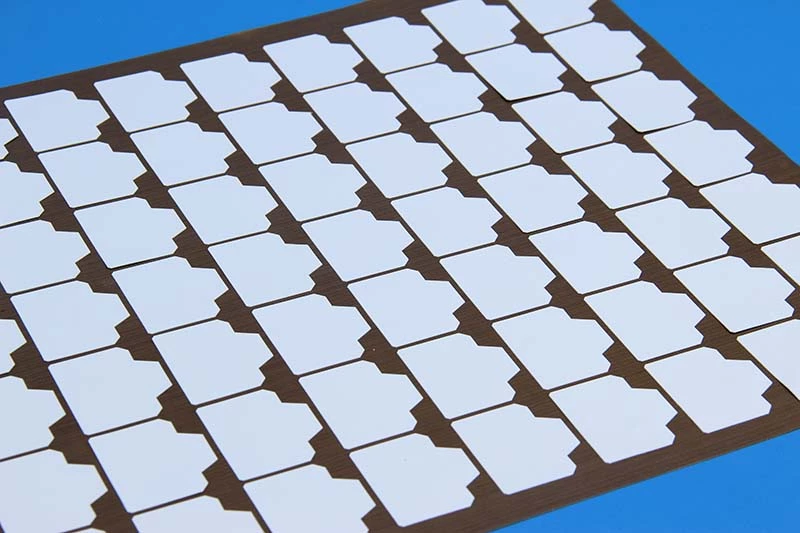
Heat hates resistance. So the trick is lowering thermal impedance inside the Adhesive-backed thermally conductive insulating pad.
• ceramic fillers create continuous conduction paths
• fiberglass reinforcement locks thickness under pressure
• Optimized material composition reduces pump-out
Here’s how it stacks up:
| Material Blend | Thermal Conductivity (W/m·K) | Thermal Resistance (°C·cm²/W) | Thickness Stability (%) |
| Base polymer | 0.8 | 1.9 | 92 |
| + Alumina | 2.5 | 1.2 | 95 |
| + AlN | 3.2 | 0.9 | 96 |
| + Fiberglass | 3.1 | 0.85 | 99 |
| Hybrid blend | 3.5 | 0.75 | 99 |
The combo boosts heat dissipation and slashes thermal resistance between IC and heat sink. A thermally conductive pad with reinforcement simply holds its ground under clamp pressure.
Silicone vs acrylic adhesive: adhesion strength under high temperature
Adhesion decides long-term survival.
Silicone adhesive
· High thermal stability up to 200°C
· Strong bond durability after aging
· Flexible under thermal cycling
Acrylic adhesive
· Reliable adhesion strength at 120–150°C
· Cost-friendly scaling
· Higher initial peel force
Performance Under Heat
· Silicone keeps structure steady.
· Acrylic handles mid-range electronics well.
An Adhesive-backed thermally conductive insulating pad using silicone adhesive suits inverters and fast chargers.
Acrylic-backed versions fit consumer LED drivers. Sheen Technology fine-tunes both for stable high temperature operation.
Case studies in power electronics and LED lighting applications
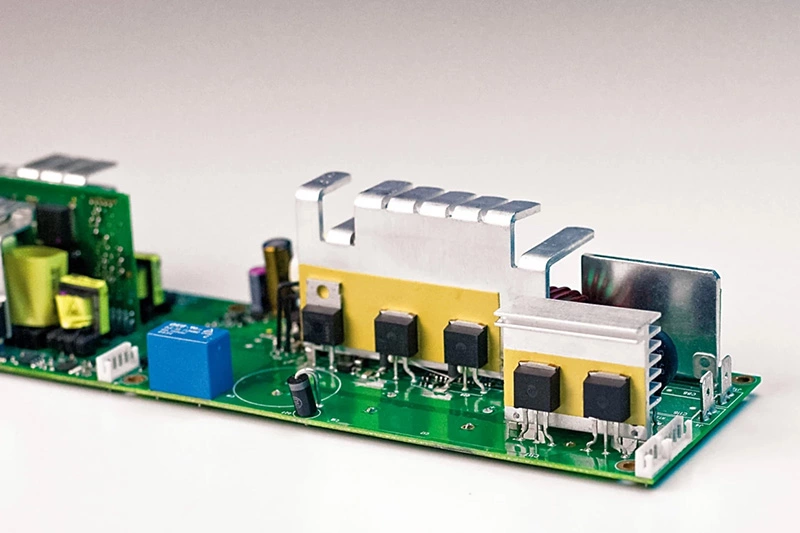
In power electronics, thermal stress hits hard:
Inverter Modules
thermal management
· Pad fills micro gaps.
· Lowers junction temperature by up to 12%.
heat sink solutions
· Maintains mounting pressure.
EV DC-DC Converters
· Supports higher switching frequency.
· Improves device efficiency.
“Power device packaging is increasingly defined by thermal interface performance and insulation reliability,” notes a 2025 Yole Group power electronics report, highlighting rising demand for advanced interface pads.
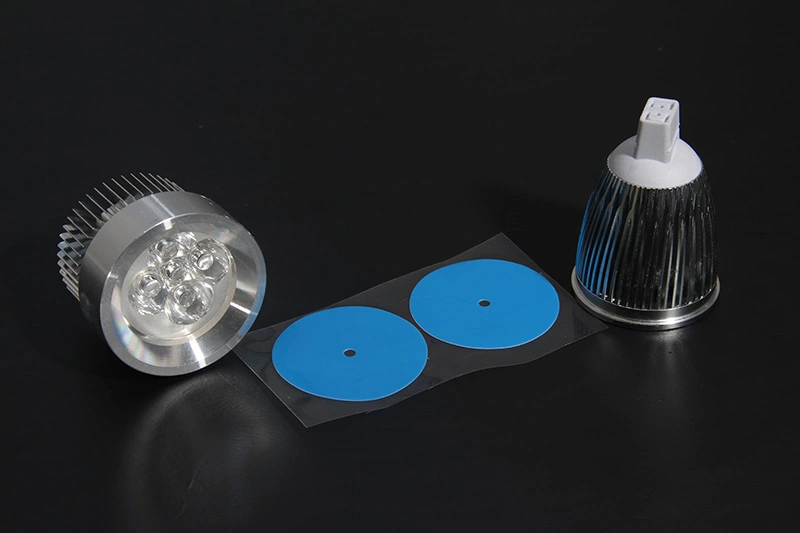
In LED lighting, stable breakdown voltage matters:
· COB arrays rely on even heat flow.
· The Adhesive-backed thermally conductive insulating pad prevents hot spots.
· Light output stays consistent over time.
That’s the sweet spot: cooler chips, safer circuits, and longer product life—all delivered by a well-engineered Adhesive-backed thermally conductive insulating pad.
4 Steps to Install an Adhesive-backed Thermally Conductive Insulating Pad
Installing an Adhesive-backed thermally conductive insulating pad is not rocket science, but small details make a big difference. Get the prep right, control pressure, and your thermal pad will perform like a champ.
Step 1 – Preparing circuit board surfaces and selecting pre-cut pads
A solid bond starts with surface preparation on the circuit board. Skipping this is asking for hot spots later.
Cleaning
· Remove flux and dust from the circuit board using isopropyl alcohol.
· Inspect for oxidation or oil that affects material compatibility.
Surface check
· Confirm flatness around mounting zones.
· Verify no solder bumps interfere with the contact area.
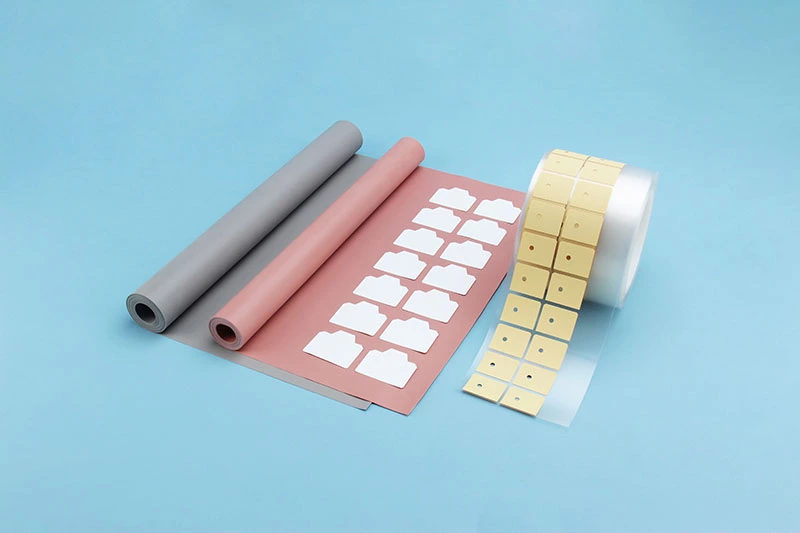
When choosing pre-cut pads, focus on:
· Thickness tolerance vs. component gap.
· Required thermal conductivity.
· Electrical insulation rating.
Below is a quick comparison engineers often review when selecting an Adhesive-backed thermally conductive insulating pad:
| Pad Type | Thermal Conductivity (W/m·K) | Thickness (mm) | Dielectric Strength (kV/mm) |
| Standard silicone pad | 1.5 | 0.5 | 6 |
| Reinforced dielectric layer pad | 3.0 | 1.0 | 8 |
| High-performance thermal interface pad | 5.0 | 1.5 | 10 |
At Sheen Technology, pad selection support includes die-cut pad selection guidance tailored to PCB layouts, helping match the right Adhesive-backed thermally conductive insulating pad to the job without guesswork.
Step 2 – Positioning custom shapes between heat sinks and ICs
Correct component placement determines how well heat moves from integrated circuits (ICs) to heat sinks.
Alignment
· Center the custom shapes over the IC package.
· Avoid overlap onto solder joints.
Thermal interface control
· Ensure full-surface contact between the thermal interface pad and both mating parts.
· Maintain the integrity of the dielectric layer.
If using a die-cut Adhesive-backed thermally conductive insulating pad, peel the liner gradually instead of all at once. This prevents stretching and air pockets.
A quick practical checklist many technicians follow:
1) Dry-fit the pad before removing adhesive liner.
2) Confirm mounting hole clearance.
3) Lower the heat sink vertically to protect alignment.
A well-positioned thermal conductive insulating pad reduces lateral heat spread and keeps sensitive ICs within design temperature.
Step 3 – Ensuring uniform pressure to optimize peel strength
Pressure is not about force; it’s about even distribution.
Uniform pressure
· Apply controlled application force across the full contact area.
· Use a flat platen or torque-controlled fasteners.
Adhesion performance
· Proper compression improves adhesion and final peel strength.
· Good bond integrity minimizes trapped air.
In assembly lines, controlled lamination ensures the Adhesive-backed thermally conductive insulating pad fully wets the metal surface. Too little pressure leads to weak bonding. Too much can squeeze material outward and thin the pad unevenly.
For larger boards, staged fastening helps:
· Pre-tighten diagonally.
· Apply final torque in cross pattern.
· Recheck compression height.
Many OEM clients working with Sheen Technology report that consistent compression directly improves long-term thermal stability, especially in power modules using thicker thermally conductive insulating pads.
Step 4 – Final curing and testing thermal resistance
Even pressure isn’t the finish line. The curing process matters.
Curing control
· Follow supplier-recommended dwell time.
· Maintain stable ambient temperature.
Performance testing
· Measure thermal resistance under load.
· Conduct temperature monitoring at peak power.
· Validate heat dissipation against design targets.
Engineers often document:
· Initial temperature rise.
· Steady-state delta T.
· Post-cycling variation for reliability validation.
A properly installed Adhesive-backed thermally conductive insulating pad should maintain low thermal resistance and stable insulation values even after repeated heating cycles. Final validation confirms that the pad supports both electrical isolation and heat flow.
When sourced from Sheen Technology, each Adhesive-backed thermally conductive insulating pad is tested for conductivity and dielectric strength, giving teams confidence that once installed, the system runs cool and stays safe.
That’s it. Clean surface. Smart alignment. Even pressure. Verified performance. Do those right, and your thermal management setup won’t let you down.
Budgeting for Large-scale Thermal Pad Purchases
Bulk sourcing an Adhesive-backed thermally conductive insulating pad is not just about price tags. It’s about material math, smart planning, and long-term supply confidence. When thermal budgets tighten in telecom racks or control cabinets, every thermally conductive insulating pad and adhesive thermal pad choice counts.
Calculating unit costs from sheet, roll, and die-cut part formats
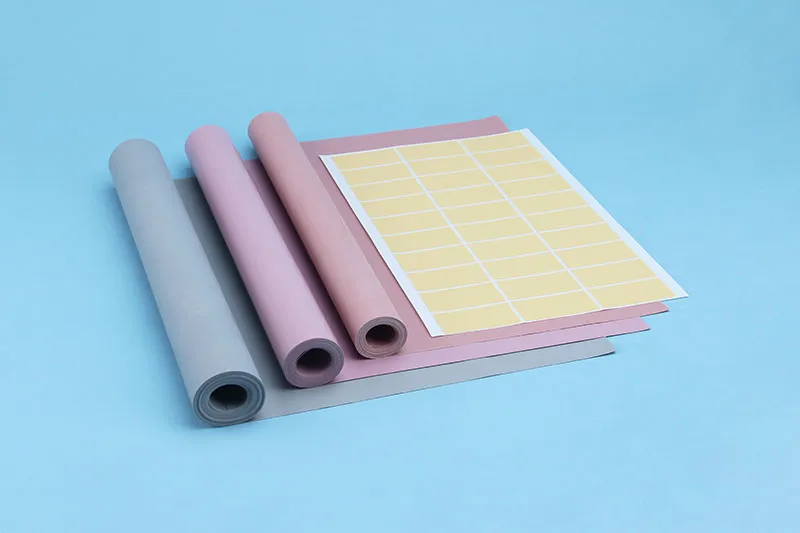
When reviewing unit cost, buyers often compare three manufacturing process paths:
Sheet format
· Raw material area pricing
· ↓ Scrap based on part complexity
· ↑ Manual cutting labor
Roll format
· Continuous lamination
· Better material yield
· Requires slitting setup
Die-cut parts
· Tooling investment upfront
· Optimized placement for complex geometries
· Minimal assembly trimming
For high-volume Adhesive-backed thermally conductive insulating pad programs, the math usually looks like this:
| Format | Avg Yield (%) | Processing Cost ($/m²) | Final Unit Cost ($) |
| Sheet format | 82 | 4.5 | 1.20 |
| Roll format | 90 | 3.2 | 0.98 |
| Die-cut parts | 95 | 2.8 | 0.88 |
With tighter nesting and lower scrap, die-cut thermally conductive pads often win at scale. Sheen Technology supports all three, helping balance tooling fees against lifetime savings.
Evaluating price impacts of ceramic filler loading and volume resistivity
Material pricing shifts mainly due to ceramic filler content. Higher filler loading boosts thermal conductivity, but raw powders and mixing time increase cost.
Short version: better performance usually means higher dollars.
Key links:
· ↑ Material composition complexity
· ↑ Coating viscosity control
· ↑ Testing for volume resistivity and insulation reliability
Yet the smart move is checking the cost-performance ratio. An Adhesive-backed thermally conductive insulating pad with moderate ceramic loading may cut overall system cost if it reduces rework or overheating risks. Sheen Technology fine-tunes filler balance so adhesive-backed thermal pads meet spec without overengineering.
Securing volume discounts for telecommunications and industrial controls markets
Long-term savings usually follow a clear path:
1) Define annual demand across market segments like the telecommunications market and industrial controls.
2) Lock multi-year forecasts into the supply chain plan.
3) Align on tooling amortization and packaging formats.
4) Finalize long-term agreements tied to quarterly volume tiers.
Strong negotiation strategy plus predictable demand unlocks real volume discounts. For telecom base stations using thermally conductive insulating pads in batches of thousands, that adds up fast.
Sheen Technology works closely with OEM buyers to stabilize pricing on every Adhesive-backed thermally conductive insulating pad, keeping budgets steady while performance stays solid.
FAQs about Adhesive-backed thermally conductive insulating pad
How does an adhesive-backed thermally conductive insulating pad improve heat control in electronics?
In power electronics and consumer electronics, this pad sits between semiconductor devices and heat sinks, quietly carrying heat away while guarding against electrical risk.
· Heat flows through a polymer matrix loaded with ceramic fillers, lowering thermal impedance and thermal resistance.
· Electrical insulation and dielectric strength protect circuit boards and integrated circuits under pressure.
· Stable adhesion strength keeps contact tight during temperature resistance swings, extending life for power transistors.
Silicone or acrylic adhesive: which suits high-temperature use better?
The choice often feels personal on the factory floor.
· Silicone: steadier peel strength during thermal cycling, trusted in automotive electronics and telecommunications equipment.
· Acrylic adhesive: lighter cost, faster handling during lamination and slitting, common in industrial controls and LED lighting.
Both maintain breakdown voltage and volume resistivity, yet differ in curing pace and long-term comfort under heat.
What does installation look like, and which formats fit real production lines?
Installation carries a moment of tension: alignment decides performance.
1) Clean circuit boards; contamination weakens adhesion strength.
2) Place pre-cut pads or die-cut parts between heat sinks and integrated circuits.
3) Apply even pressure, then allow curing after coating or lamination.
Available as sheets, rolls, custom shapes, or pre-cut pads, with die-cutting and fiberglass reinforcement helping thickness control, flammability rating, and consistency across LED lighting and industrial controls.
Sheen Thermal
Dongguan Sheen Electronic Technology Co., Ltd · Founded in 2008
Manufacturer of thermal interface materials and silicone foam for automotive electronics, energy storage, power electronics, communications and consumer electronics.
Certified
- ISO 9001:2015
- ISO 14001:2015
- IATF 16949:2016
What we supply
- Thermal conductivity Up to 90 W/m·K
- Thickness 0.3–10.0 mm
- Custom & samples Die-cut to drawing, 3–7 days