
 English
 usheenthermal

Boron Nitride Thermal Pad for AI Servers: Is It Better Than Alumina?
Date:2026-07-29
AI servers run hot, and picking the wrong boron nitride thermal pad for AI servers can choke performance fast, driving throttling, downtime, and rising energy bills.
Sheen Technology engineers high-conductivity BN filler compounds to cut junction temperatures and extend service life in high-density compute environments. This article provides an engineering-level comparison of BN and alumina thermal pads, covering thermal performance, electrical isolation, mechanical stability, and long-term reliability — so your team can make a well-informed material decision.
Key Engineering Takeaways: BN Thermal Pads in AI Infrastructure
➔ Thermal Performance: Leverage hBN’s superior conductivity and low resistance to slash junction temperatures, prevent throttling, and sustain peak GPU/CPU output.
➔ Long-Term Reliability: Rely on high dielectric strength, low density, and thermal cycling stability to extend MTBF and avert degradation in VRMs and power MOSFETs.
➔ Seamless Integration: Deploy pre-cut, cured BN pads across CPUs, memory modules, and SSDs for uniform interface contact—no grease pump-out, consistent adhesion, and RoHS / REACH compliance.
Thermal Conductivity & Heat Transfer: The Engineering Fundamentals
Getting heat out of tight, high-power setups isn’t just engineering talk—it’s survival for chips. In AI server racks, parts like GPUs run hot, fast, and nonstop. That’s where a boron nitride thermal pad for AI servers steps in, quietly moving heat along. Understanding how heat transfer works helps you pick materials that won’t choke under pressure.
What Is Thermal Conductivity in Thermal Interface Materials?
Thermal conductivity describes how quickly heat travels through thermal interface material s
- High conductivity → faster heat flow
- Low conductivity → trapped heat, rising temps
In real hardware:
- CPU/GPU die produces heat → creates a temperature gradient
- TIM fills microscopic gaps
- Smooths the heat flux path
- Reduces air pockets (poor conductors)
Material comparison:
- Boron nitride thermal pad for AI servers, Stable material properties, Consistent transfer under load
- Alternative TIMs,May degrade or pump out over time
Practical takeaway:
- Using a boron nitride pad for AI server s improves contact efficiency
- Better contact = smoother heat transfer
“Advanced thermal interface material s are becoming critical as AI workloads push chip power densities beyond traditional cooling limits.” — IDC, 2025
How Thermal Resistance Influences Heat Dissipation
Think in layers: Heat source → TIM → heatsink → airflow,Each layer adds thermal resistance.
Breaking it down: Total resistance = Bulk material resistance + interface resistance + contact imperfections
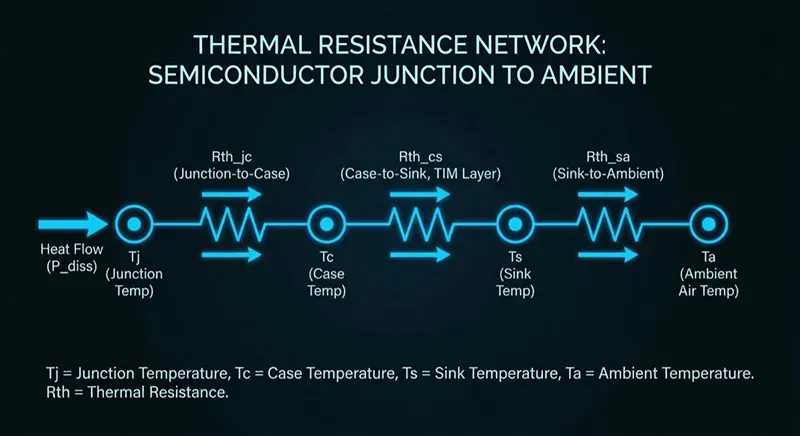
Why it matters
- High thermal impedance: Blocks heat dissipation, Raises temperature difference
- Low resistance:Improves cooling efficiency, Stabilizes performance Sheen Technology focuses on minimizing interface losses with engineered pad surfaces
Specific Heat and Thermal Stability Explained
Energy behavior:
- Specific heat defines how much energy a material absorbs before its temperature change
- Higher value → slower temp spikes
Stability under stress:
- Weak materials,Crack,Suffer material degradation
- Strong materials,Maintain thermal stability
Applied to AI systems:
- A boron nitride thermal pad for AI servers
- Handles rapid load swings
- Maintains structure over time Sheen Technology designs pads that balance heat absorption and durability, keeping systems steady even when workloads spike hard.
Key Parameters of Thermal Interface Materials
AI server cooling gets intense fast, so picking the right boron nitride thermal pad for AI servers isn’t just detail work—it’s survival. From insulation to heat flow, each parameter quietly decides uptime, safety, and long-term stability in dense racks.
Balancing Dielectric Strength with Volume Resistivity
Core targets:
- High dielectric strength
- Stable volume resistivity
- Reliable electrical insulation
Material behavior under load
- Rising voltage → risk of breakdown voltage failure
- Lower electrical resistance can mean leakage
- Bad for GPUs
- Worse for MOSFET arrays
In a boron nitride pad for AI server setups, the trick is simple: keep electrical conductivity low while heat still moves fast.
Short take: good pads insulate like plastic, cool like metal.
Brands like Sheen Technology tune this balance tightly, so insulating properties don’t kill thermal flow.
Hardness, Compressibility, and Flexibility Considerations
Feel matters more than specs sometimes:
- Soft enough for deformation
- Firm enough to hold pressure
➤ Quick breakdown
- Hardness affects mounting force.
- Compressibility drives gap filling.
- Flexibility improves surface mating.
A boron nitride thermal pad for AI servers often works best when:
- It adapts to uneven chips
- Maintains elasticity after cycles
- Keeps steady mechanical properties
Too stiff? Air gaps. Too soft? Pump-out risk.
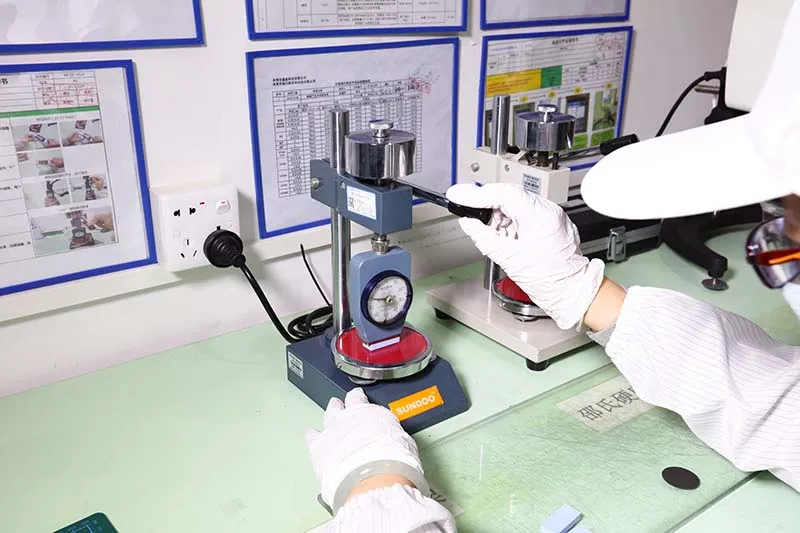
Sheen Technology pads aim for that middle ground where conformability meets durability.
Thermal Expansion versus Adhesion in Pads
Heat cycling reality:
- Chips expand
- Heatsinks lag behind
What matters:
- Low coefficient of thermal expansion
- Strong adhesion
- Prevents lift-off
- Protects interfacial bonding
Failure chain:
- Expansion mismatch → thermal stress
- Stress → cracks or lift
- Result → rising contact resistance
In a boron nitride thermal pad for AI servers, steady surface contact and smart gap filling stop that chain early.
Junction Temperature and Maximum Operating Temperature
Here’s a quick data snapshot for typical AI workloads:
| Property | BN Thermal Pad (Typical Range) | Alumina Thermal Pad (Typical Range) | Test Standard | Notes |
| Thermal Conductivity (W/m·K) | 5–16 | 1–5 | ASTM D5470 | Through-plane |
| Dielectric Strength (kV/mm) | 10–30 | 10–20 | ASTM D149 | AC breakdown |
| Volume Resistivity (Ω·cm) | 10¹²–10¹⁴ | 10¹⁰–10¹³ | ASTM D257 | 500V DC |
| Density (g/cm³) | 1.5–2.0 | 2.5–3.5 | — | Lower = lighter |
| Max. Operating Temp. (°C) | 150 | 150 | — | Similar range |
| Hardness (Shore OO) | 30–80 | 40–80 | ASTM D2240 | Lower = softer |
Note: Ranges represent typical industrial-grade thermal pads. Sheen Technology provides product-specific datasheets with guaranteed values.
What’s going on behind the numbers:
- Better heat dissipation lowers risk
- Stable thermal performance keeps GPUs consistent
- Tight temperature limits protect silicon
A solid boron nitride pad for AI server use keeps temps predictable, not spiky. That’s where uptime lives.
Sheen Technology designs pads that hold performance even near thermal ceilings, keeping device reliability from slipping when workloads spike.
3 Reasons to Choose Boron Nitride Pads
When cooling gets real in AI hardware, small material choices decide stability and lifespan. A boron nitride thermal pad for AI servers isn’t just filler—it directly shapes heat flow, insulation, and uptime. Let’s break down why engineers keep leaning toward this solution when performance pressure spikes.
Through-Plane Conductivity Driven by hBN Crystal Structure
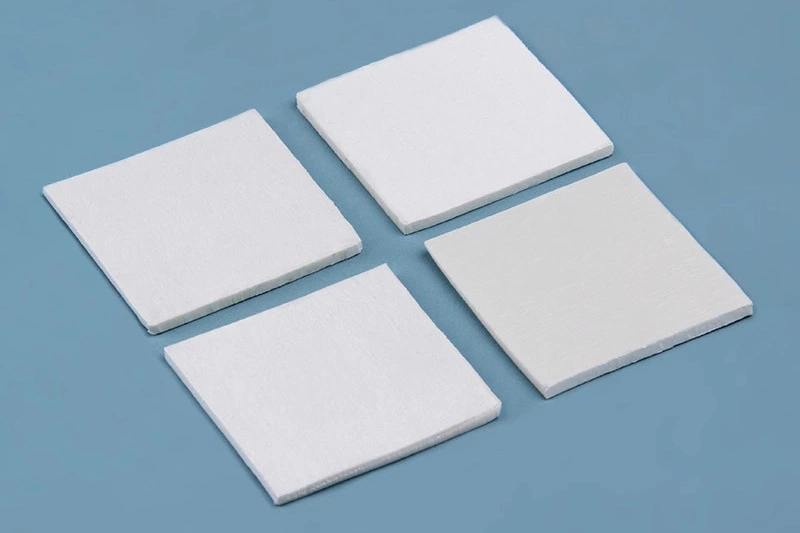
Hexagonal boron nitride ( hBN) is structurally analogous to graphite, with covalently bonded B-N layers held by weak van der Waals forces. This anisotropy enables in-plane thermal conductivity exceeding 300 W/m·K in pure hBN crystals. In engineered TIM fillers, Sheen Technology optimizes particle size distribution and orientation to maximize though-plane conductivity 16 W/m·k— the direction that matters most in a chip-to-heatsink interface.
Boron Nitride structure
- Hexagonal Boron Nitride enables layered heat transfer paths
- Promotes fast Thermal Conductivity without electrical risk
Performance in AI hardware
Heat builds fast
- Thermal Pads act as the transfer bridge
- Improves Heat Dissipation between chip and heatsink
- Keeps sustained workloads stable
Practical outcome
- Lower thermal throttling
- Noticeable Superior Performance under continuous load
| Properties | Unit | SF1600-BN-03 | SF1600-BN-05 | SF1600-BN-07 | SF1600-BN-10 | SF1600-BN-15 | SF1600-BN-20 | SF1600-BN-30 | Test Method |
| Color | - | White | White | White | White | White | White | White | Visual |
| Thermal Conductivity | W/m·K | 16 | 16 | 16 | 16 | 16 | 16 | 16 | ASTM D5470 |
Thermal Resistance (@40psi) | ℃*cm²/W | ≤0.3 | ≤0.5 | ≤0.7 | ≤0.8 | ≤1.1 | ≤1.4 | ≤1.7 | ASTM D5470 |
Application temperature | ℃ | -40~150 | -40~150 | -40~150 | -40~150 | -40~150 | -40~150 | -40~150 | - |
Thermal weight loss rate | % | ≤1 | ≤1 | ≤1 | ≤1 | ≤1 | ≤1 | ≤1 | - |
| Thickness | mm | 0.2~5.0 | 0.2~5.0 | 0.2~5.0 | 0.2~5.0 | 0.2~5.0 | 0.2~5.0 | 0.2~5.0 | ASTM D374 |
| Breakdown voltage | KV,@AC | ≥4 | ≥5 | ≥6 | ≥10 | ≥12 | ≥12 | ≥12 | ASTM D149 |
| Dielectric constant | F/m, @ 1MHz | ≤4.2 | ≤4.2 | ≤4.2 | ≤4.2 | ≤4.2 | ≤4.2 | ≤4.2 | ASTM D150 |
| Volume resistivity | Ω*cm, @250V | ≥10¹³ | ≥10¹³ | ≥10¹³ | ≥10¹³ | ≥10¹³ | ≥10¹³ | ≥10¹³ | ASTM D257 |
| Rebound rate | % | ≥90 | ≥80 | ≥70 | ≥70 | ≥60 | ≥60 | ≥60 | - |
| Density | g/cm³ | 1.6±0.2 | 1.6±0.2 | 1.6±0.2 | 1.6±0.2 | 1.6±0.2 | 1.6±0.2 | 1.6±0.2 | ASTM D792 |
| Hardness | shore 00 | 60~80 | 60~80 | 60~80 | 60~80 | 60~80 | 60~80 | 60~80 | ASTM D2240 |
| Flammability rating | - | V-0 | V-0 | V-0 | V-0 | V-0 | V-0 | V-0 | UL 94 |
A well-designed boron nitride thermal pad keeps temps predictable, which matters more than peak cooling numbers.
Simultaneous Electrical Isolation and Weight Reduction
1) Electrical safety layer
- Strong Dielectric Strength
- Reliable Electrical Insulation even under voltage spikes
2) Mechanical benefits
- Low Density build
- Acts as a Lightweight Material, Reduces pressure on boards,Helps system-level design flexibility
3) Deployment reality
- In AI Servers, compact layouts demand both cooling and isolation
- A boron nitride thermal pad for AI servers balances both without trade-offs
Thermal Cycling Endurance Validated by Accelerated Aging
Repeated Thermal Cycling
- Expansion and contraction stress
- Boron Nitride resists cracking
- Maintains interface contact
Stability outcomes
- Consistent Stable Performance
- Reduced degradation over time
- Strong Long-term Reliability in 24/7 AI Servers
Lifecycle impact
- Lower failure rates
- Better Durability
- Extended service intervals
“Thermal interface stability is now a defining factor in AI infrastructure uptime,” noted a 2025 data center materials brief from IDC.
Sheen Technology Lab: High-Temperature Aging Test for Boron Nitride Thermal Pads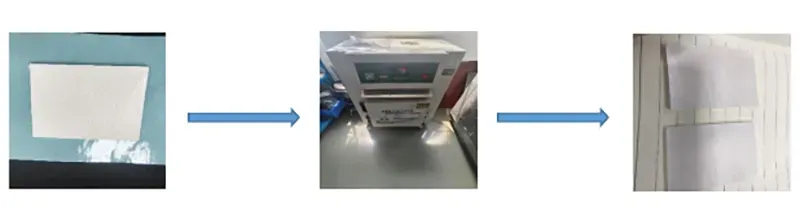
Test Method: A sample measuring 50mm x 40mm x 1.5mm was placed in a high-temperature oven at 125°C for 1,000 hours. Upon completion, the thermal resistance was measured and recorded.
Test Results: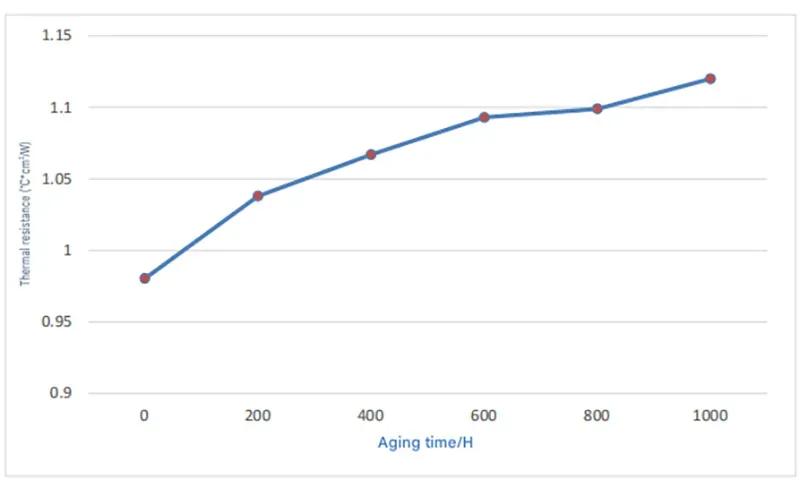
Conclusion: As shown in the figure and the data above, the boron nitride thermal pad demonstrated stable thermal resistance performance during the short-term aging test; after 1,000 hours, the thermal resistance increased by 14.2%, remaining within the acceptable range of variation.
With Sheen Technology solutions, the boron nitride thermal pad for AI servers keeps delivering even after thousands of heating cycles. That reliability isn’t flashy—but it saves real money and headaches.
Thermal Pad Comparison: BN vs. Alumina
Getting heat out of dense chips is a daily headache in AI hardware. A boron nitride thermal pad for AI servers often shows up as the go-to fix, but Alumina still holds ground where budgets bite. This comparison breaks down how each pad behaves in real workloads, from heat dissipation to long-term stability, without overcomplicating things.
Boron Nitride Pad
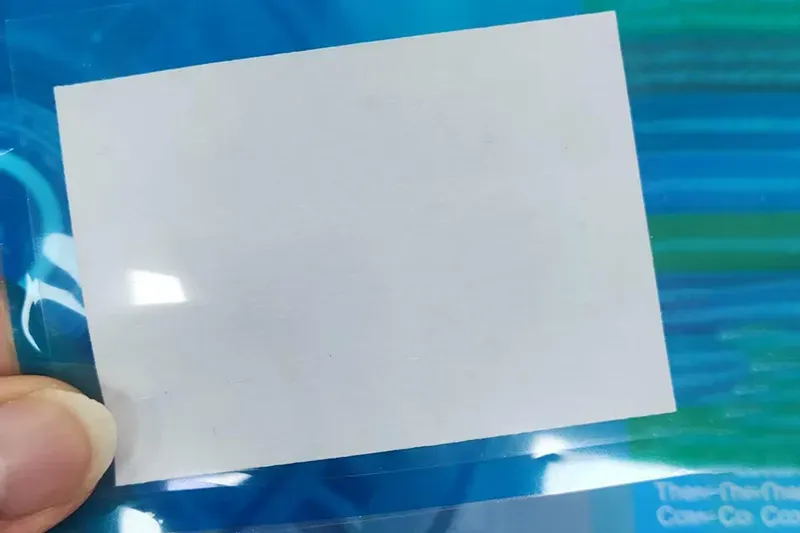
A boron nitride thermal pad for AI servers leans heavily on Boron Nitride as a dielectric material, balancing thermal conductivity and electrical insulation in a way that fits modern AI racks.
Core advantages
- High thermal conductivity keeps GPU hotspots under control
- Strong electrical insulation avoids leakage risks
- Reliable heat dissipation during sustained loads
Performance stack
- Material layer: Boron Nitride crystal structure boosts heat flow
- System layer: Works smoothly in AI servers with tight spacing
- Lifecycle layer: Stable under repeated thermal cycling
Practical deployment path
- Install between chip and heatsink
- Maintain pressure uniformity
- Monitor temperature drift over time
A boron nitride thermal pad for AI servers also handles high temps without degrading fast, which matters in nonstop compute farms. That’s why teams working on dense GPU clusters often circle back to this option.
“Advanced thermal interface materials, especially boron nitride -based solutions, are seeing accelerated adoption in AI infrastructure due to superior heat transfer efficiency,” noted a 2025 IDC materials outlook.
Sheen Technology integrates these pads into scalable cooling solutions, keeping performance consistent without overengineering.
Alumina Pad
Alumina, a classic ceramic material, still plays a role where mechanical toughness and cost matter more than peak thermal conductivity.
Short view:
- Solid mechanical strength
- Reliable electrical insulation
- Lower cost footprint
Longer take: A typical Alumina pad doesn’t match a boron nitride thermal pad for AI servers in raw heat transfer, but it survives physical stress well and fits less demanding AI servers or peripheral modules.
You’ll see it used like this:
- Mid-range processors with moderate heat dissipation needs
- Power supplies where durability beats performance
- Systems where budget caps drive decisions
Still, when workloads spike, limits show up quickly. That’s where a boron nitride thermal pad for AI servers or similar high-end thermal pad becomes hard to ignore.
| Application Scenario | Recommended TIM | Rationale |
| GPU/CPU direct-die or lid interface (>50 W/cm²) | BN Pad | High through-plane conductivity required |
| VRM / power stage cooling | BN Pad | Thermal cycling + dielectric demands |
| Memory module thermal management | BN Pad (thin grade) | Low thickness, high compliance needed |
| Power supply / auxiliary PCB cooling | Alumina Pad (or BN) | Cost-performance balance acceptable |
| Cost-constrained, moderate-density rack systems | Alumina Pad | Adequate performance; lower BOM cost |
Sheen Technology keeps both options in play, but the shift toward boron nitride thermal solutions is pretty clear as compute density climbs.
Application Notes: Deploying BN Thermal Pad s in GPU, VRM, and Heat Sink Interfaces
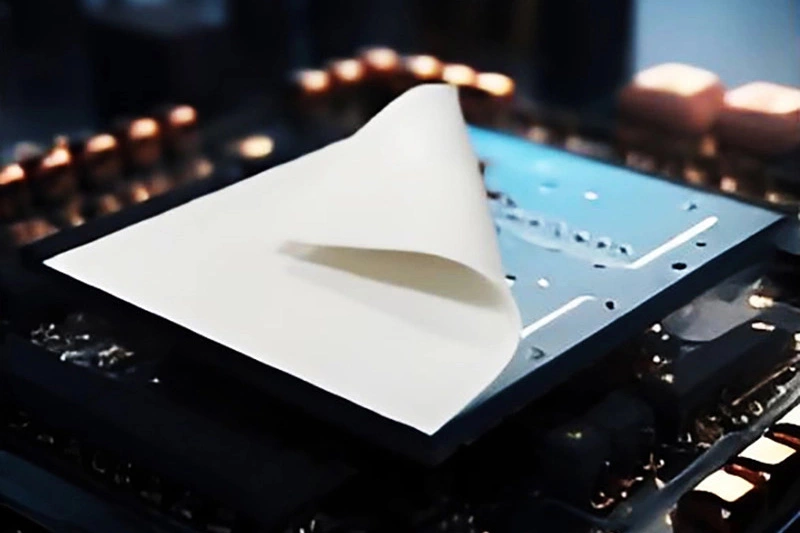
High-density AI racks run hot, no surprise. This quick read shows how a boron nitride thermal pad for AI servers keeps temps in check, steadies power, and beats messy pastes. Expect clearer heat management choices, cleaner installs, and longer-lasting GPU cooling and VRM health.
GPU Heat Management with High-Performance BN Pads
Core path
- Die → spreader → boron nitride thermal pad for AI servers → heat sink
- Result: tighter contact, lower interface resistance, steadier thermal conductivity
Material behavior
Boron nitride pads keep shape under load
- no pump-out
- stable thickness across hotspots
- boosts heat dissipation in AI servers
Deployment notes
- choose thickness by gap map
- pair with firm mounting pressure for consistent GPU cooling
Selection guidance: Map the GPU package gap using pressure paper or laser profilometry before specifying pad thickness. A pad compressed to 20–30% of its original thickness typically delivers optimal thermal performance. Sheen Technology offers gap-mapping support and pre-cut pads to your mechanical drawings.
→ Request an Engineering Consultation for Your GPU Thermal Design
VRM Cooling and Enhanced Thermal Cycling Stability
1) Interface stability
- VRM cooling improves when the boron nitride thermal pad for AI servers resists creep
- fewer micro-gaps → better heat transfer
2) Cycling durability
- handles repeated warm–cool loops
- lowers thermal stress, protecting chokes and MOSFETs, lifting component reliability
3) Power delivery
- steadier temps → tighter voltage regulation
- fewer spikes under load changes
Mix in quick wins: use a BN thermal pad on VRM banks, confirm compression, re-check after burn-in. The boron nitride thermal pad keeps contact uniform, so rails stay calm even during spiky inference runs.
Heat Sink Interfaces: BN Pads versus Thermal Grease
Comparison tree
Boron nitride pads
- clean install, fixed gap control
- consistent thermal performance over time
Thermal grease
- higher initial spread, but pump-out risk
- drying can hurt heat transfer efficiency
Practical fit
- racks that ship or vibrate favor a boron nitride thermal pad for AI servers
- service teams prefer no-mess swaps with a thermal interface material that holds form
In busy AI fleets, a boron nitride thermal pad for AI servers simplifies maintenance while keeping numbers stable. Sheen Technology options balance thermal performance and durability, and a second pass with a boron nitride pad often replaces grease entirely.
Scalable Cooling: BN Pads in Data Centers
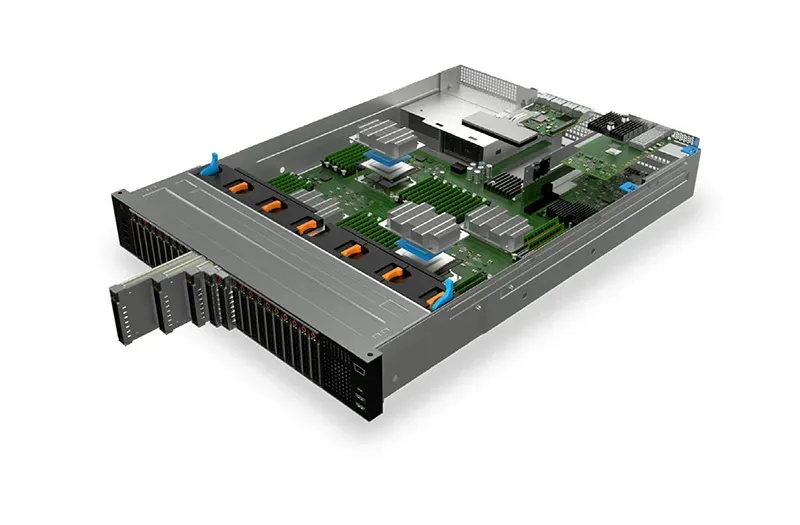
High-density racks are running hotter, no surprise. A boron nitride thermal pad for AI servers keeps heat in check across tight layouts, from chips to storage. With smarter thermal management and clean heat transfer, operators keep uptime steady while pushing more compute into the same footprint.
Deployment on CPUs, Memory Modules, and SSDs
In CPUs, a boron nitride thermal pad bridges uneven surfaces and boosts heat transfer.
On Memory Modules, thin pads stabilize temps during burst loads.
For SSDs, consistent cooling prevents throttling in dense server deployment.
A closer look shows why the boron nitride thermal pad keeps showing up in design wins. It handles pressure variation, keeps interfaces filled, and avoids dry gaps that kill performance.
Integration with Server Racks and Advanced Heat Sinks
Within Server Racks, airflow and conduction need to play nice. The boron nitride thermal pad pairs with Advanced Heat Sinks and broader cooling systems to spread heat efficiently.
- Align pad placement with fin stacks
- Tune contact pressure for even spread
Nested workflow:
Rack level
- Air path tuning:Fan curves、Baffle placement
- Conduction path:Pad → sink → chassis
Node level
- CPU cold plate interface
- DIMM edge cooling
Short bursts: tighter contact. Lower temps. Better heat dissipation.
Manufacturing Insights: Compounding and Curing Processes
Production blends BN fillers during Compounding, then locks structure in Curing Processes. A boron nitride thermal pad for AI servers from Sheen Technology shows consistent fill, clean die-cut edges, and stable compression set.
Steps that matter:
- Filler dispersion control
- Sheet casting and thickness tuning
- Cure profile optimization
- Post-cure inspection
Long view: stable batches reduce variance across racks, which keeps performance predictable at scale.
Compliance and Traceability: RoHS, REACH, and Batch Records
For ops teams, paperwork is as real as watts. The boron nitride thermal pad for AI servers aligns with RoHS and REACH, backed by clean Batch Records.
- Compliance: verified substances, documented limits
- Traceability: lot-to-lot visibility across quality assurance
- Sourcing: audited suppliers, consistent input streams
Multi-level checks
- Incoming materials:Certificates,Random sampling
- In-process:Cure logs,Thickness scans
- Final release:Performance validation,Archive records
Request a Batch Traceability Sample Kit. Sheen Technology’s manufacturing line operates under ISO 9001:2015 quality management, with in-line thickness monitoring (±5% tolerance) and 100% visual inspection on die-cut parts. Each production batch is archived with full traceability to raw material lots — critical for OEM qualification audits.
Sheen Thermal
Dongguan Sheen Electronic Technology Co., Ltd · Founded in 2008
Manufacturer of thermal interface materials and silicone foam for automotive electronics, energy storage, power electronics, communications and consumer electronics.
Certified
- ISO 9001:2015
- ISO 14001:2015
- IATF 16949:2016
What we supply
- Thermal conductivity Up to 90 W/m·K
- Thickness 0.3–10.0 mm
- Custom & samples Die-cut to drawing, 3–7 days