
 English
 usheenthermal

Carbon Fiber Thermal Pad vs Boron Nitride Thermal Pad: Which One Performs Better for Thermal Management?
Date:2026-03-11
Carbon Fiber Thermal Pad vs Boron Nitride Thermal Pad: Which One Performs Better for Thermal Management?
In the "Heat War" of 2026, choosing the wrong interface material is like bringing a squirt gun to a forest fire. As chips cross the 600W TDP threshold and EV batteries get denser, the debate between Carbon Fiber and Boron Nitride has become the ultimate "Speed vs. Safety" showdown.
Choosing between a carbon fiber thermal pad and a boron nitride thermal pad used to be a niche engineering debate. Today, it’s a mission-critical decision. One moves heat like a lightning bolt but carries a "shocking" secret, while the other is the reliable, insulating bodyguard of the high-voltage world.
At Sheen Technology, we’ve put both through the wringer in our labs. Whether you’re cooling an AI edge server or a 5G base station, here is the unfiltered breakdown of who takes the crown in the carbon fiber thermal pad vs boron nitride thermal pad rivalry.
Quick Comparison: Meet the Two Thermal Personalities
Before we dive deeper, here’s the quick “dating profile” version of these materials.
| Feature | Carbon Fiber Thermal Pad | Boron Nitride Thermal Pad |
| Thermal personality | Loves spreading heat everywhere | Calmly moves heat where it should go |
| Electrical behavior | Conductive | Insulating |
| Flexibility | Slightly stiff | Soft and adaptable |
| Surface conformity | Moderate | Excellent |
| Weight | Featherlight | Average |
| Cost | Higher | Moderate |
| Favorite workplaces | GPUs, aerospace electronics | LEDs, automotive electronics |
If thermal materials were coworkers:
• Carbon fiber would be the energetic overachiever who runs around solving problems everywhere.
• Boron nitride would be the calm project manager making sure everything works safely.
Both are valuable. They just solve problems differently.What Is a Carbon Fiber Thermal Pad?

Material Structure and Working Principle: The Z-Axis Highway
Think of the carbon fiber thermal pad as the Formula 1 car of thermal management. In 2026, we utilize vertically aligned fibers (Z-axis) to create a literal expressway for phonons to escape. Unlike standard silicone pads that move heat in every direction (and nowhere particularly fast), carbon fiber is obsessed with one direction: Out
Key Thermal and Mechanical Properties: Speed and Squish
• Ultra-High Conductivity: We are talking15 W/m·K to 80 W/m·K and beyond. It makes standard "high-performance" pads look like they're standing still.
• Low Compression Force: You don't need to crush your delicate PCB to get a good bond. Carbon fiber pads offer high rebound with minimal pressure, protecting sensitive chiplets.
• Zero Pump-Out: Since it’s a structured material, it won't migrate or "leak" oil over years of thermal cycling.
Typical Applications: Where Raw Power Wins

This is the go-to for high-TDP environments: AI server racks, high-end GPUs, and 5G base stations where every millidegree counts.
Carbon fiber is built for one thing—moving massive amounts of heat fast—but it doesn't like "bumping" into electrical traces because it is inherently conductive.
What Is a Boron Nitride Thermal Pad?

If carbon fiber is the energetic athlete, boron nitride thermal pads are the calm engineers.
Material Composition and Structure
Boron nitride thermal pads are typically made from:
• hexagonal boron nitride particles
• silicone or polymer binders
• thermally conductive fillers
The cool part is that boron nitride behaves a bit like graphite in structure—but without conducting electricity. So while heat moves through the material nicely, electricity politely stays in its lane.
Key Thermal and Electrical Properties
Typical boron nitride pad properties look like this:
| Property | Typical Range |
| Thermal conductivity | 3–15 W/mK |
| Electrical insulation | Excellent |
| Compressibility | High |
| Chemical stability | Excellent |
| Temperature range | Wide |
These pads are also soft and compressible, which helps them squeeze into tiny air gaps between components.
Typical Applications
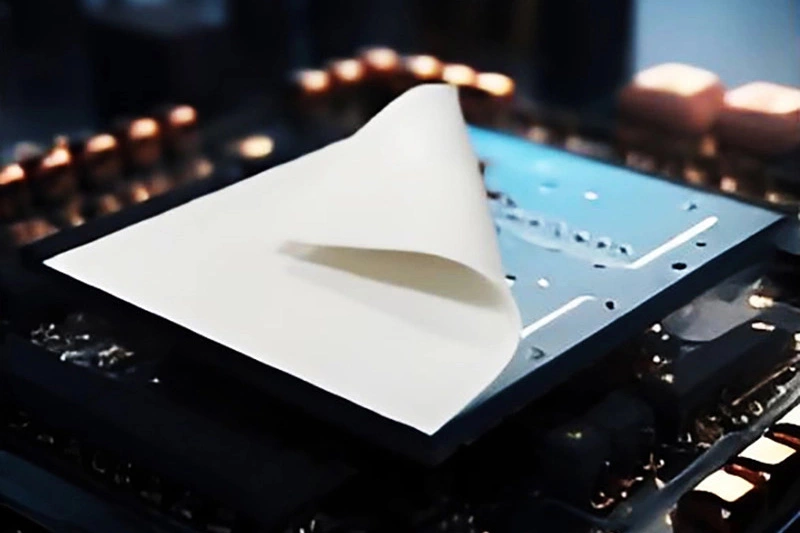
Boron nitride pads are extremely common in electronics like:
• LED lighting systems
• automotive control modules
• power supplies
• telecom equipment
• industrial controllers
They’re basically the reliable coworker that shows up everywhere and never causes problems.
Boron nitride thermal pads are the steady professionals of the thermal world.
They move heat reliably, insulate electricity, and adapt to uneven surfaces like a thermal yoga instructor.
Carbon Fiber Thermal Pad vs Boron Nitride Thermal Pad — Key Differences
Now that we’ve met both materials, let’s put them side by side and see how they behave in the real world.
Thermal Conductivity Comparison
| Feature | Carbon Fiber Pad | Boron Nitride Pad |
| Heat spreading | Extremely fast | Moderate |
| Vertical heat transfer | Moderate | Good |
| Hotspot management | Excellent | Good |
In terms of raw heat-moving muscle, carbon fiber is the undisputed heavyweight champion. While BN is respectable, carbon fiber often laps it three or four times on the datasheet.
Electrical Insulation
| Material | Electrical Property |
| Carbon fiber thermal pad | Conductive |
| Boron nitride thermal pad | Insulating |
This is the "deal-breaker." Carbon fiber is electrically conductive. If a stray fiber touches a resistor or a trace, your high-end processor becomes a very expensive lightbulb. BN, however, is a dielectric superstar.
If your interface touches exposed traces, carbon fiber is a "No-Go" zone unless you’re looking for a fireworks show.
Mechanical Flexibility and Surface Conformity
| Feature | Carbon Fiber Pad | Boron Nitride Pad |
| Compressibility | Low | High |
| Flexibility | Moderate | Moderate |
| Gap filling ability | Excellent | Excellent |
Both materials have come a long way by 2026. BN often offers a softer, more "conformal" feel, but modern carbon fiber pads have mastered the "high-rebound" squish.
BN generally "wets" the surface better at lower pressures, filling those microscopic nooks and crannies with ease.
Weight and Structural Characteristics
| Feature | Carbon Fiber | Boron Nitride |
| Density | high | low |
| Weight | Extremely light | Moderate |
| Structural strength | low | Higher |
Carbon fiber materials are incredibly lightweight. Which is why aerospace engineers adore them. When every gram matters, carbon fiber pads are the diet version of thermal materials.
Cost and Manufacturing Complexity
| Material | Cost Level |
| Carbon fiber thermal pad | Higher |
| Boron nitride thermal pad | Moderate |
Carbon fiber materials are more complex to manufacture.
Boron nitride pads are easier to produce at scale.
For large-scale electronics production, boron nitride pads are often the budget-friendly hero.
Application Matchmaking: Who Works Where?
Different industries have different thermal priorities.
Here’s how the materials usually get hired.
| Industry | Preferred Material | Why |
| GPUs and AI processors | Carbon fiber | Heat spreading |
| Aerospace electronics | Carbon fiber | Lightweight |
| Data center hardware | Carbon fiber | Hotspot management |
| LED lighting | Boron nitride | Electrical insulation |
| Automotive electronics | Boron nitride | Safety |
| EV battery systems | Boron nitride | Insulated cooling |
| Industrial power electronics | Boron nitride | Reliable heat transfer |
| Telecommunications | Boron nitride | Stable interface cooling |
| Consumer electronics | Mixed | Balanced thermal design |
FAQs About Carbon Fiber and Boron Nitride Thermal Pads
Will a carbon fiber pad short out my GPU?
Yes, if the fibers make contact with electrical components. It requires precision placement.
Does Boron Nitride dry out like thermal paste?
Nope. It's a cross-linked solid material that stays stable for the life of the device.
Can I use an insulating film with carbon fiber?
You can, but it acts like a "toll booth" for heat, significantly reducing the conductivity you paid for.
Which pad cools better?
Carbon fiber spreads heat faster, but boron nitride often performs better at the actual component interface.
Are boron nitride pads electrically insulating?
Yes. That’s one of their biggest advantages.
Which is better for power electronics?
Boron nitride pads are usually preferred because they combine thermal transfer with electrical insulation.
There is no "best" material, only the "right" material for your mission. If you need raw, unbridled cooling power and can manage the electrical risks, the carbon fiber thermal pad is your champion. If you need safety, reliability, and electrical peace of mind, the boron nitride thermal pad is the smarter play.
Choose carbon fiber thermal pads when:
• heat spreading is critical
• hotspots dominate the design
• weight must stay low
Choose boron nitride thermal pads when:
• electrical insulation is required
• surfaces are uneven
• reliability and manufacturability matter
Still debating which "Heat Hero" fits your 2026 design? [Contact Sheen's Engineering Team] today for the most suitable thermal interface material selection guide.
Sheen Thermal
Dongguan Sheen Electronic Technology Co., Ltd · Founded in 2008
Manufacturer of thermal interface materials and silicone foam for automotive electronics, energy storage, power electronics, communications and consumer electronics.
Certified
- ISO 9001:2015
- ISO 14001:2015
- IATF 16949:2016
What we supply
- Thermal conductivity Up to 90 W/m·K
- Thickness 0.3–10.0 mm
- Custom & samples Die-cut to drawing, 3–7 days