
 English
 usheenthermal

Silicone vs Non-Silicone Thermal Pads: Which One Is Right for You?
Date:2026-03-12
Silicone vs Non-Silicone Thermal Pads: Which One Is Right for You?
Heat is the silent troublemaker on your production line. One minute your boards hum along; the next, hotspots start cooking components like a backyard grill in July. Choosing between silicone pads and Non-Silicone Thermal Pads isn’t just a spec-sheet debate—it’s the difference between smooth scaling and late-night damage control. In high-volume builds, a tiny material choice can snowball into warranty claims, rework costs, and awkward calls from customers.
“Contamination control is driving more material shifts than ever in 2025,” notes a senior materials engineer at Sheen Electronic Technology, pointing to rising demand in optics and EV modules. Pick the wrong pad, and you’re patching problems. Pick the right one, and your operation runs cool—literally and financially.
Silicone vs Non-Silicone Thermal Pads Showdown
Thermal management isn’t just tech talk anymore—it’s everyday reality for gamers, EV engineers, and hardware designers. Picking between silicone and Non-Silicone Thermal Pads can feel tricky, but the differences are real. From thermal conductivity to surface cleanliness, the right pad changes performance, reliability, and even long-term maintenance vibes.
Silicone Thermal Pads
When breaking down silicone-based options, performance usually flows through material science and structure:Material Core
• Polymer matrix blended with ceramic fillers
• Aluminum oxide
• Boron nitride
• Aluminum oxide
• Boron nitride
Result: steady thermal conductivity with strong electrical insulation
Functional Strengths
• Wide temperature resistance for CPUs and power modules
• High flexibility for uneven heatsinks
• Noticeable durability under compression cycles
Application Edge
• Easy die-cut formats
• Clean ease of application in mass assembly
• Reliable contact across variable gaps
At Sheen Electronic Technology, silicone pads are engineered to balance softness and structure, so compression doesn’t mean breakdown. That balance keeps heat moving while circuits stay protected.
Non-Silicone Thermal Pads
Now let’s talk Non-Silicone Thermal Pads—a phrase worth splitting into its working parts: Non-Silicone. Thermal. Pads. Remove silicone oil bleed. Focus on heat flow. Keep surfaces clean.
• Cleaner contact for optics and sensitive chipsets
• Stable thermal conductivity over time
• Controlled adhesion without residue
Material composition often blends graphite or resin systems. Designed for reliable gap filling. Tuned for long longevity within a defined operating temperature range.
That’s exactly where Non-Silicone Thermal Pads shine. Sheen Electronic Technology refines its Non Silicone thermal pads and non silicon thermal pad lines to meet tight assembly specs, giving engineers cleaner builds and steady performance.
3 Key Factors In Thermal Pad Selection
Choosing the right Non-Silicone Thermal Pads is not just a spec-sheet exercise. It shapes device stability, lifespan, and even safety. When silicone-free thermal pads replace traditional materials, performance depends on conductivity, insulation, and compressibility working together smoothly.
Factor 1 – Thermal Conductivity and Heat Dissipation
When evaluating thermal conductivity and heat dissipation, break it down like this:
Material Core
• Ceramic particles improve heat transfer while maintaining insulation.
• Graphite blends push higher performance in compact systems.
Conductivity Rating
• 3–6 W/m·K: standard consumer electronics
• 6–12 W/m·K: gaming GPUs, industrial boards
System Impact
• Lower thermal resistance
• Better temperature management
• Higher operating efficiency
Factor 2 – Dielectric Strength and Electrical Insulation
Electrical safety deserves equal weight.Core Protection Metrics
• Dielectric strength rating (kV/mm)
• Resistance to voltage breakdown
• Verified electrical insulation
Risk Control
• Prevent short circuit events
• Improve component protection
• Maintain system safety and isolation
Non-Silicone Thermal Pads often sit between heat sinks and power modules. If insulation fails, damage follows fast. Sheen Electronic Technology designs non silicone thermal pads that meet strict compliance standards while protecting sensitive chipsets.
Factor 3 – Compressibility for Gap Filling
Surface mismatch is normal. Good pads adapt.
Mechanical Behavior
• Controlled compressibility under mounting pressure
• Material flexibility for tight layouts
Contact Performance
• Improved surface contact
• Effective gap filling
• Strong conformability on uneven surfaces
Silicone-free thermal pads that compress evenly reduce air pockets and cut thermal resistance. That’s why engineers choosing Non-Silicone Thermal Pads often test hardness and rebound before mass production. With the right spec, heat moves out fast, and components stay cool without messy silicone residue.
Silicone Or Non-Silicone? Major Differences Explained
Picking between silicone and Non-Silicone Thermal Pads can feel like splitting hairs, but in electronics, small details matter. From heat flow to surface cleanliness, each material plays its own game. Let’s break down how silicone pads stack up against Non-Silicone Thermal Pads in real-world use.
Silicone Pads

When engineers compare silicone pads with Non-Silicone Thermal Pads, the differences show up fast.
thermal conductivity
• Efficient heat transfer for power modules
• Stable output across wide load swings
Flexibility
• Conforms to uneven surfaces
• Reduces air gaps in stacked assemblies
Temperature resistance
• Handles extreme cycling
• Maintains electrical insulation under stress
Reliability Considerations
• durability
• Long compression life
• Good rebound after mechanical shock
Risk Point
• Possible oil migration if curing control slips
Silicone works great for rugged builds. Yet in contamination-sensitive optics, many designers lean toward Non-Silicone Thermal Pads for cleaner interfaces.
Non-Silicone Pads

Non-Silicone Thermal Pads, sometimes called non silicone thermal pads or non-silicone heat pads, focus on purity and consistency. The material composition avoids siloxane bleed, which helps keep lenses and sensors spotless.
Key traits:
• Controlled viscosity for tight bond lines
• Reliable adhesion on metals and ceramics
• Competitive cost-effectiveness in volume
Gartner’s 2025 semiconductor packaging outlook notes that contamination control is now a top-tier constraint in advanced electronics assembly, especially for optical and automotive systems.
Short take? Non-Silicone Thermal Pads shine where cleanliness is king. Brands like Sheen Electronic Technology fine-tune Non-Silicone Thermal Pads for precision builds, while still offering silicone options for heavy-duty heat loads. If your design hates residue but loves stable heat flow, Non-Silicone Thermal Pads might be the smarter call.
Scenario: Bulk Electronics Assembly Needs
Bulk electronics assembly moves fast, and heat control can’t slow it down. Thermal Pads keep production smooth, clean, and reliable in high-throughput environments where precision matters every single day.
Maximizing Gap Filling with Die-Cut Sheet Formats
In automated plants, consistency wins. Silicone thermal pad and Non-Silicone Thermal Pads in Die-cut Sheet format help maintain tight tolerances while boosting Gap filling and stable Thermal conductivity.
Precision advantages
• Uniform thickness supports steady Surface conformity
• Clean edges improve alignment in Automated assembly
• Flexible Custom shapes match irregular boards
Performance impact
• Better contact equals improved heat flow
• Reduced air pockets protect chip lifespan
• Non silicone thermal interface solutions avoid silicone bleed
Sheen Electronic Technology supplies thermal pads designs tailored for repeatable die-cut production, keeping lines running without rework headaches.
Roll Stock Pads for High-Volume CPU and GPU Mounting
High-speed mounting demands flow.
• Roll stock supports Continuous feed systems
• Works smoothly with Automated dispensing
Application focus
• Stable thickness for CPU mounting
• Reliable compression for GPU mounting
• Efficient Heat dissipation using advanced Thermal interface material
Using Thermal Pads in roll format keeps volume high and scrap low. Sheen Electronic Technology aligns roll dimensions with real production speeds.
Fiberglass-Reinforced Pads for Vibration Dampening
Power modules shake. Pads must hold steady.
• Fiberglass reinforcement strengthens internal layers
• Improves Structural integrity under Mechanical stress
Functional benefits
• Added Vibration dampening
• Maintained Thermal performance
• Long-term Durability and Component protection
Surface Tackiness Solutions to Protect Chipsets
Adhesive control
• Balanced Surface tackiness
• Clean Residue-free removal
Assembly value
• Easier Component placement
• Better Handling ease
• Preserved Surface integrity and reliable Chipset protection
Thermal pads with tuned Adhesion stay put during installation but lift cleanly during service. That’s the sweet spot modern factories expect.
FAQs about Silicone Thermal Pads and Non-Silicone Thermal Pads
What sets Non-Silicone Thermal Pads apart in high-performance electronics?
Non-Silicone Thermal Pads replace traditional polymer matrix systems with resin structures filled with graphite particles, aluminum oxide, or boron nitride. The shift matters in sensitive builds:
• No silicone oil bleed near optics or chipsets
• Stable thermal conductivity for steady heat dissipation
• Strong dielectric strength for electrical insulation
• Clean surfaces with low outgassing
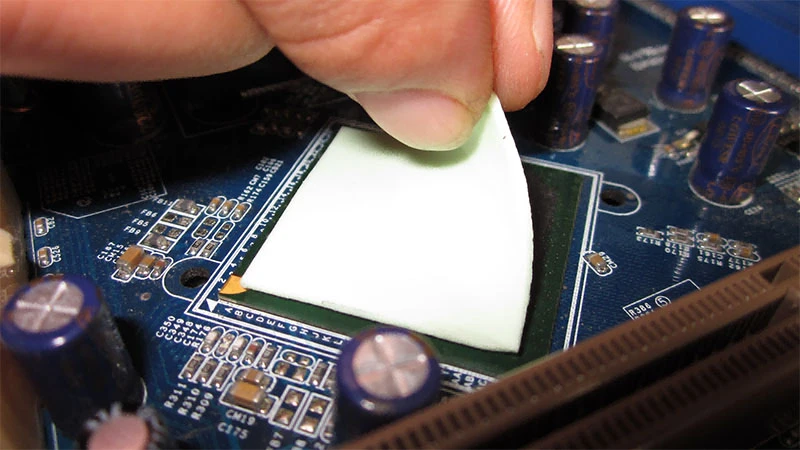
For CPUs, GPUs, and power modules packed tightly together, that cleanliness can decide long-term reliability.
How do material properties affect real-world performance?
Heat and pressure expose every weakness. The following properties shape daily operation:
• Thermal conductivity – controls heat dissipation from memory modules and LED arrays
• Compressibility – improves gap filling across surface irregularities
• Hardness – balances support and component protection
• Operating temperature range – keeps performance steady through repeated heating cycles
• Flammability rating – supports UL certification in dense assemblies
When these factors align, heat moves out smoothly instead of building silent stress inside the system.
Why is dielectric strength critical in dense assemblies?
Modern boards squeeze chipsets and power modules into millimeters of space. One slip in insulation can trigger failure.
→ High dielectric strength blocks short circuits
→ Stable resin systems maintain electrical insulation under pressure
→ Compliance with RoHS, REACH, and halogen-free standards supports global distribution
In high-voltage layouts, insulation is not optional—it is protection built into every layer.
How do specifications influence production efficiency?
Consistent output depends on precise product control.
Short overview: pad thickness, format, and backing determine how smoothly parts move down the line.
| Specification | Production Impact | Application Benefit |
| Pad thickness | Uniform lamination | Accurate gap filling |
| Die-cut shapes | Fast die cutting integration | Precise fit for CPUs & GPUs |
| Roll stock | Efficient slitting & molding flow | High-volume builds |
| Adhesive backing | Reduced repositioning | Secure component protection |
Small dimensional errors can multiply across thousands of boards.
When is fiberglass reinforcement necessary?
In vibration-prone environments, structure matters as much as heat flow.
• Fiberglass reinforcement increases mechanical strength
• Enhances vibration dampening in power modules
• Maintains pad dimensions under compression
• Preserves surface tackiness without shifting
In industrial systems under constant motion, stability prevents micro-movements that quietly damage solder joints and chipsets over time.
Still struggling to choose between silicone and non-silicone thermal pads? Don't let this question bother you anymore. [Contact Sheen's Engineering Team] today for a professional and customized thermal interface materials selection guide.
Sheen Thermal
Dongguan Sheen Electronic Technology Co., Ltd · Founded in 2008
Manufacturer of thermal interface materials and silicone foam for automotive electronics, energy storage, power electronics, communications and consumer electronics.
Certified
- ISO 9001:2015
- ISO 14001:2015
- IATF 16949:2016
What we supply
- Thermal conductivity Up to 90 W/m·K
- Thickness 0.3–10.0 mm
- Custom & samples Die-cut to drawing, 3–7 days