
 English
 usheenthermal

Testing the Graphene Thermal Pad for 800G OSFP Module Reliability
Date:2026-08-27
A Graphene thermal pad for 800G OSFP Module can look stellar on paper, yet one impressive conductivity number won’t keep procurement headaches away. For volume buyers, the real test is repeatable thermal and mechanical performance across every production lot.
Thickness, compression, hardness, adhesion, and aging can all upset the apple cart. Smart qualification checks these variables, test methods, batch consistency, and compliance documents before purchase orders start rolling.
Melodic Key Points: Graphene thermal pad for 800G OSFP Module
→ High Conductivity & Precision: Ensure laser flash and hot disk methods confirm thermal impedance, density, and conductivity within specs.
→ Mechanical Consistency: Verify Shore hardness, compression ratio, thickness tolerance, and surface roughness across batches.
→ Reliability Under Stress: Perform adhesion tests after thermal aging and simulate OSFP transceiver–heat sink integration in datacenter or HPC scenarios.
→ Compliance & Supply Assurance: Check RoHS, halogen-free, REACH, flammability ratings, plus batch consistency, storage stability, and lead-time documentation.
Request the 800G OSFP Graphene Pad Test Report →
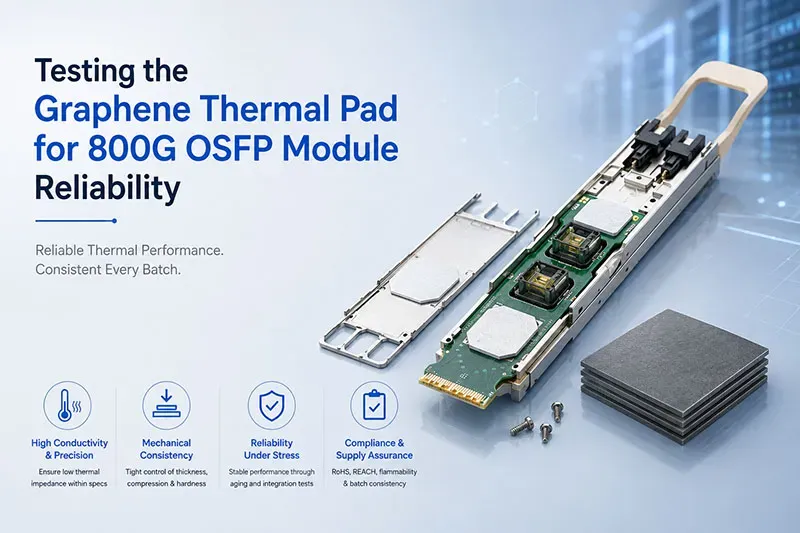
Graphene Thermal Pad For 800G OSFP Module Overview
A Graphene thermal pad for 800G OSFP Module helps move heat from tightly packed electronics toward the heat sink while filling small contact gaps. For designers, the real trick is balancing heat flow with mechanical fit. Sheen Technology supports graphene thermal pad designs where stable dimensions, controlled compression, and material compliance matter just as much as headline conductivity.
Understanding Thermal Conductivity and Thickness Tolerance
A Graphene thermal pad for 800G OSFP Module depends on linked thermal and physical values:
Heat-transfer factors
- Higher thermal conductivity supports faster heat dissipation.
- Low thermal resistance across the interface is the practical goal.
Fit factors
- Tight thickness tolerance keeps contact pressure predictable.
- Stable density and dimensional stability reflect consistent material property control.
Small thickness changes can matter a lot when tolerances stack up.
Graphene Pad Integration with OSFP Transceiver and Optical Engine
Good module integration starts with the actual heat path.
Upper interface
- Place the graphene pad between the OSFP module and heat sink.
- Confirm full thermal interface contact.
Internal hot spots
- Check the transceiver and optical engine near the PCB substrate.
A Graphene thermal pad for 800G OSFP Module should fill gaps without creating harmful pressure.
Manufacturing Specifications from Die-Cutting Precision to Compression Ratio
Production consistency comes down to measurable controls:
Dimensional controls
- Specify die-cutting precision and tolerance control.
Mechanical controls
- Set compression ratio, Shore hardness, and surface targets.
- Verify each mechanical property against the approved manufacturing specification.
That keeps graphene thermal interface pads consistent batch to batch.
Ensuring RoHS Compliance and Halogen-Free Attributes
Material paperwork deserves equal attention:
Chemical requirements
- Verify RoHS compliance, halogen-free composition, and REACH declarations.
- Screen each hazardous substance limit.
Deployment records
- Maintain material certification and flammability documentation.
- Favor eco-friendly choices that support environmental safety goals.
Key Tests For Module Reliability
A Graphene thermal pad for 800G OSFP Module faces heat, pressure, and dimensional changes in daily service. Reliability tests check the thermal and mechanical details that matter, giving engineers a practical way to catch material drift before it becomes a cooling headache.
Laser Flash Analysis on Graphene Thermal Impedance
Laser Flash Analysis tracks a rapid thermal transient through the graphene pad.
- Measured thermal diffusivity, paired with specific heat capacity, supports conductivity calculations.
- Results help judge thermal impedance and real heat dissipation potential for a Graphene thermal pad for 800G OSFP Module.
Hot Disk Method for Density and Thermal Conductivity
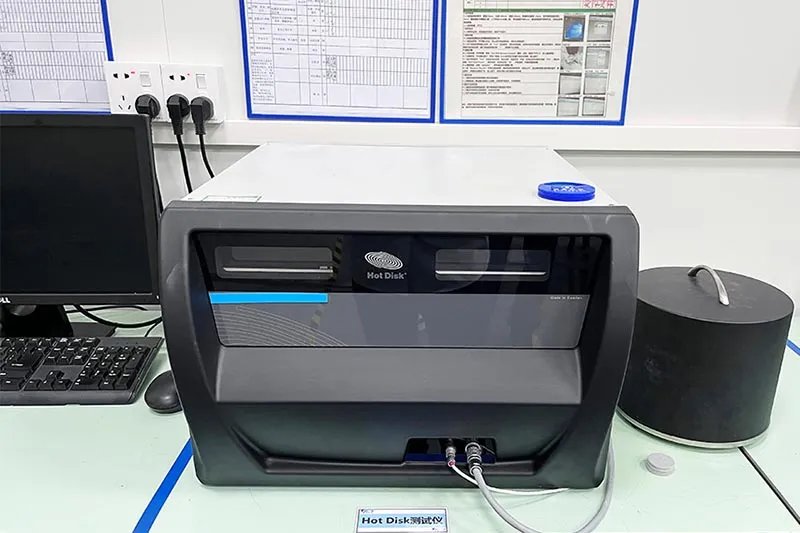
The Hot Disk method uses a transient plane source to check thermal conductivity. Comparing density between batches also flags shifts in material composition, a useful heads-up when graphene heat transfer and each physical property need steady performance.
Hardness Tester Measuring Shore Hardness and Compression
A hardness tester records Shore hardness. This checks the pad's basic mechanical property.
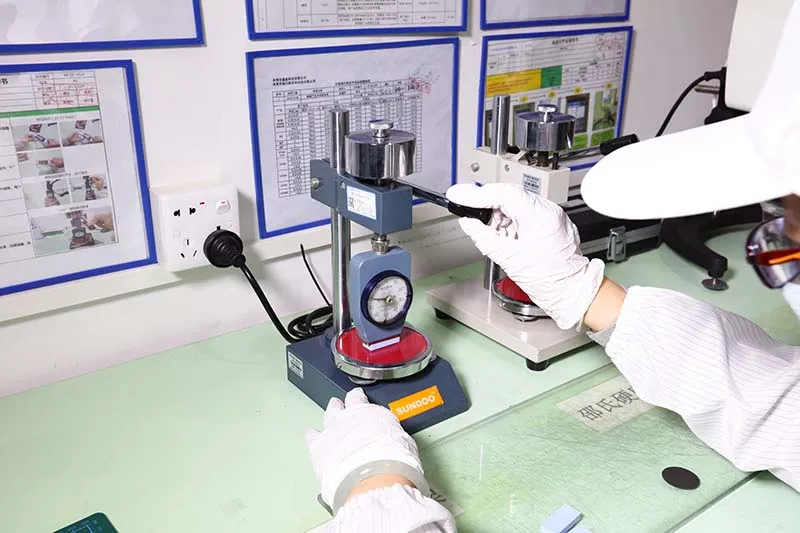
Controlled compression then shows:
- elasticity during loading;
- deformation after pressure;
- pad flexibility around OSFP interfaces.
Together, these checks help a Graphene thermal pad for 800G OSFP Module make close contact without pushing sensitive parts too hard.
Thickness Gauge Assessment of Tolerance and Surface Roughness
Thickness control: A thickness gauge checks tolerance, dimensional accuracy, and graphene thickness.
Surface control: Profile measurement identifies surface roughness linked to the material microstructure. Small variations can bump up contact resistance, so consistency matters.
Adhesion Test under Thermal Aging Conditions
Adhesion test
- measures initial bonding strength.
Thermal aging
- applies sustained environmental stress;
- reveals aging degradation.
Final reliability testing
- checks interface stability for a graphene thermal interface pad under long-term OSFP heat.
Test methods mapped to ASTM/ISO standards:
| Test | What It Verifies | Standard |
| Laser flash | Thermal diffusivity → conductivity | ASTM E1461 |
| Hot Disk (TPS) | Thermal conductivity, density | ISO 22007-2 |
| Through-plane impedance | Steady-state thermal resistance | ASTM D5470 |
| Shore hardness | Indentation resistance | ASTM D2240 |
| Compression set | Permanent deformation | ASTM D395 |
| Adhesion | Bonding strength | ASTM D903 (peel) |
Does Graphene Thermal Pad For 800G OSFP Module Work?
A Graphene thermal pad for 800G OSFP Module can improve heat transfer, but real results depend on pressure, thickness, airflow, and installation. Sheen Technology evaluates these factors so Graphene thermal pad performance matches demanding optical hardware.
In Datacenter Switch: Thermal Performance Evaluation
A Graphene thermal pad for 800G OSFP Module should lower interface Thermal resistance without blocking normal airflow.
Switch conditions
- Datacenter switch airflow must reflect real rack use.
- 800G OSFP module loading should remain sustained.
Thermal results
- Higher Thermal conductivity supports Heat dissipation.
- Stable Operating temperature shows the interface is doing its job.
High-Performance Computing Stability Under Load
Under High-performance computing loads, a graphene pad has little room for thermal drift.
Load control
- Run Full load testing with an active OSFP transceiver.
Performance checks
- Track Junction temperature and Thermal stability.
- Use Reliability assessment to spot changes in the Graphene material.
Sheen Technology GSF90 Reliability Test Report
Test Conditions
| Test Item | Test Conditions | Test Equipment |
| High‑Temperature Aging | 125 °C, 1000 h | Constant‑temperature Oven |
| High‑Temperature High‑Humidity | 85 °C / 85 %RH | Temperature & Humidity Chamber |
| Thermal Shock | −40 °C ↔ 150 °C | Thermal Shock Chamber |
- Criteria for Evaluation
| Property | Initial Value | Acceptance Criterion |
Thermal Resistance (°C·cm²/W) | 0.094 | ±15% of initial value |
High‑Temperature Aging Test
| Aging time (H) | 0 | 200 | 400 | 600 | 800 | 1000 | judge |
| Thermal Resistance (°C·cm²/W) | 0.094 | 0.096 | 0.097 | 0.096 | 0.099 | 0.101 | OK |
High‑Temperature High‑Humidity Aging Test
| Aging time (H) | 0 | 200 | 400 | 600 | 800 | 1000 | judge |
| Thermal Resistance (°C·cm²/W) | 0.095 | 0.096 | 0.096 | 0.097 | 0.096 | 0.098 | OK |
Thermal Shock Aging Test
| Aging time (H) | 0 | 200 | 400 | 600 | 800 | 1000 | judge |
| Thermal Resistance (°C·cm²/W) | 0.094 | 0.095 | 0.096 | 0.095 | 0.096 | 0.097 | OK |
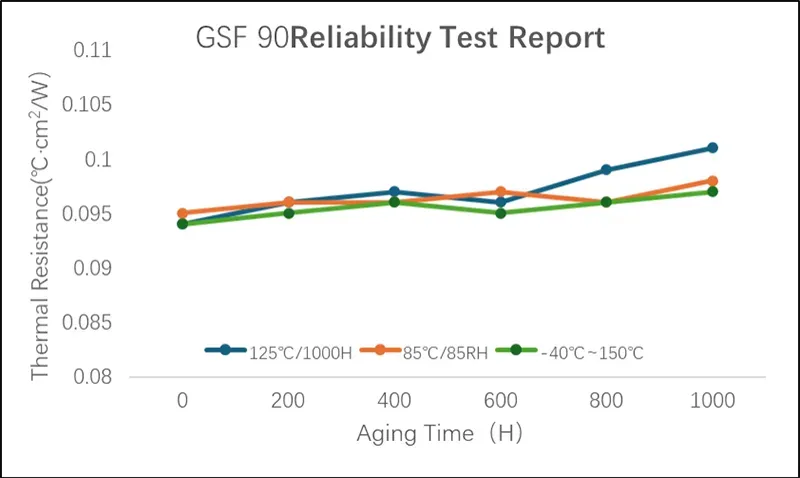
Sheen Technology tests the Graphene thermal pad for 800G OSFP Module across sustained heat cycles, not just quick bench runs.
Telecommunication Network Signal Integrity via Electrical Resistivity
A Graphene pad also needs electrical care; good cooling cannot come at the expense of Signal integrity.
Electrical checks
- Measure Electrical resistivity near the OSFP form factor.
- Check Electromagnetic interference risks.
Network checks
- Verify High-speed data transmission inside the Telecommunication network.
That keeps graphene thermal interface choices practical, not just cool on paper.
AI Hardware Batch Consistency and Storage Stability Impact
For large AI hardware orders, Sheen Technology links material control with deployment planning.
Before deployment
- Confirm Batch consistency and Storage stability.
- Inspect each Thermal interface material lot.
After conditioning
- Run Environmental testing.
- Compare Degradation analysis results against Graphene reliability targets.
That way, a Graphene thermal pad for 800G OSFP Module stays predictable from stored inventory to installed hardware.
Qualifying a graphene thermal pad for 800G OSFP modules requires more than a conductivity number. Thermal methods (laser flash, Hot Disk, ASTM D5470 impedance) and mechanical checks (Shore hardness, compression, thickness, adhesion under aging) verify lot-to-lot consistency. Critically, because graphene is conductive, OSFP qualification must also verify electrical isolation through edge sealing or film lamination and EMI/resistivity checks — a bare graphene pad is not an insulating TIM in this application. Sheen Technology provides vertically aligned graphene pads with test data and insulated variants for signal-integrity-sensitive optical hardware.
Contact Sheen Technology for 800G OSFP Pad Qualification Support →
Sheen Thermal
Dongguan Sheen Electronic Technology Co., Ltd · Founded in 2008
Manufacturer of thermal interface materials and silicone foam for automotive electronics, energy storage, power electronics, communications and consumer electronics.
Certified
- ISO 9001:2015
- ISO 14001:2015
- IATF 16949:2016
What we supply
- Thermal conductivity Up to 90 W/m·K
- Thickness 0.3–10.0 mm
- Custom & samples Die-cut to drawing, 3–7 days