
 English
 usheenthermal

Meet SHEEN at Electronica 2026 in Munich: Thermal Materials for the Next Generation of Electronics
Date:2026-08-27
From November 10–13, 2026, SHEEN will be exhibiting at Electronica 2026 in Munich, Germany, one of the most important international meeting points for the global electronics industry.
We invite engineers, product developers, thermal designers, sourcing professionals, distributors and manufacturing partners to meet the SHEEN team at:
November 10–13, 2026
Munich, Germany
Hall 2 | Booth No. 275/5
Book a meeting with the SHEEN team at electronica 2026 →
As electronic systems continue to become smaller, faster and more power-dense, thermal management is no longer simply a matter of placing a thermal pad between a component and a heatsink. Material selection increasingly involves thermal performance, electrical insulation, mechanical compliance, cleanliness, reliability, assembly pressure and long-term stability.
These are exactly the types of application challenges SHEEN hopes to discuss with visitors at electronica 2026.
From Functional Materials to Practical Thermal Solutions
Founded in 2008, SHEEN focuses on the development and manufacturing of functional materials for electronics and industrial applications.
Over the years, our work has expanded beyond conventional thermal interface materials into a broader range of materials designed to support heat transfer, electrical insulation, sealing, cushioning, fire protection and system reliability.
Today, our material portfolio serves applications in computing, telecommunications, automotive electronics, medical equipment, industrial systems and other demanding electronic environments.
At electronica 2026, rather than simply displaying a catalog of individual part numbers, we want to discuss a more important question:
What does the real interface inside your product require?
A thermal material that performs well on a datasheet may behave very differently once it is placed between a component and a heatsink, cold plate, enclosure or structural frame.
Actual performance can be affected by gap thickness, pressure, surface roughness, mechanical tolerance, material hardness, contact area, temperature cycling and long-term compression behavior.
This is why SHEEN approaches thermal material development from both a material and an application perspective.
Explore a Broad Thermal Interface Material Portfolio
Visitors to the SHEEN booth will be able to discuss a wide range of thermal management material technologies.
Our conventional silicone thermal pads are available across multiple conductivity, hardness and thickness ranges and can be customized for different assembly conditions.
For applications requiring higher thermal performance, SHEEN also develops advanced material solutions including carbon-fiber-based thermal pads designed to achieve very high through-plane thermal conductivity. For applications where silicone oil migration or siloxane volatility is a concern, silicone-free thermal interface materials provide another design option. Where the interface is extremely thin and minimizing thermal impedance is more important than filling a large gap, phase change materials, thermal grease and thin thermal films can be evaluated. For assemblies with large component height tolerances or fragile components, thermal gels provide low assembly stress and excellent surface wetting.
SHEEN is also continuing to develop newer material platforms including graphene thermal materials and boron nitride thermal interface materials for applications where engineers are looking for different combinations of high thermal performance, insulation, thinness or material structure.
1. Graphene Thermal Pads — Vertically Aligned, Edge-sealing
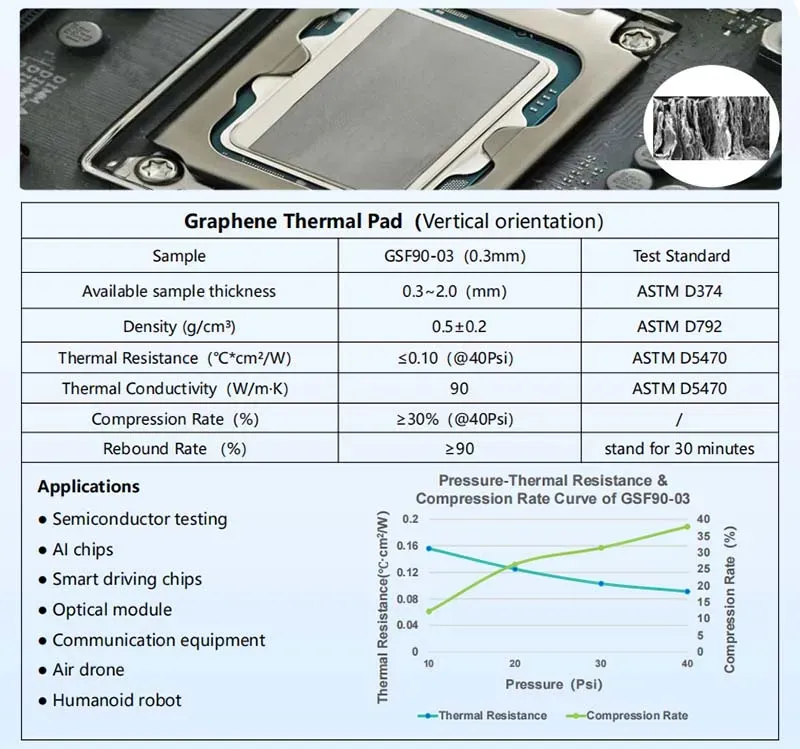
SHEEN graphene thermal pads use vertically aligned graphene for strong through-plane (thickness-direction) heat transfer — the direction that matters for moving heat from a processor or ASIC into a heat sink or cold plate. Graphene pads are electrically conductive, so they target high-heat-flux interfaces that do not require dielectric isolation, or that pair the pad with edge sealing or film lamination. High elastic recovery sustains contact through repeated thermal cycling.
2. Boron Nitride Thermal Pads — Insulating, High Conductivity
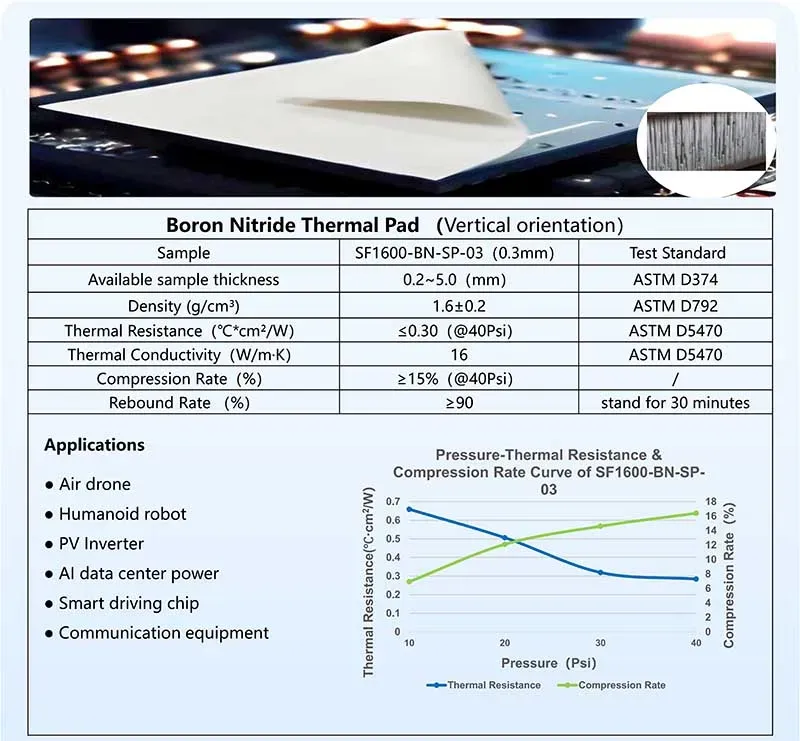
Boron nitride (BN) thermal pads combine high thermal conductivity with electrical insulation, making them suited to power electronics, inverters, and assemblies where a dielectric barrier is required across the interface. BN’s low dielectric loss also supports applications sensitive to electrical performance.
3. Carbon Fiber Thermal Pads — High compression + high resilience
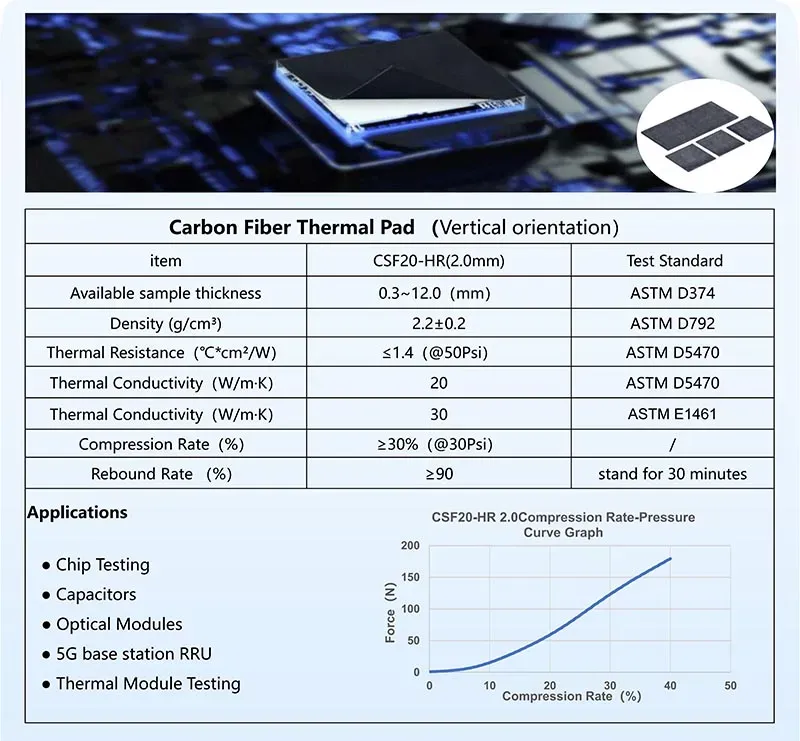
Carbon-fiber-based thermal pads are engineered for very high through-plane thermal conductivity, targeting the highest heat-flux interfaces where minimizing thermal impedance is the priority. They complement the portfolio for designs that demand maximum vertical heat transfer.
The objective is not to promote one material as suitable for every application. The objective is to help engineers identify the material structure that best matches the actual mechanical and thermal conditions of the device.
Request graphene / BN / carbon-fiber pad samples in advance →
More Than Thermal Conductivity
One of the most common questions in the thermal interface material industry is:
“What is the thermal conductivity?”
It is an important parameter—but it is only one part of the design.
For many real applications, engineers also need to consider:
- thermal resistance at the actual interface;
- material softness and compression behavior;
- gap tolerance;
- electrical insulation;
- silicone oil bleeding or siloxane volatility;
- dimensional stability;
- long-term compression set;
- flame-retardant requirements;
- assembly repeatability;
- compatibility with automated manufacturing.
A higher thermal conductivity number does not automatically guarantee lower device temperature.
For example, a material with very high conductivity may still perform poorly if it does not conform effectively to the mating surfaces. Conversely, a softer material may provide excellent contact but introduce mechanical or long-term compression concerns if it is not correctly matched to the assembly.
These trade-offs are best discussed using the actual structure of the customer’s product. That is why we encourage visitors to bring drawings, stack-up information, gap dimensions or thermal requirements when visiting our booth.
Thermal Materials for Emerging Electronics
electronica brings together companies from almost every segment of the electronics supply chain, making it an ideal environment to discuss how thermal materials are evolving.
- AI servers and high-performance computing systems are increasing heat density around processors, accelerators, memory and power delivery components.
- Telecommunications equipment requires reliable thermal interfaces for high-power electronics operating continuously in compact enclosures.
- Power supplies, inverters and industrial power electronics must manage heat while maintaining electrical insulation and long-term reliability.
- Automotive electronics introduce additional requirements related to vibration, thermal cycling and durability.
- Energy storage systems and battery structures increasingly require not only thermal management but also sealing, cushioning and fire-protection materials.
These applications may appear very different, but they share one important trend: the interface between heat-generating components and the surrounding structure is becoming more demanding.
Supporting Development with Testing and Validation
Material selection should not end with a datasheet comparison.
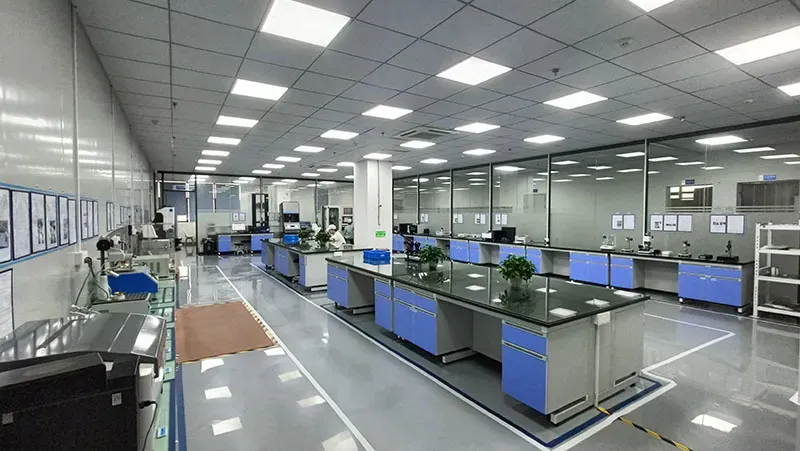
SHEEN has developed internal testing capabilities to evaluate important material characteristics including thermal conductivity, siloxane behavior, oil bleeding, humidity aging and thermal shock performance.
For customers developing long-life electronic products, validation under realistic environmental and mechanical conditions is often as important as initial thermal performance. Our goal is therefore to support customers from material selection through prototype evaluation and toward scalable production.
Let’s Meet in Munich
electronica 2026 will provide an opportunity for SHEEN to meet existing partners, new customers and engineers working on the next generation of electronic products.
Whether you are currently evaluating a conventional thermal pad, a high-conductivity interface, a silicone-free solution, a thermal gel, an insulating material, graphene, boron nitride, carbon fiber or silicone foam, we welcome the opportunity to understand your application.
Bring us your thermal challenge.
Bring us your gap dimensions.
Bring us your drawing.
Bring us the problem that cannot be solved by simply choosing the highest number on a datasheet.
Our team will be ready to discuss the application with you.
Visit SHEEN at electronica 2026
November 10–13, 2026
Munich, Germany
Hall 2 | Booth No. 275/5
Learn more about SHEEN and our material solutions at www.sheenthermal.com.
Sheen Thermal
Dongguan Sheen Electronic Technology Co., Ltd · Founded in 2008
Manufacturer of thermal interface materials and silicone foam for automotive electronics, energy storage, power electronics, communications and consumer electronics.
Certified
- ISO 9001:2015
- ISO 14001:2015
- IATF 16949:2016
What we supply
- Thermal conductivity Up to 90 W/m·K
- Thickness 0.3–10.0 mm
- Custom & samples Die-cut to drawing, 3–7 days