
 English
 usheenthermal

How to Perform an Accurate Judgment of Graphite Sheet Failure
Date:2026-07-10
How to Perform an Accurate Judgment of Graphite Sheet Failure
Judgment of graphite sheet failure isn’t a lab-only problem—it’s the moment your device runs hot, your battery swells, and your warranty budget takes a hit. Specs can look shiny, yet hidden flaws quietly set the stage for breakdown.
You need street-smart ways to spot risk before bulk orders lock you in. This guide cuts through noise, showing to check, what to test, and how to avoid costly surprises.
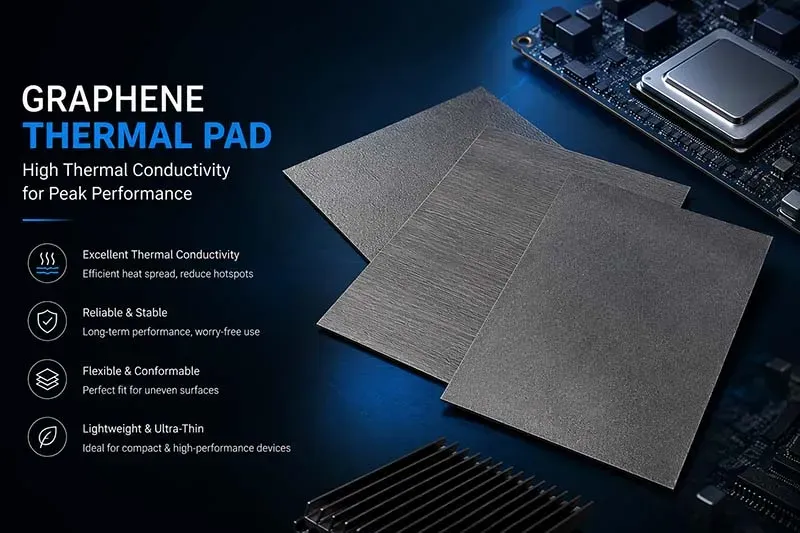
Key Points: Judgment of Graphite Sheet Failure
➔ Material Composition: Analyze carbon content, graphitization degree, and impurity levels to predict thermal and electrical performance.
➔ Structural Integrity: Employ microscopic examination to reveal cracks, delamination, inclusions, and voids that impact strength under stress.
➔ Thermal Performance: Measure thermal resistance and diffusivity to ensure adequate heat dissipation for battery control and heat spreading.
➔ Long-Term Stability: Run accelerated aging tests with thermal cycling to uncover oxidation, warping and degradation mechanisms early.
4 Steps For Rapid Failure Assessment
Failure can sneak up on you. A smart Judgment of graphite sheet failure helps avoid shutdowns, overheating, and costly recalls. Here’s a practical way to break down graphite sheet failure analysis without overcomplicating things.
Step 1: Evaluate Material Composition via Carbon Content Analysis
When starting a Judgment of graphite sheet failure, always go back to material basics. The composition of a graphite sheet defines its ceiling performance.
Core chemical indicators
Carbon content
· High purity levels improve conductivity
· Low purity may increase oxidation risk
Purity and trace impurities
· Metallic residues reduce thermal stability
· Non-carbon phases interrupt heat paths
Structural carbon behavior
· Degree of graphitization
· Alignment of carbon layers
A weak graphite sheet failure judgment often ignores how small impurity spikes distort thermal flow. In real-world production, Sheen Technology conducts precise analysis to ensure the carbon structure meets thermal demands before scaling output.
Step 2 Assess Structural Integrity through Microscopic Examination
Once chemistry checks out, physical structure comes next.
You’re looking at structural integrity under stress. That means detailed microscopy and close examination of morphology. Even tiny defects can snowball.
Watch for:
· Surface cracks spreading along layered planes
· Separation between layers
· Hidden voids reducing mechanical strength
Here’s the reality: graphite sheet failure rarely starts big. It begins with micro-level separation that expands during heat cycling. A sharp Judgment of graphite sheet failure connects these micro signs to macro breakdown.
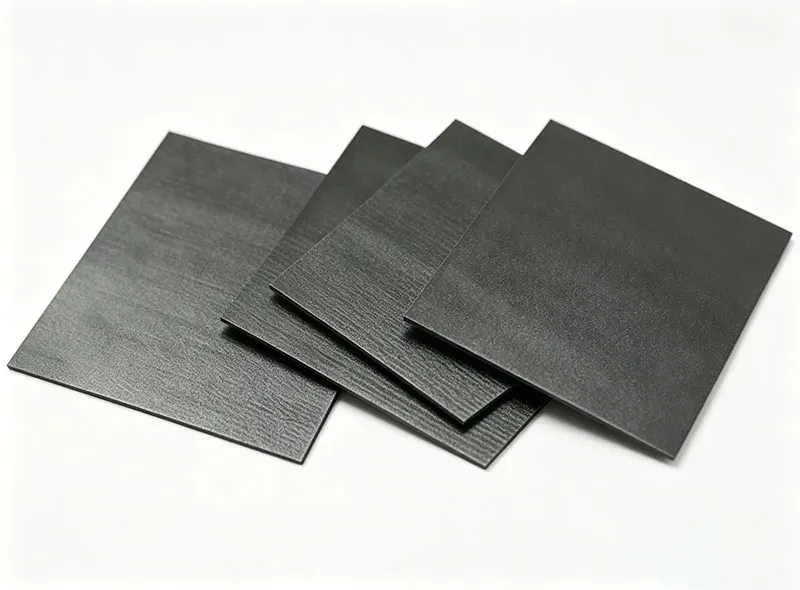
In addition, the manufacturer Sheen Technology has optimized the graphite structure to produce a single-layer, vertically oriented graphene thermal pad, thereby avoiding failure issues caused by interlayer separation in graphite sheets.
Step 3 Measure Thermal Resistance and Heat Dissipation Capability
Heat tells the truth.
If thermal resistance climbs, something’s wrong. If heat dissipation slows, degradation has started. If temperature spreads unevenly, internal damage may already exist.
Strong conductivity equals stable performance. Poor heat flow signals graphite sheet failure risk.
Thermal testing is not just about numbers. It supports accurate graphite sheet failure judgment in battery packs, LEDs, and heat spreaders where margins are tight.
Step 4 Conduct Accelerated Aging Test for Long-term Stability
Short-term success can be misleading. Real insight comes from accelerated aging.
Stress simulation
· Repeated thermal cycling
· High-humidity exposure
· Oxidative environments
Monitoring checkpoints
· Dimensional stability
· Surface warping
· Signs of degradation
Sheen Technology laboratory Graphene Thermal pad aging Test:
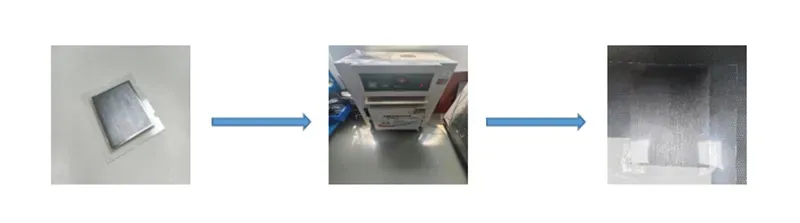
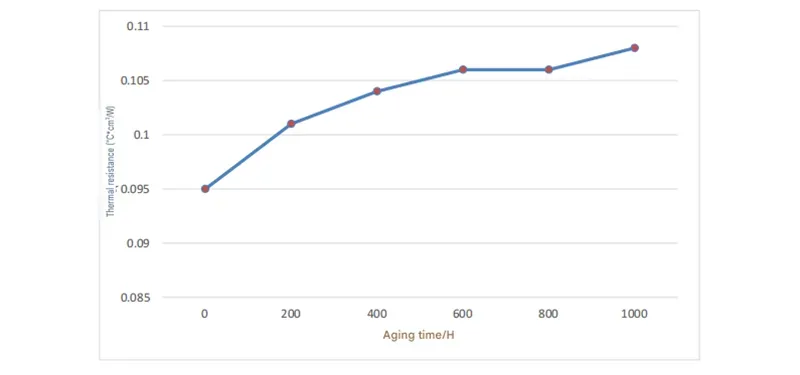
Conclusion: As shown in the figures and data above, the graphene thermal pad demonstrated stable thermal resistance during short-term aging tests; after 1,000 hours, the thermal resistance increased by 13.7%, remaining within the acceptable range of variation.
A reliable test predicts long-term stability, not just initial specs.
Key aging signals include:
· Declining mechanical strength
· Increased oxidation rate
· Reduced durability and shortened lifetime
Consistent Judgment of graphite sheet failure combines chemistry, structure, heat behavior, and aging insight. That full-picture approach is how Sheen Technology helps manufacturers reduce risk before products hit the market.
Need exact thermal conductivity, thickness range, aging stability, tensile strength, and reliability data before selecting a graphite thermal material? Download the product datasheets to compare graphite sheet and graphene thermal pad options for battery packs, power electronics, LED modules, and other high-reliability thermal management applications.
Visual Inspection Vs. Instrumented Testing
When it comes to Judgment of graphite sheet failure, relying on guesswork just doesn’t cut it. A solid call on graphite sheet failure means pairing sharp eyes with hard data. Below, we break down how visual checks and instrumented methods work together to strengthen every graphite sheet failure assessment.
Visual Inspection
For quick Judgment of graphite sheet failure, visual review sets the tone. It focuses on what can be seen, felt, and flagged fast.
· Surface defects
· Cracks
· Discoloration
· Delamination
· Pitting
· Oxidation
Surface Layer Review
1.1 Check for surface defects and discoloration under angled lighting.
1.2 Track early oxidation spots near edges.
Structural Integrity Scan
2.1 Identify micro cracks spreading from mounting holes.
2.2 Inspect signs of delamination between bonded layers.
Failure Pattern Mapping
3.1 Compare visible damage to known failure modes.
3.2 Record density of pitting for trend tracking.
This stage supports fast graphite sheet failure analysis in production lines. At Sheen Technology, technicians treat visual graphite sheet failure assessment as the frontline filter before deeper testing begins.
Instrumented Testing
Visual cues only tell part of the story. Instrumented testing confirms the Judgment of graphite sheet failure with numbers that don’t lie.
Core checks include:
· Electrical conductivity and resistance measurement
· Thermal conductivity
· Mechanical properties such as tensile strength, compression testing, and flexural strength
· Material validation through spectroscopy
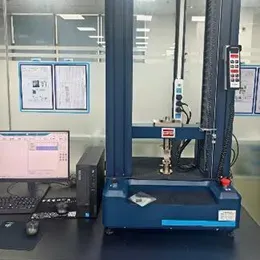
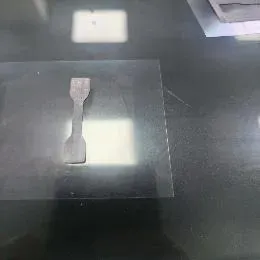
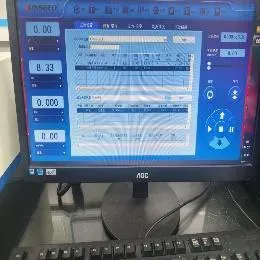
Sheen Technology laboratory GSF90-03 Graphene Thermal pad Tensile strength test:
· Test Standard: ASTM D412
· Sample Preparation: Dumbbell-shaped standard specimens were prepared using a mold.
· Test Method: The specimen was clamped vertically in the grips, the speed was set to 300 mm/min, the initial gauge length was measured, and the test was initiated.
| Test Equipment | Pre-test Status | Test Results |
 |
 |
 |
| Test Item | GSF90-03 Graphene Thermal pad Tensile strength test Data | |||
| Sample 1 | Sample 2 | Sample 3 | Average Value | |
| Tensile Strength(Mpa) | 0.061 | 0.058 | 0.059 | 0.059 |
A typical graphite sheet failure assessment flows like this: measure baseline conductivity, compare thermal drift, then verify mechanical limits. If electrical conductivity drops while thermal conductivity shifts, hidden internal cracks are likely.
“Advanced material testing is becoming non-negotiable in electronics reliability,” notes a 2025 IDTechEx materials reliability outlook, highlighting stricter validation standards across flexible electronics markets.
That trend reinforces why Sheen Technology integrates layered testing into every graphite sheet failure evaluation. Smart Judgment of graphite sheet failure blends sight with science—because solid data beats guesswork every time.
Need a closer match for your project? Browse related application pages to see how graphite sheets and graphene thermal pads are used in battery systems, consumer electronics, power modules, LED assemblies, and other heat-sensitive devices that demand long-term reliability.
Manufacturing QC: Instant Failure Verification
In day to day production, Judgment of graphite sheet failure is not guesswork; it’s a fast, practical call based on signals from structure, thickness, and purity. A solid graphite sheet judgment keeps scrap low and performance steady.
Detect Inclusions and Voids in Crystal Structure
For reliable Judgment of graphite sheet failure, start inside the graphite sheet itself.
· Check visible defects under microscopy.
· Scan internal voids with X-ray diffraction.
· Flag abnormal inclusions affecting material integrity.
At plant level, failure judgment flows like this:
Crystal Structure Review
· Lattice alignment:Distortion = risk of graphite sheet failure.
· Foreign particle check:Metallic inclusion → conductivity drop.
Void Mapping
· Micro-void clusters:Reduced tensile strength.
· Large cavities:Thermal hot spots.
A tiny void today can mean full graphite sheet failure tomorrow. That’s why Sheen Technology pushes sheet failure analysis right after forming, not after customer complaints. Smart, simple, no drama.
Verify Thickness Variation with Electrical Resistance Measurement
Thickness drift often hides behind a stable appearance. The Judgment of graphite sheet failure here depends on electrical resistance trends.
Step-by-step material failure check:
· Measure multi-point thickness.
· Record resistivity values.
· Compare resistance map for uniformity.
· Confirm stable conductivity across zones.
If resistance spikes, graphite sheet failure is likely tied to uneven compression. Quick failure judgment avoids shipping weak stock. Keep it tight; keep it consistent.
Confirm Purity and Impurity Level for Consistent Performance
Purity speaks louder than looks. For steady Judgment of graphite sheet failure, focus on material composition.
• Run chemical analysis for contamination.
• Use spectroscopy to track trace impurity.
• Validate high purity for long-term performance.
Short checks. Clear calls. No fluff.
Low contamination supports stable oxidation resistance. Excess impurity speeds graphite sheet failure and ruins thermal paths. Through disciplined sheet failure analysis, Sheen Technology ensures every graphite sheet judgment stands up in real-world heat cycles.
When purity, thickness, and structure line up, Judgment of graphite sheet failure becomes fast, factual, and reliable.
【Request a Custom Quote】 Not sure which graphite sheet or graphene thermal pad is best for your battery pack, power module, LED system, or electronics reliability project? Send us your operating temperature range, target thickness, assembly structure, and thermal performance requirements, and we can help recommend the right thermal solution for your application.
Sheen Thermal
Dongguan Sheen Electronic Technology Co., Ltd · Founded in 2008
Manufacturer of thermal interface materials and silicone foam for automotive electronics, energy storage, power electronics, communications and consumer electronics.
Certified
- ISO 9001:2015
- ISO 14001:2015
- IATF 16949:2016
What we supply
- Thermal conductivity Up to 90 W/m·K
- Thickness 0.3–10.0 mm
- Custom & samples Die-cut to drawing, 3–7 days