
 English
 usheenthermal

Maximize Thermal Efficiency With This Graphite Sheet Selection Guide
Date:2026-07-10
Maximize Thermal Efficiency With This Graphite Sheet Selection Guide
Overheating isn’t glitch—it’s money slipping out the back door, and this Graphite sheet selection guide cuts straight to what stops it.
One prototype means nothing when thousands roll off the line and start acting up.
Sheen Technology engineers in 2025 stress consistent thermal spread reduces failure rates.
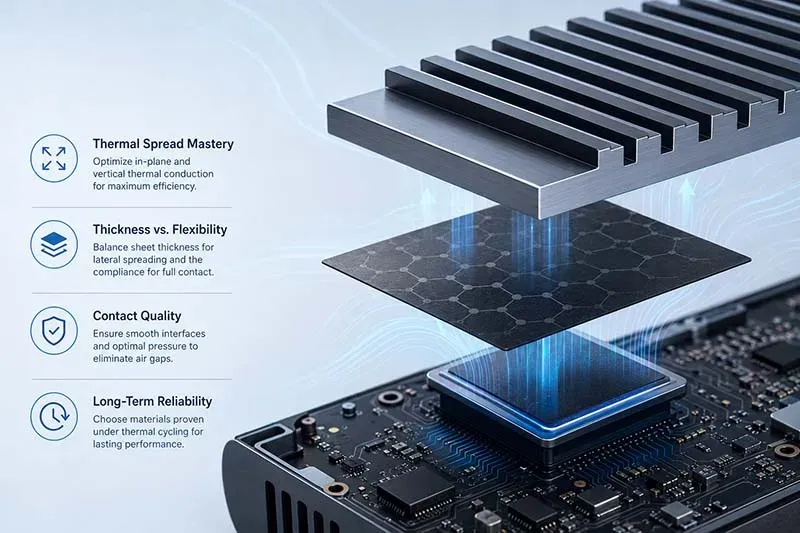
Reading Notes: Graphite Sheet Selection Guide
→ Thermal Spread Mastery: select in-plane thermal conduction materials to achieve high horizontal thermal conductivity, and choose vertically oriented thermal conduction materials to enable efficient vertical heat transfer.
→ Thickness vs. Flexibility: Balance sheet thickness for lateral spreading with the compliance needed for full surface contact.
→ Contact Quality: Ensure flat, smooth interfaces and optimal pressure to eliminate air gaps and boost thermal transfer.
→ Long-Term Reliability: Select materials proven under thermal cycling to maintain conductivity and structural integrity over time.
5 Emotional Reasons To Read Our Graphite Sheet Selection Guide Now
Choosing the right thermal material can feel confusing. That’s exactly why this Graphite sheet selection guide exists. When you break down graphite, sheet structure, and smart selection tips, everything clicks. This graphite sheet guide helps you pick with confidence instead of guesswork.
Reason 1: Gain Confidence in Device Reliability
A solid Graphite sheet selection guide strengthens trust in your hardware by reinforcing:
· device lifespan
· system stability
· component integrity
· long-term performance
Material Selection Logic
1.1 Matching thickness to heat load
1.2 Matching of in-plane and through-plane thermal conductivity
1.3 Ensuring electrical insulation where needed
Thermal Risk Control
2.1 Lowering peak temperatures for failure prevention
2.2 Reducing thermal gradients that harm product durability
Operational Benefits
3.1 Smoother operational consistency
3.2 Reduced stress during power spikes
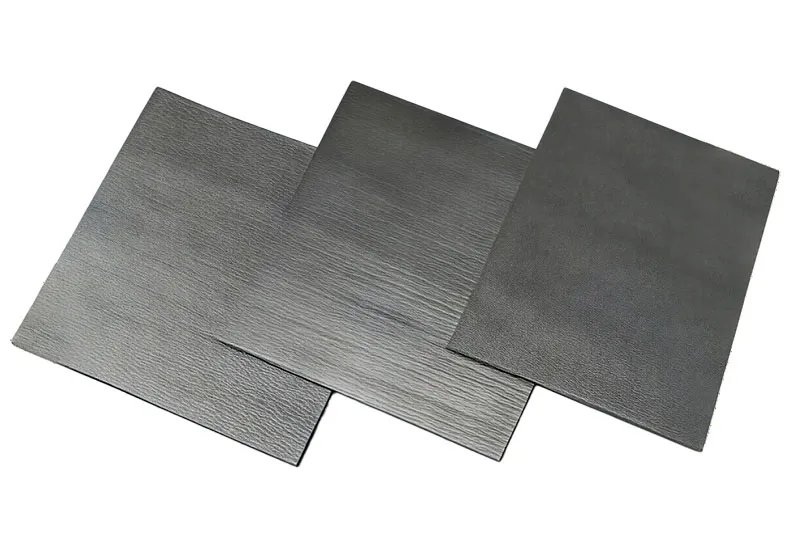
When thermal pathways are designed right, devices simply last longer. This reliability is a key focus for Sheen Technology; their newly developed vertically aligned graphene thermal pad utilizes a vertical thermal conduction path to ensure optimal equipment performance.
Reason 2: Experience Quieter Operation and Less Fan Noise
Nobody enjoys loud cooling fans ramping up mid-task. A smart graphite sheet guide explains how better thermal dissipation improves:
· acoustic performance
· noise reduction
· fan speed control
Here’s how it plays out:
· Heat spreads faster across the surface.
· Peak temperature drops.
· Fans don’t need to spin aggressively.
The result? Near silent operation and smoother airflow optimization.
• Better heat spreading
• Lower fan cycles
• More quiet computing
Sheen Technology designs graphite solutions that make cooling feel effortless. It’s not magic. It’s physics done right.
Reason 3: Protect Your Components from Overheating Stress
Overheating quietly damages electronics. A proper Graphite sheet selection guide helps prevent that in three clear moves:
Step 1: Improve temperature regulation to avoid sharp thermal spikes.
Step 2: Spread heat evenly to minimize thermal stress on solder joints and critical components.
Step 3: Maintain system-wide component protection, reducing risk of thermal runaway and long-term heat damage.
This isn’t just about comfort—it’s about preserving system integrity over time.
Reason 4: Enjoy Faster Warm-Up and Cool-Down Cycles
Fast response matters.
· Shorter warm-up time.
· Shorter cool-down time.
· Higher heat transfer speed.
Better thermal response improves overall system responsiveness. During heavy processing, heat spreads quickly. When demand drops, dissipation accelerates. Controlled thermal cycling protects materials and improves temperature control without lag.
It feels smoother. And it performs smoother.
Reason 5: Achieve Peace of Mind with Uniform Heat Spread
Hot spots create hidden risks. A graphite sheet guide shows how heat distribution directly impacts device safety and stability.
· Balanced surface temperature
· Reduced thermal gradient
· Effective hot spot elimination
Uniform Layer Contact
· Enhances thermal uniformity
· Maintains consistent even temperature
Cross-Device Stability
· Promotes thermal equilibrium
· Improves reliable heat spreading across boards
When heat flows evenly, performance becomes predictable. No surprise shutdowns. No uneven aging.
That peace of mind is what the Graphite sheet selection guide is built to deliver. With the right graphite sheet selection process—and support from Sheen Technology—you move from uncertainty to steady control.
Need a closer match for your project? Browse related application pages to see how graphite sheets and graphene thermal pads are used in smartphones, laptops, battery systems, power electronics, and other compact devices that require reliable thermal spreading.
Thermal Interface Mastery
Choosing the right graphite material is not guesswork; it’s applied physics with a bit of street smarts. This Graphite sheet selection guide breaks down how thermal conductivity, sheet thickness, pressure, and aging shape real-world heat transfer performance. If you're comparing options or refining a graphite sheet guide, this is your practical playbook.
Understanding Thermal Conductivity Metrics
When reading a Graphite sheet selection guide, focus on how thermal conductivity is reported and measured.
Core properties
· In-plane: spreads heat laterally.
· Through-plane: drives heat transfer across interfaces.
· Units: W/m·K; higher isn’t always better without context.
Measurement factors
· Sample prep affects measurement results.
· Pressure alters thermal resistance.
· Surface finish shifts real performance.
| Material Type | In-Plane (W/m·K) | Through-Plane (W/m·K) | Typical Thermal Resistance (°C·cm²/W) |
| Natural Graphite | 800–1500 | 10–20 | 0.15–0.30 |
| Sheen Graphene thermal pad | - | 75-90 | ≤0.10 |
The Role of Sheet Thickness in Heat Transfer
Thickness directly changes thermal impedance.
At a glance:
· Thin sheets → lower contact thermal resistance.
· Thick sheets → stronger lateral conduction.
· Material properties dictate flexibility.
In practice:
1) Map the thermal path.
2) Estimate spreading distance.
3) Balance flexibility and structural support.
This part of any graphite sheet guide is often overlooked. Go too thin, and durability drops. Go too thick, and interface losses climb.
Surface Compliance and Contact Pressure
Real surfaces aren’t flat. Surface roughness creates micro-gaps.
To reduce contact resistance:
· Adjust contact pressure within safe mechanical limits.
· Select high conformability for better gap filling.
· Confirm compatibility with the thermal interface stack.
Sheen Technology designs graphite materials with tuned surface compliance so pressure improves conduction without crushing delicate chips. Smart pressure equals smoother heat flow. Simple.
Ensuring Long-Term Stability and Reliability
Heat cycles age materials. Over time, material degradation affects performance retention.
“Thermal cycling durability is becoming a primary qualification metric for advanced electronics in 2025 and beyond.” — IPC Electronics Assembly Market Update, 2025
Evaluate reliability in layers:
Environmental factors
· Humidity
· Oxidation exposure
Mechanical stress
· Repeated compression
· Vibration
Aging impact
· Shift in thermal resistance
· Loss of structural integrity
Sheen Technology laboratory Graphene Thermal pad aging Test:
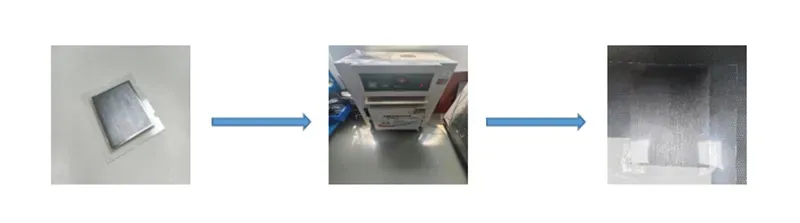
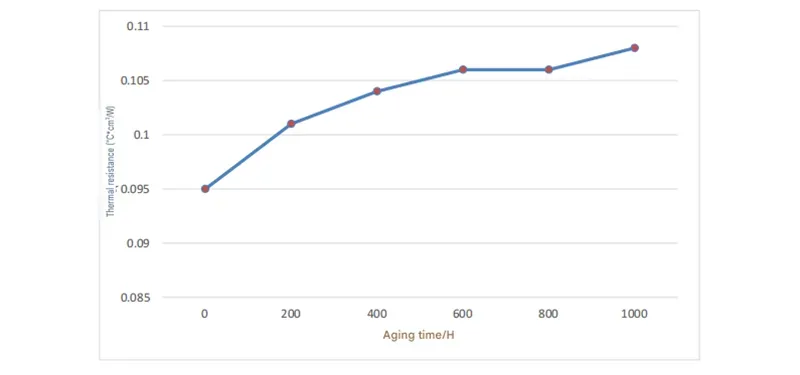
Conclusion: As shown in the figures and data above, the graphene thermal pad demonstrated stable thermal resistance during short-term aging tests; after 1,000 hours, the thermal resistance increased by 13.7%, remaining within the acceptable range of variation.
A solid Graphite sheet selection guide always checks long-term stability under real loads. Sheen Technology validates products through accelerated thermal cycling to secure consistent reliability.
Need exact thermal conductivity, thickness range, thermal resistance, aging stability, and interface pressure data before choosing a graphite thermal material? Download the product datasheets to compare graphite sheet and graphene thermal pad options for battery packs, consumer electronics, power modules, and other heat-sensitive applications.
Pick smart now, avoid heat headaches later.
Graphite Sheet Selection Guide: Master Thermal Interface Performance Variables
Choosing the right material isn’t guesswork. This Graphite sheet selection guide breaks down the real drivers behind heat control so your devices stay cool without wasting energy. If you're comparing a graphite sheet, building a sheet selection guide, or refining a thermal interface guide, this walkthrough keeps it practical and grounded.
Thermal Conductivity’s Impact on Efficiency
In any Graphite sheet selection guide, performance starts with thermal conductivity. Higher values push faster heat transfer, shrinking thermal resistance across the thermal path.
Material capability
· High in-plane thermal conductivity supports rapid heat dissipation.
· Stable through-plane conduction controls the temperature gradient.
Sheen Technology through-plane Graphene Thermal pad performance properties:
| Properties | Unit | GSF75-03 Graphene Thermal Pad | GSF90-03 Graphene Thermal Pad | Test Method |
| Color | - | Black | Black | Visual |
| Thermal Conductivity (vertical orientation) |
W/m·K | 75 | 90 | ASTM E1461 |
| Thermal Resistance (@40psi) | ℃*cm2/W | ≤0.12 | ≤0.10 | ASTM D5470 |
| Thickness | mm | 0.3~2.0 | 0.3~2.0 | ASTM D374 |
| Density | g/cm³ | 0.3~0.7 | 0.3~0.7 | ASTM D792 |
| Rebound Rate | % | ≥90 | ≥90 | - |
| Tensile Strength | Mpa | ≥0.03 | ≥0.05 | ASTM D412 |
| Oil Bleeding Rate | % | ≤3 | ≤3 | / |
| Application Temperature | ℃ | -40~150 | -40~150 | / |
| Flame rating | - | V-0 | V-0 | UL 94 |
System response
· Lower thermal resistance improves thermal performance.
· Efficient heat transfer reduces energy draw, lifting overall energy efficiency.
Application fit
· Thin electronics demand aggressive heat dissipation.
· Power modules tolerate wider temperature gradient ranges.
A smart graphite sheet choice balances conductivity with realistic operating loads. In practice, Sheen Technology engineers often tune conductivity grades to match device power density rather than chasing the highest number on paper.
Sheet Thickness and Density Effects
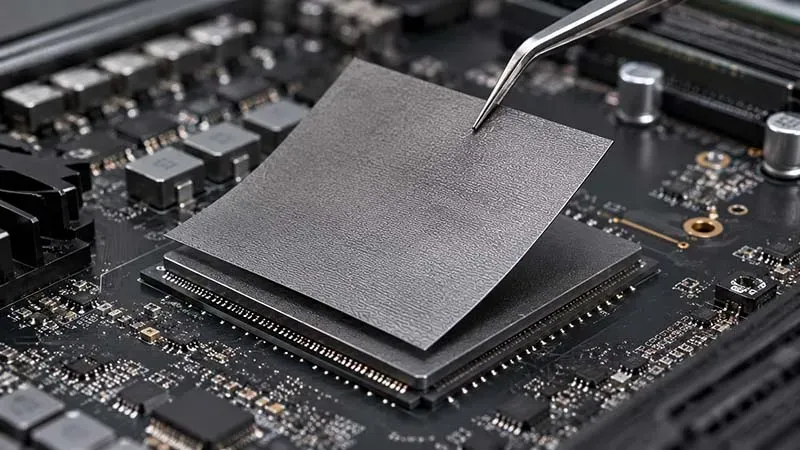
A solid Graphite sheet selection guide never ignores sheet thickness and material density. Both shape thermal impedance and overall heat flow.
· Thin sheets shorten the thermal path, yet may increase compression sensitivity.
· Higher material density boosts conductive continuity but raises material volume constraints.
Step-by-step evaluation:
· Define allowable stack height.
· Measure interface compression range.
· Match sheet thickness to required heat flow.
· Confirm acceptable thermal impedance under load.
For compact devices, even 0.1 mm shifts in sheet thickness can alter heat flow noticeably. That’s why many engineers treat the graphite sheet selection process as both mechanical and thermal design, not just a materials pick.
Surface Flatness and Contact Quality
Even the best Graphite sheet selection guide falls short if surface flatness and contact quality are ignored.
Key interaction layers:
· Base plate:Surface finish influences thermal contact resistance.
· Graphite sheet:Adapts under interface pressure to reduce air gaps.
· Heat source:Uneven zones raise thermal contact resistance.
When surface flatness is tight and interface pressure is controlled, heat transfer efficiency climbs sharply. Tiny air gaps act like insulation, quietly blocking performance.
For brands like Sheen Technology, consistent surface finish specs and pressure guidelines are built directly into their graphite sheet selection guide, helping users secure reliable contact quality and stable long-term thermal output.
【Request a Custom Quote】Not sure which graphite sheet or graphene thermal pad is the best fit for your battery pack, laptop, smartphone, power module, or electronics cooling design? Send us your operating temperature range, target thickness, interface structure, and thermal performance goals, and we can help recommend the right thermal solution for your project.
Sheen Thermal
Dongguan Sheen Electronic Technology Co., Ltd · Founded in 2008
Manufacturer of thermal interface materials and silicone foam for automotive electronics, energy storage, power electronics, communications and consumer electronics.
Certified
- ISO 9001:2015
- ISO 14001:2015
- IATF 16949:2016
What we supply
- Thermal conductivity Up to 90 W/m·K
- Thickness 0.3–10.0 mm
- Custom & samples Die-cut to drawing, 3–7 days