
 English
 usheenthermal

How to Select a Silicone-Free Thermal Pad for Precision Instruments
Date:2026-07-24
Production lines hate surprises — choose a Silicone-free thermal pad for precision instruments that keeps yields high and costly rework out of sight.
One bad material choice can stall an entire production run, and a Silicone-free thermal pad for precision instruments often decides that outcome fast.
Recent Gartner and IDC research shows demand for contamination-safe materials in electronics, driven by stricter compliance expectations.
Pick right, and production hums; pick wrong, and costs quietly stack up.
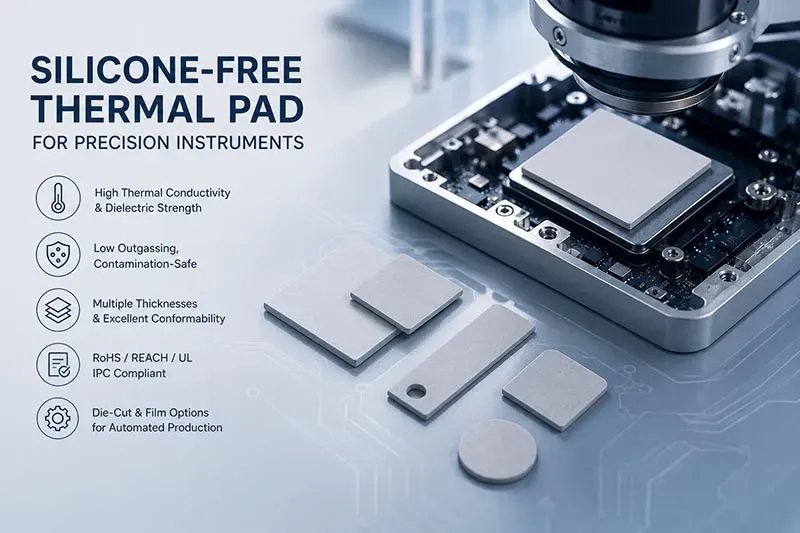
Key Points — Silicone-free thermal pad for precision instruments
- Prioritize high thermal conductivity and dielectric strength to safeguard sensitive electronics and ensure efficient heat dissipation.
- Select low-outgassing fillers like boron nitride or aluminum nitride for contamination-free performance in vacuum and medical environments.
- Match pad thickness (ultra-thin to >1.5 mm) and conformability to surface finish, from optical sensors to power semiconductors.
- Verify RoHS, REACH, ASTM, UL, and IPC compliance to meet aerospace, defense, and medical device regulations.
- Opt for forms — gap pads, films, custom die-cuts — compatible with automated placement and mass-production workflows.
7 Selection Steps for a Silicone-Free Thermal Pad in Precision Instruments
Dialing in a Silicone-free thermal pad for precision instruments isn't just spec chasing — it's about keeping heat in check without messing up sensitive electronics. Here's a practical, no-nonsense way through the selection process.
Secret 1: Prioritize High Thermal Conductivity and Dielectric Strength
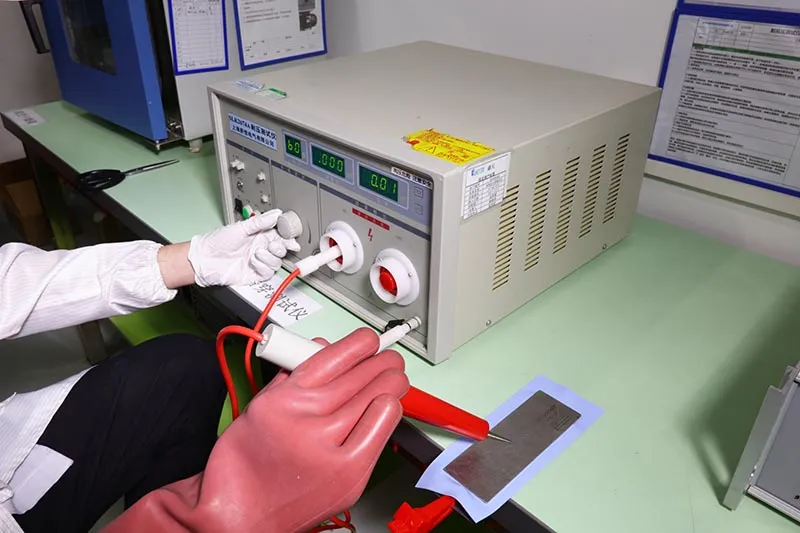
Thermal conductivity drives clean heat transfer, while dielectric strength ensures electrical insulation. A solid silicone-free thermal pad lowers thermal resistance without risking shorts through sensitive electronics. Sheen Technology’s laboratory conducts breakdown voltage tests on every thermal interface material to demonstrate its high dielectric strength.
Secret 2: Match Conformability to Your Instrument's Surface Finish
A silicone-free thermal pad must flex just enough to fill surface irregularities. Rough surface finishes demand higher conformability; smooth interfaces benefit from lower contact resistance. Better gap filling leads to improved thermal efficiency across optical and medical instruments.
Secret 3: Opt for Low Outgassing Compositions Like Boron Nitride
Outgassing ruins clean systems fast. Boron nitride filler boosts thermal conductivity while maintaining material purity. For vacuum and optical systems, review the material's volatile compound data and ensure it meets low-outgassing specs before committing.
Secret 4: Balance Compressibility with Operating Temperature Range
A good silicone-free thermal pad handles mechanical stress without drifting. Compressibility absorbs tolerance stack-up and vibration, while a wide operating temperature range ensures stable thermal expansion behavior across the instrument's full working range.
Secret 5: Select the Right Form — Gap Pads, Films, or Die-cut Shapes
- gap pads for uneven spacing
- thermal films for tight stacks
- die-cut shapes for custom layouts
Select based on material geometry and application-specific requirements for fit, assembly speed, and thermal contact area.
Secret 6: Verify RoHS, REACH, and ASTM Standards Compliance
Quick checks matter:
- RoHS compliance and REACH compliance
- ASTM standards for testing
- Ensures material safety and quality assurance in regulated builds using a Silicone-free thermal pad for precision instruments
Material safety and quality assurance documentation should accompany every production lot.
Secret 7: Plan for Efficient Mass Production via Automated Placement
When scaling a silicone-free thermal pad into production, automation improves placement consistency and reduces defect rates. Optimize pad design for automated pick-and-place, enable clean assembly workflow, and ensure compatibility with high-speed manufacturing lines.
What Defines Silicone-Free Thermal Pads?
Precision gear runs hot, and contamination risks aren't welcome. A Silicone-free thermal pad for precision instruments keeps heat moving without siloxane bleed, so optics, sensors, and lab systems stay clean and reliable.
Core Non-Silicone Fillers: Ceramic, Graphite, Aluminum Nitride
material composition
- non-silicone fillers — ceramic — electrically insulating, steady under temp swings
- graphite — high in-plane spread, great for hotspots
- aluminum nitride — strong thermal interface materials choice with balanced conductivity and insulation
- filler types — hybrid blends tune flow vs. rigidity
A Silicone-free thermal pad for precision instruments often mixes these to avoid outgassing while keeping contact tight. In practice, engineers swap ratios to match clamp force and surface roughness.
Key Thermal Material Properties: Thermal Conductivity & Chemical Resistance
Short takeaways:
- thermal conductivity drives heat transfer speed
- electrical insulation prevents shorts in dense layouts
- chemical resistance resists oils, solvents, and lab reagents
Sheen Technology Silicone-free thermal pad performance properties:
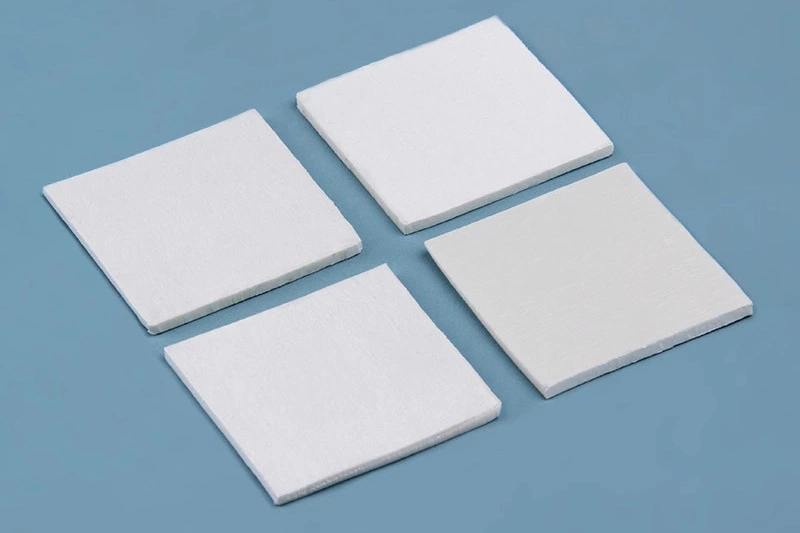
| Properties | Color | Thermal Conductivity | Thermal Impedance (1mm,@30psi) | Thickness | Standard Hardness |
| Unit | - | W/m·K | ℃*in2/W | mm | Shore 00 |
| AF100 | White | 1.0 | 1.1 | 0.25 ~ 5.0 | 50/70±5 |
| AF300 | White | 2.0 | 0.8 | 0.25 ~ 5.0 | 50/70±5 |
| AF500 | White | 3.0 | 0.6 | 0.25 ~ 5.0 | 50/70±5 |
| AF600 | White | 5.0 | 0.3 | 0.5 ~ 5.0 | 50/70±5 |
| AF600G | White | 6.0 | 0.25 | 0.5 ~ 5.0 | 50/70±5 |
| AF800 | White | 8.0 | 0.2 | 0.5 ~ 5.0 | 50/70±5 |
| AF1000 | Grey | 10.0 | ≤0.13 | 1.0~2.0 | 50~65 |
| Test Method | Visual | ASTM D5470 | ASTM D5470 | ASTM D374 | ASTM D2240 |
For a silicone-free thermal pad for precision instruments, stability matters more than peak numbers.
Available Forms: Sheets, Dispensable Compounds, Custom Configurations
1) Start with sheets for quick prototyping
2) Move to die-cut shapes for repeat builds
3) Use dispensable compounds (gels, pastes) for odd gaps
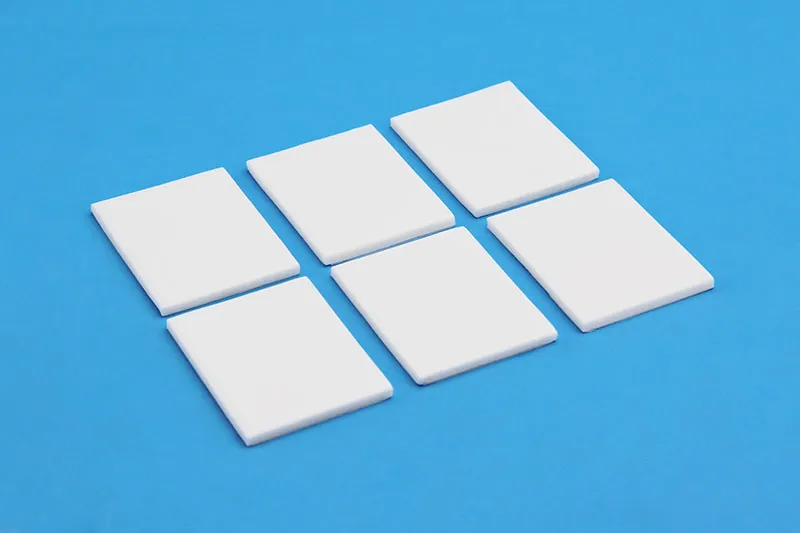
A Silicone-free thermal pad for precision instruments can be tailored as custom configurations to fit lenses, stages, or sensor stacks. Sheen Technology offers flexible form factors that slot into tight assemblies without re-engineering the whole stack.
Compliance & Testing: UL Certification and IPC Reliability Testing
compliance standards
- UL certification — flame ratings, safety checks
- IPC reliability testing — thermal cycling, humidity bias
quality assurance
- incoming material checks
- lot traceability
testing protocols
- power cycling under load
- long-duration soak
Pick a thermal pad for precision instruments that clears industry standards; that's how a silicone-free thermal pad for precision instruments proves it won't drift, crack, or contaminate over time.
Sheen Technology provides detailed technical datasheets for silicone-free thermal pads. Download the Silicone-Free Thermal Pad Engineering Datasheet for complete specifications.
3 Performance Advantages of Silicone-Free Thermal Pads
Getting thermal control right in tight systems isn't just engineering talk — it's everyday reliability. A Silicone-free thermal pad for precision instruments keeps heat steady, avoids contamination, and protects sensitive electronics across demanding environments.
Superior Heat Transfer: Boron Nitride-Enhanced Conductivity
Boron nitride filler within the silicone-free matrix boosts thermal conductivity while maintaining electrical insulation. The clean interface formed by the pad against the heat source and heat sink reduces contact resistance significantly.
Material layer stack
- Filler: boron nitride boosts thermal conductivity
- Matrix: stable, clean, no silicone bleed
- Interface: tight contact improves thermal management
Performance impact
- Lower resistance → faster heat transfer
- Better cooling → longer component life
- Consistency → ideal for precision instruments
| Material Type | Thermal Conductivity (W/mK) | Operating Temp (°C) | Application Fit |
|---|---|---|---|
| Silicone thermal pad | 1-15 | −40 to 150 | General use |
| BN thermal pad | 16 | −40 to 150 | GPUs/CPUs |
A Silicone-free thermal pad for precision instruments clearly wins when heat density climbs.
Enhanced Reliability: Zero Siloxane Outgassing in Medical Devices
Short version? Clean equals dependable.
- No siloxane outgassing — no film buildup
- Safer medical devices and optics
- Protects electronic components
A silicone-free thermal pad keeps precision instruments stable over time. No residue, no drift. That matters in imaging gear and lab systems where even tiny contamination wrecks accuracy.
Sheen Technology focuses on this exact gap — clean materials that stay predictable.
Robust Insulation: High Dielectric Strength for Aerospace Electronics
Electrical protection chain
- Base: electrical insulation layer
- Shield: high dielectric strength
- Result: prevents arc and leakage
Application tiers
- Flight systems — aerospace electronics need stability
- Defense modules — high voltage tolerance
- Sensors — protect precision instruments
Why it holds up
- Stable under stress
- Handles high voltage swings
- Maintains robustness
A Silicone-free thermal pad for precision instruments isn't just about cooling — it's about staying safe when voltage spikes hit. Sheen Technology aligns this balance of insulation and thermal control with the demands of precision electronics.
Application Scenario: Thickness Selection for Precision Instruments
Getting the right thickness isn't just a spec sheet thing — it directly affects heat flow, fit, and long-term stability. A well-chosen Silicone-free thermal pad for precision instruments keeps sensitive electronics running cool and stable.
Ultra-thin (<0.5 mm) for Optical Sensors and Laboratory Equipment
Optical sensors need near-zero spacing, and precision instruments rely on stable positioning. An ultra-thin silicone-free thermal pad avoids contamination while maintaining minimal gap integrity. Thin pads also reduce thermal resistance in compact optical modules.
Standard (0.5–1 mm) for Microprocessors and Integrated Circuits
This range sits in the sweet spot for everyday electronics.
Why it works
- balances compression and contact
- supports microprocessors and integrated circuits without overfilling gaps
Practical layout
- Layer 1: chip surface (CPUs, ICs)
- Layer 2: standard thickness pad
- Layer 3: heatsink
A Silicone-free thermal pad for precision instruments here ensures steady heat dissipation and clean operation across electronic components. Sheen Technology often tunes these pads to match real-world clamping forces.
Mid-range (1–1.5 mm) for Power Semiconductors & FPGAs
More power means more heat — and usually more uneven surfaces.
Heat handling chain
- Source: power semiconductors, FPGAs
- Transfer: mid-range thickness pad
- Output: cooling plate
Key benefits
- Fills larger gaps
- Protects against vibration
- Improves heat transfer
A silicone-free thermal pad for precision instruments in this range keeps high power applications stable. Sheen Technology designs these for voltage regulators where reliability matters every second.
Thick (>1.5 mm) for High-end Computing and Telecommunications Infrastructure
Big systems bring big spacing challenges.
System stack
- Hardware layer — servers, data centers, networking equipment
- Interface layer — thick thermal pads acting as thermal gap filler
- Cooling layer — heatsinks or cold plates
What stands out
- absorbs tolerance mismatch
- supports robust cooling
- stabilizes long-term loads
In these setups, a Silicone-free thermal pad for precision instruments still plays a role, especially where contamination risks exist. Sheen Technology pushes consistency here, keeping high-end computing and telecommunications infrastructure stable.
Explore Silicone-Free Pad Applications. Sheen Technology silicone-free thermal pads are deployed across medical imaging, optical sensing, aerospace avionics, defense electronics, and precision laboratory instruments. Please visit applications page for application notes, selection guides, and case studies.
Selecting a silicone-free thermal pad for precision instruments requires balancing thermal conductivity, outgassing, conformability, compliance, and producibility. For applications where silicone contamination must be eliminated, the silicone-free formulation is the only appropriate choice.
Sheen Technology provides silicone-free thermal pads in thicknesses from 0.5 mm to 5.0 mm, with custom die-cutting, roll formats, and multiple filler formulations (BN, ceramic, graphite, hybrid). Contact our engineering team for a technical datasheet, free sample kit, or application-specific material recommendation.
Sheen Thermal
Dongguan Sheen Electronic Technology Co., Ltd · Founded in 2008
Manufacturer of thermal interface materials and silicone foam for automotive electronics, energy storage, power electronics, communications and consumer electronics.
Certified
- ISO 9001:2015
- ISO 14001:2015
- IATF 16949:2016
What we supply
- Thermal conductivity Up to 90 W/m·K
- Thickness 0.3–10.0 mm
- Custom & samples Die-cut to drawing, 3–7 days