
 English
 usheenthermal

How to Select a Thermal Pad for OSFP and QSFP-DD Optical Modules
Date:2026-09-03
Choosing a Thermal Pad for OSFP and QSFP-DD Optical Modules by conductivity alone can backfire. Heat has to cross real gaps, tolerances, and contact surfaces, where pad thickness, thermal impedance, compression ratio, Shore hardness, and heat-sink design call the shots.
For volume buyers, the plot thickens: compliance, traceability, reliability, customization, and batch consistency matter too. This guide shows how to qualify performance and suppliers before production gets hot.
Reading Notes: Thermal Pad for OSFP and QSFP-DD Optical Modules
➔ Thermal Performance: Balance conductivity with real‐world thermal impedance under specified compression to ensure efficient heat transfer.
➔ Mechanical Fit: Specify pad thickness, compression ratio, and Shore hardness to fill module tolerances without overstressing components.
➔ Compliance & Safety: Verify RoHS, REACH, Halogen-Free, and UL94 V-0 certifications plus dielectric strength for electrical isolation.
➔ Reliability & Traceability: Inspect oil bleed, surface tackiness, moisture absorption, and require batch traceability and first-article inspection for consistent quality.
Request the OSFP/QSFP-DD Pad Datasheet →
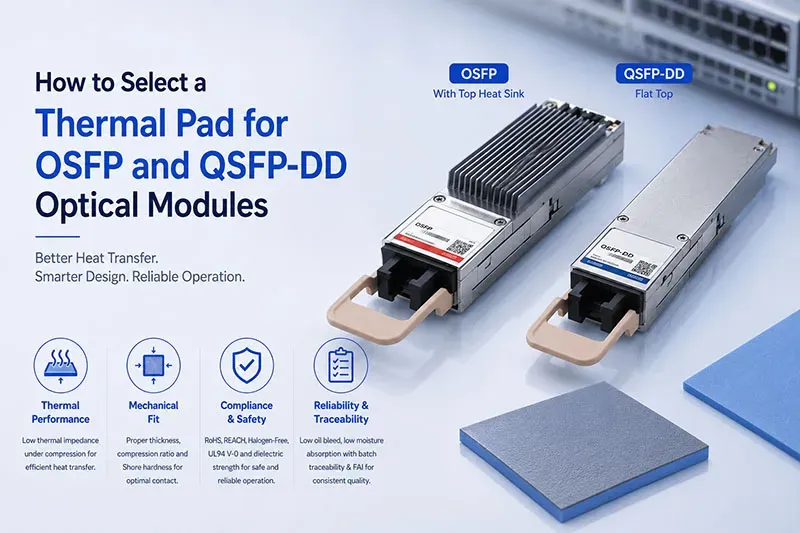
Thermal Pad For OSFP And QSFP-DD Optical Modules: Key Specifications
A Thermal Pad for OSFP and QSFP-DD Optical Modules bridges small air gaps between hot optical hardware and its cooler. Picking the right material is a balancing act: Sheen Technology options can address heat flow, fit, safety, and service needs without making installation a headache.
Balancing Thermal Conductivity and Thermal Impedance
For a Thermal Pad for OSFP and QSFP-DD Optical Modules, datasheet thermal conductivity in W/m-K is only the starting point.
Compare samples at realistic compression. Check thermal impedance and interface thermal resistance.
Relate both figures to:
- OSFP heat dissipation.
- QSFP-DD heat transfer efficiency through the heat sink.
| Pad | Conductivity (W/m-K) | Thickness (mm) | Compression |
| A | 3.0 | 0.5 | 20% |
| B | 5.0 | 1.0 | 25% |
| C | 8.0 | 1.5 | 30% |
| D | 12.0 | 2.0 | 30% |
Note: these values are comparison targets, not product specifications. Validate against Sheen datasheet values at the specified thickness and pressure.
Selecting Pad Thickness and Compression Ratio
A Thermal Pad for OSFP and QSFP-DD Optical Modules needs enough pad thickness for gap filling, yet not so much that contact pressure strains the module housing. Match compression ratio and Shore hardness to tolerance stack-up; controlled deflection keeps contact steady without over-squeezing the module.
Ensuring RoHS Compliance and Flame Retardant UL94 V-0
For a Thermal Pad for OSFP and QSFP-DD Optical Modules, paperwork matters too.
- RoHS compliance and REACH support environmental safety.
- UL94 V-0 documents flame retardancy.
- Halogen-free declarations help confirm hazard-free materials against applicable regulatory standards.
Verifying Oil Bleed Resistance and Surface Tackiness
Test oil bleed resistance after heat aging. Watch for silicone oil migration and nearby contamination. Sheen Technology provide Silicone-free Thermal pad for Optical Modules Thermal management.

Check surface tackiness during servicing.
- Moderate adhesive property helps positioning.
- Clean removal supports long-term reliability and easier optical-module replacement.
4 Steps To Choose Thermal Pad For Optical Modules
Choosing the right Thermal Pad for OSFP and QSFP-DD Optical Modules comes down to heat control, fit, safety, and production quality. Get those basics right, and qualification gets much easier. Sheen Technology can support custom optical-module thermal pad choices from prototype checks through volume production.
Step 1: Assess Thermal Conductivity Needs for OSFP Transceiver
Start with the OSFP transceiver or QSFP-DD module.
- Check power consumption, contact area, and required heat dissipation.
Compare thermal conductivity and thermal resistance on supplier data sheets.
A suitable thermal interface material helps limit junction temperature.
This gives the Thermal Pad for OSFP and QSFP-DD Optical Modules a sound thermal starting point.
Step 2: Confirm Pad Thickness and Dielectric Breakdown Voltage
Match pad thickness to the actual interface.
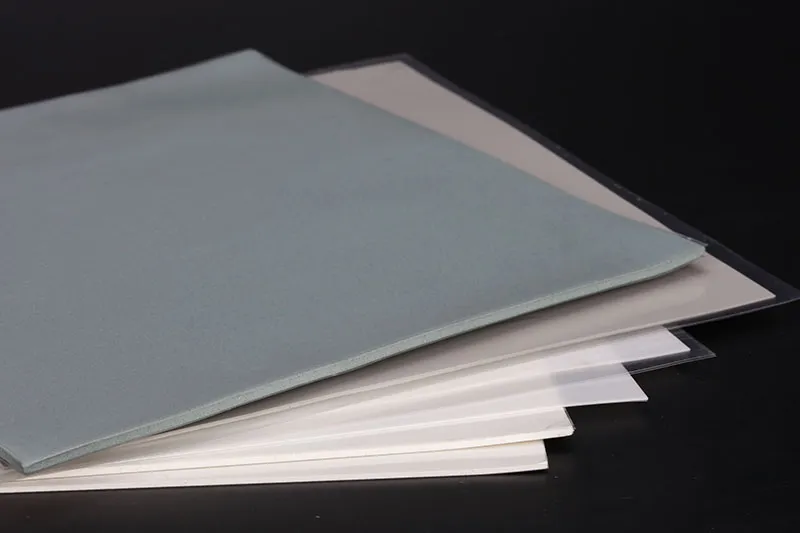
Check the mechanical gap.
- Allow for tolerance and compression rate.
- Confirm reliable gap filling without excessive pressure.
Where electronics need electrical insulation:
- Verify dielectric breakdown voltage and volume resistivity.
- Recheck thermal resistance after compression.
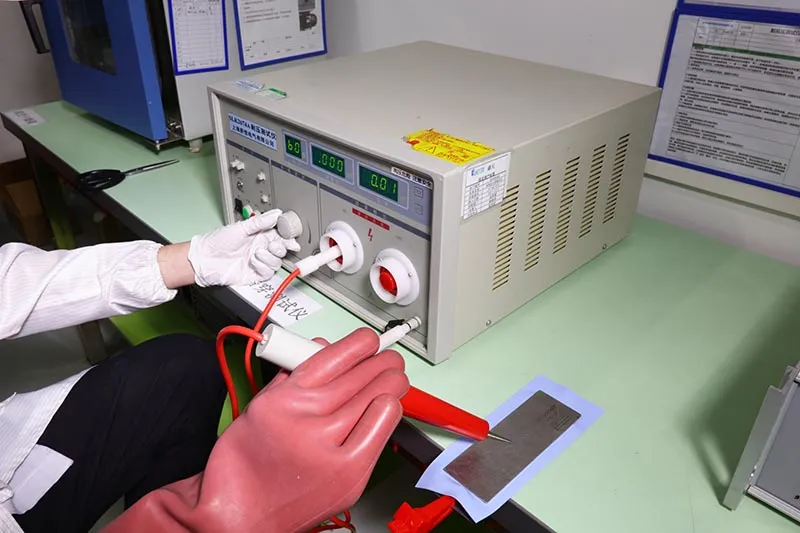
A QSFP-DD thermal pad has to fit, not just look good on paper.
Step 3: Check Environmental Compliance and Operating Temperature Range
Start with deployment conditions, then work inward.
- Compliance: Confirm RoHS and REACH, plus halogen-free requirements.
- Temperature: Compare operating temperature, storage temperature, and thermal stability.
- Reliability: Review moisture absorption and test reports supporting environmental compliance.
These checks help qualify a Thermal Pad for OSFP and QSFP-DD Optical Modules for real service conditions.
Step 4: Review Batch Traceability and First Article Inspection
Production consistency matters just as much as samples.
- Verify batch traceability by manufacturing lot. Require first article inspection and an inspection report.
- Review ongoing quality control. Include reliability testing, die-cut options, roll packaging, shelf life, storage rules, and the quality assurance agreement.
Thermal Conductivity Vs. Thickness: What Matters?
Choosing a Thermal Pad for OSFP and QSFP-DD Optical Modules takes more than checking a conductivity number. Good heat transfer also depends on contact, pressure, and gap size. For reliable temperature control, Sheen Technology considers both material properties and mechanical fit—because, in practice, both matter.
Thermal Conductivity
A Thermal Pad for OSFP and QSFP-DD Optical Modules with higher conductivity, measured in W/m-K, can improve heat dissipation, but conductivity alone does not guarantee a cooler module.
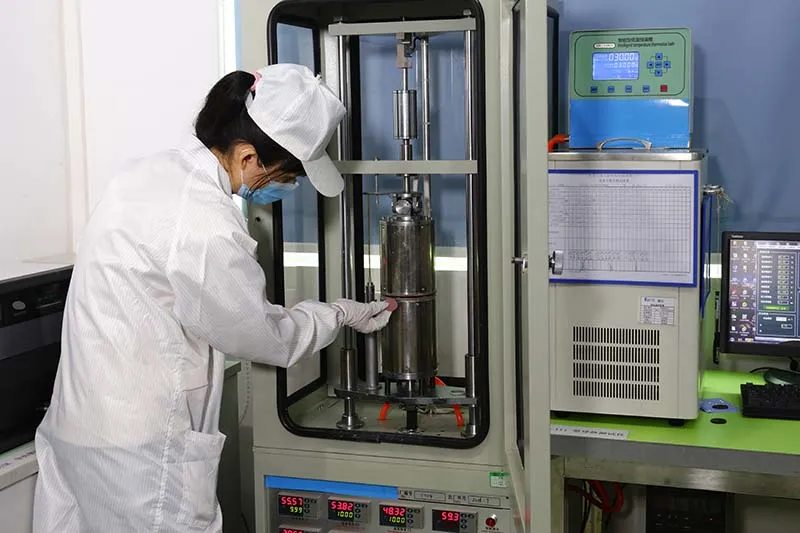
Conductivity affects the material:
- Higher values can support a faster dissipation rate.
- Lower bulk thermal resistance can reduce temperature gradients.
Real interfaces add other variables:
A Thermal Pad for OSFP and QSFP-DD Optical Modules needs even contact with the heat sink.
- Poor contact raises thermal impedance.
- Proper compression improves the interface material contact area.
| Conductivity (W/m-K) | Thickness (mm) | Area-specific resistance (mm²·K/W)* |
| 6 | 0.5 | 83.3 |
| 8 | 1.0 | 125.0 |
| 12 | 1.5 | 125.0 |
Calculated as thickness ÷ conductivity for basic material comparison; interface resistance is excluded.
Thickness
The right Thermal Pad for OSFP and QSFP-DD Optical Modules should be thin enough to limit the heat path while still handling real assembly gaps.
- Check tolerance stack-up and module height.
- Select a pad profile that provides full gap filling without excessive deflection.
- Verify working compression, Too thick can increase resistance, Too thin can leave air gaps.
- Confirm suitable interface pressure across the OSFP or QSFP-DD module.
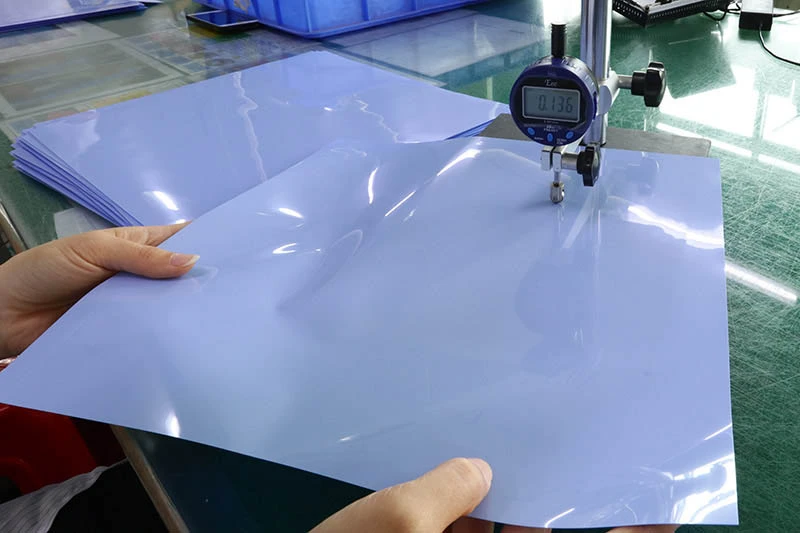
In short, an optical-module thermal pad works best when thickness follows the actual mechanical gap rather than a bigger-is-better rule.
Sheen Technology Provide Selection Decision Framework
The framework below maps the most common OSFP/QSFP-DD scenarios to the priority property.
| Scenario | Priority Property | Why |
| High heat flux, flat surfaces | High conductivity + thin pad | Minimize through-plane R |
| Uneven gap / tolerance stack-up | Compression + Shore hardness | Fill gap without over-stress |
| Electrical isolation required | Dielectric strength (D149) | Prevent shorts to housing |
| Long service / cycling | Low compression set + oil-bleed resistance | Stable contact over life |
| Volume production | Batch traceability + first article | Lot-to-lot consistency |
The selection steps above should be tied to recognized standards so results are comparable and auditable.
| Property | Standard | What It Verifies |
| Through-plane thermal impedance | ASTM D5470 | Interface resistance at compression |
| Dielectric breakdown | ASTM D149 / IEC 60243 | Electrical isolation |
| Volume resistivity | ASTM D257 | Insulation resistivity |
| Shore hardness | ASTM D2240 | Indentation / conformability |
| Compression set | ASTM D395 | Permanent deformation |
| Flammability | UL 94 (V-0) | Flame-retardant rating |
Selecting a thermal pad for OSFP and QSFP-DD optical modules is a multi-parameter decision. Sheen Technology provides optical-module thermal pads with specification data, die-cut options, and application engineering support.
Contact Sheen Technology for OSFP/QSFP-DD Pad Selection →
Sheen Thermal
Dongguan Sheen Electronic Technology Co., Ltd · Founded in 2008
Manufacturer of thermal interface materials and silicone foam for automotive electronics, energy storage, power electronics, communications and consumer electronics.
Certified
- ISO 9001:2015
- ISO 14001:2015
- IATF 16949:2016
What we supply
- Thermal conductivity Up to 90 W/m·K
- Thickness 0.3–10.0 mm
- Custom & samples Die-cut to drawing, 3–7 days