
 English
 usheenthermal

Precision Custom-Shaped Graphite Sheet Manufacturer for Thermal Needs
Date:2026-07-09
Precision Custom-Shaped Graphite Sheet Manufacturer for Thermal Needs
Heat keeps creeping into tighter spaces, and every overheated chip feels like a ticking clock. A Custom-shaped graphite sheet manufacturer steps in not as a vendor, but as the quiet fix engineers rely on when standard parts fall short and designs get squeezed beyond comfort.
Precision cuts, consistent thickness, and dependable supply turn chaos into control, helping teams cool hotspots, meet specs, and keep products moving without last-minute compromises today.
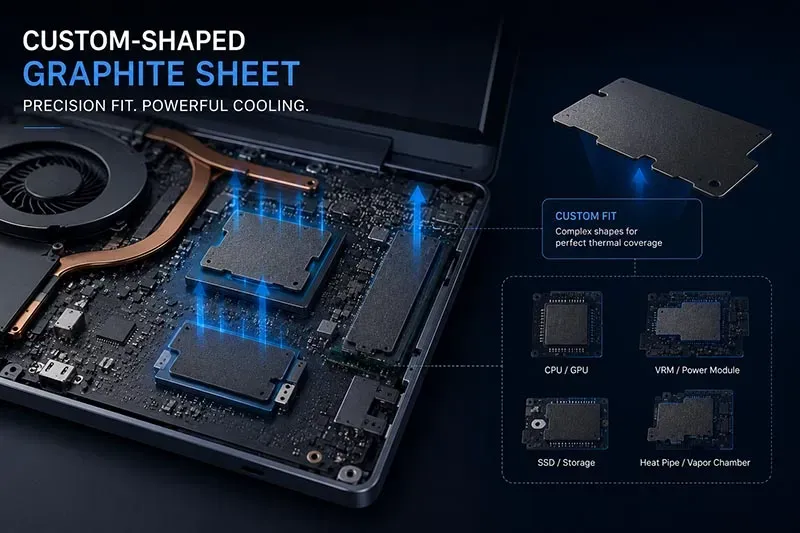
Harmonious Highlights: Custom-shaped Graphite Sheet Manufacturer Guide Tips
➔ Material Mastery: Choose high-purity carbon precursors to ensure low resistivity, superior thermal conductivity, and minimal defects.
➔ Precision Cutting: Leverage CNC, laser, or die cutting for tight tolerances and complex geometries, fitting gaskets, pads, and flexible circuits flawlessly.
➔ Uniform Thickness: Implement strict inspection of thickness uniformity, surface roughness, and batch consistency to meet stringent thermal interface specifications.
➔ Thermal Solutions: Deploy graphite sheets as ultra-thin heat spreaders and EMI shields, ideal for hotspots, slim designs, and combined thermal‐EMI management.
Custom-Shaped Graphite Sheet Manufacturer: Core Production Steps
A Custom-shaped graphite sheet manufacturer lives or dies by process control. From carbon precursors to final inspection, every move affects thermal conductivity, flatness, and fit. If you’re sourcing from a custom graphite sheet manufacturer, knowing how graphite sheets are built helps you spot real quality instead of marketing talk.
Selecting High-Purity Carbon Precursors
Material selection sets the tone.
Carbon source qualification
a. Audit raw materials origin
i. Check ash content
ii. Verify sulfur level
iii. Confirm trace metal limits
b. Evaluate high purity graphite feedstock
i. Fixed carbon ≥ 99.9%
ii. Controlled particle distribution
c. Stability testing
i. Moisture resistance
ii. Thermal expansion behavior
Feedstock classification
a. Petroleum-based carbon precursors
b. PAN-based synthetic options
c. Recycled high-grade graphite streams
Typical incoming metrics:
| Parameter | Standard Range | Test Method |
| Fixed Carbon (%) | 99.5–99.99 | ASTM C537 |
| Ash Content (%) | ≤0.1 | Combustion |
| Sulfur (ppm) | ≤50 | ICP-OES |
A seasoned Custom-shaped graphite sheet manufacturer screens each batch before thermal processing. That’s how consistent electrical and thermal performance starts.
Graphitization and Sintering for Optimal Purity
Heat changes everything.
· High-temperature graphitization above 2500°C
· Controlled sintering atmosphere
· Multi-stage heat treatment
Process flow looks like this:
1) Pre-carbonization
2) Ramp-up under inert gas
3) High-temperature thermal processing
4) Slow cooling to protect crystal structure
During material transformation, carbon atoms realign into ordered layers. Density climbs. Impurities drop. Anisotropic conductivity improves.
The International Energy Agency noted in its 2025 materials outlook that high-purity graphite demand for electronics continues to rise due to advanced packaging and EV growth.
In plain terms, tighter purification means better heat spreading. A reliable graphite sheet manufacturer won’t rush this cycle.
Precision CNC, Laser Cutting & Die Cutting
Shaping is where engineering meets accuracy.
CNC machining
a. Programmed tool paths
i. Micro-slot milling
ii. Edge chamfer control
b. Tolerance verification
i. ±0.02 mm for thin sheets
Laser cutting
a. Low thermal distortion settings
b. Clean edge fabrication for flexible pads
Die cutting
a. High-volume custom shapes
b. Repeatable precision shaping
Applications include:
· Gaskets
· EMI shielding pads
· Heat spreaders for compact devices
A capable Custom-shaped graphite sheet manufacturer integrates cutting technology and smart tooling to avoid cracks or burrs. Sheen Technology keeps dimensional control tight, especially for ultra-thin graphite layers used in electronics.
Thickness Uniformity: Inspection and Finishing
Consistency isn’t optional.
Metrology control
a. Automated thickness scanning
i. Multi-point laser gauges
ii. Statistical sampling
b. Dimensional accuracy mapping
Surface finish management
a. Controlled polishing
b. Debris removal
c. Flatness calibration
Final validation
a. Quality inspection reports
b. Batch traceability
c. Packing protection
Key checkpoints:
· ±3% thickness uniformity
· Verified surface roughness
· Stable post-finishing mechanical strength
For buyers comparing suppliers, this is the real difference between an average shop and a serious Custom-shaped graphite sheet manufacturer. Sheen Technology backs each shipment with inspection data, so performance in thermal interface applications stays predictable and repeatable.
3 Thermal Challenges Solved By Graphite Sheets
Heat problems sneak up fast in compact electronics. A reliable Custom-shaped graphite sheet manufacturer helps brands tame heat, save space, and simplify design without overcomplicating production.
Mitigating Hotspots with Ultra-High Thermal Conductivity
When chips run hard, graphite sheets with high thermal conductivity push heat sideways fast, improving temperature uniformity and real-world thermal management.
· Rapid heat spreading across crowded PCB zones
· Targeted hotspot mitigation near CPUs and PMICs
· Stable heat dissipation under peak loads
In practical applications, performance depends on material grade and thickness. By optimizing the molecular alignment of the graphite, Sheen Technology has developed a graphene thermal pad featuring vertical orientation—a characteristic that distinguishes it from most materials marketed for in-plane thermal conductivity.
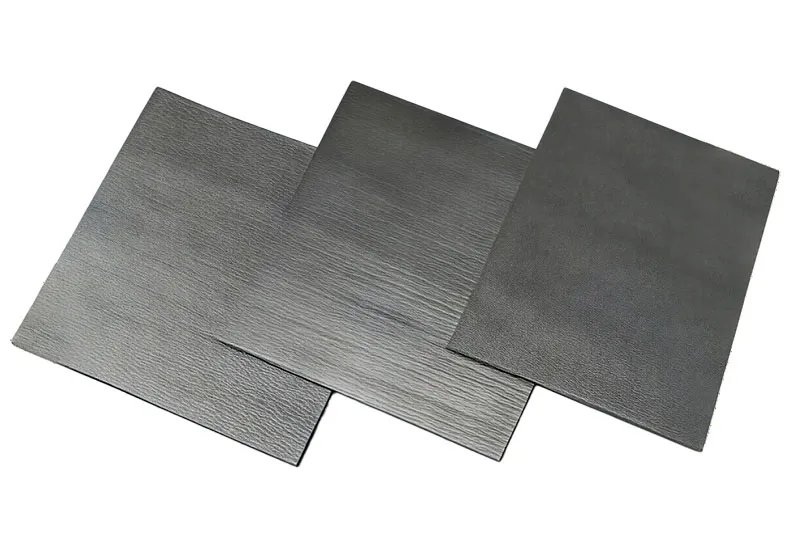
| Properties | Unit | GSF75-03 Graphene Thermal Pad | GSF90-03 Graphene Thermal Pad | Test Method |
| Color | - | Black | Black | Visual |
| Thermal Conductivity (vertical orientation) |
W/m·K | 75 | 90 | ASTM E1461 |
| Thermal Resistance (@40psi) | ℃*cm2/W | ≤0.12 | ≤0.10 | ASTM D5470 |
| Thickness | mm | 0.3~2.0 | 0.3~2.0 | ASTM D374 |
| Density | g/cm³ | 0.3~0.7 | 0.3~0.7 | ASTM D792 |
| Rebound Rate | % | ≥90 | ≥90 | - |
| Tensile Strength | Mpa | ≥0.03 | ≥0.05 | ASTM D412 |
| Oil Bleeding Rate | % | ≤3 | ≤3 | / |
| Application Temperature | ℃ | -40~150 | -40~150 | / |
| Flame rating | - | V-0 | V-0 | UL 94 |
According to the 2025 Gartner data center infrastructure outlook:
“Thermal efficiency remains a top three design priority as compute density continues to climb.”
A seasoned graphite sheet manufacturer tunes thickness and layering so devices stay cool without bulky sinks. That’s where a capable Custom-shaped graphite sheet manufacturer earns trust.
Need exact thermal conductivity, thickness range, thermal resistance, and compliance data before selecting a custom graphite thermal material? Download the product datasheets to compare custom-shaped graphite sheet options for 5G base stations, compact electronics, power modules, and other high-density thermal management applications.
Slim Profile Heat Spreaders for Space-Constrained Designs
For ultra-thin builds, the real win is structure:
· Slim profile integration inside stacked assemblies
· Precision die-cut by a shaped graphite sheet manufacturer
· Flexible routing around batteries and antennas
A deeper look at compact layouts:
Space-constrained designs
Mobile devices
· Foldables
· Tablets
Wearables
· Smart bands
· AR glasses
Material focus
· Thin graphite layers
· Lightweight materials
· Flexible graphite for curved frames
A dependable Custom-shaped graphite sheet manufacturer works closely with thermal engineers:
· Define power density map
· Select thickness for thermal design balance
· Validate bend radius for mechanical safety
Sheen Technology often supplies custom graphite sheet solutions trimmed to complex outlines, cutting assembly time and reducing rework. A precise graphite sheet supplier makes tight layouts feel manageable.
EMI Shielding and Thermal Interface in One
Some builds need more than cooling. They need dual function.
· EMI shielding
· Thermal interface material performance
· Consistent electrical conductivity
A layered approach typically includes:
Functional targets
· Electromagnetic compatibility compliance
· Efficient thermal management
Material stack
· Graphite composite core
· Adhesive backing
System outcome
· Fewer parts
· Lower thickness
· Stable grounding path
Instead of separate shields and pads, an integrated thermal solution from a skilled Custom-shaped graphite sheet manufacturer simplifies sourcing. Sheen Technology supports OEM teams that want multi-functional material without adding design headaches.
Need a closer match for your project? Browse related application pages to see how custom-shaped graphite sheets are used in 5G base stations, power modules, consumer electronics, compact RF systems, and other space-constrained thermal management applications.
In fast-moving electronics, that kind of practical integration just makes life easier.
Scenario: Thermal Management In 5G Base Stations
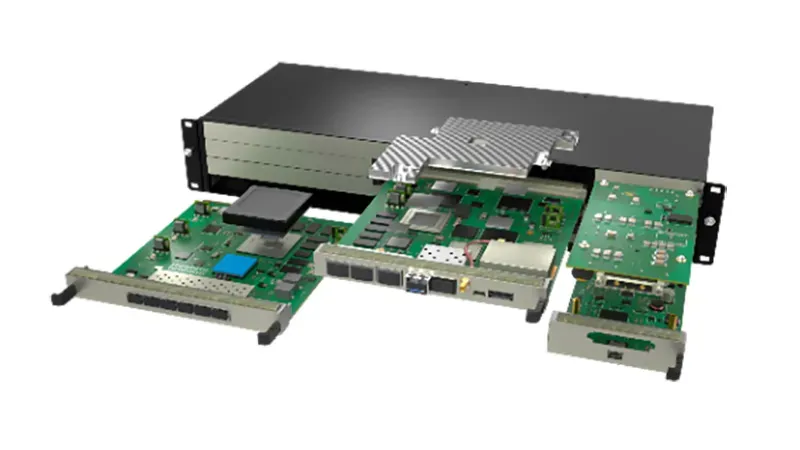
5G hardware runs hot, and heat is the silent troublemaker behind signal drift and early failure. From Antenna substrate design to Power module cooling, smart use of graphite parts—often sourced from a Custom-shaped graphite sheet manufacturer—keeps systems steady and compliant.
Heat Dissipation in Antenna Substrates
Inside a 5G base station, the Antenna substrate faces dense RF loading. Heat must move fast.
Material Layer Strategy
· Graphite sheet as primary Heat spreader
· Bonded Thermal interface material to reduce contact resistance
· Aluminum housing for secondary Heat transfer
Performance Targets
· In-plane Thermal conductivity > 800 W/m·K
· Temperature rise < 15°C at peak load
· Stable impedance under thermal cycling
Supplier Alignment
· Work with a Custom-shaped graphite sheet manufacturer
· Confirm tolerance on custom-cut graphite sheet geometry
· Validate surface flatness for tight stack-up
| Parameter | Graphite Layer | Aluminum Plate | TIM Layer |
| Thermal Conductivity (W/m·K) | 800–1500 | 200–230 | 3–8 |
| Thickness (mm) | 0.05–0.2 | 1–3 | 0.1–0.3 |
| Density (g/cm³) | 1.8–2.2 | 2.7 | 2.5–3.2 |
| Max Temp (°C) | 400 | 300 | 150 |
When the graphite material is precisely cut by a custom graphite sheet supplier, hot spots drop fast. Signal stability follows.
Custom Gaskets for Power Module Cooling
High-load Power module units push heat toward the Heat sink interface. That gap needs a flexible Thermal gasket.
· Custom shape matters. Odd footprints demand die-cut graphite from a Custom-shaped graphite sheet manufacturer.
· Compression control keeps the graphite material intact.
· Contact pressure improves Thermal management efficiency.
1) Measure module height variation.
2) Select density and thickness.
3) Prototype the cooling solution.
4) Run burn-in tests.
“Telecom infrastructure upgrades are accelerating, with thermal materials playing a growing role in reliability,” noted a 2025 GSMA infrastructure outlook.
A custom-shaped graphite sheet manufacturer that handles tight tolerances reduces rework. A precise graphite sheet manufacturer also helps match gasket elasticity with clamping force. Small tweak, big payoff.
Ensuring RoHS Compliance and Reliability Testing
Telecom buyers expect proof, not promises.
Regulatory Control
· Verify RoHS compliance
· Archive Material certification
· Track Environmental standards
Reliability Matrix
· Thermal cycling: −40°C to 125°C
· Humidity bias testing
· Long-term load aging
Quality Workflow
· Incoming inspection
· In-process Quality assurance
· Final Product validation
A reliable Custom-shaped graphite sheet manufacturer documents every batch. That discipline keeps custom-cut graphite sheet parts consistent across global rollouts. When audits come, paperwork is ready. When heat rises, performance holds.
【Request a Custom Quote】Not sure which custom-shaped graphite sheet fits your 5G base station, antenna substrate, power module, or compact electronics design? Send us your operating temperature range, target thickness, shape requirements, and thermal performance goals, and we can help recommend the right graphite thermal solution for your project.
Sheen Thermal
Dongguan Sheen Electronic Technology Co., Ltd · Founded in 2008
Manufacturer of thermal interface materials and silicone foam for automotive electronics, energy storage, power electronics, communications and consumer electronics.
Certified
- ISO 9001:2015
- ISO 14001:2015
- IATF 16949:2016
What we supply
- Thermal conductivity Up to 90 W/m·K
- Thickness 0.3–10.0 mm
- Custom & samples Die-cut to drawing, 3–7 days