
 English
 usheenthermal

A quick scenario. Your project runs on SIL-PAD 2000. Then one day, the quote comes back ugly, or the lead time stretches into next quarter, and suddenly "the material we always use" is the material that's holding everything hostage.
What you need at that moment isn't a lecture on thermal theory. You need three things:
- a specific part number you can actually talk about
- a supplier that can actually ship it
- something worth spending your validation hours on
That's the slot Sheen SC1000FG is built to fill. And our honest position on substitution: a replacement earns its keep by passing your thermal and electrical isolation requirements first — and only then by competing on like-for-like pricing and delivery. Cost-down voodoo that skips step one isn't a savings, it's a time bomb with a thermal pad inside.
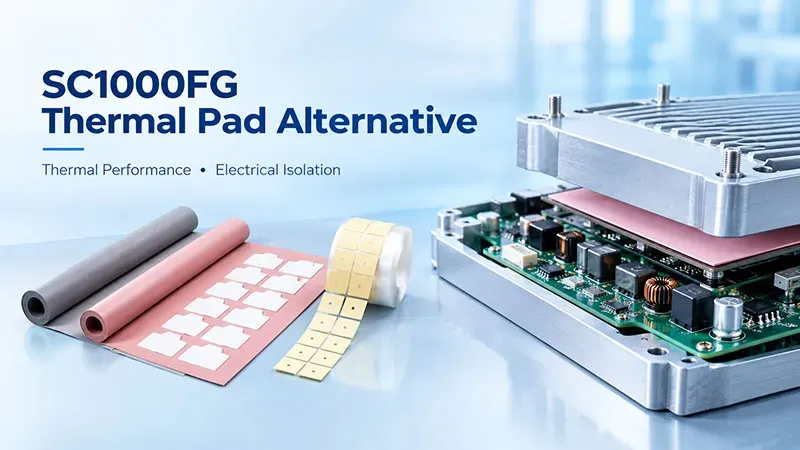
So What is SC1000FG, Anyway?
Picture a thin silicone insulating sheet that happens to conduct heat. That's SC1000FG. It bends a little, wraps around device outlines, plays nice with mounting holes, and — this part matters — it can be die-cut to your exact drawing.
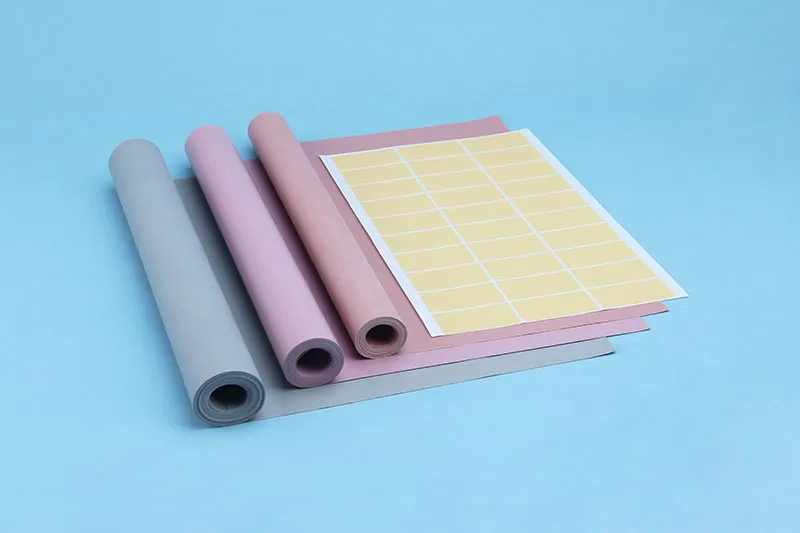
Figure 1. SC1000FG sheet and die-cut forms. Supplied color and surface configuration follow the confirmed specification.
The headline specs:
- Thickness: 0.2 to 0.5 mm
- Hardness: Shore A 85–95
- Density: 1.80 ± 0.2 g/cm³
- Tensile strength: ≥ 40 MPa (listed)
- Color: your call, made to order
- Applications: semiconductor cooling, telecom gear, power supplies — wherever a screw-down or press-plate interface needs thin isolation
Confirm exact dimensions, thickness tolerance, and surface configuration when you ask for a quote. Saves everyone a round trip.
One honest note on fit. SC1000FG is a thin-sheet solution. It expects a reasonably flat interface and a real clamp load. If your devices have serious height steps, or you're counting on big material deformation to fill gaps — stop. That's a different material's job. And if your heatsink looks like a potato chip or your clamping force is wishful thinking, fix the structure first. A new material can't out-cute bad geometry.
Compare the Thermal and Electrical Conditions—Not Just the Conductivity Number
The SC1000FG TDS lists thermal, electrical, and mechanical parameters that make a side-by-side screen possible. The comparison below is a starting point, not a certification of equivalence.
| Comparison point | Sheen SC1000FG | BERGQUIST SP 2000 |
|---|---|---|
| Supply status | Available; confirm specification and lead time | Confirm through the actual channel |
| Material / carrier | boron nitride insulation sheet / fiberglass | Silicone / fiberglass reinforced |
| Thermal conductivity | 3.5 W/m·K (TDS) | 3.5 W/m·K (TDS) |
| Thickness range | 0.2–0.5 mm (TDS) | 0.254–0.508 mm (TDS) |
| Thermal-resistance comparison thickness | 0.23 mm (TDS) | 0.254 mm (TDS) |
| Thermal resistance at 50 psi | ≤0.3 °C·in²/W (TDS) | 0.33 °C·in²/W (typical TDS value) |
| Hardness | Shore A 85–95 (TDS) | Shore A 90 (TDS) |
| AC breakdown voltage | ≥5 kV (TDS) | 4 kV (typical TDS value) |
| Temperature range | −40 to 150°C (TDS) | −60 to 200°C (TDS) |
| Flammability | UL94 V-0 (TDS) | UL94 V-0 (TDS) |
| Custom die-cutting | Supported | Supported |
Now the fine print — read this before screenshotting the table into a slide deck:
- Different thicknesses, different conditions. SC1000FG's ≤0.3 is a TDS header value at 0.23 mm; SP 2000's 0.33 is a typical at 0.254 mm. No same-stage test, no "X% better" math. Don't do the ratio — it won't survive an audit.
- Don't stretch the header. The 0.23 mm data point doesn't get a free pass across the whole 0.2–0.5 mm range. Confirm your target thickness and test at that thickness.
- Units are a trap. °C·in²/W is area-normalized resistance. It doesn't shake hands with °C/W or °C·cm²/W. Pick one and stay loyal.
- 50 psi ≈ 345 kPa is a test pressure, not your torque wrench setting. Torque-to-pressure conversion runs through friction, fastener path, and structure. Apples to apples, or don't bother.
Why Put SC1000FG on The Shortlist? Three Practical Reasons
1. The part number is real and it ships.
"In stock" doesn't mean every thickness sits on a shelf — sample, pilot, and production lead times get confirmed separately. But you can go from "we need an alternative" to "here's the drawing and our volume" this week, not this quarter.
2. Material and die-cut in one conversation.
Holes, outlines, narrow edges, install orientation — all of it shapes whether the pad lands where it should and keeps insulating where it must. SC1000FG comes as 305 × 305 mm sheets or custom forms, die-cut to your drawing. That doesn't guarantee zero design tweaks, but it does mean you're evaluating fit against your parts, not a catalog rectangle.
3. You get a second source.
Procurement loves options. Whether it's actually cheaper gets decided by quotes on the same drawing, same quantity, same delivery terms — not by comparing square-meter list prices, and definitely not by assuming a fixed percentage of savings.
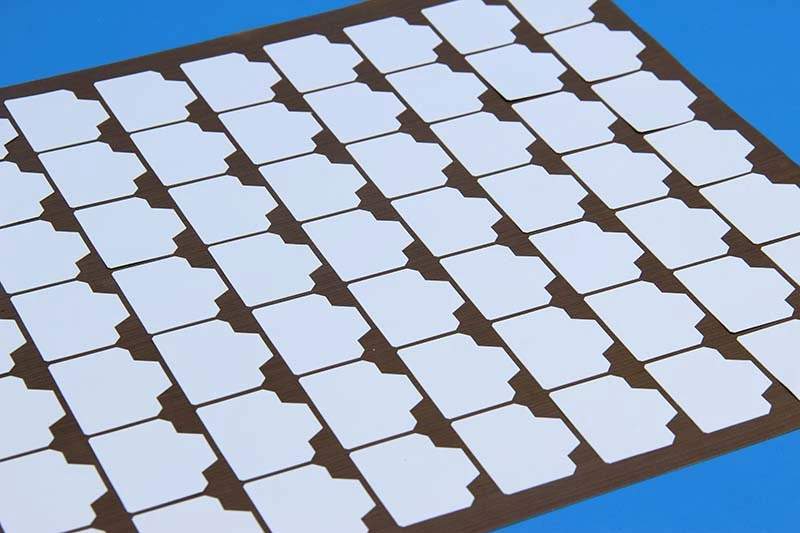
Figure 2. Close-up of the die-cut insulation sheet surface. Appearance alone does not establish adhesive structure, thickness, or thermal performance.
Objective Assessment: Practical Application Advantages of the SC1000FG
Where SC1000FG is genuinely handy:
- Clear thermal and electrical numbers on the TDS — thin heat transfer and isolation in one sheet
- Sheet stock or die-cut-to-drawing delivery
- Adhesive options: light tack, strong tack, single- or double-sided — match it to your placement process
Where it needs respect:
It won't fill gaps by deforming dramatically. Flat interface, real clamp load. Non-negotiable.
Burrs, hole edges, local over-compression — thin sheets bruise. Handle accordingly.
Added adhesive changes total thickness and interface resistance. Validate the complete delivery configuration, not the bare film.
SP 2000's TDS publishes resistance at multiple pressures — handy for studying assembly-load effects. SC1000FG needs that behavior characterized in your stack.
Two boundaries to spell out before anyone says "drop-in":
- Temperature. SC1000FG lists −40 to 150 °C; SP 2000 lists −60 to 200 °C. If your interface lives above 150 °C, this is not a direct swap. Full stop.
- Electrical. Breakdown voltage ≥ 5 kV and volume resistivity ≥ 10¹³ Ω·cm (at 250 V) sound great — and they are — but breakdown is not your operating voltage. Creepage, screw holes, insulation coverage, humidity: all of it still has to pass your equipment's design review.
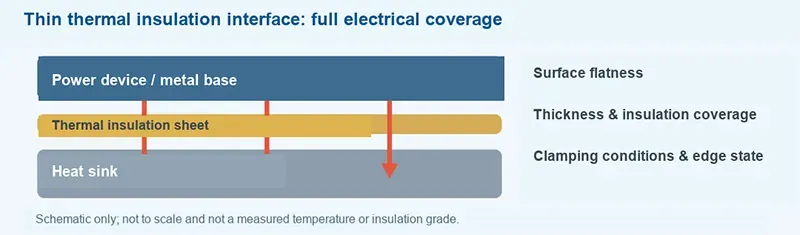
Figure 3. General thin thermal-insulation interface diagram. It illustrates the relationship between contact surfaces, insulation coverage, and clamping pressure; it is not a product layer stack or test result.
How to Start: One Drawing, One Email
Seriously, it's that light:
- Send the package. Current Bergquist part number, nominal thickness, the part drawing, estimated volume, target delivery date — plus working voltage, device loss, and how the interface is fastened.
- Spell out the configuration. Adhesive setup, dimensional tolerances, packaging. If adhesive is added, re-confirm total thickness and thermal resistance for the full build.
- Prototype against the incumbent. Same assembly conditions, both materials, measure temperature rise, finished-part withstand voltage, and post-teardown interface condition. Then run the aging tests your environment demands.
- Paper the win. Once samples pass, write the model, revision, thickness, and inspection conditions into your technical agreement — so the validation actually covers what arrives in production boxes.
- Count everything. Material + die-cutting + assembly + validation effort on the cost side; material prep, processing, and transit on the delivery side. Same-sheet comparison, or the math lies.
【Request a Custom Quote】If you're hunting for an in-stock alternative to SP 2000, SC1000FG deserves a spot on your shortlist. Ask Sheen for the configuration datasheet, samples, and a quote against your drawing — and let real operating conditions and real delivery terms decide whether it becomes your second source.
Source note: Product names, TDS values, comparison conditions, and limitations in this article are based on the supplied source document. The source uses SIL-PAD 2000 in the title and SP 2000 in the comparison table; confirm the exact BERGQUIST grade before formal qualification.