
 English
 usheenthermal

From a Bead of Gel to a Soft Thermal Interface: The Assembly Story of Sheen's Two-Part Gels
Date:2026-11-11
At the dispensing station, a pink bead of gel settles slowly onto a metal surface. It looks calm. It looks simple. But if that bead comes out of a two-part cartridge, an invisible relay is already underway inside: A meets B, the reaction starts, and the material now owes the line two things at once — enough time to assemble, and a proper cure afterwards.
That is the whole value of a two-part thermal gel, in two acts: it conforms while you dispense, and it turns elastic after it cures. Sheen's SE two-part series is built around that idea, for electronic assemblies that need dispensable gap filling and can accept a curing step.
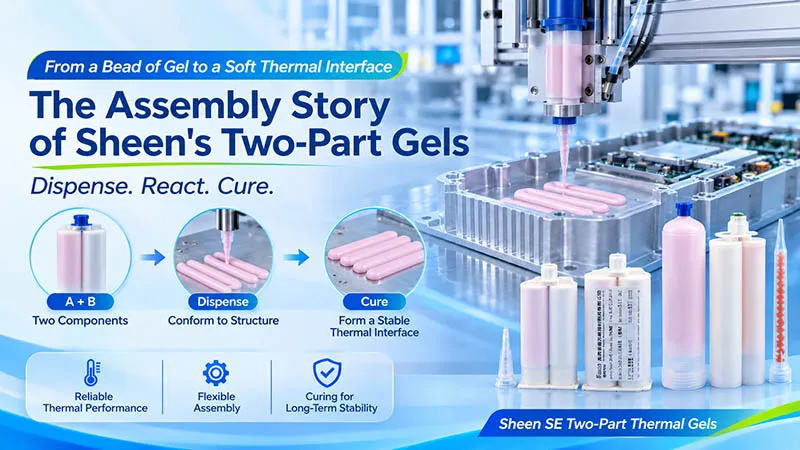
Figure 1. Bead dispensing illustrated in the accompanying SE400AB TDS. The photo shows the dispensing form only — it is not a validation result for any specific piece of equipment.
Why Some Projects Want “Fill First, Cure Later”
Some structures ask for two seemingly opposite things. Spread fully when the parts close. Then hold a soft, elastic shape once assembly is done. The two-part route puts both goals into one process: arrive dispensable, cure into shape.
And here's what “cure” does not mean: it does not turn the gap between your devices into a brick. Take SE400AB from the accompanying TDS. Cured hardness: 55 ± 10 Shore 00. Still a soft thermal gap filler — just one that remembers its shape.
One caution before anyone falls in love with that hardness number:
- Hardness alone cannot be converted into assembly stress.
- Stress gets judged together with bond line thickness, coverage area, and the actual clamping condition.
The other thing that changes with two-part? Who carries the process responsibility. On a one-part line, you control volume. On a two-part line, the list gets longer:
- A/B mix ratio.
- Mixing uniformity.
- Assembly timing after dispensing.
- Cure state at the end.
Choosing two-part means choosing a material process your line can actually execute — not just a nicer datasheet.
SE400AB, Translated Into Language the Line Understands
| Item | SE400AB | How to Read It on the Line |
|---|---|---|
| Mix ratio | 1:1 | Confirm whether the ratio is by mass or by volume before setting the equipment |
| Thermal conductivity | 4.0 W/m·K | Quoted from the standalone TDS page |
| Density, components A and B | 3.1 g/cm³ each | Listed separately per component |
| Extrusion rate | 30 ± 5 g/min | Listed with a 50 cc EFD cartridge at 90 psi; nozzle-outlet field needs confirmation |
| Minimum interface thickness | 0.10 mm | Not an achievable gap for every design |
| Tack-free / full cure at 25 °C | 30 min / 4 h | Managed as two separate checkpoints |
| Full cure at 100 °C | 15 min | Verify actual gel temperature and component heat tolerance |
| Cured hardness | 55 ± 10 Shore 00 | Soft elastomer; does not translate into zero stress |
| Operating temperature | −50 to 150 °C | Not a substitute for a long-term reliability report |
| Volume resistivity / dielectric breakdown strength | >10¹⁴ Ω·cm / >5000 V/mm @AC | Material-level figures; device insulation is designed separately |
Data source: the standalone SE400AB TDS page accompanying this article — not series-wide specifications.
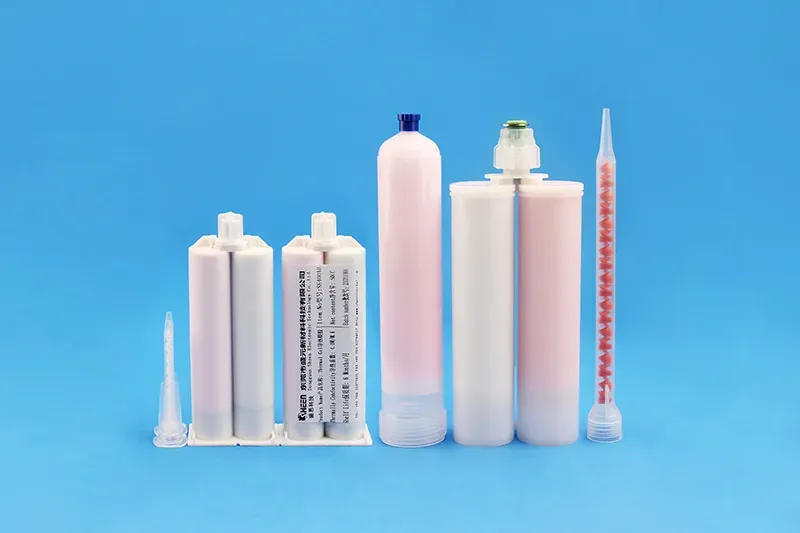
Figure 2. Sheen two-part thermal gel showcase. The image shows two-part thermal gel in general; it does not distinguish between specific product models.
Of all these numbers, one pair gets mixed up the most: tack-free in 30 minutes at 25 °C, full cure in 4 hours. The surface can feel dry while the inside is still working. And here's the trap: tack-free time is not your assembly window. Treating it that way is how good material gets blamed for a process mistake.
In a hurry? The TDS offers a heated route: full cure in 15 minutes at 100 °C. But setting the oven to 100 °C doesn't mean the gel is at 100 °C. The metal housing's heat capacity, where the bond line sits, and how much heat neighboring components can take — all of that belongs in the process evaluation.
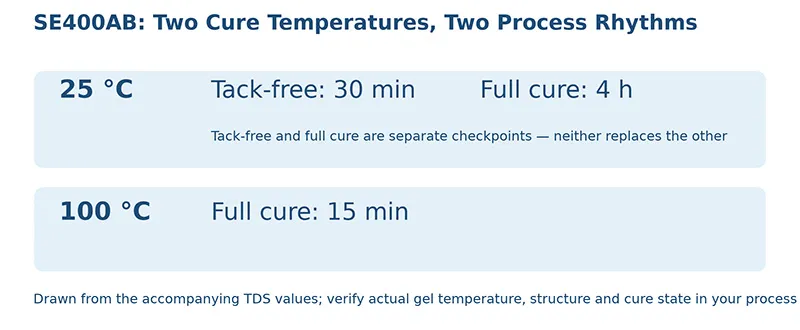
Figure 3. SE400AB cure reference. The two rows are different temperature conditions, not steps to stack one after another.
From Cartridge to Housing: Four Handoffs
01 · Supply
Match the packaging to the equipment and the volume. The accompanying material describes 50 mL and 400 mL dual cartridges plus repackaged supply options; the SE400AB TDS lists 50 cc and 400 cc. Interface, piston, mixing tube, and equipment all have to fit each other — the cartridge is where the relay starts, and a mismatch here fails every later stage.
02 · Mixing
A and B enter the mixing system at the specified ratio. Striped or locally uneven color is a warning sign worth reading. But a uniform color is not a certificate: it never replaces ratio verification and cure-state confirmation.
03 · Dispensing and Closing
Plan dots, beads, and the closing path around the real contact zone — spreading and air escape both need a route. Use the working time to set the rhythm from dispense to close. And decide in advance what happens after a stop-and-restart, before the line teaches you the hard way.
04 · Curing and Moving On
Build the cure condition around the specific model, temperature, and structure. Confirm the state required for the next handling or assembly step. “Doesn't feel sticky” is a fingertip's opinion, not a cure judgment.
One small part deserves its own paragraph: the mixing tube. It decides how the two components meet and mix. It also adds flow resistance and holds residual gel. After a stop, the mixture inside can keep reacting — so handle restart per the material and equipment requirements, and replace the tube when needed. And never pour mixed material back into the original component containers.
Where the Gel Sits in Automotive and Power Hardware
In sealed or semi-sealed electronics, the metal housing is often part of the heat path. The gel can build a local thermal connection between a target device and that metal — but every application has to answer two questions first: where does the heat enter, and where is it going?
| Application Scenario | Candidate Gap-Fill Location | Conditions to Confirm Alongside the Material |
|---|---|---|
| OBC (on-board charger) | Between board-level hot zones and the metal housing | Division of labor between local gap filling and the power insulation interface; allowable device load |
| DC-DC power module | Local gaps between target devices and the heat-removal structure | Bond line spread, device temperature, keep-out zones and insulation boundaries |
| Automotive electronic controller | Between target heat sources and the housing | Actual mounting orientation, vibration and thermal-cycling requirements, available cure conditions |
| Industrial control equipment | Local heat sources on control or power boards to the housing | Assembly rhythm, maintenance needs, and post-cure interface state |
| Communication equipment | Power or control devices to the metal heat-removal structure | Dispensing boundaries, connector protection, and compatibility with surrounding materials |
What these scenarios share: local gaps and structural constraints. Where they differ: device heat tolerance, insulation requirements, working environment, assembly rhythm. So don't lock in a gel just because of the equipment category — and never write one model's application direction as an admission ticket for the whole series.
Same Series, but Every Model Gets Its Own Name
The one-part and two-part models listed in Sheen's accompanying material leave room for different thermal designs and supply needs. Here is the series map, organized per that material, to narrow the first conversation:
| System | Models Listed in the Accompanying Material | Corresponding Thermal Conductivity / W/m·K |
|---|---|---|
| One-part | SE10 / SE15 / SE20 / SE25 | 1.5 / 1.5 / 2.0 / 2.0 |
| One-part | SE30 / SE35 / SE40 / SE50 / SE60 | 3.0 / 3.5 / 4.0 / 5.0 / 6.0 |
| Two-part | SE100AB / SE200AB / SE250AB / SE300AB | 1.0 / 2.0 / 2.5 / 3.0 |
| Two-part | SE400AB / SE500AB / SE700AB / SE800AB | 4.0* / 5.0 / 7.0 / 8.0 |
This is an overview of standard series parameters from the accompanying material — it does not replace per-model TDS documents.
Two habits make this map useful instead of misleading:
- For purchasing: confirm the model together with packaging, document version, and batch management.
- For process: read extrusion rate together with cartridge, nozzle outlet, pressure, and temperature. Numbers measured under different conditions are not a speed comparison between two lines.
Tack, Rework, Storage: Settle Three Things Early
Natural Tack Is Not Structural Fixing
The gel's tack helps the interface make contact. It is not a structural adhesive for carrying a heatsink. Screws, clips, or whatever fixing method the device design calls for stay in place. Adhesion is a helping hand — don't promote it to load-bearing without asking it first.
Reworkable Does Not Mean Reusable
Rework difficulty depends on contact area, dispense location, surrounding structure, and material state. After opening the unit: inspect the devices and the residue, then clean, re-dispense, and re-assemble per the rework procedure. “Can be reworked” never means the old gel goes back to work.
Shelf Life Is Managed Model by Model
The accompanying SE400AB TDS lists a 6-month shelf life at 25 °C. The SE30 TDS lists 12 months. Different systems, different clocks — never borrow one model's calendar for another. Manage by original packaging, storage instructions, production date, and batch label. For material that saw transport-temperature excursions, was opened, or went past its date: ask Sheen how to handle it before using it.
From a Bead to an Interface: Let the Sample Carry Your Questions
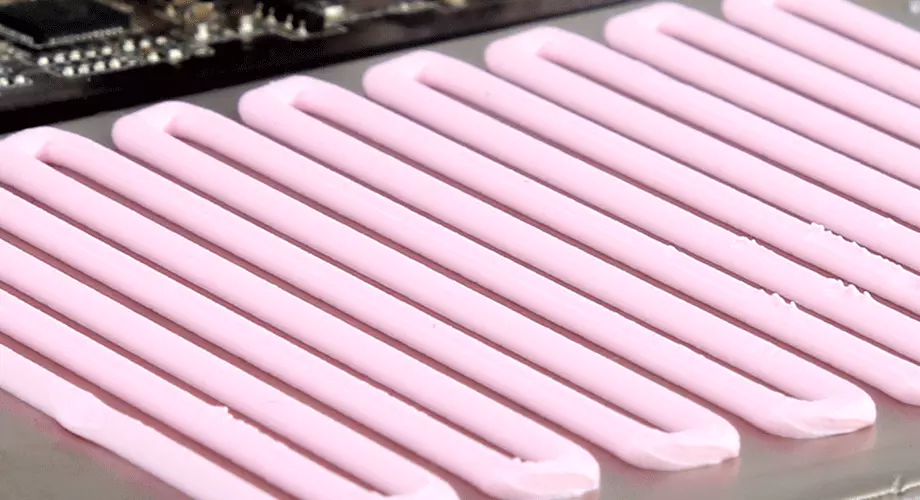
From that first pink bead to a finished interface, the softness that actually matters does two jobs: follow the structure, and fit into production. Sheen thermal gels bring material capability to the space between devices and heat-removal structures — one-part for direct dispensing and plastic gap filling, two-part for assemblies that want a soft elastomer after curing. Model, volume, supply, cure: only when every step connects does it become a complete thermal interface scheme.
Ready to talk? 【Request a Custom Quote】 Sheen can discuss SE series candidate models, TDS documents, supply formats, and the first round of samples.
Sheen Thermal
Dongguan Sheen Electronic Technology Co., Ltd · Founded in 2008
Manufacturer of thermal interface materials and silicone foam for automotive electronics, energy storage, power electronics, communications and consumer electronics.
Certified
- ISO 9001:2015
- ISO 14001:2015
- IATF 16949:2016
What we supply
- Thermal conductivity Up to 90 W/m·K
- Thickness 0.3–10.0 mm
- Custom & samples Die-cut to drawing, 3–7 days