
 English
 usheenthermal

Silicone Thermal Interface Materials: Advantages, Applications & Key Engineering Considerations
Silicone thermal interface materials remain one of the most widely adopted solutions for enhancing electronic device performance and ensuring operational stability. This comprehensive overview of silicone thermal interface materials provides guidance on selecting the appropriate type of thermal interface material (TIM) and practical design considerations to help maintain consistent thermal performance throughout the product lifecycle.What Are Silicone Thermal Interface Materials?
Silicone thermal interface materials are polymer-based compounds engineered to conduct heat between heat-generating components (CPUs, MOSFETs, batteries, IC packages) and heat spreaders or heat sinks. They are generally loaded with ceramic or carbon-based fillers to improve thermal conductivity.Common Types of Silicone TIMs
.webp "silicone thermal pad")
Solid, elastomeric gap fillers available in thicknesses from 0.3–5 mm and beyond. Ideal for automated assembly and large tolerances.
.webp "silicone thermal grease")
High-consistency paste with low thermal resistance and excellent surface wetting.
.webp "silicone thermal gel")
Soft, form-in-place (FIP) materials ideal for delicate components and uneven topographies.
.webp "silicone phase change material")
Solid at room temperature, soften at ~50–60°C to improve surface wetting.
How Silicone-Based TIMs Work
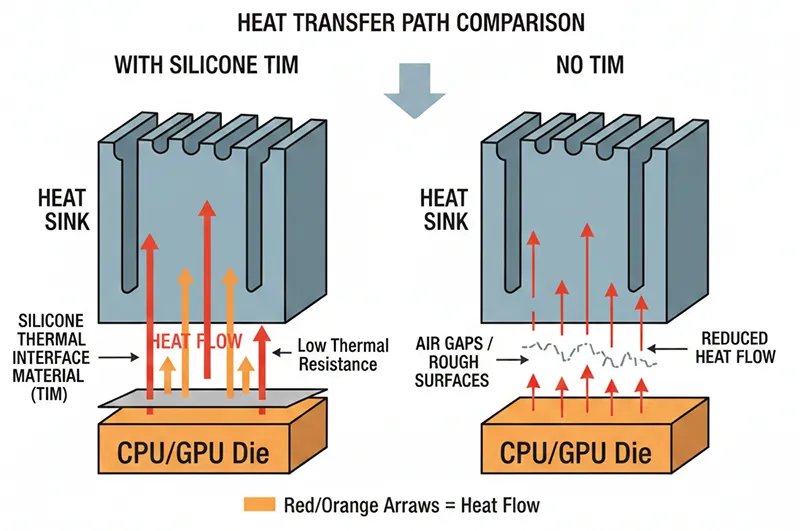
Silicone TIMs fill microscopic surface irregularities and air gaps—a major barrier to heat transfer. Their low modulus allows intimate surface contact at minimal pressure, significantly reducing contact thermal resistance (R_c).Common Fillers Used
- Alumina (Al₂O₃) for general-purpose insulation
-
Boron nitride (BN) for higher conductivity & insulation
-
Aluminum nitride (AlN) for premium conductivity
- Graphite or carbon fiber for anisotropic conduction
Advantages of Silicone Thermal Interface Materials
Excellent Thermal Stability and Reliability
Silicone materials maintain elasticity, dielectric strength, and thermal properties across wide temperature ranges (−40°C to +200°C). This makes them ideal for automotive electronics, outdoor telecom, and industrial environments.High Compressibility and Conformability
Compared with non-silicone pads or graphite sheets, silicone TIMs offer:- Lower hardness (Shore 00 ~20–40)
- Better adaptability to uneven surfaces
- Lower assembly pressure requirements
Strong Electrical Insulation
Most silicone pads provide dielectric strength > 5 kV/mm — critical for EV battery modules, power converters, and IGBT modules.Long-Term Material Stability
Silicone chemistry resists oxidation, UV exposure, and long-term thermal cycling.This prevents hardening, cracking, or pump-out—common issues with greases.
Potential Limitations of Silicone TIMs
Silicone Oil Migration (Volatile Siloxanes)
Some grades may release low-molecular-weight siloxanes, which can migrate or outgas. This is a concern in:- Optical systems
- MEMS devices
- Relay contacts
- High-voltage environments
- Low-outgassing formulations
- Non-silicone thermal pads
- Encapsulated gap fillers
Lower Mechanical Strength Compared to Graphite or PCM
Silicone pads are softer and may not be ideal for thin-profile or high-pressure applications.Cost Considerations
High-conductivity pads (≥10 W/mK) or gels can be more expensive than greases or PCMs.Sheen Technology Thermal pad vs. Silicone-Free Thermal pad
| Product Models | Thickness(mm) | Density(g/cm³) | Thermal Conductivity(W/m·K) | Thermal Resistance(℃*in²/W)@30psi, 1mm |
| SF800 Thermal Pad | 0.5-5.0 | 3.1 | 8.0 | 0.22 |
| AF800 Silicone-Free Thermal Pad | 0.5-5.0 | 3.4 | 8.0 | 0.2 |
Key Performance Metrics for Engineers to Evaluate
Thermal Conductivity (W/m·K)
Typical silicone pad range: 1–15 W/m·KHigh-end gel range: 3–12 W/m·K
Choose based on component heat load and thermal resistance target.
Thermal Impedance & Compression Behavior
Thermal impedance depends not only on conductivity but also:- Thickness
- Compression force
- Filler type
- Shore hardness
|
Test Item |
Test Data |
Pressure |
|||
|
Sample |
10psi |
10psi |
10psi |
10psi |
|
|
10~40Psi Thermal Resistance (°C*in²/W)@2mm |
1 |
0.197 |
0.188 |
0.186 |
0.196 |
|
2 |
0.188 |
0.183 |
0.181 |
0.196 |
|
|
3 |
0.192 |
0.188 |
0.184 |
0.192 |
|
|
Average Value |
0.192 |
0.186 |
0.184 |
0.195 |
|

Dielectric Strength & Volume Resistivity
Battery packs, inverter modules, and LED drivers require electrically insulated materials.Most silicone TIMs:
- Volume resistivity: 10¹²–10¹⁵ Ω·cm
- Dielectric strength: >4–8 kV/mm
Reliability Tests to Consider
- ISO 16750 thermal shock
- 1,000-hr high-temperature aging
- UL94 flammability (V-0 standard preferred)
- Outgassing (GC-MS)
Application Use Cases for Silicone TIMs
Automotive & New Energy Vehicles (NEV)
Applications include:- EV battery modules (cell to cold plate interface)
- OBC, DC-DC, inverter power modules
- ADAS domain controllers
Consumer Electronics & Servers
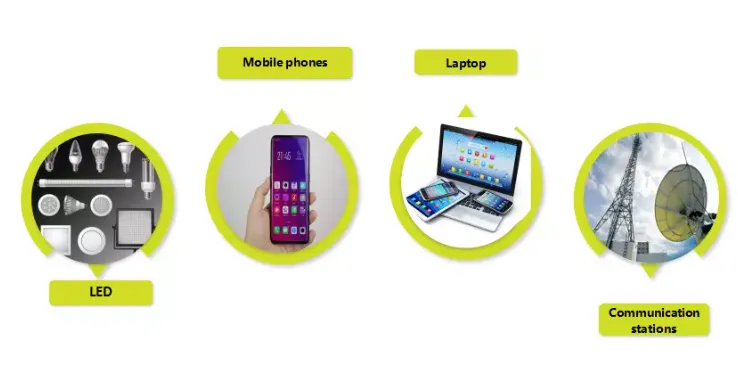
Used in smartphones, routers, GPUs, 5G base stations.
Advantages:
- Simplified assembly
- Consistent performance over time
- Vibration resistance
Industrial Power Electronics
Silicone gels and pads are ideal for:- IGBT modules
- MOSFET power boards
- Transformer and PSU insulation
Silicone TIMs withstand high junction temperatures, ensuring stable lumen output.
Choosing the Right Silicone TIM: Engineering Selection Guide
When to Use Thermal Pads
Best for:- Large tolerances
- High-volume assembly
- Electrically insulated environments
When to Use Thermal Gel
Best for:- Uneven surfaces
- Delicate components
- Large modules (automotive powertrain)
- Automation (dispensing systems)
When to Use Thermal Grease
Best for:- High thermal performance
- Ultra-thin bond line (<50–100 µm)
Selection Criteria Checklist
- Heat load (W)
- Bond line thickness (BLT)
- Operating temperature range
- Voltage isolation requirements
- Compression force limitations
- Tolerance stack-up
- Reliability requirements
FAQ — People Also Ask
Question 1 — What is silicone thermal interface material (TIM)?Answer: Silicone thermal interface material is a polysiloxane-based pad, gel, or grease filled with thermally conductive fillers. It bridges the gap between heat sources and heat sinks to reduce thermal resistance.
Question 2— Are silicone thermal pads better than thermal paste?
Silicone thermal pads offer easier assembly, electrical insulation, and long-term reliability, while thermal paste provides lower thermal resistance. The right choice depends on thickness requirements, compression force, and tolerance stack-up.
Question 3 — How do I select the appropriate silicone thermal pad?
A: Measure the gap (BLT), calculate the heat dissipation (W), set the target temperature difference (ΔT), then select the pad thickness and thermal conductivity based on the supplier's provided Rth and thickness/compression data.
Question 4 — Is silicone thermal interface material conductive?
Answer: No — Silicone itself is insulating. It becomes conductive only when conductive fillers (metal/carbon) are added or incorporated.
Question 5 — What test reports should I request?
Answer: ASTM D5470 / ISO 22007-2 (Rth vs. thickness/compression relationship), ASTM E595 (TML/CVCM) (if necessary), compression stress-strain, compression set, and dielectric property test reports.
Question 6 — What are typical pad thickness and compression guidelines?
A: Common nominal thicknesses: 0.5–5.0 mm. Target compression rate is approximately 10–30%.
Question 7 — Are silicone thermal interface materials (TIM) suitable for electric vehicles?
A: Yes, provided automotive-grade TIM is used and documented thermal cycling, vibration, flame retardancy, and certification data are available.
Based on professional analysis by the Sheen laboratory team, we believe that silicone thermal interface materials (TIMs) remain one of the most common and widely used choices for thermal management in modern electronic products.
If you are selecting a TIM for your project, Sheen's engineering team can recommend the most suitable TIM material based on your needs and product characteristics.
Contact us today for samples, datasheets, or custom thermal design consultations.



