
 English
 usheenthermal

Why AI Network Switch Thermal Management Is Key to Scaling Clusters
Date:2026-08-25
In dense AI clusters, network switch thermal management directly governs ASIC junction temperature, packet throughput, and long-term field reliability. As switch power density climbs, engineers must control heat at the die, the interface, and the system level to prevent thermal throttling and bandwidth loss.
This guide reviews the critical materials, cooling methods, health metrics, and retrofit practices that keep scaling clusters within safe operating limits.
Melodic Key Points: AI Network Switch Thermal Management
➔ Critical Materials: Deploy Phase Change Materials, Aluminum Nitride substrates, and Graphite Sheets to ensure uniform heat spreading and low interface resistance.
➔ Optimal Cooling Methods: Combine Microchannel Cold Plates, Copper Vapor Chambers, and Fluorocarbon Liquid immersion to tackle hot spots and maintain sustained bandwidth.
➔ Health Metrics: Monitor junction temperatures, substrate thermal resistance, and interface uniformity to detect throttling risks and validate scale-out readiness.
➔ Retrofit Best Practices: Use UV-curable resins, Silicone Encapsulants, and thermal gels during upgrades to seal voids, improve reliability, and boost cluster uptime.
→ Request the AI Switch Thermal Management Datasheet

Note: This diagram was created with AI assistance and is not an actual photograph; the illustrated structure and operational logic align with real-world engineering applications and serve as a valid reference.
Data Shows 40% Throughput Loss From Switch Overheating
High-density AI traffic can turn cooling details into packet-rate problems fast. AI Network Switch Thermal Management connects cooling quality with stable switching, helping operators catch rising temperatures before network throughput takes a hit. Sheen Technology focuses on practical AI network cooling controls.
How Poor Thermal Grease Application Reduces Packet Rates
Poorly spread thermal grease raises interface resistance, trapping heat right where a network switch needs efficient heat dissipation.
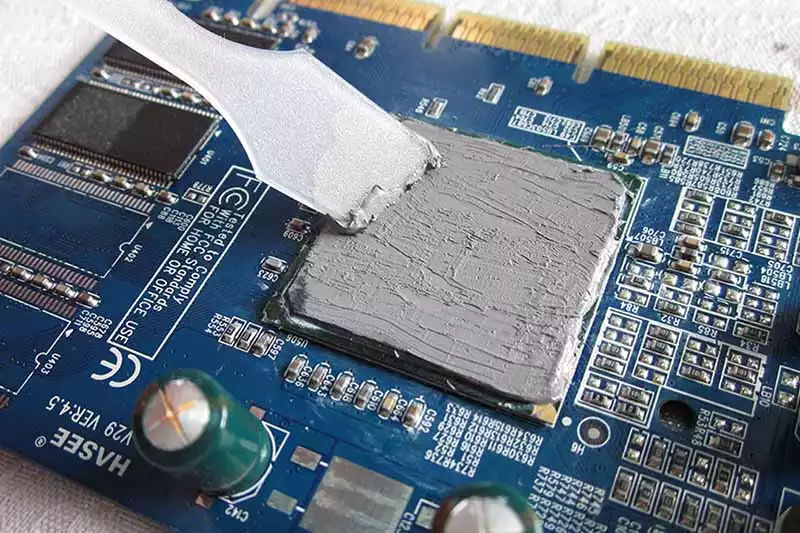
Cooling contact
- Voids lower thermal conductivity and widen the temperature gradient.
- Higher junction heat can trigger clock throttling.
- The resulting packet rate falls as processing speed drops.
Under heavy AI network traffic, that slowdown can compound across many ports.
Good AI Network Switch Thermal Management therefore starts with controlled grease thickness, coverage, and mounting pressure. Small application errors can become a big deal.
Microchannel Cold Plate Failures and Their Impact on Bandwidth
A microchannel cold plate carries heat into a circulating liquid, but tiny restrictions can upset fluid dynamics surprisingly quickly.
- Reduced coolant flow limits heat pickup.
- Weak liquid cooling raises processor temperature.
- The heat exchanger receives less effective heat transfer, increasing thermal failure risk.
Bandwidth then slides as thermal controls reduce processing frequency. That bandwidth degradation makes flow monitoring a key part of AI Network Switch Thermal Management, particularly during sustained AI workloads.
Copper Laminate Substrate Hot Spots Causing Performance Dips
Copper laminate spreads heat across the substrate, yet uneven heat flux can still create a concentrated hot spot.
- Heat buildup: Higher chip junction temperature can force temporary throttling.
- Material impact: Repeated gradients add thermal stress around local connections.
- Traffic impact: A short performance dip may show up as unstable throughput during peak loads.
Why AI Network Switch Thermal Management Scales Clusters
AI Network Switch Thermal Management keeps fast clusters from getting tripped up by heat as traffic climbs. Better materials and cooling paths protect switch hardware, control temperatures, and give operators more room to scale dense AI Network Switch Thermal Management designs.
Boost Reliability with Phase Change Material Enhancements
Repeated heating can strain interfaces. Phase change material softens near its designed operating range, improving the thermal interface between chips and heat spreaders.
During load spikes:
- stored latent heat supports temperature stabilization;
- improved contact lowers resistance and aids heat dissipation.
During cooldown:
- the material resets for later cycles;
- steady thermal conductivity supports network switch reliability.
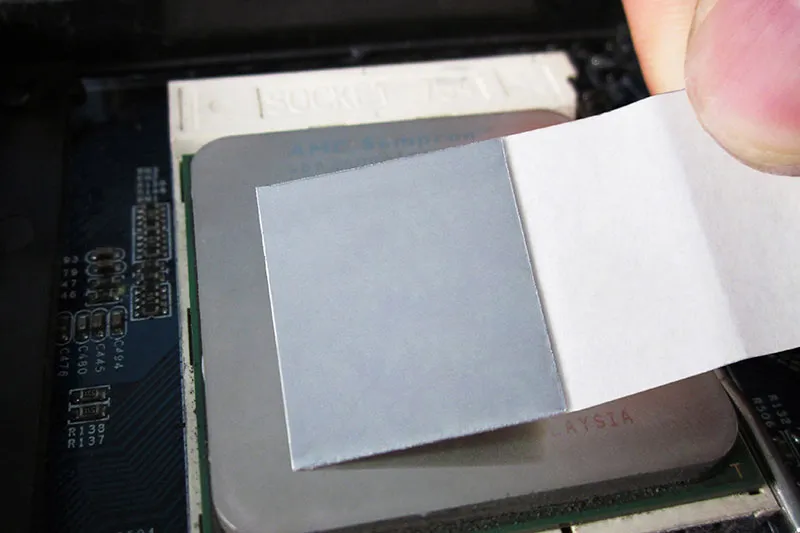
That makes AI Network Switch Thermal Management less vulnerable to frequent workload swings.
Maximize Density Using Aluminum Nitride Substrates
Aluminum nitride gives compact designs a handy combination: strong heat movement and electrical insulation.
- A thin ceramic substrate moves heat from tightly packed devices.
- Better thermal performance supports higher power density without simply adding bulk.
- In turn, component miniaturization gives engineers more freedom when shaping switch architecture.
Sheen Technology can apply these material choices where AI networking density is the key design constraint.
Drive Efficiency through Copper Vapor Chamber Integration
A vapor chamber uses two-phase cooling to move ASIC heat quickly.
Heat enters the chamber:
- internal fluid evaporates;
- vapor carries energy across the plate.
Heat reaches cooler surfaces:
- vapor condenses;
- copper cooling returns liquid through the wick.
This heat spreading lowers local thermal resistance, improving thermal efficiency when an AI cluster stays busy for hours.
Extend Uptime via Dielectric Coolant Circulation
Dielectric coolant tackles heat close to powered network hardware without conducting electricity.
• Pumped fluid circulation supports targeted liquid cooling.
• Stable coolant flow strengthens overall thermal management under nonstop traffic.
• Direct or immersion cooling can remove heat where air struggles, helping protect system uptime as clusters scale.
Comparison of Key Materials for Switch Thermal Management:
| Material | Reference Thermal Conductivity | Key Characteristics | Typical Application in Switches | Data Nature |
| Phase‑Change Material (PCM) | Varies by product | Softens under heat for conformable contact, resettable | Chip‑heatsink interface | Product measured data |
| Aluminum Nitride (AlN) Substrate | 170‑230 W/m·K | High thermal conductivity + electrical insulation | High‑power device substrate | Bulk material value |
| Graphite Sheet | In‑plane 1500+ W/m·K | Excellent in‑plane temperature equalization | Heatsink / chassis temperature equalization | Bulk material value |
| Silicon Carbide (SiC) Substrate | 120‑490 W/m·K | High‑power semiconductors | Power‑level packaging | Bulk material value |
Note: bulk material conductivity must be distinguished from composite product values. Selection must use Sheen product datasheet values at the specified thickness and pressure.
Need thermal conductivity, thermal resistance, junction temperature, dielectric coolant specs, and phase change material data for AI network switch cooling? Download the product datasheets to compare thermal gels, phase change materials, aluminum nitride substrates, copper vapor chambers, and graphite sheet interfaces for AI clusters and data center switches.
3 Key Metrics For Switch Thermal Health
AI Network Switch Thermal Management comes down to three practical checks: device temperature, heat-transfer resistance, and interface consistency. For dense AI network hardware, these readings show where cooling works and where heat gets stuck. Sheen Technology uses these metrics to guide thermal management choices.
Junction Temperature Across Pin Fin Array
During sustained traffic, junction temperature gives engineers a direct read on thermal performance inside a switch.
Cooling condition
- Compare sensor readings across the pin fin array rather than relying on one peak value.
- Check airflow distribution near high-power chips.
Thermal response
- Rising edge temperatures can reveal weak heat dissipation.
- Stable readings indicate better cooling efficiency and hotspot mitigation.
For AI Network Switch Thermal Management, that spread matters because a cool average can still hide a hot chip. Good AI Network cooling keeps temperatures controlled under real switching loads.
Thermal Resistance of Silicon Carbide Substrates
A silicon carbide path can move heat effectively thanks to high thermal conductivity, but package design still decides the final result.
- Measure thermal resistance from the device toward the cooler.
- Compare results as power density increases.
- Review the substrate material, joints, and semiconductor packaging for restrictions in heat conduction.
Lower resistance generally supports AI Network Switch Thermal Management by giving heat an easier route out. That’s the practical goal: fewer thermal choke points.
Temperature Uniformity in Graphite Sheet Interfaces
AI Network Switch Thermal Management also depends on even temperatures where components meet heat spreaders.
Map temperature uniformity across the graphite sheet.
- Small differences suggest steady heat spreading.
- Sharp gradients may flag poor thermal interface contact.
Compare hot spots with mounting pressure.
- High contact resistance can expose gaps.
- A suitable interface material improves overall thermal management.
| Indicator | Monitoring Content | Relevant Standard | Engineering Tips |
| Junction Temperature (Tj) | Chip junction temperature vs. allowable upper limit | JEDEC JESD51 series | Read values by array under continuous load; do not only check peak values |
| Interface Thermal Resistance | TIM thermal resistance (W·K⁻¹) | ASTM D5470 | Compare the effect of assembly pressure on thermal resistance |
| Temperature Uniformity | Hot‑spot temperature gradient | IEC 60068‑2‑14 | Verify assembly contact for vapor chamber / graphite sheet |
This thermal control check is simple but useful: uneven maps can reveal assembly problems before higher switch loads make them worse.
Four Cooling Methods For AI Network Switches
AI Network Switch Thermal Management keeps high-speed switching gear within safe operating temperatures. As AI network traffic pushes chip power upward, cooling gets tricky fast; engineers must balance heat flow, power use, space, maintenance, and the practical limits of each cooling method.
Airflow-Driven Cooling with Extruded Aluminum Fin
AI Network Switch Thermal Management often starts with familiar air cooling.
Thermal path
- An extruded aluminum fin uses high thermal conductivity and added surface area to spread ASIC heat.
- Forced air cooling then carries that heat away.
Operating controls
- Fan speed control responds as load or ambient temperature rises, keeping heat dissipation steady without running fans flat out all day.
Immersion Techniques Using Fluorocarbon Liquid
For denser AI network systems, immersion removes the air barrier around components.
Fluid behavior
- fluorocarbon liquid serves as a dielectric fluid, allowing direct liquid cooling around energized hardware.
- In two-phase immersion, heat reaches the fluid’s boiling point and produces vapor.
Heat cycle
- A high heat transfer coefficient supports rapid cooling.
- Vapor condensation returns fluid to the bath, closing the loop.
Heat Pipe Assembly for Targeted Hot-Spot Removal
AI Network Switch Thermal Management also benefits from passive heat transport where one ASIC runs especially hot.
A thermal interface material transfers chip heat into the heat pipe assembly.
- Internal phase change moves energy with low thermal resistance.
- A capillary wick returns condensed working fluid.
For wider hot-spot removal, a vapor chamber spreads heat toward a remote sink.
Direct Liquid Cooling via Microchannel Cold Plate
Direct cooling gets coolant close to the silicon, which can really pay off at high switch power.
Cooling hardware
- A microchannel cold plate supports direct liquid cooling with short heat paths.
- Careful manifold design balances coolant distribution across channels.
System operation
- A pumped loop maintains flow.
- Good fluid dynamics limits pressure loss while improving thermal performance, making AI Network Switch Thermal Management practical for dense AI network switch racks.
Comparative Analysis of Switch Cooling Methods:
| Cooling Method | Applicable Power Density | Typical Applications | Key Advantages | Main Limitations |
| Air Cooling (Extruded Aluminum Fins) | Medium–Low | General-purpose switches, edge nodes | Low cost, easy maintenance | Limited by ambient temperature and noise |
| Heat Pipe / Vapor Chamber | Medium | Single-point heat sources, localized hotspots | Passive, zero power consumption, reliable | Heat dissipation capacity has an upper limit |
| Microchannel Cold Plate (Direct Liquid Cooling) | High | High-density racks, AI clusters | Low thermal resistance, supports high power loads | Requires pumps and piping, complex maintenance |
| Fluorinated Liquid Immersion (Two-Phase) | Very High | Fully liquid-cooled data centers | High heat transfer coefficient, eliminates air barrier | High investment, requires compatibility validation |
Real-World Case: 50-Node Cluster Thermal Retrofit
A 50-node retrofit needs more than swapping materials and hoping temperatures drop. This AI Network Switch Thermal Management case tracks heat before, during, and after changes, giving operators a practical way to connect thermal monitoring, material choices, and cluster performance without losing sight of uptime or safe operating limits.
Baseline Assessment: Temperature Profiling on 50 Nodes
AI Network Switch Thermal Management starts with consistent temperature profiling under the same workload. That keeps the comparison apples-to-apples.
Baseline checks:
Thermal behavior
- Record node temperature at idle and load.
- Map each thermal hotspot near processors, optics, and power stages.
Operating behavior
- Compare heat dissipation with fan speed and throttling.
- Use baseline analysis to flag weak cluster performance.
| Node group | Avg. °C | Peak °C | Throttle events |
| 1–10 | 69 | 83 | 8 |
| 11–30 | 66 | 79 | 4 |
| 31–50 | 71 | 86 | 11 |
These illustrative readings create a repeatable thermal-management reference.
Applying Thermal Gel and UV Curable Resin Solutions
For AI Network Switch Thermal Management, thermal gel works as a thermal interface material, filling small air gaps so heat transfer improves.

Clean and inspect the contact surface.
- Apply a controlled gel thickness using a repeatable application technique.
- Use UV curable resin only for suitable component protection, keeping it away from interfaces that need service access.
Validate the curing process, electrical properties, and material compatibility before powering the node.
That practical routine helps avoid the “more material must be better” trap.
Post-Retrofit Gains from Silicone Encapsulant and Ceramic Coating
Post-retrofit AI Network Switch Thermal Management needs measurements, not guesswork.
Protection:
- silicone encapsulant:Adds environmental protection where moisture or contamination is a concern.
- ceramic coating:Provides electrical insulation when correctly specified.
Validation:
- Compare thermal resistance before and after treatment.
- Track temperature reduction and cooling efficiency under matched loads.
- Confirm retrofit gains through temperature stability, throttling frequency, and uptime.
A coating can also trap heat if poorly selected, so network-switch cooling results should drive the final material choice.
Thermal Management Decision Framework
Decision framework for AI switch thermal management:
| Step | Question | Decision |
| 1 | What is the switch power density / rack wattage? | Low–moderate → air; high → liquid/immersion |
| 2 | Is electrical isolation required at the substrate? | Yes → AlN or ceramic; No → graphite/vapor chamber |
| 3 | Are there localized ASIC hotspots? | Yes → vapor chamber / heat pipe / microchannel |
| 4 | Is this a retrofit of an existing cluster? | Yes → gel + encapsulant + ceramic coating, validated |
| 5 | What metrics gate scale-out? | Tj, interface resistance, uniformity |
AI network switch thermal management is a system-level discipline: it connects material selection, cooling architecture, and measurable health metrics to sustained bandwidth and cluster uptime. Phase-change materials, aluminum nitride substrates, graphite sheets, vapor chambers, and liquid cooling each address a specific failure mode. Operators who instrument junction temperature, interface resistance, and uniformity — and who validate retrofits with measured data rather than assumptions — can scale clusters without thermal surprises. Sheen Technology provides the interface materials and application engineering to support this selection process.
→ Request the AI Switch Thermal Management Whitepaper
Sheen Thermal
Dongguan Sheen Electronic Technology Co., Ltd · Founded in 2008
Manufacturer of thermal interface materials and silicone foam for automotive electronics, energy storage, power electronics, communications and consumer electronics.
Certified
- ISO 9001:2015
- ISO 14001:2015
- IATF 16949:2016
What we supply
- Thermal conductivity Up to 90 W/m·K
- Thickness 0.3–10.0 mm
- Custom & samples Die-cut to drawing, 3–7 days