
 English
 usheenthermal

The thermal conductivity of silicone sheet to the higher the better?
Date:2026-09-16
Recently, many customers have learned about our company through the network platform and conducted consultation on heat-conducting silica gel sheets. They often ask whether the thermal conductivity of heat-conducting silica gel sheets is the higher the better.
Or the product engineer of our company gives a reasonable thermal conductivity according to the data provided by the customer, but the customer requires a higher thermal conductivity coefficient, so the higher the coefficient of thermal silica gel sheet, the better?
No. A silicone sheet with a higher thermal conductivity rating is not automatically the better choice. Conductivity governs only the material's bulk resistance — one term in a series thermal path that also includes contact resistance, spreading resistance, and the heat sink itself. Past the point where the pad stops being the bottleneck, additional conductivity buys almost no temperature reduction while raising hardness, degrading surface wetting, and multiplying cost. The right rating is the one your thermal budget calculates — not the highest number on the datasheet.
What Thermal Conductivity Measures — and What It Does Not
The main reason for the heating of electrical equipment is that a part of the energy will be consumed when the electric energy is converted into other energy, and a large part of the energy will be distributed in the form of heat. If the temperature in the equipment is not controlled, the equipment may be damaged due to high temperature, affecting its reliability and safety.
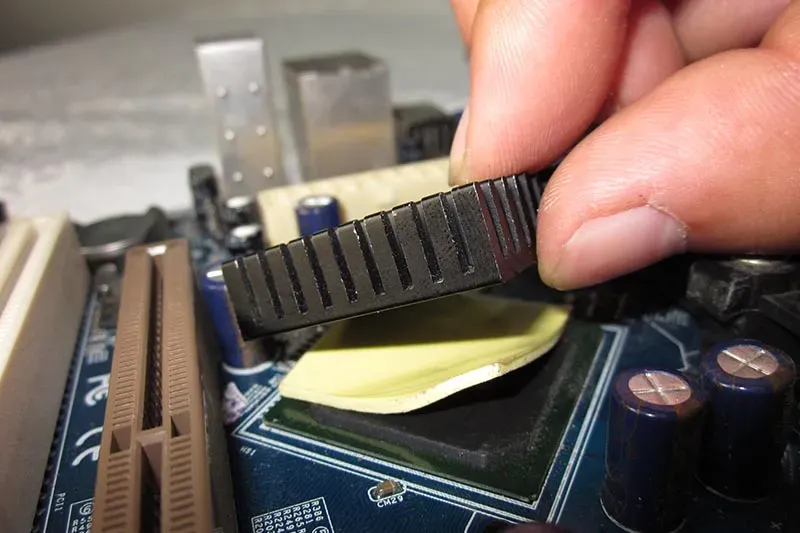
Thermal conductive silicone piece is one of the many thermal conductive materials, as well as the birth of the material which is developed to solve the problem of heating equipment, it is a kind of silicon resin as base material, add heat resistance, thermal conductivity materials gap filling thermal conductive gaskets, it have the high thermal conductivity, low thermal resistance, insulation, compressibility, and so on characteristics, because of its soft hardness, make its can be realized under the condition of low pressure the small heat resistance, and eliminate interface between air and full fill the contact area between the rough surface, improve the heat conduction effect of contact surface.
Because of its good filling effect, thermally conductive silicone sheet can effectively conduct the heat from the heat source to the shell, and thermally conductive silicone sheet has good compressibility and elasticity, which can be a good shock absorber.
Thermal conductivity, expressed in W/m·K, describes how efficiently the pad material transports heat through its own bulk. It is a material property, measured on the raw sheet.
- the reference method for gap-filler pads is ASTM D5470 (steady-state thermal transmission).
- with transient methods such as ASTM E1461 laser-flash or ISO 22007-2 used for material characterization.
What conductivity alone does not tell you is how the pad will perform in your joint, at your pressure, at your thickness. That is the job of thermal resistance and thermal impedance — and this distinction drives the entire selection question that follows.
The Arithmetic of Diminishing Returns
Total resistance from heat source to ambient is a series sum: R(total) = R(junction) + R(TIM) + R(contact) + R(spreading) + R(sink). The pad occupies only the R(TIM) and R(contact) terms, and its bulk resistance follows the simple relation R(TIM) = t / (k·A) — thickness divided by conductivity times contact area. Two consequences follow immediately.
Thickness hurts linearly:
- halving the bond line halves bulk resistance, exactly as doubling conductivity does.
- A thin, well-wetted moderate-conductivity pad routinely outperforms a thick, hard, high-conductivity one.
Conductivity gains saturate:
- Because R(TIM) sits in a series sum alongside terms that do not change, each doubling of k buys a smaller absolute improvement than the last.
| Pad conductivity (W/m·K) | Pad bulk resistance t/(k·A) (K/W) | Total stack resistance (K/W) | Source-to-ambient ΔT at 10 W (°C) | Gain vs. previous step |
| 1 | 20.0 | 26.5 | 265 | — |
| 3 | 6.7 | 13.2 | 132 | 133 °C |
| 6 | 3.3 | 9.8 | 98 | 34 °C |
| 12 | 1.7 | 8.2 | 82 | 16 °C |
Table 1 · Diminishing returns of conductivity in a representative stack. Illustrative calculation from R = t/(k·A) with fixed contact and sink terms; not measured product data — datasheet values govern.
Why Chasing the Highest Number Can Backfire
Conductivity in a silicone sheet is bought with filler loading, and filler loading taxes everything else. In engineering terms, a low-hardness pad wets the mating surfaces, squeezes into their roughness, and keeps contact resistance low. Raise the filler loading far enough and the trade turns hostile:
| Rises as filler loading increases | Falls or degrades |
| Thermal conductivity | Compressibility — thicker bond line at the same mounting pressure |
| Shore 00 hardness (ASTM D2240) | Surface wetting — higher contact resistance at both interfaces |
| Density and weight per unit area | Conformability to tall components and tolerance stack-ups |
| Material cost — steeply toward the top of the range | Dielectric-strength headroom with certain conductive filler systems |
Table 2 · The trade-offs of high filler loading in silicone thermal sheets.
The result can be perverse: a heavily loaded 12 W/m·K sheet, mounted at low pressure over a rough die or lid, can show higher total impedance than a compliant 6 W/m·K sheet that wets both surfaces — the contact-resistance penalty outweighs the bulk-conductivity gain. Higher loading also narrows the window for gap absorption: the pad compresses less, so the tolerances and coplanarity errors a softer sheet would have absorbed now translate directly into a thicker bond line.
None of this argues against high-conductivity materials. It argues for specifying them where their bulk advantage can actually be collected — at adequate pressure, over a controlled bond line — which is a design decision, not a catalog browsing decision.
The Heat Sink Still Sets the Ceiling
To put it simply, the key to the whole heat dissipation system lies in the heat sink (or enclosure). The thermally conductive silicone sheet is the auxiliary material. Its job is to lower the resistance between heat source and radiator so that the radiator can do its work; it cannot reject heat on its own. If the sink cannot dissipate what the source generates, no conductivity rating will fix the problem — the extra conduction merely delivers heat to the bottleneck faster.
The pad can only reduce R(TIM) and R(contact). R(spreading) and R(sink) belong to the system designer. Selecting a sheet rating that outruns the sink's rejection capacity buys nothing thermally — the original article's point, and it is correct.
Thermal conductivity is an important parameter for measuring sheet performance, and price is largely determined by it, because filler content is the primary cost driver in these materials. So the conductivity of a silicone sheet cannot be said to be as high as possible: find the suitable rating and the sheet plays its role at the lowest cost.
Over-specifying therefore wastes budget twice — once at purchase, and again if the harder sheet degrades wetting. The economical choice is the rating that meets the thermal budget with margin, verified by impedance data rather than the headline number.
How to Select the Right Rating in Five Steps
Step 1 — Establish the thermal budget.
- Maximum allowable source temperature minus maximum ambient, divided by heat flow, gives the total resistance you can afford.
- Example: 105 °C − 45 °C at 10 W → R(total) ≤ 6.0 K/W.
Step 2 — Subtract what you cannot change.
- Assign realistic values to the fixed terms: say 2.5 K/W for spreading plus sink, 0.8 K/W for both contact interfaces combined. The remainder — 2.7 K/W here — is the pad's budget.
Step 3 — Estimate the bond line.
- A 2.0 mm pad at 25% compression yields roughly a 1.5 mm bond line.
- the contact area comes from the mechanical design — 100 mm² here.
Step 4 — Solve for conductivity.
- k ≥ t / (R·A) = 0.0015 / (2.7 × 10⁻⁴) ≈ 5.6 W/m·K.
- A 6 W/m·K class sheet meets the budget.
- A 12 W/m·K class buys margin this stack cannot use.
Step 5 — Verify with impedance, not headline conductivity.
- Ask the supplier for ASTM D5470 impedance data at your thickness and pressure, and for compression-deflection data to confirm the bond-line assumption from Step 3.
For orientation, commercial silicone sheets cluster into recognizable classes:
| Class (W/m·K) | Typical fit | Notes |
| 1–3 | Low-power boards, large clearances, cost-sensitive assemblies | Soft and highly compressible; often the best value per degree |
| 3–6 | General electronics: telecom, LED drivers, controllers, enclosure-to-sink joints | The workhorse range for most applications |
| 6–12 | High power density with a lid or spreader in the path | Verify pressure and bond line; hardness rises with the rating |
Table 3 · Typical commercial pad classes — orientation only, not Sheen product specifications; the stack calculation governs, and datasheets prevail.
Is a silicone sheet's thermal conductivity the higher the better? No — it is the better the closer it is calculated. Conductivity is one term in a series thermal path, and it is purchased at the price of hardness, compressibility, and cost. The correct rating makes the pad's resistance small relative to the stack, collects its benefit through a thin, well-wetted bond line, and leaves the ceiling where it belongs — with the heat dissipation system. Specify by arithmetic, verify by impedance, and let the thermal budget, not the datasheet's biggest number, make the decision.
Share your stack-up — heat source power and footprint, temperatures, gap height, and mounting pressure — and Sheen's engineering team will run the selection arithmetic and recommend sheet candidates with ASTM D5470 impedance data.
Sheen Thermal
Dongguan Sheen Electronic Technology Co., Ltd · Founded in 2008
Manufacturer of thermal interface materials and silicone foam for automotive electronics, energy storage, power electronics, communications and consumer electronics.
Certified
- ISO 9001:2015
- ISO 14001:2015
- IATF 16949:2016
What we supply
- Thermal conductivity Up to 90 W/m·K
- Thickness 0.3–10.0 mm
- Custom & samples Die-cut to drawing, 3–7 days