
 English
 usheenthermal

Scaling for AI: Essential Data Center Thermal Management Solutions
Date:2026-09-29
AI racks run hot, and Data Center Thermal Management Solutions now hinge on materials as much as cooling hardware. Gap pads, graphene sheets, vapor chambers, gaskets, and coolants keep hotspots from calling the shots.
At scale, compatibility, dielectric performance, durability, and steady supply all matter.
Sheen Technology’s materials portfolio connects component-level heat control with air, liquid, and immersion cooling choices.”
Key Points for Data Center Thermal Management Solutions
➔ Integrate Graphene Thermal Sheets and Gap Pads to disperse AI rack hotspots and ensure uniform heat spreading.
➔ Adopt Two-Phase Immersion Coolants in high-density GPU deployments to leverage boiling–condensation cycles for peak heat removal.
➔ Employ Ceramic-Filled Polymer Seals and Silicone Rubber Gaskets to maintain airtight, leak-proof assemblies and guide airflow.
➔ Optimize Server Room Airflow by sealing gaps, deploying vapor chamber baseplates, and using direct bonded copper ceramic substrates for efficient heat dissipation.
➔ Balance Liquid and Air Cooling by selecting appropriate dielectrics, fluorinated fluids, or advanced interface materials to match density and reliability needs.

This image was generated with the assistance of AI; it is not a real photograph and is for reference only.
Can AI Scale Without Proper Cooling?
AI growth packs more heat into less space, so Data Center Thermal Management Solutions need smarter materials, cooling paths, and reliable seals. Sheen Technology helps operators keep Data Center thermal management practical.
Graphene Thermal pad: Bridging AI Rack Hotspots
Graphene Thermal pad support Data Center Thermal Management Solutions where concentrated chips create tough hot spots. Sheen Technology’s vertically oriented graphene thermal pads feature a thermal conductivity of up to 110 W/m·K and a thermal resistance as low as 0.08 °C·cm²/W.
| Performance | Properties | Unit | GSF110-03 | Test Method |
| Thermal Properties | Thermal Conductivity | W/m·K | 110 | ASTM E1461 |
| Thermal Resistance (@40psi) | ℃*cm²/W | ≤0.08 | ASTM D5470 | |
| Application Temperature | ℃ | -40~150 | / | |
| Physical Properties | Rebound Rate | % | ≥90 | / |
| Tensile Strength | Mpa | ≥0.05 | ASTM D412 | |
| Color | - | Black | Visual | |
| Thickness | mm | 0.2~2.0 | ASTM D374 | |
| Density | g/cm³ | 0.3~0.7 | ASTM D792 | |
| Oil Bleeding Rate | % | ≤3 | / | |
| Flame Retardancy | Flame rating | - | V-0 | UL 94 |
The pad is also electrically conductive, and that has to be designed for rather than checked at assembly. Where a graphene pad sits against exposed bond pads, an energised substrate or a conductive lid without separation, the requirement is edge seal, film lamination, dielectric standoff, or a verified clearance.
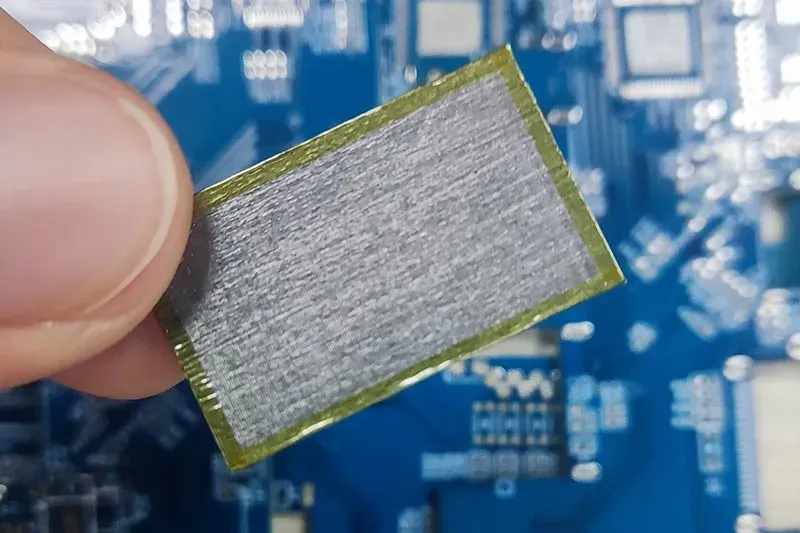
- High through-plane conductivity moves heat rapidly across the joint, which is what reduces the local hotspot temperature in an AI server rack.
- Used as a thermal interface material, improves heat dissipation and supports steadier processor cooling. Pretty handy when rack density climbs.
A graphite sheet spreads heat along its plane and does not conform to a joint — in-plane typically 300–700 W/m·K for natural grades and up to a nominal 1,500–1,900 W/m·K for top synthetic grades, through-plane typically 5–20 W/m·K, so the two directions differ by two orders of magnitude. A graphene thermal pad carries heat through its thickness and conforms. Where the design needs lateral spreading above a hot die, specify the sheet; where it needs a compliant bond line across a gap, specify the pad. Both are electrically conductive and both carry the isolation requirement above.
Two-Phase Immersion Coolant for High-Density GPUs
Data Center Thermal Management Solutions can also put hardware directly into dielectric fluid, cutting reliance on room airflow.
- Immersion cooling surrounds each high-density GPU with coolant.
- Heat triggers a phase change as fluid boils, carrying energy away quickly.
- Condensation returns coolant for another cycle, raising thermal efficiency and improving server cooling through direct heat transfer.
Sheen Technology supplies the materials on the hot side of that boundary — the interface material, the gaskets and the sealing compounds that have to survive the fluid — and can provide their compatibility and specification limits against the fluid the deployment uses.
Ceramic-Filled Polymer Seals to Maintain Thermal Integrity
A ceramic filled polymer can protect joints around a cooling system.
For sealing:
- A stable thermal seal supports leak prevention.
- Strong heat resistance limits damage during temperature swings.
For long-term operation:
- Better thermal integrity helps cooling hardware stay consistent.
- Good material reliability reduces maintenance headaches.
For Data Center Thermal Management Solutions, Sheen Technology combines these material choices to support dependable thermal solutions as AI racks get hotter.
5 Steps To Optimize Server Room Airflow
Good airflow keeps dense computing gear cooler without wasting conditioned air. Effective Data Center Thermal Management Solutions combine airflow control, heat transfer, and fluid care; done right, these thermal management solutions help the server room handle rising heat loads.
| Step | Material specified | Governing property | Method |
| 1 | Silicone rubber gasket | Compression set, durometer, flame rating | ASTM D395, ASTM D2240, UL 94 |
| 2 | Thermal conductive gap pad | Compression range and thickness, dielectric strength | ASTM D575 / D395, ASTM D149 / IEC 60243 |
| 3 | Direct bonded copper substrate | Dielectric withstand traded against substrate thermal impedance | ASTM D149 / IEC 60243, ASTM D5470 |
| 4 | Vapor chamber baseplate with interface joints | Joint impedance at the intended bond line; orientation range | ASTM D5470 |
| 5 | Fluid-path materials and seals | Elastomer swell and hardness retention in the working fluid | ASTM D471 |
Step 1: Seal Cable Gaps with Silicone Rubber Gaskets
Close cable gaps around floor and rack openings.
- Fit silicone rubber gaskets snugly around cables.
- Check edges for air leakage after installation.
Better airflow sealing keeps cold air headed toward servers, not empty spaces.
Step 2: Fill Panel Voids Using Thermal Conductive Gap Pads

Soft gap pads fill panel voids where hard surfaces cannot make even contact. In a server rack, this thermal interface improves heat dissipation.
- Pick thermal conductive material with suitable thickness and electrical insulation.
- Avoid crushing the pad; a proper fit works better.
Step 3: Deploy Direct Bonded Copper Ceramic Substrates for Air Heat Spread
Use direct bonded copper where concentrated heat demands high thermal conductivity.
- Ceramic substrates add electrical isolation.
- Wide heat spread gives moving air more surface area to cool.
For power electronics, this approach can raise cooling efficiency within Data Center Thermal Management Solutions.
Step 4: Position Vapor Chamber Baseplates to Channel Cool Air
- Place each vapor chamber near high-load chips so its baseplates spread heat toward the heat sink.
- Keep the airflow channel clear, allowing cool air to support processor cooling and steady thermal cooling.
Step 5: Control Condensation via Biocide Water Treatment Agent
Watch humidity management alongside coolant temperature. A biocide limits microbial growth in the cooling system, while proper water treatment, corrosion control, and fluid management support long-term server protection and reliable data center cooling.
Liquid Vs. Air Cooling
Data Center Thermal Management Solutions now have to handle hotter chips and tighter racks without making operations a headache. Liquid and air approaches tackle that heat differently. Choosing suitable Data Center Thermal Management Solutions comes down to density, site design, energy use, and maintenance needs, while practical thermal management keeps compute hardware within safe operating temperatures.
Liquid Cooling Materials
Liquid-based Data Center Thermal Management Solutions move heat through fluids that carry far more heat than air. A dielectric fluid can contact electronics safely, while glycol-water mixtures and synthetic oils serve indirect cooling loops.
A cold plate captures processor heat.
- Thermal interface material improves contact with the chip.
- Tubing carries warmed coolant onward.
Facility loop
- A manifold divides flow among servers.
- A coolant distribution unit controls pressure and temperature.
- A heat exchanger transfers heat to the building system.
| Coolant | Typical specific heat, kJ/kg·K | Typical use |
| Water | 4.18 | Facility loops |
| 50% glycol-water | ~3.3 | Freeze-protected loops |
| Mineral oil | ~1.7–2.0 | Immersion cooling |
Such cooling solutions suit dense AI racks where air alone runs out of steam.
Air Cooling Solutions
Air-based Data Center Thermal Management Solutions remain practical for moderate rack loads and existing facilities. Good airflow management is the key: a computer room air handler supplies conditioned air, often through a raised floor, while a containment system limits hot-and-cold air mixing.
- A server heat sink draws heat from processors and accelerators.
- An exhaust fan pushes hot air toward the return path.
- Operators track ambient temperature and airflow, then adjust fan speed or containment.
Graphite sheets, vapor chambers, conductive substrates, and thermal interface materials boost heat transfer without full liquid infrastructure. This familiar data center cooling approach can also simplify maintenance.
【Request a Custom Quote】Racking at higher density and hitting hotspots, leak paths, or condensation problems? Send us your rack layout, heat load per node, cooling method (air, liquid, or two-phase immersion), gap and tolerance map, coolant chemistry, and volume ramp plan, and our engineers can recommend the interface materials, seals and gaskets that keep your data center thermal management solutions consistent from pilot to full deployment.
Sheen Thermal
Dongguan Sheen Electronic Technology Co., Ltd · Founded in 2008
Manufacturer of thermal interface materials and silicone foam for automotive electronics, energy storage, power electronics, communications and consumer electronics.
Certified
- ISO 9001:2015
- ISO 14001:2015
- IATF 16949:2016
What we supply
- Thermal conductivity Up to 90 W/m·K
- Thickness 0.3–10.0 mm
- Custom & samples Die-cut to drawing, 3–7 days
LAST:Nothing