
 English
 usheenthermal

Reliable Cooling Solutions From a Premier Graphene Thermal Pad Manufacturer
Date:2026-08-18
Rising power density makes heat a make-or-break sourcing issue. A graphene thermal pad manufacturer must pair controlled thermal performance with custom converting, consistent quality, and dependable volume supply.
The IEA’s Global EV Outlook 2025 reports electric-car sales exceeded 17 million in 2024, accounting for more than 20% of global car sales.
For buyers, the rubber meets the road in specifications, installation, material trade-offs, quality checks, lead times, applications, support, and next-generation graphene technologies.
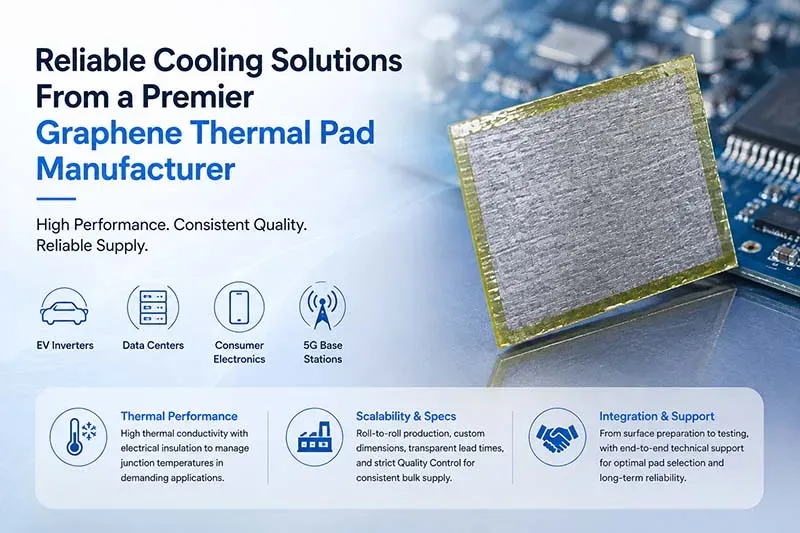
Image caption: The structure and scene shown in the image were generated with the help of artificial intelligence, but the product is a real graphene thermal pad with edge wrapping from Sheen Technology.
Reading Notes: Graphene Thermal Pad Manufacturer Essentials
➔ Thermal Performance: Leverage unmatched conductivity (W/m·K) with electrical insulation to manage junction temperatures and power density in EV inverters, data centers, and consumer electronics.
➔ Scalability & Specs: Opt for roll‐to‐roll production, custom dimensions, transparent lead times, and rigorous quality control to ensure consistent bulk supply and precise thermal resistance ratings.
➔ Integration & Support: Follow surface preparation, alignment, and uniform‐pressure lamination steps; then verify contact and test dissipation efficiency. Rely on end‐to‐end technical support for optimal pad selection and long‐term reliability.
Why Choose a Graphene Thermal Pad Manufacturer?
Choosing a graphene thermal pad manufacturer is about more than buying sheets of material. The right graphene manufacturer brings dependable heat control, scalable production, and practical engineering help together, so high-power electronics can stay cooler without making sourcing or assembly a headache.
Unmatched Thermal Conductivity
A capable graphene thermal pad manufacturer delivers high through-plane thermal conductivity (90 W/m·K for composite pads) through controlled vertical graphene orientation. The product is ELECTRICALLY CONDUCTIVE — this enables combined thermal + grounding between metal surfaces, but requires external electrical isolation where needed.
Scalable Roll-to-Roll Production for Bulk Material Supply
A graphene thermal pad manufacturer such as Sheen Technology can pair roll-to-roll manufacturing with coating, lamination, and die cutting. This setup improves manufacturing efficiency while moving from prototypes toward mass production.
At industrial scale, stable production capacity matters just as much as pad performance. Controlled material sourcing and an organized supply chain also help a graphene supplier provide custom sizes and bulk materials for EVs, servers, and consumer devices without turning procurement into a hassle.
End-to-End Quality Control Standards and Technical Support
Reliable supply depends on quality control, not specs on paper alone. A graphene thermal pad manufacturer should:
- Apply defined testing protocols for thickness and thermal resistance.
- Check results against suitable performance standards.
- Confirm product reliability and durability.
- Maintain relevant certification records.
- Provide technical support and customer assistance for material selection, installation, and process optimization.
Sheen Technology connects graphene manufacturing with practical engineering support, helping customers tune pad thickness, contact pressure, and heat dissipation for real assemblies.
Key Specifications for Thermal Pads
Choosing a graphene thermal pad manufacturer comes down to measurable thermal performance, fit, and supply readiness. A capable graphene thermal pad manufacturer should make specifications easy to compare, so engineers can match graphene materials to real operating needs. Sheen Technology supports that practical selection process from prototypes through production.
Thermal Resistance and Watt-per-Meter-Kelvin Ratings
Start with thermal conductivity and the W/mK rating.
- Higher conductivity can improve heat dissipation, but thermal resistance also depends on thickness and contact quality.
- A temperature differential under load gives engineers a useful real-world check on the interface material and its effective heat transfer coefficient.
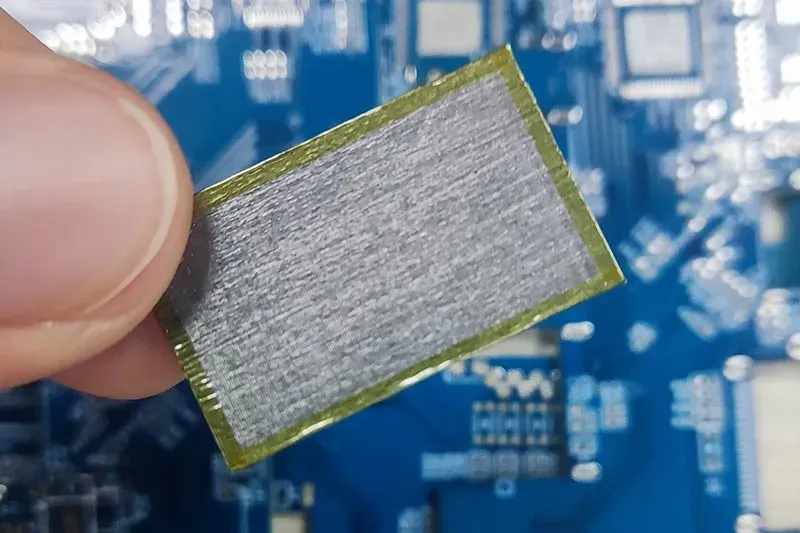
Sheen Technology vertically aligned graphene thermal pad performance properties:
| Properties | Unit | GSF75-03 | GSF90-03 | Test Method |
| Color | - | Black | Black | Visual |
| Thermal Conductivity | W/m·K | 75 | 90 | ASTM E1461 |
| Thermal Resistance (@40psi) | ℃*cm2/W | ≤0.12 | ≤0.10 | ASTM D5470 |
| Thickness | mm | 0.3~2.0 | 0.3~2.0 | ASTM D374 |
| Density | g/cm³ | 0.3~0.7 | 0.3~0.7 | ASTM D792 |
| Rebound Rate | % | ≥90 | ≥90 | - |
| Tensile Strength | Mpa | ≥0.03 | ≥0.05 | ASTM D412 |
| Oil Bleeding Rate | % | ≤3 | ≤3 | / |
| Application Temperature | ℃ | -40~150 | -40~150 | / |
| Flame rating | - | V-0 | V-0 | UL 94 |
Need thermal conductivity, thermal resistance, dielectric strength, thickness tolerance, and long-term cycling data for graphene thermal pads? Download the product datasheets to compare graphene thermal pads, graphene films, and carbon-based solutions for power electronics, data centers, EV inverters, and LED lighting.
Mechanical Flexibility in Graphene Films
A graphene film needs enough flexibility to sit snugly against uneven parts.
Check conformability around edges and small gaps.
- Review mechanical properties under repeated installation.
- Consider bending stress, material elasticity, and long-term durability rather than thickness alone.
Junction Temperature Reduction and Thermal Cycling Stability
Track junction temperature during realistic workloads.
- Lower peaks support device reliability and steadier heat management.
Repeat thermal cycling tests.
- Watch temperature stability as cycles build up.
Limited thermal stress can help extend component lifespan. A qualified graphene thermal pad manufacturer should provide useful test conditions, not just headline numbers.
Custom Dimensions and Lead Time Considerations
- Define specification requirements:Set custom dimensions, pad thickness, and form factor.
- Confirm material customization:Die cutting or lamination can make assembly easier.
- Lock down manufacturing lead time:Align samples and orders with the production schedule so deadlines do not get tight.
5 Steps to Install Graphene Pads
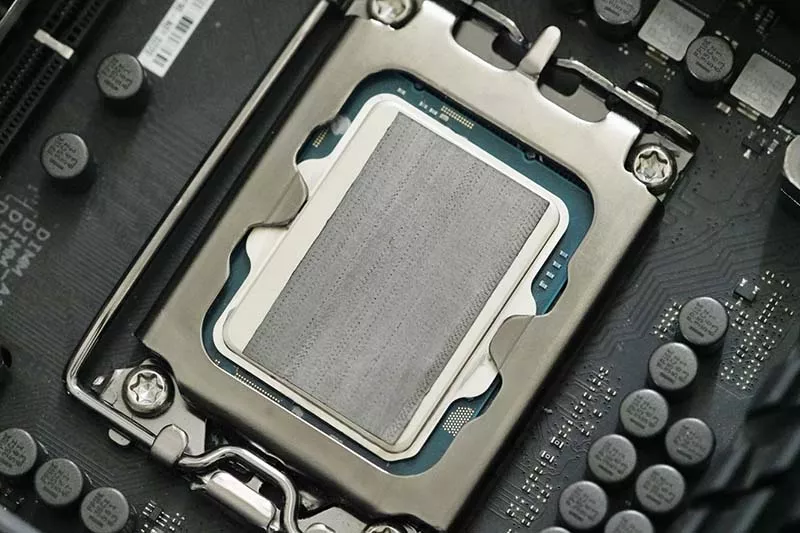
Installing a graphene pad takes careful handling, not fancy tricks. A reliable graphene thermal pad manufacturer should provide material suited to the target heat load and assembly. Sheen Technology supplies graphene thermal solutions for electronics where accurate fit matters. Good surface condition, controlled pressure, and final temperature checks help keep cooling performance on track.
1. Surface Preparation and Cleaning Guidelines
- Clean the substrate thoroughly.
- Remove grease residue, dust, oils, and other contaminants.
- Use a compatible solvent with a lint-free cloth.
Keep the prepared surface dry. Good cleaning and preparation give graphene thermal pad manufacturer products a fair shot at low contact resistance.
2. Aligning Graphene Sheets with Heat Spreaders
Set the graphene sheet on the heat spreader with precise alignment and orientation. Check placement around nearby parts; careful positioning keeps the thermal pad flat without wrinkles. A graphene pad supplier should specify suitable dimensions and tolerances.
3. Applying Uniform Pressure during Lamination
- Control pressure during lamination.
- Keep force even across the pad.
- Avoid excessive compression.
Check contact after application. Consistent bonding and adhesion support stable heat transfer.
4. Verifying Contact with Thermal Interface Material
- Inspect the thermal interface material (TIM).
- Look for air voids, wrinkles, or shifted edges.
- Confirm full contact and adhesion.
Good verification and inspection help limit unwanted thermal resistance.
5. Testing Heat Dissipation Efficiency Post-Installation
Record temperature by measurement at idle and representative load. Compare heat dissipation, efficiency, and cooling against the design target. Sheen Technology recommends checking real operating conditions after fitting graphene thermal pad manufacturer materials, since practical thermal performance depends on contact quality as well as thermal conductivity.
Carbon-Based Pads vs. Metal Shims
Choosing between carbon pads and metal shims comes down to more than raw conductivity. Thickness, contact quality, electrical behavior, weight, and installation all matter in real hardware. A graphene thermal pad manufacturer may favor engineered carbon interfaces for tight assemblies, while traditional metals remain handy when stiffness and straightforward mechanical support count most.
Carbon-Based Pads
Vertically aligned graphene pads provide strong THROUGH-PLANE thermal conductivity — the direction that matters for chip-to-heatsink heat transfer. This is fundamentally different from conventional graphite sheets, whose high conductivity is in-plane (lateral) with much lower through-plane values. For TIM applications, through-plane conductivity governs junction temperature.
Carbon interfaces
Fit
- A thin Interface material can conform to compact electronics with little fuss.
- High-performance designs may replace grease where cleanliness and repeatable placement matter.
Selection
- Ask a graphene thermal pad supplier for directional conductivity, compression, and electrical-isolation data.
- A qualified graphene thermal pad manufacturer should specify test methods, since headline conductivity alone can be misleading.
Metal Shims
Copper and Aluminum are familiar choices when a Rigid, durable spacer must also act as a Heat spreader. Their bulk properties are easier to compare, but surface gaps often need grease or another TIM for effective Thermal transfer.
| Material | Typical conductivity (W/m·K) | Electrical behavior |
| Copper | ~400 | Conductive |
| Aluminum | ~205–237 | Conductive |
| Graphite, in-plane | ~300–1,500+ | Conductive |
| Thermal grease | ~1–12 | Varies |
- Durability: Metal handles clamping and repeated assembly well.
- Contact: A shim may look simple, but rough mating faces add thermal resistance.
- Safety: Electrical isolation can require an added insulating layer, unlike suitably engineered graphene thermal interfaces.
Industrial Machinery: Robust Cooling Assurance
Choosing a graphene thermal pad manufacturer involves more than checking conductivity on a spec sheet. In demanding cooling jobs, graphene materials must handle pressure, temperature swings, and years of service. Good engineering keeps heat moving without making maintenance a headache.
Aerospace Power Electronics with Graphene Composites
For aerospace systems, low weight meets tough thermal demands. A qualified graphene thermal pad manufacturer can support:
Power modules
- Heat dissipation across compact assemblies
- Thermal management where hot spots limit output
Composite structures
- Thin graphene materials around electronic components
- Electrical isolation when avionics cooling designs require it
That combination helps engineers balance mass and power density without going overboard on cooling hardware.
Heavy-Duty Data Center Heat Sink Retrofits
A graphene thermal pad manufacturer can also simplify thermal retrofits for older data center infrastructure.
| Pad thickness (mm) | Pressure (kPa) | Interface temp (°C) | Cycles |
| 0.5 | 100 | 60 | 500 |
| 1.0 | 150 | 70 | 1000 |
| 1.5 | 200 | 80 | 1500 |
| 2.0 | 250 | 90 | 2000 |
| 2.5 | 300 | 100 | 2500 |
These test points can compare server cooling, heat sink technology, and cooling efficiency in high-density computing upgrades.
Durability and Long-Term Reliability under Thermal Cycling
Measure initial cooling system integrity.
- Record thickness and thermal resistance.
- Check surface contact.
Apply thermal cycling stress.
- Track thermal fatigue.
- Repeat thermal stability testing.
Complete a reliability assessment.
- Compare final material durability.
- Estimate long-term performance and operational lifespan.
Future of Graphene in Electronics Cooling
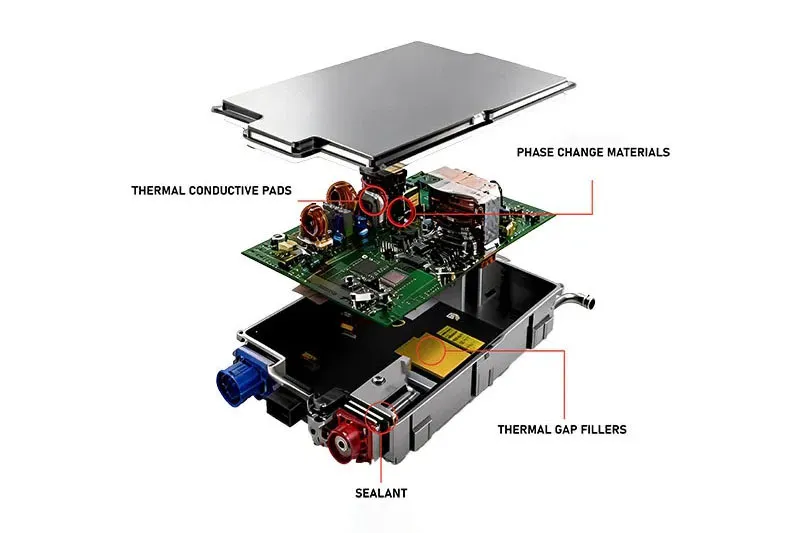
Cooling electronics gets tricky as devices become smaller and hotter. From EVs to LEDs, graphene-based materials can move heat more efficiently, giving designers practical options when standard metals or pads start hitting their limits.
Graphene Nanoplatelets in High-Power EV Inverters
Modern electric vehicles place serious heat loads on compact power inverters. Adding graphene nanoplatelets to polymers or interface materials can improve thermal management, especially when higher high power density pushes conventional solutions hard.
Inverter cooling design
Heat spreading
- Graphene fillers can support faster heat dissipation around power modules.
- A graphene thermal pad manufacturer can tune filler loading and pad thickness for tight assemblies.
Interface performance
- Softer graphene thermal pads can bridge tiny surface gaps, which is pretty handy when modules and heat sinks are not perfectly flat.
- Sheen Technology develops thermal interface options for demanding electronics applications.
For engineers comparing a graphene thermal pad manufacturer with traditional pad suppliers, electrical insulation, compression, aging, and real operating temperatures still matter as much as headline conductivity.
Reduced Graphene Oxide for Next-Gen LED Lighting Cooling
LED lighting converts part of its electrical input into unwanted heat, and poor temperature control can shorten useful life. Reduced graphene derived from graphene oxide offers a lightweight route for spreading that heat.
- Apply coatings or graphene composites near the LED thermal path.
- Move heat toward heat sinks, where larger surfaces release it.
- Check thermal conductivity, adhesion, and long-term stability under real fixture conditions.
This advanced cooling approach can support slimmer solid-state lighting designs without treating graphene as a magic fix. A graphene thermal pad manufacturer may also supply graphene thermal pads or related thermal interface products when direct contact cooling makes more sense than a coating.
→ Contact Sheen Technology for Vertically Aligned Graphene Pad Qualification
Sheen Thermal
Dongguan Sheen Electronic Technology Co., Ltd · Founded in 2008
Manufacturer of thermal interface materials and silicone foam for automotive electronics, energy storage, power electronics, communications and consumer electronics.
Certified
- ISO 9001:2015
- ISO 14001:2015
- IATF 16949:2016
What we supply
- Thermal conductivity Up to 90 W/m·K
- Thickness 0.3–10.0 mm
- Custom & samples Die-cut to drawing, 3–7 days