
 English
 usheenthermal

How Long Do Carbon Fiber Thermal Sheets Last? You Might Be Surprised
Date:2026-05-23
How Long Do Carbon Fiber Thermal Sheets Last? You Might Be Surprised
How long do carbon fiber thermal sheets last stops being small talk when a hot spot shows up and your RMA queue blows up. Carbon usually holds; resin aging, delamination, or a sloppy interface causes the drift.
So don’t shop on initial conductivity alone—ask for cycling, damp-heat, resistivity stability, and bond consistency at volume, lot after lot.
Reading Notes: How Long Do Carbon Fiber Thermal Sheets Last
➔ Service Life Expectancy: Typically 3–10 years in stable indoor use, validated by thermal cycling, resistivity stability, and QA metrics.
➔ Key Degradation Mechanisms: Polymer oxidation, resin embrittlement, CTE‐mismatch delamination, and moisture ingress reduce conductivity over time.
➔ Environmental Impact: Outdoors, UV, humidity, salt fog, and thermal swings accelerate aging—certification often mandates harsher testing.
➔ Durability Boosters: Apply protective coatings, integrate vapor chambers or PCM, and optimize fiber–resin systems to extend life and maintain performance.
How Long Do Carbon Fiber Thermal Sheets Last In Electronics?
If you’re asking how long do carbon fiber thermal sheets last in real devices, you’re really asking about heat, pressure, and time. This run-down keeps it practical, with what usually fails, and what to track when performance starts slipping.
Typical Service Life Expectancy and Reliability Metrics
People Googling how long do carbon fiber thermal sheets last usually want a number, but service life is really a bundle of reliability checks. It’s about lifespan under steady heat and clamping force, not calendar time.
What “lasting” means in electronics
Performance metrics that matter
· Thermal: thermal conductivity retention, interface thermal resistance drift
· Electrical: electrical resistivity stability (no surprise leakage paths)
Durability signals you can actually measure
· rising hotspot delta-T at the same power
· higher torque needed to keep the same contact pressure
Common reporting language you’ll see in test docs
· Operational hours at a set temperature (ex: 85–125 °C soak)
· Failure rate across lots after heat/humidity or cycling
· Mean time to failure tied to a defined “end-of-life” threshold
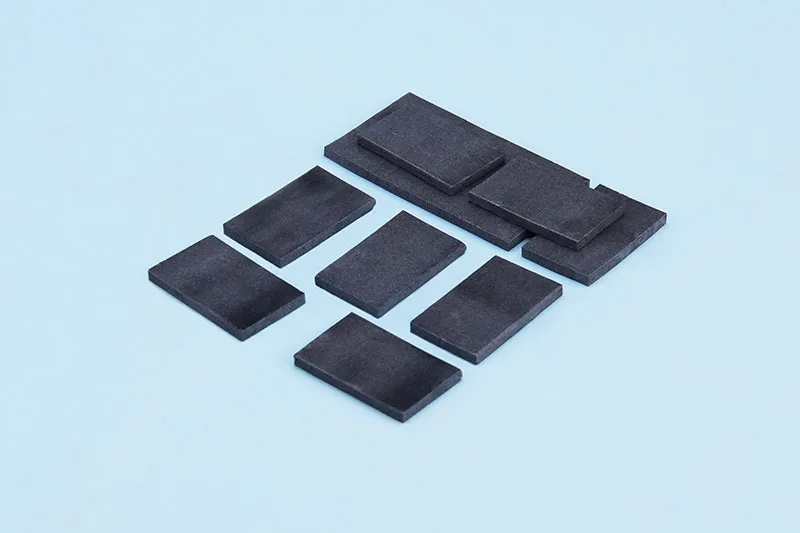
CSF35 Carbon Fiber Thermal Pad Reliability Test Report:
| Test Items | Test Conditions | Test Equipment |
| High-Temperature Aging | 150℃,1000H | Precision Oven |
| Constant Temperature & Humidity | 85℃、85%RH,1000H | Constant Temperature & Humidity Chamber |
| Thermal Shock | -40℃~125℃,1000H | Constant Temperature & Humidity Chamber |
Criteria for Judging Test Results
| Performance Parameter | Initial Value | Acceptance Criteria |
| Thermal Conductivity | 35.6 | ±15% |
| Hardness | 75 | ±10% |
| Compression (20% Compression Rate) | 27.3 | ±60% |
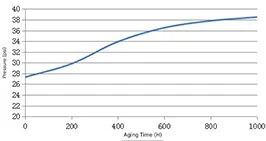
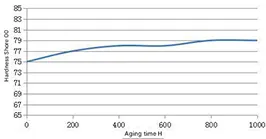
High-Temperature Aging Test Results
| High-Temperature Aging Test Record Sheet | |||||||
| Aging Time | H | 0 | 200 | 400 | 600 | 800 | 1000 |
| Thermal Conductivity | W/m*k | 35.6 | 36.0 | 36.5 | 36.2 | 36.7 | 37.0 |
| Hardness | Shore00 | 75 | 78 | 79 | 79 | 81 | 80 |
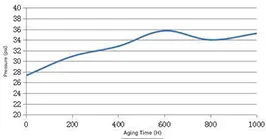
| Compression (20% Compression Rate) | psi | 27.3 | 29.8 | 33.9 | 36.5 | 37.8 | 38.5 |
| Performance Curve | 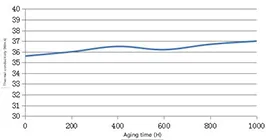 |
 |
 |
||||
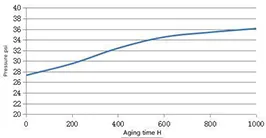
Constant Temperature and Humidity Test Results
| Constant Temperature and Humidity Test Record Sheet | |||||||
| Aging Time | H | 0 | 200 | 400 | 600 | 800 | 1000 |
| Thermal Conductivity | W/m*k | 35.6 | 36.3 | 37.1 | 36.6 | 37.1 | 37.4 |
| Hardness | Shore00 | 75 | 77 | 78 | 78 | 79 | 79 |
| Compression (20% Compression Rate) | psi | 27.3 | 29.5 | 32.4 | 34.5 | 35.4 | 36.1 |
| Performance Curve | 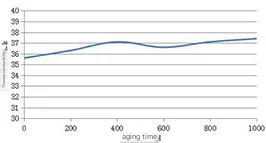 |
 |
 |
||||
Thermal Shock Test Results
| Thermal Shock Test Record Sheet | |||||||
| Aging Time | H | 0 | 200 | 400 | 600 | 800 | 1000 |
| Thermal Conductivity | W/m*k | 35.6 | 35.9 | 37.0 | 37.9 | 38.1 | 37.6 |
| Hardness | Shore00 | 75 | 78 | 77 | 79 | 81 | 80 |
| Compression (20% Compression Rate) | psi | 27.3 | 30.9 | 32.8 | 35.7 | 34.0 | 35.2 |
| Performance Curve | 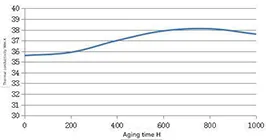 |
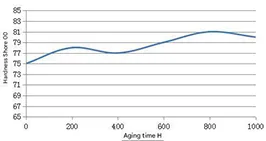 |
 |
||||
Test Conclusion: After aging for 1000 hours under various conditions, the CSF35 carbon fiber thermal pad maintained satisfactory performance with no changes to its appearance. Therefore, the CSF35 has successfully passed the reliability testing.
Need exact thermal conductivity, thickness range, dielectric strength, and aging data before you choose? Download the product datasheets to compare carbon fiber thermal sheet options for your build.
If you keep asking how long do carbon fiber thermal sheets last, anchor your decision to these tripwires, not vibes.
Key Degradation Mechanisms in Thermal Management
The short answer to how long do carbon fiber thermal sheets last: they last until thermal degradation stacks up faster than your design margin. Slow at first. Then it gets annoying.
Main ways performance goes sideways:
· Polymer matrix oxidation and chemical changes that stiffen the sheet
· Resin embrittlement that pushes material fatigue during heat cycling
· Delamination from CTE mismatch, hitting structural integrity at the interface
· Interface “dry-out” behavior versus pads/grease, raising contact resistance
· Moisture plus environmental factors shifting thickness and electrical behavior
A quick sanity flow when stuff starts failing in the field:
· Check mounting pressure history (creep, fastener relaxation).
· Inspect for edge lift, fretting marks, or shiny “no-contact” zones.
· Compare against a fresh control sample to spot oxidation-driven drift.
For anyone still circling back to how long do carbon fiber thermal sheets last, the big killers are interface problems and cycling, not a single dramatic crack.
Aging Performance Under Continuous Heat Spreading
Under continuous load, the question how long do carbon fiber thermal sheets last turns into “how fast does heat spreading efficiency decay.” You might not notice day one. You will notice when your fan curve starts acting weird.
What changes as continuous operation drags on
· Thermal conductivity can slip from microcracks and void growth
· Thermal resistance at the heat sink joint creeps up as contact gets rougher
· Long-term stability depends on thickness set and compression recovery
What to watch in a normal lab without fancy gear
· Log case-to-ambient delta at fixed watts (trend it weekly)
· Track torque retention, then correlate to heat dissipation changes
· Re-measure flatness; warping messes with heat transfer efficiency
When you need a redesign, not a band-aid
· If interface Rth keeps climbing after re-torque
· If hotspot-to-case gradient widens at the same airflow
· If dimensional drift shows up across the operating temperature range
If you need a plain synonym: carbon fiber thermal sheet longevity is mostly about keeping the interface tight and stable. And yes, people keep asking how long do carbon fiber thermal sheets last—because the answer is written in the trend line, not the datasheet.
4 Factors Affecting Carbon Fiber Sheet Lifespan
People keep asking, “How long do carbon fiber thermal sheets last” because the answer isn’t a single number. It depends on heat swings, water in the air, build quality, and plain old mechanical stress. If you’re trying to figure out “How long do carbon fiber thermal sheets last” in real devices, these four angles keep you honest.
Thermal Cycling Resistance and Operating Temperature Range
If “How long do carbon fiber thermal sheets last” is your big question, start with thermal cycling and your true operating temperature. Stuff fails faster when temperature fluctuations never stop.
Fit with the substrate
· Match thermal stability needs to the base material’s expansion
· A mismatch makes micro-shear each cycle, then resin fatigue
Heat ceiling rules the clock
· Exceeding the temperature range pushes thermal degradation
· Resin softens, then interlaminar cracks show up
What to check on day one (yes, boring, but it saves you)
· Vendor test notes for heat resistance and cycle count; Sheen Technology typically lists these right next to cure specs
· Your real peak temp, not the “should be” temp
So when someone asks, “How long do carbon fiber thermal sheets last,” the real answer starts with cycle profile, not calendar time.
Moisture Resistance, Density, and Environmental Stability
“How long do carbon fiber thermal sheets last” also gets wrecked by water sneaking in. Moisture resistance comes from the resin network and material density, and that ties directly to environmental stability during humidity exposure.
Water uptake isn’t just cosmetic
· water absorption can shift electrical resistivity and soften adhesive bonds
Battery areas are extra picky
· Heat plus moisture speeds environmental degradation and hydrolysis
Quick gut-check signs
· edge whitening, tacky feel, or bonding that peels too clean
If you’re asking “How long do carbon fiber thermal sheets last” in battery thermal regulation, treat sealing and resin choice like a big deal, not an afterthought.
Sheet Thickness, Lamination Process, and Dimensional Stability
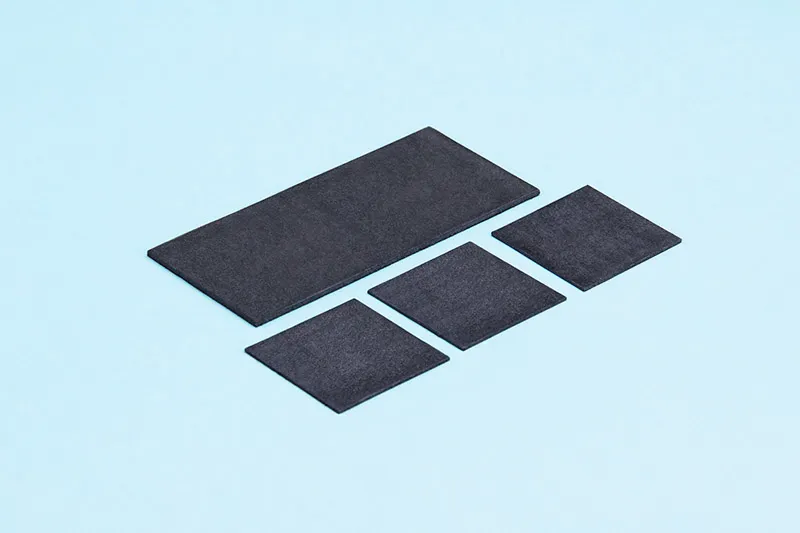
When people say “How long do carbon fiber thermal sheets last,” they often ignore geometry. sheet thickness and the lamination process decide how stable the part stays in a stack-up, and dimensional stability affects contact pressure over time.
Build choices that age well
Thickness selection
· Thin: less tolerance to local stress; thick: better spreading, but can store stress
Process discipline
· Poor manufacturing process control traps voids, then warpage
Failure chain you can actually trace
Voids in material layers
· local hot spots
· resin fatigue
· edge lift and delamination in the composite structure
Practical payoff
· Cleaner cutting, fewer fit issues, steadier interface contact; Sheen Technology often tunes layups for that kind of repeatability
So, “How long do carbon fiber thermal sheets last” can hinge on boring shop-floor details.
Tensile Strength, Flexural Modulus, and Long-Term Durability
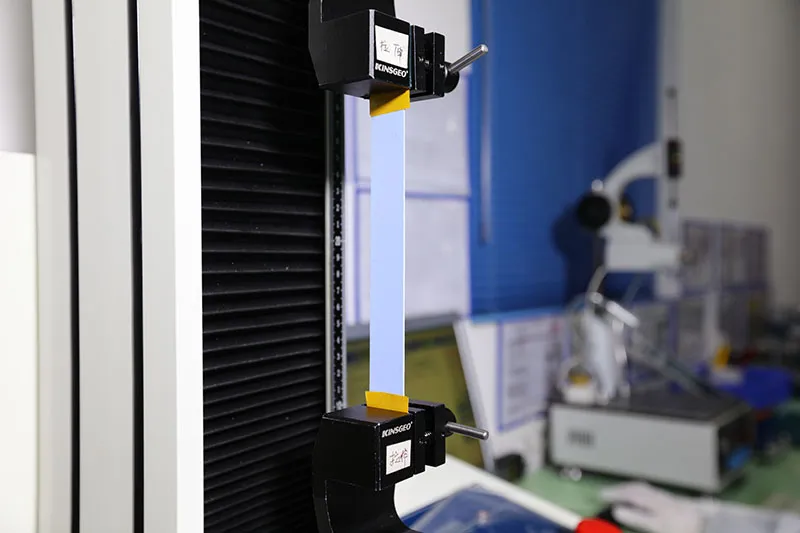
To answer “How long do carbon fiber thermal sheets last,” you’ve got to look at mechanical properties, not just thermal specs. Higher tensile strength and flexural modulus usually mean better long-term durability under clamps, drops, and vibration, which drives real lifespan prediction.
What’s stressing the sheet?
· Handling + rework → edge nicks turn into material fatigue
· Screws and clips → constant squeeze tests stress resistance
Quick comparison table (typical screening targets)
| Use case | Key structural performance stress | Suggested focus metric | Simple acceptance target |
| Phone/consumer assembly | clamp + bend | flexural modulus | minimal permanent set after fixture load |
| Power module interface | vibration + heat | tensile strength | no crack growth after vibe sweep |
| Battery pack pad/bridge | creep + humidity | long-term durability | stable thickness after soak + load |
If you’re still asking, “How long do carbon fiber thermal sheets last,” the plain-language version is: better fibers and stronger resin systems resist creep and cracking, so the sheet keeps doing its job longer. Synonym-wise, that’s the real service life.
Indoor Vs. Outdoor Lifespan Comparison
How long do carbon fiber thermal sheets last under indoor conditions? Here’s the real-life vibe: the calendar is usually ruled by steady humidity levels and solid temperature stability, not wild weather. If you’re asking “How long do carbon fiber thermal sheets last” for a device rack, a battery pack, or a lab setup, it mostly comes down to heat cycling and clamp force staying put.
Indoor Environment Durability
How long do carbon fiber thermal sheets last indoors when humidity levels don’t swing hard and temperature stability is decent? Expect the expected lifespan to track boring mechanical stuff—yet that “boring” is what decides performance retention.
· Quick reality check: carbon fiber thermal sheets rarely “age out” from sunlight indoors; they usually drift from pressure or pump-out.
· What actually sets material durability in indoor conditions:
Heat-cycle stress
· Interface sees repeated expansion and contraction
· Minor gaps grow, contact gets patchy, and performance retention starts slipping.
Pressure stability
· Fasteners relax over time
· If clamp force drops, the sheet can lose intimate contact and the expected lifespan shrinks.
Ambient control
· Stable humidity levels
· Lower moisture-driven creep means steadier material durability.
Small telltales you’ll notice: slightly higher steady-state temps, then bigger temp swings under load.
For buyers asking How long do carbon fiber thermal sheets last, Sheen Technology typically frames indoor selection around maintaining pressure and keeping thermal cycles tame, not chasing extreme coatings.
Need a closer match for your project? Browse these related application pages to see where carbon fiber thermal sheets are used in real production environments.
Outdoor Exposure Degradation
How long do carbon fiber thermal sheets last outside is a different story, because outdoor elements stack the deck: UV radiation, moisture ingress, and temperature extremes push multiple degradation pathways at once. People keep repeating “How long do carbon fiber thermal sheets last” because the answer changes fast with mounting, sealing, and location.
Environmental stressors and what they do to carbon fiber thermal sheets:
UV radiation
· Resin oxidation
· Surface embrittlement can kick off peeling and edge cracks.
Water + oxygen
· moisture ingress
· Swelling and interfacial weakening show up as lift or bubbles.
Salt + humidity
· weathering effects
· Conductive contamination plus corrosion at nearby metals can accelerate failure.
temperature extremes
· Rapid expansion mismatch
· Delamination risk rises, especially at corners and cutouts.
| Exposure driver | Typical outdoor severity (1–5) | Common outcome on sheets |
| UV radiation | 5 | Resin chalking, surface cracking |
| High humidity levels | 4 | Softening, adhesion loss |
| Salt fog | 4 | Edge creep, contamination paths |
| Freeze–thaw temperature extremes | 3 | Micro-gaps, delamination |
| Standing water / splash | 3 | Faster moisture ingress |
So, how long do carbon fiber thermal sheets last in the field? In plain terms: if you don’t block UV and seal edges, the “carbon fiber thermal sheets lifespan” gets cut down hard; Sheen Technology usually steers outdoor builds toward qualification plans that prove resistance across these degradation pathways.
Too Short Lifespan? Extend Sheet Durability Now
If you’re asking, “How long do carbon fiber thermal sheets last,” you’re not being picky—you’re being practical. Lifespan swings with heat, humidity, rubbing, and how clean the bonding surface is. Below is a straight-talk playbook to stretch service life, keep thermal flow steady, and cut performance fade, including what Sheen Technology tends to prioritize in real builds.
Apply Protective Coatings and Surface Finish Enhancements
When someone asks, How long do carbon fiber thermal sheets last, the unsexy answer is “as long as the surface stays stable.” A smart surface treatment buys time.
Protective coatings and barrier layers
What they block
· Moisture ingress that bumps contact resistance
· Oxygen-driven oxidation on exposed edges
What to use (typical picks)
· Thin conformal films for environmental protection
· Hard topcoats aimed at wear resistance and scratch control
Surface finish tuning for bonding
Goals
· Lower micro-voids so adhesives wet out evenly
· More consistent electrical resistivity across the pad
Shop-floor checks
· Edge sealing after die-cut
· Uniform roughness targets before lamination
This is the stuff that quietly answers “How long do carbon fiber thermal sheets last” with “longer than last time.”
Integrate Vapor Chambers or Phase Change Materials
If you keep peak temps down, you cut fatigue. That’s the heart of thermal management, and it changes how long parts stay glued and flat.
Use vapor chambers when heat spikes fast
· Better heat dissipation across the footprint
· Smoother temperature regulation, less thermal shock
Use phase change materials when loads pulse on/off
· Buffers the peak, lowers cycle amplitude
· Helps maintain thermal conductivity under repeated bursts
Pair with a simple verification routine
△ Log junction-to-case temps over 200+ cycles
△ Re-check bondline thickness after soak
| Cooling technology option | Typical peak temp drop (°C) | Expected impact on sheet life (relative) |
| Baseline graphite/carbon sheet only | 0–3 | 1.0× |
| Sheet + PCM pad | 4–9 | 1.2× |
| Sheet + vapor chamber | 8–15 | 1.4× |
If you’re still wondering, How long do carbon fiber thermal sheets last, this is often the fastest way to stretch lifespan without changing the sheet itself. Sheen Technology usually treats this as a system problem, not a single-material problem.
Optimize Material Composition with Reinforcement Fibers and Resin System
“How long do carbon fiber thermal sheets last” turns into “how well does the structure survive cycling.” That’s material composition territory.
Reinforcement fibers + resin system choices
Fiber side
· Hybrid plies that reduce crack growth under bending
· Better interleaf designs to protect the fiber matrix interface
Resin side
· Toughened chemistries that resist micro-cracking
· Lower moisture uptake to protect structural integrity
Composite structure tuning
Stack-up moves
· Add thin support scrims where clamp pressure is high
· Avoid sharp ply terminations at cut edges
Hybrid material options
· Graphite sheet or graphene film layers to keep mechanical properties from trading off too hard against heat flow
Ask it plainly: How long do carbon fiber thermal sheets last? If you upgrade material optimization plus cooling, the answer usually shifts from “it depends” to “it holds up.” Sheen Technology can help spec the mix so durability doesn’t wreck conductivity.
【Request a Custom Quote】 Not sure which carbon fiber thermal sheet fits your application? Send us your target thickness, operating temperature, expected cycle profile, and device type, and we can help recommend the right thermal solution for your build.
Sheen Thermal
Dongguan Sheen Electronic Technology Co., Ltd · Founded in 2008
Manufacturer of thermal interface materials and silicone foam for automotive electronics, energy storage, power electronics, communications and consumer electronics.
Certified
- ISO 9001:2015
- ISO 14001:2015
- IATF 16949:2016
What we supply
- Thermal conductivity Up to 90 W/m·K
- Thickness 0.3–10.0 mm
- Custom & samples Die-cut to drawing, 3–7 days