
 English
 usheenthermal

How to Choose the Best Thermal Interface Materials Supplier for Medical Equipment
Date:2026-01-23
How to Choose the Best Thermal Interface Materials Supplier for Medical Equipment
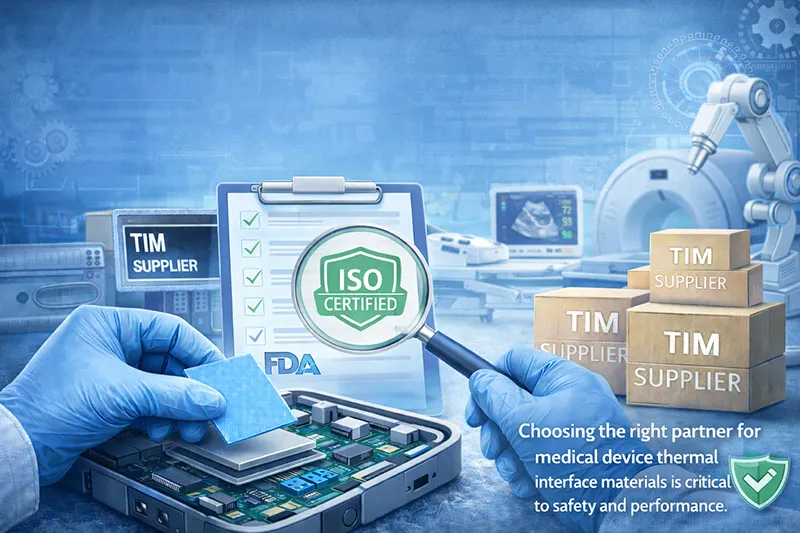
When you’re hunting for a thermal interface materials supplier for medical equipment, you're not just shopping—you’re betting the safety of patients and reliability of million-dollar machines on someone else's chemistry set.From MRI coils to ventilator cores, one lousy batch can cook your circuits or stall production faster than you can say “compliance recall”, This is the result of choosing the wrong supplier.
Understanding Thermal Interface Materials in Medical Equipment
From imaging machines to implantables, smart thermal interface materials keep medical tech cool and safe.Types of Thermal Interface Materials for Medical Devices
.webp "Thermal pad")
.webp "Thermal Gel")
- Thermal pads are flexible and offer different options for various device needs, including high-performance carbon fiber thermal pads, silicone-free thermal pads, thermal insulation sheets, and thermal phase change sheets. These materials provide stable performance over a wide temperature range, making them ideal when equipment needs to withstand continuous thermal cycling.
- Thermal potting compounds provide structural integrity and are best suited for applications requiring permanent bonding.
- Thermal greases and gels can fill tiny surface gaps between components, enhancing heat transfer without adding bulk.
Key Properties of Thermal Interface Materials in Healthcare
- High thermal conductivity ensures efficient heat dissipation from sensors and processors inside diagnostic gear like MRI or CT scanners.
- Electrical insulation prevents interference with sensitive patient-monitoring electronics—vital in intensive care setups.
Evaluating Supplier Capabilities for Medical TIMs
- Quality assurance systems like ISO-certified production lines
- Strong technical support teams who understand device-specific challenges
- In-house R&D capacity to develop custom solutions
- Manufacturing scale that meets both prototyping and volume production
- Transparent supply chain tracking from raw material sourcing to delivery
- Short lead times backed by global logistics networks
- Competitive cost models without compromising compliance
Understanding TIM Types and Applications in Healthcare
Short-run diagnostics? Long-term implants? Each use case demands different TIMs:.webp "thermal adhesives")
.webp "phase change Thermal material")
.webp "Thermal greases")
| Product Series | SF1500 Thermal Pad |
CSF45 Carbon fiber thermal pad |
SE100 thermal gel |
SG560-50 thermal paste |
SP205A-60 phase change thermal pad |
TIV800-30 thermal adhesives |
| Thermal Conductivity (W/mK) |
15.0 | 45.0 | 10.0 | 5.0 | 6.0 | 3.0 |
| Thermal Resistance (°C·in²/W) @30psi |
0.1 | 0.07 | 0.045 | 0.015 | 0.015 | - |
| Thickness Range (mm) |
1.0~5.0 | 0.3~12.0 | - | - | 0.2~0.5 | - |
| Density (g/cm³) |
3.2 | 2.6 | 3.4 | 2.8 | 3.0 | - |
| Operating Temperature (°C) |
-40~120 | -50~160 | -50~150 | -50~150 | -40~125 | -50~200 |
- For low-pressure applications: soft silicone-based thermal pads work great on uneven surfaces inside imaging machines.
- Gap fillers handle higher tolerances between PCBs and enclosures—think ventilators or infusion pumps.
- Adhesives come into play when bonding components permanently inside handheld ultrasound probes.
- Phase change materials suit high-performance processors used in robotic surgery systems.
- Greases work well when reworkability is needed—like replacing boards during maintenance cycles.
Performance Metrics for Medical Device Thermal Management
Heat Transfer Efficiency:- Measured via thermal conductivity, often >2 W/mK required in imaging gear.
- Surface wetting characteristics also influence micro-gap coverage efficiency.
- Must meet dielectric strength thresholds without compromising heat flow.
- Especially vital near patient-connected electrodes or biosensors.
- Resistance against outgassing protects optics inside diagnostic lenses.
- Mechanical durability keeps wearables functional through daily flexing cycles.
- Operating temperature ranges should span at least –40°C to +125°C depending on use case.
Why Choose the Right Thermal Interface Materials Supplier?
Choosing a reliable thermal interface materials supplier for medical equipment isn't just about price—it's about trust, safety, and long-term performance.The Impact of Material Quality on Patient Safety
High-quality thermal interface materials are non-negotiable when patient lives are on the line. Here's why:- They prevent overheating in surgical tools, protecting both users and patients.
- Consistent heat dissipation ensures diagnostic accuracy in imaging systems.
- Durable materials cut down on device failures during critical procedures.
Supplier Expertise: Ensuring Regulatory Compliance and Reliability
Medical-grade TIMs must hit more than just performance benchmarks—they need to meet strict regulatory frameworks too.- A seasoned supplier understands how to align with FDA regulations and ISO standards without slowing down your production cycle.
- Their knowledge helps you avoid costly re-certifications due to material inconsistencies or non-conformity issues.
Key Factors to Consider When Selecting a Supplier
Choosing the right thermal interface materials supplier for medical equipment isn’t just about availability—it's about trust, precision, and long-term value.- ISO Certification. A Must for Medical Suppliers, isn't just a badge—it’s your assurance that the supplier is playing by the rules of safety and consistency. For any thermal interface materials supplier for medical equipment, this certification separates contenders from pretenders.
- A clean, dust-free manufacturing environment guarantees product quality. it’s essential when producing components like ultrasound transducer housings or MRI-compatible thermal pads. Any reputable supplier should operate within certified cleanrooms to maintain low defect rates, especially when dealing with sensitive applications requiring stable material consistency.
- Custom Formulation Services for Unique Medical Applications. A top-notch thermal interface materials supplier for medical equipment will offer more than off-the-shelf options. They’ll collaborate with you to tweak ingredients, optimize thermal conductivity, or adjust curing times based on your product's needs—making sure everything aligns with your unique performance specs and compliance mandates.
- Material Traceability Systems and Their Importance in Healthcare. “By 2025, over 80% of healthcare procurement teams will require end-to-end traceability from raw material sourcing to final delivery.” — Gartner Healthcare Insights, Q1 2024 Report Traceability isn’t just a checkbox—it’s protection against liability and supply chain chaos. Whether it’s ensuring compliance with REACH or tracking down a single batch anomaly during a recall, strong traceability systems give manufacturers peace of mind while reinforcing accountability across the board.
5 Steps to Choose the Best Thermal Materials Supplier
Finding the right thermal interface materials supplier for medical equipment is no walk in the park. Here's how to make sure you're teaming up with the real deal.Step 1: Identify Your Specific Application Needs
- Pinpointing your exact application—like patient monitoring systems or defibrillator components—is where it all begins.
- Each device has unique performance demands, so don't skip this step.
- Think about operating temperature, thermal conductivity, and whether you need electrical insulation too.
✔ Does your material need to meet strict biocompatibility standards?
✔ Are there mechanical stress factors at play?
Getting clear on these details upfront saves a ton of headaches later when sourcing from a thermal interface materials supplier for medical equipment.
Step 2: Evaluate Supplier Certifications and Compliance
- Look for suppliers with valid ISO certification—this isn’t just paperwork; it’s peace of mind.
- Make sure they’re familiar with FDA regulations, especially if your product touches patients directly.
- Ask about their track record with audits and compliance checks.
Step 3: Assess Thermal Management Design Capabilities
- A solid supplier should have deep experience designing for complex assemblies like X-ray tubes or imaging modules.
- Their team must understand both passive and active cooling strategies tailored for healthcare-grade electronics.
- Look out for proven R&D strengths, including detailed modeling tools and access to cutting-edge testing environments.
Step 4: Investigate Their Approach to Curing Process Optimization
- How do they handle adhesive curing under variable humidity conditions?
- Can they tailor cure profiles based on substrate types like aluminum or polycarbonate?
- Do they offer data-backed insights into curing times versus bond strength?
Step 5: Confirm Proficiency in Surface Preparation Techniques
Short answer? If they can’t prep surfaces right, nothing else matters.Some suppliers still rely on outdated mechanical abrasion methods, but modern players use plasma activation or chemical treatments that enhance bonding without damaging sensitive substrates.
You’ll want someone who understands how surface energy impacts adhesion—and who can prove it with real-world test results across different material properties and device classes.
When sourcing from a thermal interface materials supplier for medical equipment, this is often the hidden deal-breaker nobody talks about until it's too late.
FAQs about Thermal Interface Materials Supplier for Medical Equipment
Why does the supplier choice matter so much in medical electronics?A trustworthy supplier of thermal interface materials provides high-quality materials, ensuring stable performance of the equipment while safeguarding patient safety.
Which types of materials work best for healthcare devices?
- Thermal Pads: Effective heat transfer for X-ray machine components.
- Thermal Potting Compound: Strong chemical resistance for defibrillator internal parts.
- Thermal Adhesives: Excellent electrical insulation properties for surgical robotics components.
- Thermal Greases: High thermal conductivity suited to patient monitoring systems.
- Phase Change Materials: safe for implantable medical devices.
From a single misstep during curing process optimization to poor adhesion caused by inadequate surface preparation techniques—defects don't just affect equipment; they directly influence diagnostic accuracy in test devices or signal integrity within lifesaving machinery.
What must a dependable supplier bring beyond certification success?
Cleanroom manufacturing environments protect sensitive assembly lines from contamination risk; material traceability systems map every batch under REACH regulation requirements;
Custom formulation services transform standard silicone thermal adhesives into tailored solutions built precisely around your application’s endurance needs.
In bulk orders, what prevents failures from multiplying across shipments?
Material traceability acts as a vigilant guardrail: each lot tracked against UL flammability ratings and RoHS compliance standards means that if one piece falters inside an MRI scanner subassembly or ventilator module, the origin is known quickly—containment before widespread harm.
Sheen Thermal
Dongguan Sheen Electronic Technology Co., Ltd · Founded in 2008
Manufacturer of thermal interface materials and silicone foam for automotive electronics, energy storage, power electronics, communications and consumer electronics.
Certified
- ISO 9001:2015
- ISO 14001:2015
- IATF 16949:2016
What we supply
- Thermal conductivity Up to 90 W/m·K
- Thickness 0.3–10.0 mm
- Custom & samples Die-cut to drawing, 3–7 days