
 English
 usheenthermal

How to Select Punchable Silicone-Free Thermal Conductive Material
Date:2026-07-23
In high-volume electronics, Punchable silicone-free thermal conductive material isn't a nice-to-have — it's the line between smooth production and costly slowdowns, where heat, mess, and compliance headaches gang up fast.
Punchability — the ability to die-cut clean edges without cracking, tearing, or burr formation — is a critical requirement for high-volume gasket and pad production. This guide provides engineers with the material properties, cost drivers, and reliability test methods needed to specify a punchable silicone-free thermal conductive material for volume production.
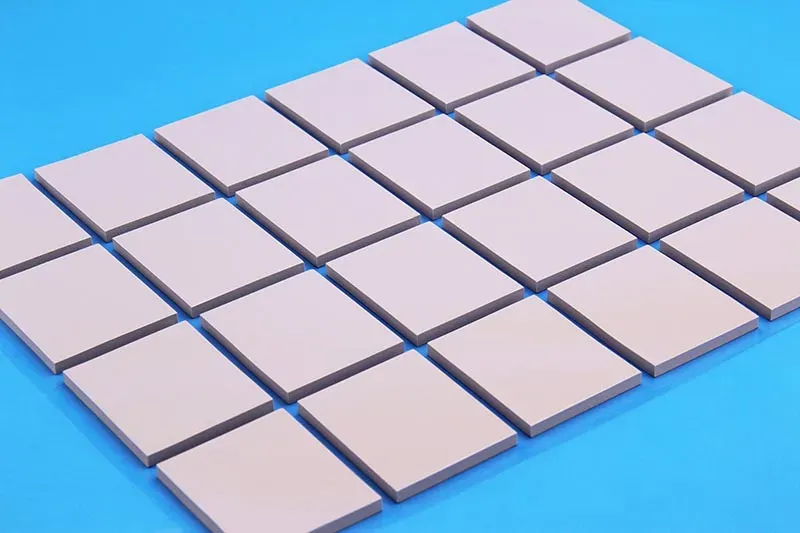
Rapid Notes on Punchable Silicone-Free Thermal Conductive Material
- Maximize Heat Transfer: Choose high-conductivity fillers (ceramic or graphite) to minimize thermal resistance in power electronics and LED modules.
- Ensure Die-Cut Precision: Verify punchability and flexibility for clean edges and conformable thermal pads that fit complex surfaces.
- Maintain Electrical Safety: Prioritize high dielectric strength and volume resistivity to prevent shorts in telecom and automotive units.
- Control Cost & Compliance: Balance filler choice and automated assembly compatibility, and factor in RoHS, REACH, and UL 94 V-0 certification expenses.
Data Shows 4 Key Properties For Punchable Silicone-Free Thermal Conductive Material
A punchable silicone-free thermal conductive material isn't just a spec-sheet thing — it's what keeps modern electronics cool, safe, and easy to assemble without messy trade-offs or performance dips.
Thermal Conductivity: Maximizing Heat Transfer Efficiency
When engineers talk thermal conductivity, they're really chasing smoother heat transfer and lower thermal resistance. A well-designed punchable silicone-free thermal conductive material makes that happen without adding processing headaches.
Key performance flow:
Material composition
- Ceramic-loaded pads — stable heat dissipation
- Graphite blends — faster heat flow paths
Interface behavior
- Tight surface contact — reduced air gaps
- Compression fit — improved thermal performance
Select proper filler ratio
- Optimize pad thickness
- Match surface roughness
Sheen Technology Silicone-free thermal pad series performance properties:
| Properties | Color | Thermal Conductivity | Thermal Impedance (1mm,@30psi) | Thickness | Standard Hardness |
|---|---|---|---|---|---|
| Unit | - | W/m·K | ℃*in2/W | mm | Shore 00 |
| AF100 | White | 1.0 | 1.1 | 0.25 ~ 5.0 | 50/70±5 |
| AF300 | White | 2.0 | 0.8 | 0.25 ~ 5.0 | 50/70±5 |
| AF500 | White | 3.0 | 0.6 | 0.25 ~ 5.0 | 50/70±5 |
| AF600 | White | 5.0 | 0.3 | 0.5 ~ 5.0 | 50/70±5 |
| AF600G | White | 6.0 | 0.25 | 0.5 ~ 5.0 | 50/70±5 |
| AF800 | White | 8.0 | 0.2 | 0.5 ~ 5.0 | 50/70±5 |
| AF1000 | Gray | 10.0 | ≤0.13 | 1.0 ~ 2.0 | 50~65 |
| Test Method | Visual | ASTM D5470 | ASTM D5470 | ASTM D374 | ASTM D2240 |
A silicone free thermal pad from Sheen Technology often balances these variables, keeping efficiency high while staying clean and easy to process.
"Advanced TIM adoption is accelerating as power density rises across EV and AI hardware," noted a 2025 IDC materials outlook, highlighting efficiency gains tied to non-silicone formulations.
Thermal Impedance and Cycling Stability Insights
Low thermal impedance at operating pressure (target <0.5 °C·cm²/W at 50 psi) ensures effective heat transfer. Cycling stability — less than 5% change in thermal impedance after 1,000 thermal cycles (–40 °C to +125 °C) — prevents long-term performance drift.
- Ceramic-filled grades: Stable through >2,000 cycles; filler network does not reorganize under thermal stress
- Graphite-filled grades: Slightly higher cycle-to-cycle variation due to anisotropy; verify at application-specific cycle count
Sheen Technology validates cycling stability per IEC 60068-2-14 on all silicone-free formulations.
Punchability and Flexibility for Custom Die-Cut Shapes
Not all materials survive fabrication. A punchable thermal interface material needs real punchability and flexibility, or production slows down fast.
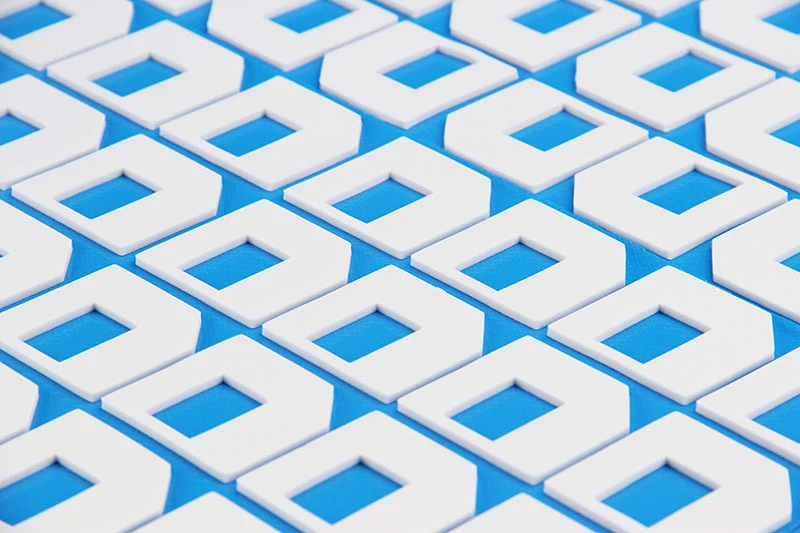
Fabrication chain:
- Material form — Soft yet stable sheets
- Die-cutting stage — Clean edges, no cracking
- Assembly — Fits tight custom shapes
Punchable silicone-free thermal conductive material stands out here, especially in high-volume manufacturing where consistency matters.
Dielectric Strength and Non-Conductive Performance
Heat control means nothing if safety drops. High dielectric strength ensures solid electrical insulation, especially in compact, high-voltage setups.
Protection hierarchy:
Core properties
- High voltage resistance
- Strong electrical properties
Functional outcome
- Prevent electrical breakdown
- Maintain system isolation
A silicone-free thermal interface material from Sheen Technology delivers this dual role — cooling plus protection — without conductive risks. That's why it fits telecom gear, power modules, and dense PCB layouts where safety margins are tight.
4 Cost Drivers Of Silicone-Free Thermal Materials
Silicone-free thermal choices are getting real attention, especially for clean processing and reliability. When working with punchable silicone-free thermal conductive material, cost isn't just raw material — it's manufacturing, compliance, and scale. Let's break down what actually moves the price needle in day-to-day production.
Ceramic Fillers vs. Graphite Composites Pricing
Material selection for punchable silicone-free thermally conductive material often splits into two tracks:
Ceramic path
- Material composition: alumina, boron nitride
- Traits: stable dielectric strength, decent thermal properties
- Cost behavior: lower, predictable
Graphite path
- Graphite composites engineered for high conductivity
- Traits: superior heat spreading, directional performance
- Cost behavior: higher due to processing complexity
Decision layers
Performance target
- Mid-range cooling — ceramic fillers
- High flux — graphite systems
Application fit
- Electrical insulation — ceramic wins
- Ultra-thin gap pads — graphite shines
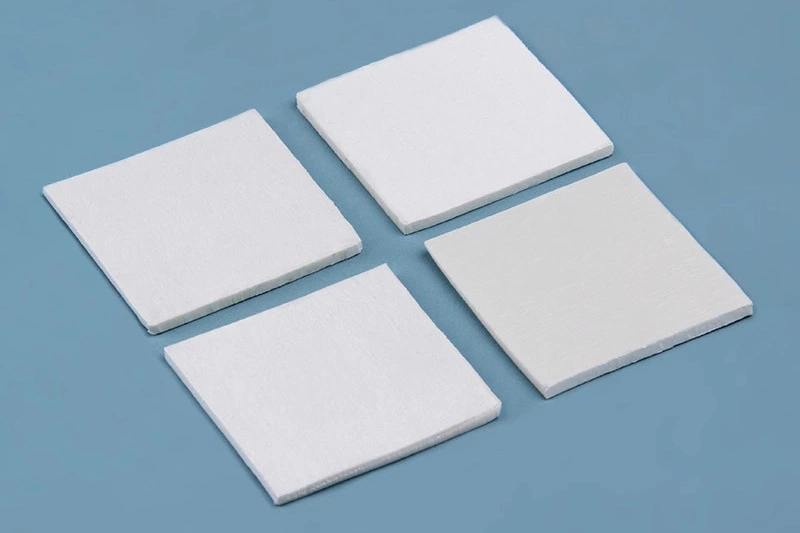
Sheen Technology often balances these trade-offs when designing punchable thermal conductive materials that stay cost-efficient without sacrificing reliability. At the same time, Sheen Technology also offers a complete range of boron nitride thermal pad and graphene thermal pad.
Automated Assembly Compatibility and Its Impact on Cost
Automation isn't optional anymore — it's survival. A punchable silicone-free thermal conductive material that feeds smoothly into automation lines cuts waste fast.
If assembly process matches material behavior:
- Less tearing during punching
- Smoother material handling
- Fewer rejects
Now zoom in:
- Roll-to-roll friendly formats
- Stable thickness control
- Clean die-cut edges
That's where Sheen Technology stands out — its silicone-free thermal conductive material is tuned for production efficiency, not just lab specs.
Regulatory Compliance Expenses from RoHS to UL 94 V-0
Compliance feels boring — until it delays a launch.
Steps shaping cost in punchable silicone-free thermal conductive material:
- Raw formulation screening
- RoHS and REACH verification
- Flame testing for UL 94 V-0
- Documentation and certification cycles
Each step adds lab fees, iteration time, and sometimes reformulation. Still, skipping it? Not an option in global regulatory markets focused on environmental and safety standards.
Economies of Scale in High-Volume Manufacturing
Cost drops when volume climbs — but only if execution is tight.
Key drivers in high-volume manufacturing:
- Bulk sourcing of polymers and fillers
- Optimized supply chain
- Higher capacity utilization
Quick snapshot:
| Material Type | Volume (units) | Cost per unit | Efficiency gain |
|---|---|---|---|
| Ceramic-based | 10K | $1.20 | Low |
| Ceramic-based | 100K | $0.85 | Medium |
| Graphite-based | 10K | $2.40 | Low |
| Graphite-based | 100K | $1.70 | High |
For punchable silicone-free thermal conductive material, scaling properly turns a premium product into a competitive one. That's the edge industrial buyers look for.
Sheen Technology provides detailed technical datasheets for punchable silicone-free thermal conductive materials. Download the Silicone-Free TIM Engineering Datasheet for complete specifications.
5 Punchable Material Tests To Ensure Reliability
Picking a Punchable silicone-free thermal conductive material isn't just about heat flow — it's about how it behaves under stress, cutting, voltage, and real-world wear. From silicone-free thermal pad punching to long-term durability, these tests keep performance honest. Brands like Sheen Technology build around these checks so your thermal conductive material doesn't fail when things heat up.
Thermal Cycling Stability Evaluation
Core focus:
- Temperature swings across repeated cycles
- Tracking degradation in performance
- Confirming long-term reliability
1) Test flow
- Heat to peak heat resistance limit
- Rapid cool for thermal shock
- Repeat until material integrity shifts
2) What to watch
- Micro-cracks
- Warping
- Loss in thermal conductive material efficiency
Sheen Technology AF300 Silicone-free thermal pad Reliability Test Report:
- Test Conditions
| Test Item | Test Conditions | Test Equipment |
| High-Temperature Aging | 100℃,360H | Precision Oven |
| Constant Temperature & Humidity | 85℃,85%RH,360H | Constant Temperature & Humidity Chamber |
| Thermal Shock | -20℃~100℃,360H | Thermal Shock Chamber |
- Acceptance Criteria
| Property | Initial Value | Acceptance Criteria |
| Thermal Conductivity(W/m·k) | 1.9098 | ±15% |
| Hardness(Shore 00) | 70 | ±10% |
| Pressure (20% compression) psi | 20 | ±60% |
| Volume resistivity(10¹³ Ω·cm) | 3.063 | ±5% |
High-Temperature Aging Test Results:
| Aging Time | H | 0 | 100 | 300 | 360 |
| Thermal Conductivity | W/(m·K) | 1.9088 | 1.9191 | 1.8917 | 1.9031 |
| Hardness | Shore 00 | 70 | 73 | 75 | 75 |
| Pressure (20% compression) | psi | 20 | 24.3 | 20.5 | 21 |
Constant Temperature and Humidity Test Results:
| Aging Time | H | 0 | 100 | 300 | 360 |
| Thermal Conductivity | W/(m·K) | 1.9088 | 1.8503 | 1.9135 | 1.8764 |
| Hardness | Shore 00 | 70 | 73 | 74 | 74 |
| Pressure (20% compression) | psi | 20 | 22 | 26 | 24 |
| Volume resistivity | 10¹³ Ω·cm | 3.063 | 3.338 | 2.356 | 3.475 |
Thermal Shock Test Results:
| Aging Time | H | 0 | 100 | 300 | 360 |
| Thermal Conductivity | W/(m·K) | 1.9088 | 1.9746 | 1.9325 | 1.9233 |
| Hardness | Shore 00 | 70 | 70 | 71 | 71 |
| Pressure (20% compression) | psi | 20 | 21 | 25 | 23 |
Comparison of appearance before and after aging:
| Before aging | High-temperature aging | Constant temperature & humidity | Thermal shock |
 |  |  |  |
Test Conclusion: Under the specified test conditions, AF300 performed satisfactorily after 360 hours of aging, with no changes in appearance. Based on the overall reliability test results: Pass.
Small shifts matter. A punchable thermal interface material that survives 500+ cycles without drift keeps devices stable, especially in compact electronics.
Punchability and Die-Cutting Capability Test
Clean processing matters more than it sounds.
Evaluation path:
- Tool contact — punching
- Shape formation — die-cutting
- Edge check — clean edges vs burrs
Key observations:
- Material deformation under pressure
- Consistency during fabrication
- Tooling wear impact
A Punchable silicone-free thermal conductive material should cut cleanly, no tearing. Sheen Technology tunes formulations so processing stays smooth even at high volumes.
Compressibility and Conformability Assessment
Why it matters:
- Better interface contact
- Reduced contact resistance
- Check gap filling across uneven surfaces
Performance signals:
- Stable material thickness
- Strong surface adaptation via conformability
Short take: if your silicone-free thermal pad punching material can't flex right, it traps air — and air kills heat transfer.
Volume Resistivity and Breakdown Voltage Analysis
Electrical safety breakdown:
Insulation check
- Volume resistance
- Resistivity
Stress test
- Rising voltage
- Detect current leakage
Failure point
- Breakdown threshold
- Confirm dielectric strength
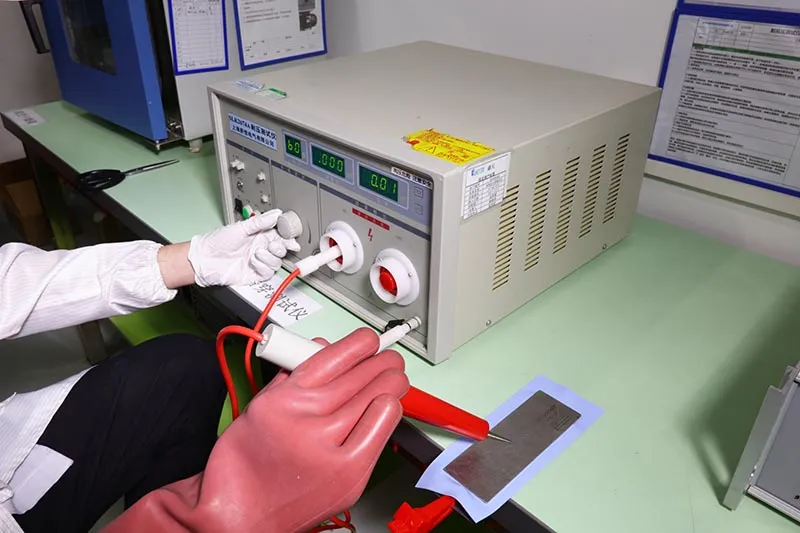
Sheen Technology AF1000 Silicone-free Thermal Pad Breakdown Voltage Test:
- Use the SLK2674A dielectric strength tester to measure the sample's breakdown voltage, referencing the ASTM D149 standard.
- Sample preparation: One sample measuring 60mm x 120mm x 2mm.
- Test method:
- After verifying the instrument is functioning correctly, securely connect the high-voltage test clip and the grounding clamp to the test specimen.
- Press the start button (the test indicator light will turn on). Slowly rotate the output voltage adjustment knob while monitoring the voltage reading on the display until the desired voltage is reached. If the instrument emits an alarm and the leakage indicator light turns on during this process, the specimen is considered non-compliant (failed); if there is no alarm and the leakage indicator light does not turn on, the specimen is considered compliant (passed).
- Record the test data.
- Upon completion of the test, reset the output voltage knob, press the start switch to stop the test, turn off the power, and clear any residue from the test surface.
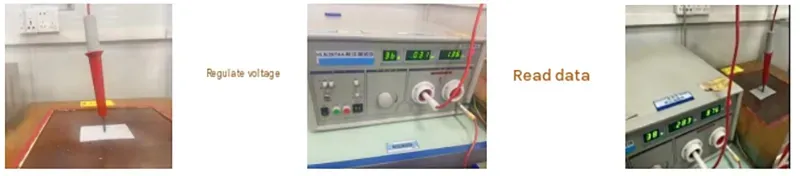
Test results:
| Test item | Test data |
| Breakdown voltage(Kv) | 8.76 |
A reliable Punchable silicone-free thermal conductive material doubles as solid electrical insulation, especially in high-density boards.
Low Outgassing and Flammability Testing
Safety and purity checklist:
Emission control
- Low outgassing
- Minimal volatile compounds
Fire response
- Flammability rating
- Combustion resistance
Stability
- Reduced thermal decomposition
- Improved fire resistance
Sheen Technology focuses on low-emission thermal conductive material options that meet UL standards without sacrificing punchability or performance.
Silicone-free thermal conductive materials serve a specific but growing segment of the TIM market: high-volume applications where silicone outgassing, migration, or cost requirements mandate an alternative binder system. The selection process requires evaluating thermal conductivity, punchability, dielectric safety, and cost across ceramic and graphite filler grades.
Sheen Technology provides punchable silicone-free thermal conductive materials in thicknesses from 0.25 mm to 5.0 mm, in sheet and roll formats with custom die-cutting options. Contact our engineering team for a technical datasheet, free sample kit, or application-specific material recommendation.
Sheen Thermal
Dongguan Sheen Electronic Technology Co., Ltd · Founded in 2008
Manufacturer of thermal interface materials and silicone foam for automotive electronics, energy storage, power electronics, communications and consumer electronics.
Certified
- ISO 9001:2015
- ISO 14001:2015
- IATF 16949:2016
What we supply
- Thermal conductivity Up to 90 W/m·K
- Thickness 0.3–10.0 mm
- Custom & samples Die-cut to drawing, 3–7 days