
 English
 usheenthermal

How to Select the Best High-Compressibility Carbon Fiber Thermal Pad
Date:2026-04-09
How to Select the Best High-Compressibility Carbon Fiber Thermal Pad
Heat sneaks up like rush hour traffic. In packed electronics, a High compressibility carbon fiber thermal pad acts like shock absorbers for heat, squeezing into gaps, calming hotspots, keeping boards cool when workloads spike.
U.S. Department of Energy data shows data centers draw about 2% of national electricity—cooling eats a big slice.
Buyers feel the squeeze: warped boards, rework, late nights. This guide pulls back the curtain on pads that flex, conduct, and behave under pressure, so volume orders stop feeling like a gamble and start paying rent.
Why Choose Compressible Carbon Fiber Pad?
Modern electronics are getting slimmer and hotter at the same time. That’s where a High compressibility carbon fiber thermal pad steps in. Built from carbon fiber, thermal graphite networks, and flexible binders, this carbon fiber thermal pad keeps heat under control while fitting tight, uneven spaces like a glove.
Enhanced Heat Dissipation in Tight Interfaces
When space is tight, heat has nowhere to hide. A High compressibility carbon fiber thermal pad improves thermal conductivity while lowering contact resistance, especially across rough or uneven surfaces.
Core performance factors:
· Higher interface pressure improves heat transfer
· Reduced surface roughness gaps
· Stable thermal management in compact devices
Material Layer
· Carbon fiber network:Boosts in-plane thermal conductivity
· Graphite pathways:Enhances lateral heat spreading
Interface Behavior
· Compression phase:Fills micro-voids
· Contact phase:Minimizes contact resistance
Performance Comparison Table
| Material Type | Thermal Conductivity (W/m·K) | Contact Resistance (°C·cm²/W) | Compression Rate (%) |
| Silicone Pad | 1.5–15 | 0.1–0.9 | 10–20 |
| High compressibility carbon fiber thermal pad | 15–45 | 0.07–0.28 | 30–50 |
This high compressibility thermal pad simply moves heat faster and cleaner.
Conforming to Custom Shapes for Electronic Enclosures
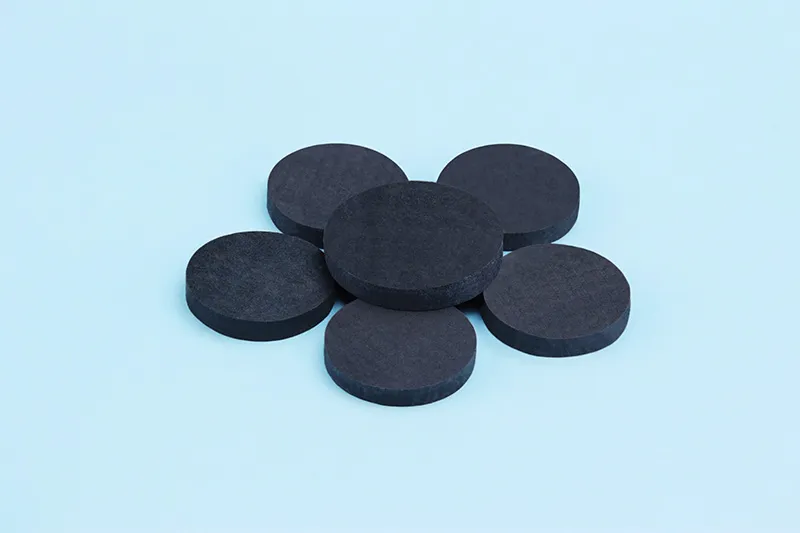
Not all housings are flat. Some are curved, stepped, or packed with components.
A High compressibility carbon fiber thermal pad handles that with serious conformability and flexibility.
✔ Strong gap filling ability
✔ Adapts to complex geometries
✔ Supports real customization
Short and sweet: it bends. It fits. It seals.
In practical use:
· Measure enclosure variation.
· Select thickness based on tolerance stack-up.
· Apply controlled compression.
· Achieve full-surface contact.
Inside battery packs, LED modules, and control boards, this carbon fiber thermal interface pad maintains steady pressure. That improves application flexibility and avoids air pockets. Even better, brands like Sheen Technology fine-tune carbon fiber pad formats for tight enclosures without sacrificing structural integrity.
Maintaining Long-Term Stability Under Thermal Cycling
Heat comes and goes. Materials expand and shrink. Weak pads crack or pump out.
A High compressibility carbon fiber thermal pad resists material degradation through smart binder chemistry and reinforced fiber networks.
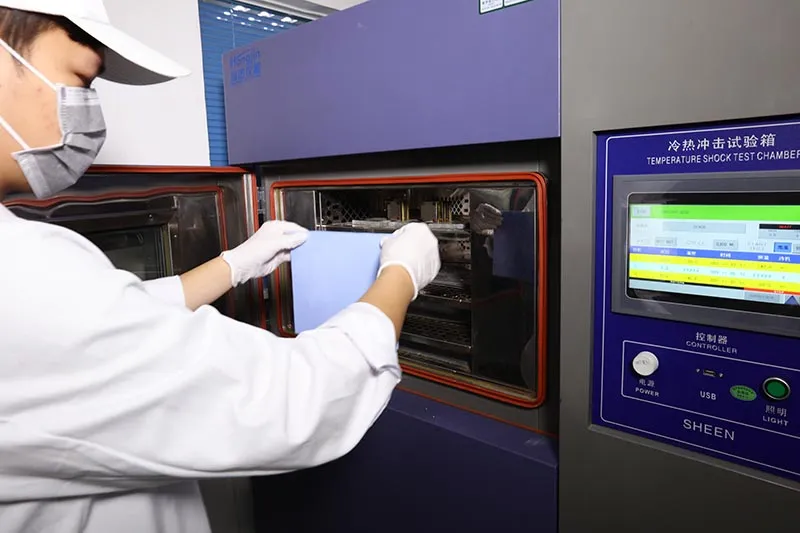
Thermal Cycling Resistance
· Repeated expansion control:Preserves performance consistency
· Fiber reinforcement:Enhances durability
Aging Control
· Oxidation-resistant matrix:Improves aging resistance
· Stable compression set:Protects long-term reliability
Over thousands of thermal cycling loops, the high compressibility carbon fiber thermal pad holds its structure. That means fewer failures, steadier temperatures, and less maintenance drama.
For engineers who need a compressible carbon fiber thermal pad that stays solid year after year, Sheen Technology delivers practical solutions built for real-world stress.
5 Key Parameters for Carbon Fiber Thermal Pad Selection
High compressibility carbon fiber thermal pad solutions sit at the heart of modern cooling design. From compact SSDs to power modules, choosing the right carbon fiber thermal pad can make or break your thermal management plan. Let’s break it down in plain terms.
Thermal Conductivity: Maximizing Heat Flow to Heat Sinks
When selecting a High compressibility carbon fiber thermal pad, start with thermal conductivity—it defines real heat transfer capacity.
Core Material Factors
· Carbon fiber orientation
· Filler loading ratio
· Binder distribution
Performance Impact
· Higher heat dissipation lowers component temperature
· Stable flow toward the heat sink improves long-term thermal performance
A high compressibility carbon fiber thermal pad with balanced conductivity keeps heat moving, not lingering.
Compressibility: Ensuring Full Contact with Integrated Circuits
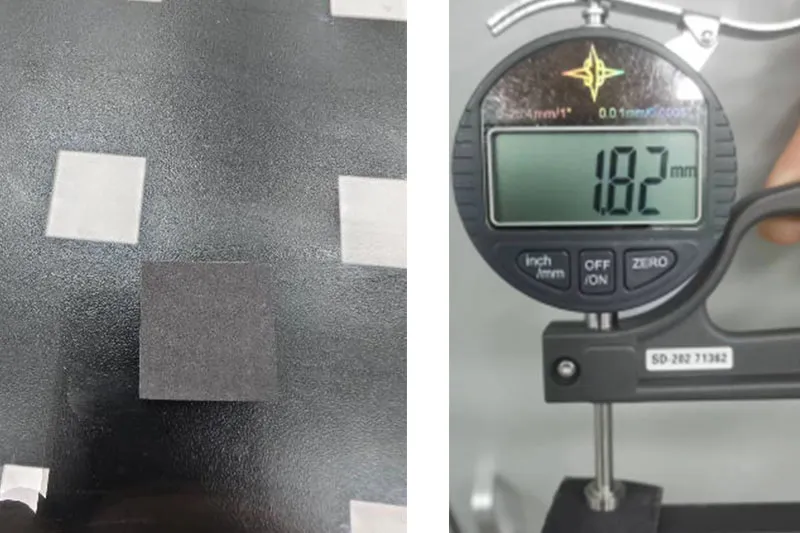
CSF20 Carbon Fiber Thermal Pad Compression Recovery Test Data:
| Test Item | Test Equipment | Test Conditions |
| Recovery Rate | Compression Recovery Tester | Compressed by 50% for 30 minutes, followed by a 30-minute rest period. |
Test Data:
| D0: Initial Thickness(mm) | 2.02 |
| D1: Thickness After Compression(mm) | 1.01 |
| D2: Thickness After Rest(mm) | 1.82 |
| Recovery Rate(%) | 80.4 |
High compressibility carbon fiber thermal pad performance isn’t just about numbers. Compressibility defines surface conformity and proper gap filling.
• Low compression → poor void reduction
• Moderate compression → ideal contact pressure
• Excess compression → risk to integrated circuits
A compressible carbon fiber pad adapts to component flatness variations. That means tighter contact area, better heat spread, fewer hotspots. Sheen Technology fine-tunes compression ratio so the high compressibility carbon fiber thermal pad maintains structure while improving real-world sealing.
Short version? Good squeeze equals good cooling.
Interface Resistance: Minimizing Thermal Barriers
Even with strong thermal conductivity, high interface resistance can choke performance.
Surface Factors
· Surface roughness
· Oxidation layers
· Mounting force
Material Response
· Pad elasticity improves contact surface mating
· Higher conformity reduces thermal barrier thickness
Result
· Improved heat transfer efficiency
· Stronger thermal interface material reliability
A High compressibility carbon fiber thermal pad lowers micro-gaps that quietly block heat.
Durability: Polymer Matrix and Binder Aging Performance
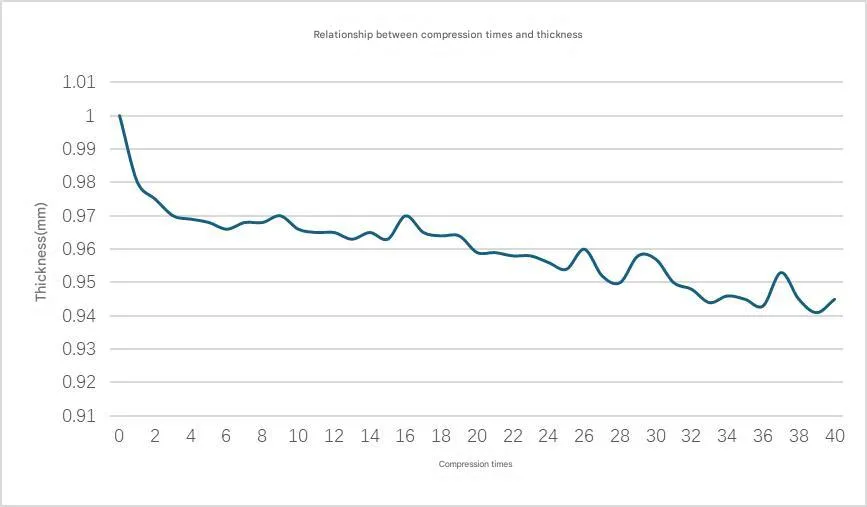
CSF20 Carbon Fiber Thermal Pad Fatigue Resistance Test Data:
| Test Item | Test Equipment | Test Conditions | Product Model | Sample Thickness |
| Fatigue Resistance |
Compression- Recovery Tester |
Compressed at 20 psi for 40 cycles; pressure held for 3 minutes. |
CSF20 | 1mm |
Test Data:
| Compression Cycles | 0 | 1 | 2 | 3 | 4 | 5 | 6 | 7 | 8 | 9 | 10 |
| Thickness(mm) | 1.00 | 0.980 | 0.975 | 0.970 | 0.969 | 0.968 | 0.966 | 0.968 | 0.968 | 0.970 | 0.966 |
| Compression Cycles | 11 | 12 | 13 | 14 | 15 | 16 | 17 | 18 | 19 | 20 | 21 |
| Thickness(mm) | 0.965 | 0.965 | 0.963 | 0.965 | 0.963 | 0.970 | 0.965 | 0.964 | 0.964 | 0.959 | 0.959 |
| Compression Cycles | 22 | 23 | 24 | 25 | 26 | 27 | 28 | 29 | 30 | 31 | 32 |
| Thickness(mm) | 0.958 | 0.958 | 0.956 | 0.954 | 0.96 | 0.962 | 0.950 | 0.958 | 0.957 | 0.950 | 0.958 |
| Compression Cycles | 33 | 34 | 35 | 36 | 37 | 38 | 39 | 40 | |||
| Thickness(mm) | 0.944 | 0.946 | 0.945 | 0.943 | 0.953 | 0.945 | 0.941 | 0.945 | |||
Long service life depends on internal chemistry.
Step 1: Evaluate polymer matrix stability under thermal cycling.
Step 2: Test binder aging at elevated temperatures.
Step 3: Measure resistance to material degradation in humid air.
Step 4: Confirm environmental stability after repeated load cycles.
A high compressibility carbon fiber thermal pad built with stable resin systems keeps its elasticity and conductivity year after year. No early cracking. No sudden drop in long-term performance.
Electrical Insulation: Balancing Safety and Performance
Cooling means nothing if safety slips.
Protection Layer
· Strong electrical insulation
· High dielectric strength
Circuit Safety
· Reduced leakage current
· Reliable short circuit prevention
System Integrity
· Preserved signal integrity
· Better component protection aligned with safety standards
A High compressibility carbon fiber thermal pad must cool efficiently while guarding circuitry. Sheen Technology designs carbon fiber thermal interface pads that balance thermal flow and electrical shielding—so your hardware stays cool and protected at the same time.
Compression Vs Conductivity: Which Matters?
When picking a High compressibility carbon fiber thermal pad, people often get stuck between softness and heat flow. Is it about pressure fit, or pure cooling speed? Let’s break it down in plain talk and see what really counts.
Compression
A High compressibility carbon fiber thermal pad lives or dies by its Compressibility and real-world fit. In uneven CPU lids or rough aluminum housings, that softness makes a big difference.
Core performance drivers:
· Thickness Reduction under load
· Better Surface Conformability
· Stable Contact Pressure
Material response
1.1 Under mounting force
· Controlled Deformation fills gaps
· Reduces trapped air through Void Elimination
1.2 During long-term use
· Manages Mechanical Stress
· Maintains interface shape
Application impact
2.1 In compression molding
· A carbon fiber thermal pad adapts to tolerance stack-ups
2.2 In rework cycles
· A high compressibility pad keeps structure without cracking
For tight assemblies, a High compressibility carbon fiber thermal pad from Sheen Technology handles uneven substrates like a pro. It simply hugs the surface better.
Conductivity
Softness is great, but Thermal Conductivity moves the heat. Fast.
· Higher Heat Transfer rate
· Lower Interface Thermal Resistance
· Smoother Temperature Gradient
A High compressibility carbon fiber thermal pad with optimized Material Composition pushes heat away from hotspots in CPU and GPU modules. That means stronger Thermal Performance when power loads spike.
Here’s the balance in real life:
· If conductivity is low, Heat Dissipation slows.
· If compression is poor, gaps raise resistance.
· If both align, the system runs cooler and steadier.
A high compressibility carbon thermal pad that blends pressure fit and conductivity wins in dense electronics. That’s why Sheen Technology designs each High compressibility carbon fiber thermal pad to support both structural compliance and serious cooling muscle.
Compression Ranges of Carbon Fiber Thermal Pads
Carbon fiber thermal pads come in different compression ranges, and that difference really matters in real builds. From tight, flat interfaces to awkward gaps that fight back, choosing the right high compressibility carbon fiber thermal pad affects cooling, lifespan, and assembly sanity.
Low Compressibility (10–30%): Sheets and Pads
Material properties stay consistent because deformation is limited.
· Flat contact favors steady interface pressure.
· Controlled thickness protects fragile chips.
Performance logic:
· Stable thermal conductivity
· Predictable heat dissipation across wide surface area
· Common application: CPUs, power modules, metal housings
This type of carbon fiber thermal pad works when movement is the enemy.
Medium Compressibility (30–50%): Standard Pre-Cut Forms
Short cuts, clean fits, fewer headaches. These pads balance durability with fit, helping device performance without pushing stress too hard. In consumer gear, component spacing is never perfect, so a thermal interface material that forgives small gaps matters. Sheen Technology often recommends this range for LED boards and routers using a high compressibility carbon fiber thermal pad alternative.
| Use Case | Compression % | Reliability Impact |
| LED drivers | 35% | High |
| Set-top boxes | 40% | Stable |
| Small power units | 45% | Improved |
High Compressibility (50–70%): Custom Shapes and Rolls
Design intent:
· Strong conformability for bad tolerances
· Real gap filling across complex geometries
Build flow:
· Easier assembly ease
· Flexible manufacturing flexibility
Thermal result:
· Lower thermal resistance supports smarter product design
A true high compressibility carbon fiber thermal pad shines here, especially in telecom racks.
Ultra-High Compressibility (>70%): Advanced Polymer Matrix
Extreme builds need extreme materials.
Core traits:
· Extreme compression without collapse
· Balanced pressure distribution on non-uniform surfaces
Material edge:
· Advanced materials protect long-term stability
· Proven performance under stress
Fit logic:
· Tuned for application-specific solutions
For harsh cycles, Sheen Technology relies on this carbon fiber thermal pad class, including advanced high compressibility carbon fiber thermal pad designs.
GPU Cooling: High Compressibility Pad Advantage
High-performance GPUs run hot, no surprise there. A High compressibility carbon fiber thermal pad bridges uneven surfaces, boosts contact, and keeps heat moving. Here’s how carbon fiber thermal pad design makes cooling smoother and more dependable in real-world GPU systems.
Enhanced Contact with GPU Modules and Heat Sinks
When a High compressibility carbon fiber thermal pad sits between a GPU module and a heat sink, contact quality defines everything.
Surface Interaction Layer
· Surface conformity allows the carbon fiber thermal pad to adapt to uneven dies and substrates.
· Micro-gap filling eliminates trapped air pockets that usually block heat flow.
· Better component mating improves physical alignment under mounting pressure.
Mechanical Response Under Load
· Balanced pressure distribution prevents stress concentration on delicate chips.
· Maintained interface integrity keeps the pad stable during vibration and transport.
Thermal Path Optimization
· Higher heat transfer efficiency begins with full-area contact.
· A high compressibility thermal interface pad keeps that contact consistent over time.
Sheen Technology designs each High compressibility carbon fiber thermal pad to stay flexible without losing structure, so GPUs get tight contact without extra mounting force.
Optimized Thermal Resistance for High Operating Temperatures
Heat spikes happen fast during rendering or AI training. A High compressibility carbon fiber thermal pad responds by keeping resistance low and flow steady.
Good thermal conductivity starts at the material core. Carbon fiber networks guide heat away from hotspots, supporting reliable heat dissipation even when clocks are pushed hard. With strong temperature management, GPUs maintain performance stability instead of throttling at critical operational limits.
In practical builds, installers notice three things:
· The pad compresses easily.
· Contact stays uniform.
· Thermal performance remains steady after repeated heat cycles.
That’s where Sheen Technology stands out. Its carbon fiber thermal pad lineup balances softness and structure, giving system integrators a high compressibility thermal pad that handles sustained workloads without drama.
Improved Reliability in Continuous GPU Workloads
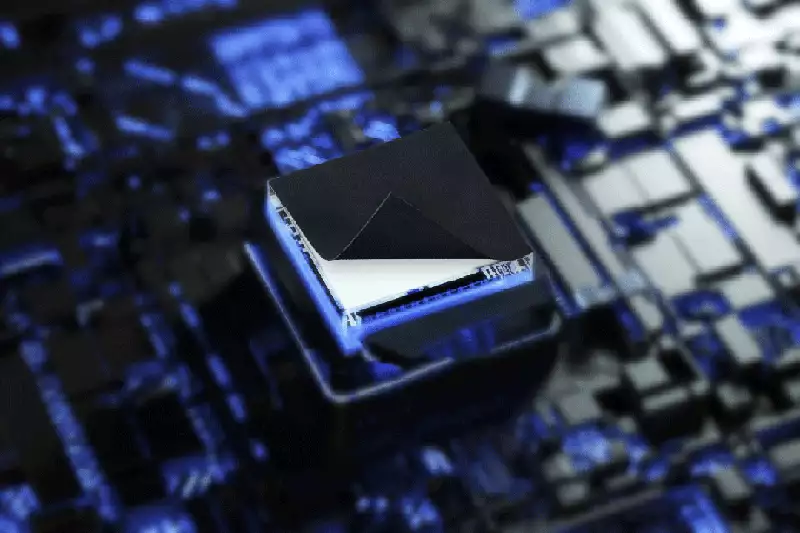
Long training sessions and 24/7 rendering farms demand consistency. A High compressibility carbon fiber thermal pad supports that through layered material control:
Material Core Stability
· Carbon fiber matrix resists material degradation under constant heat.
· Cured binders increase stress tolerance during expansion and contraction.
Interface Consistency Over Time
· Maintains consistent contact despite thermal cycling.
· Protects solder joints by reducing mechanical strain.
Lifecycle Performance
· Enhances overall durability in dense GPU clusters.
· Extends operational lifespan with predictable long-term performance.
A well-built high compressibility carbon fiber thermal pad doesn’t just cool on day one. It keeps cooling months later. That steady behavior is why many integrators choose a carbon fiber thermal pad solution from Sheen Technology when uptime really matters.
FAQs about High Compressibility Carbon Fiber Thermal Pad
Why is a High compressibility carbon fiber thermal pad critical for GPU modules and CPU cooling?
When GPU modules press against heat sinks, even a slight surface gap can trap heat and raise thermal resistance fast. A high compressibility carbon fiber thermal pad solves this through:
· High compressibility (10%–70%+) that fills microscopic voids between integrated circuits and substrates
· Strong thermal conductivity from carbon fiber and graphite networks for rapid heat dissipation
· Low interface resistance under compression molding pressure
· Stable electrical insulation for sensitive power electronics
In real workloads—AI graphics, rendering, telecom equipment—this balance directly improves reliability and keeps operating temperature range under control.
How does the material composition affect long-term stability and durability?
The structure works as a layered system:
Carbon fiber / Graphite filler materials
· Create continuous thermal pathways
· Improve heat dissipation across pads and custom shapes
Polymer matrix + Binder
· Maintain mechanical integrity during curing
· Protect against performance loss under thermal cycling
Overall performance impact
· Lower thermal resistance
· Strong durability under repeated compression
· Consistent long-term stability in LED lighting, solid-state drives, and telecom equipment
The tension lies in balance—too soft loses structure, too rigid increases interface resistance. The right formulation holds both.
Can High compressibility carbon fiber thermal pads be customized for complex electronic enclosures?
Yes—and customization often determines performance success.
Short overview: Pads, sheets, rolls, and pre-cut forms can be shaped to match irregular electronic enclosures without sacrificing thermal conductivity.
Manufacturing flexibility includes:
· Sheet fabrication for large substrates
· Precision die cutting for custom shapes
· Surface treatment for better contact with heat sinks
· Compression molding for controlled thickness and pressure response
Result: a thermal interface material that adapts to tight spaces in power electronics and GPU assemblies while maintaining reliability across wide operating temperature ranges.
Sheen Thermal
Dongguan Sheen Electronic Technology Co., Ltd · Founded in 2008
Manufacturer of thermal interface materials and silicone foam for automotive electronics, energy storage, power electronics, communications and consumer electronics.
Certified
- ISO 9001:2015
- ISO 14001:2015
- IATF 16949:2016
What we supply
- Thermal conductivity Up to 90 W/m·K
- Thickness 0.3–10.0 mm
- Custom & samples Die-cut to drawing, 3–7 days