
 English
 usheenthermal

Achieve Peak Cooling with Low Thermal Resistance Silicone-Free Pads
Date:2026-06-05
Achieve Peak Cooling with Low Thermal Resistance Silicone-Free Pads
Heat is chewing through modern electronics, and the fix isn’t another gimmick—it’s a low-thermal-resistance, silicone-free thermal-conductive pad that keeps components cool without the messy side effects engineers dread.
Buyers want performance, longer lifespans, and cleaner builds, not heat spikes or contamination, and this shift is rewriting what reliable cooling means.
Quick Answers: Low Thermal Resistance Silicone-Free Thermal Conductive Pad
➔ Use ASTM D5470 for accurate measurements: it ensures true thermal conductivity readings by minimizing interface errors.
➔ Optimize Pad Thickness: balance ultra-thin design with compression tolerance to reduce bulk resistance and maintain contact.
➔ Leverage Ceramic Fillers: incorporate aluminum oxide or boron nitride for enhanced conductivity and electrical insulation without contamination.
➔ Follow Best Application Practices: clean surfaces, align precisely, apply even pressure, and adhere to the manufacturer’s compression guidelines for consistent long-term performance.
5 Secrets: Low Thermal Resistance Silicone-Free Pads
Thermal management is getting real attention these days. As devices shrink and power climbs, engineers are hunting for smarter interface materials. The Low thermal resistance silicone-free thermal conductive pad stands out because it cuts heat fast without silicone bleed. Let’s break down what actually drives performance and how to get the most from a low-thermal-resistance silicone-free thermal-conductive pad in real applications.
Accurate Thermal Conductivity Measurements of Silicone-Free Pads
When evaluating a Low thermal resistance silicone-free thermal conductive pad, accurate thermal conductivity data matters.
· Control measurement techniques to reduce edge losses
· Follow strict test standards such as ASTM D5470
· Document full characterization conditions
· Verify surface flatness before testing
· Calibrate sensors for accuracy
· Minimize parasitic heat transfer paths
At the core:
★ Stable pressure
★ Clean interfaces
★ Repeatable setup
A reliable process digs deeper:
· Test Environment:Temperature stabilization,Controlled humidity.
· Interface Control:Polished plates,Consistent torque.
· Data Validation:Multiple cycles,Statistical averaging.
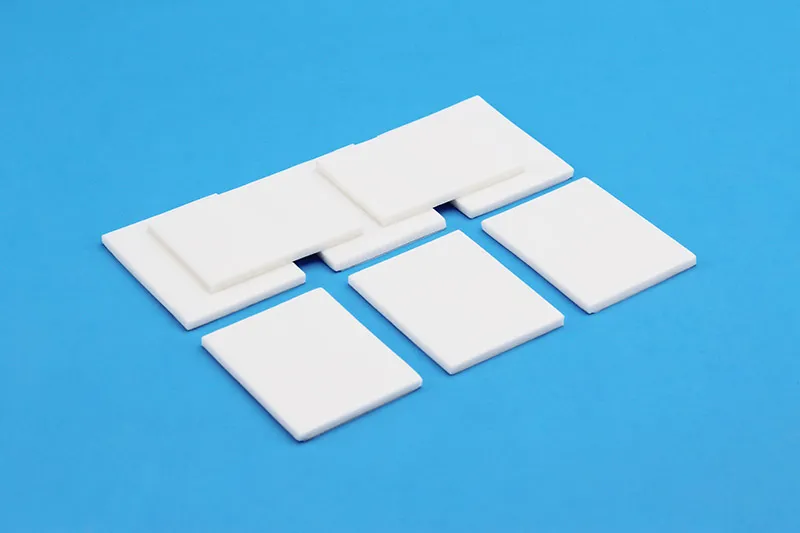
Sheen Technology Silicone-free thermal pad performance properties:
| Properties | Color | Thermal Conductivity | Thermal Impedance (1mm,@30psi) | Thickness | Standard Hardness |
|---|---|---|---|---|---|
| Unit | - | W/m·K | ℃*in2/W | mm | Shore 00 |
| AF100 | White | 1.0 | 1.1 | 0.25 ~ 5.0 | 50/70±5 |
| AF300 | White | 2.0 | 0.8 | 0.25 ~ 5.0 | 50/70±5 |
| AF500 | White | 3.0 | 0.6 | 0.25 ~ 5.0 | 50/70±5 |
| AF600 | White | 5.0 | 0.3 | 0.5 ~ 5.0 | 50/70±5 |
| AF600G | White | 6.0 | 0.25 | 0.5 ~ 5.0 | 50/70±5 |
| AF800 | White | 8.0 | 0.2 | 0.5 ~ 5.0 | 50/70±5 |
| Test Method | Visual | ASTM D5470 | ASTM D5470 | ASTM D374 | ASTM D2240 |
Recent IDC reporting (2025) notes that thermal validation standards are tightening as power densities rise in AI hardware.
“Thermal interface reliability is becoming a procurement-level metric in high-density electronics.” — IDC, 2025 market brief
Without disciplined measurement techniques, claims around silicone-free pads don’t mean much. Solid testing turns marketing talk into proof.
Optimizing Pad Thickness for Ultra-Low Thermal Resistance
Pad thickness drives thermal resistance more than most people expect.
· Thinner equals lower bulk resistance
· Too thin risks poor gap filler compliance
· Balance supports long-term heat dissipation
Optimization typically follows:
· Measure the real gap
· Select minimum compressible pad thickness
· Validate under assembly load
For a Low thermal resistance silicone-free thermal conductive pad, tuning thickness involves layered thinking:
· Mechanical Factors:Tolerance stack-up,Vibration margin.
· Thermal Path:Shortest conduction route,Reduced interfacial resistance.
· Reliability:Compression set,Long-term stability.
A low thermal resistance silicone-free thermal conductive pad only performs as designed when compression sits in its sweet spot. Too loose? Air pockets. Too tight? Mechanical stress. Get it right, and the heat moves smoothly.
Ceramic Fillers Enhance Silicone-Free Pad Performance
The magic inside many silicone-free thermal pads lies in ceramic fillers.
Common choices include:
· Aluminum oxide
· Boron nitride
These improve heat conduction while preserving electrical insulation.
· Material Selection:Evaluate material properties,Match target conductivity.
· Composite Design:Filler loading ratio,Particle distribution.
· Performance Verification:Cross-plane conductivity,Long-term stability.
In advanced composite materials, ceramic networks form continuous thermal paths. That’s how a Low thermal resistance silicone-free thermal conductive pad reaches higher conductivity without silicone oils. The result? Cleaner assembly lines and stable performance in sensitive optical or power electronics systems.
Sheen Technology focuses heavily on engineered filler dispersion to maintain conductivity without sacrificing flexibility.
Surface Pre-Treatment Techniques for Maximum Contact Efficiency
Even the best thermal interface materials fail on dirty surfaces.
Quick wins include:
· Solvent cleaning
· Light abrasion to reduce surface roughness
· Controlled drying
To reduce thermal contact resistance, follow a structured prep flow:
· Cleaning Stage:Remove grease,Eliminate oxidation.
· Surface Conditioning:Micro-polish uneven spots,Inspect flatness.
· Interface Alignment:Proper positioning,Even clamping force.
Good surface pre-treatment increases real contact efficiency and improves bonding conformity. A low thermal resistance silicone-free thermal conductive pad adapts better when surfaces are smooth and debris-free. Skip prep, and even premium materials lose their edge.
Best Practices for Applying Silicone-Free Thermal Conductive Pads
Application technique can make or break heat transfer.
· Avoid trapped air
· Follow specified compression range
· Keep alignment precise
Step-by-step application flow:
· Inspect pad integrity
· Position without stretching
· Apply uniform pressure
· Verify compression height
For consistent installation during mass assembly, consider:
· Operator Training:Handling guidelines,Storage conditions.
· Process Control:Torque monitoring,Compression checks.
· Post-Install Review:Thermal imaging,Performance logging.
A Low thermal resistance silicone-free thermal conductive pad performs best when applied evenly and handled carefully. Sheen Technology supports manufacturers with application guidance to ensure that silicone-free thermal pads maintain stable output over long service cycles.
When done right, the low-thermal-resistance silicone-free thermal-conductive pad becomes a quiet hero inside high-power systems—no silicone bleed, no drama, just steady thermal flow.
Comparing Silicone Vs. Silicone-Free Thermal Conductive Pads
Picking the right thermal interface isn’t just a technical call; it affects product lifespan, safety, and even brand trust. From classic silicone material designs to a Low thermal resistance silicone-free thermal conductive pad, each option handles heat dissipation and reliability in its own way. Let’s break it down in a clear, practical way.
Silicone Thermal Pads
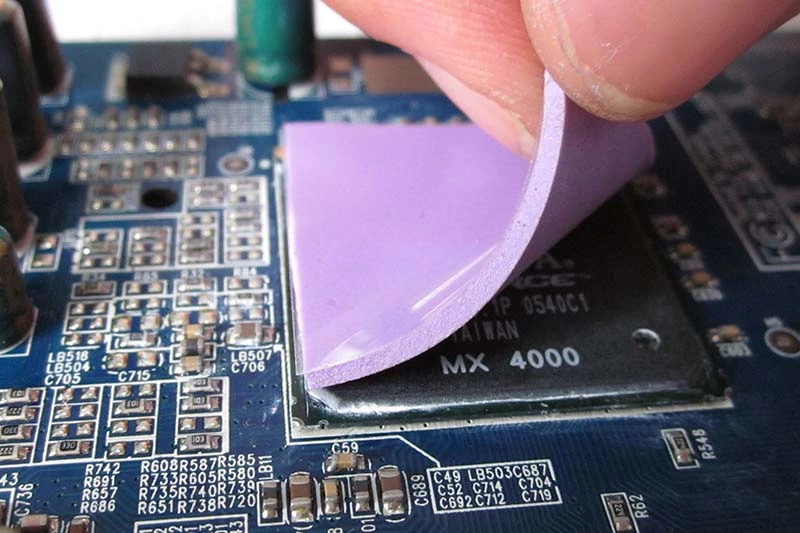
Sheen Technology Silicone-free thermal pad performance properties:
| Properties | Color | Thermal Conductivity | Thermal Impedance (1mm,@30psi) | Thickness | Standard Hardness | Customized Hardness |
|---|---|---|---|---|---|---|
| Unit | - | W/m·K | ℃*in2/W | mm | Shore 00 | Shore 00 |
| SF100 | Gray White | 1.5 | 0.90 | 0.3 ~ 10.0 | 40/60±5 | 10 ~ 90 |
| SF300 | Dark Gray | 2.0 | 0.70 | 0.3 ~ 10.0 | 40/60±5 | 10 ~ 90 |
| SF400 | Yellow | 2.5 | 0.50 | 0.3 ~ 10.0 | 40/60±5 | 10 ~ 90 |
| SF500 | Blue | 3.0 | 0.45 | 0.3 ~ 10.0 | 40/60±5 | 20 ~ 90 |
| SF600D | Gray | 4.0 | 0.40 | 0.3 ~ 5.0 | 40/60±5 | 30 ~ 90 |
| SF600 | Gray/Pink | 5.0 | 0.35 | 0.5 ~ 5.0 | 40/60±5 | 30 ~ 90 |
| SF600G | Gray | 6.0 | 0.30 | 0.5 ~ 5.0 | 40/60±5 | 30 ~ 90 |
| SF700 | Gray | 7.0 | 0.25 | 0.5 ~ 5.0 | 40/60±5 | 30 ~ 90 |
| SF800 | Gray | 8.0 | 0.22 | 0.5 ~ 5.0 | 40/60±5 | 30 ~ 90 |
| SF1000 | Gray | 10.0 | 0.18 | 0.5 ~ 5.0 | 40/60±5 | 30 ~ 80 |
| SF1200 | Gray | 12.0 | 0.15 | 0.8 ~ 5.0 | 40/60±5 | 30 ~ 80 |
| SF1500 | Gray | 15.0 | 0.10 | 1.0 ~ 5.0 | 40±10 | 30 ~ 60 |
At a glance, Silicone material solutions are popular because they balance thermal conductivity with flexibility.
• Stable compression properties
• Reliable electrical insulation
• Wide operating temperature range
Key performance layers:
Core Material
· Base: Silicone material
· Additives: Ceramic fillers improving thermal conductivity
Functional Traits
· Mechanical: Elastic recovery, stable compression properties
· Electrical: Safe electrical insulation
Risk Factors
· Oil bleed → potential contamination
· Surface migration → optics sensitivity concerns
In practical builds, silicone pads are easy to install. Compress, mount, done. Yet in clean environments, oil bleed can raise contamination risk. For sensitive optics or high-end processors chasing peak cooling, engineers sometimes step back and consider a Low thermal resistance silicone-free thermal conductive pad instead.
Silicone pads still shine in:
• automotive modules
• power supplies
• industrial controllers
Simple. Reliable. Budget-friendly.
Silicone-Free Thermal Conductive Pads
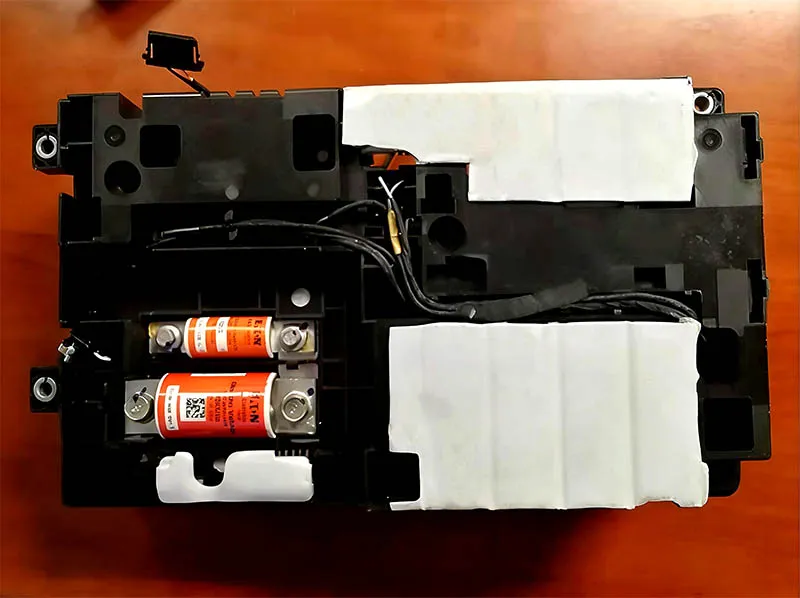
Now let’s talk about the Low thermal resistance silicone-free thermal conductive pad category. This design focuses on silicone-free composition, cutting down on outgassing and surface residue.
Performance priorities often stack up like this:
· Lower thermal resistance
· Cleaner interface contact
· Better material compatibility
Core structure breakdown:
Composition
· Polymer matrix without silicone
· High filler loading for improved heat transfer
Thermal Behavior
· Reduced interface gap → low thermal resistance
· Stable thermal performance under cycling
Environmental Control
✔ Outgassing prevention
✔ Lower contamination risk
A Low thermal resistance silicone-free thermal conductive pad works especially well in optical modules, medical devices, and precision electronics. The tighter interface helps achieve peak cooling without the migration concerns tied to silicone material systems.
Design notes engineers care about:
• Slightly firmer feel than silicone
• Needs controlled mounting force
• Optimized for thin-gap assemblies
For brands like Sheen Technology, offering both silicone and Low thermal resistance silicone-free thermal conductive pad options means customers can match application needs with accurate heat transfer control. In high-density electronics, even small reductions in thermal resistance can make a big difference.
When clean operation and strong thermal performance matter most, a Low thermal resistance silicone-free thermal conductive pad often becomes the smarter call.
Need exact thermal conductivity, thickness range, compression recovery, and electrical insulation details before you choose? Download the product datasheets to compare low thermal resistance silicone-free thermal conductive pad options.
Server Rack Cooling: Silicone-Free Pad Solutions
High-density racks run hot, and airflow alone can’t save the day. Choosing a Low thermal resistance silicone-free thermal conductive pad helps balance tight spacing, clean operation, and steady thermal management without messy residue.
Selecting Ultra-Thin Silicone-Free Pads for Blade Servers
Blade setups squeeze server components into minimal space, so pad thickness becomes critical. A Low thermal resistance silicone-free thermal conductive pad improves heat transfer while keeping pressure balanced across the blade server assembly.
Core considerations:
· Thermal conductivity rating suited for high-watt CPUs
· Compression tolerance under fixed mounting load
· Stability during long-term thermal management
· Define clearance between chip and heat sink.
· Match compression ratio to interface gap.
· Validate thermal interface material reliability under cycling.
When selecting a Low thermal resistance silicone-free thermal conductive pad, break the spec review into tiers:
Gap measurement
· ±0.05 mm tolerance
· Uniform surface planarity
Target thermal resistance
· Low contact impedance
· Consistent heat transfer path
Environmental safety
· Silicone-free composition
· No oil bleed
· Clean neighboring optics
A low thermal resistance pad that is silicone free also protects delicate sensors. That’s why teams often turn to Sheen Technology for consistent quality in thin-gap builds.
Need a closer match for your project? Browse these related application pages to see where low thermal resistance silicone-free thermal conductive pads are used in real systems.
Enhancing Heat Sink Contact in 1U Rack Units
In a 1U rack unit, vertical clearance is tight. The right Low thermal resistance silicone-free thermal conductive pad keeps full thermal contact without overstressing the mounting mechanism.
Key impact areas:
· Improved heat dissipation
· Reduced thermal resistance
· Stable interface pressure
A silicone-free thermal conductive pad works best when compression is even. Too thick? Pressure spikes. Too thin? Air gaps form. The sweet spot boosts overall thermal performance and keeps hotspots under control.
“Data center thermal density continues to rise, increasing demand for advanced interface materials that maintain performance under constrained airflow,” noted a 2025 IDC data center infrastructure update.
That’s real-world pressure. A Low thermal resistance silicone-free thermal conductive pad handles that squeeze while staying clean and reliable.
Integrating Pads with High-Airflow Cooling Systems
Air cooling still rules most racks. Pairing strong airflow with a Low thermal resistance silicone-free thermal conductive pad sharpens total thermal management.
Integration roadmap:
Align pad spec with fan curve
· Confirm heat transfer rate
· Check exhaust temperature spread
Optimize thermal pads placement
· CPU
· VR modules
Monitor thermal performance
· Load spikes
· Long-duration runtime
Short and simple: better contact equals better air cooling. A low thermal resistance silicone-free thermal conductive pad channels heat straight into the heat sink, letting the cooling system push it out fast.
For teams refining rack builds, Sheen Technology offers silicone-free thermal management materials tuned for high-airflow, high-density servers—clean, efficient, and ready for serious workloads.
【Request a Custom Quote】 Not sure which low thermal resistance silicone-free thermal conductive pad fits your build? Send us your target operating temperature, thickness target, gap size, and application type, and we can help recommend the right thermal solution for your project.
Sheen Thermal
Dongguan Sheen Electronic Technology Co., Ltd · Founded in 2008
Manufacturer of thermal interface materials and silicone foam for automotive electronics, energy storage, power electronics, communications and consumer electronics.
Certified
- ISO 9001:2015
- ISO 14001:2015
- IATF 16949:2016
What we supply
- Thermal conductivity Up to 90 W/m·K
- Thickness 0.3–10.0 mm
- Custom & samples Die-cut to drawing, 3–7 days