
 English
 usheenthermal

New Benchmarks for Thermal Conductivity Performance Testing of Boron Nitride
Date:2026-07-15
New Benchmarks for Thermal Conductivity Performance Testing of Boron Nitride
Heat transfer performance is a serious qualification issue in modern electronics, power modules, substrates, and thermal interface materials. Thermal conductivity performance testing of boron nitride helps engineers move beyond supplier claims and understand how a material is likely to behave in a real design.
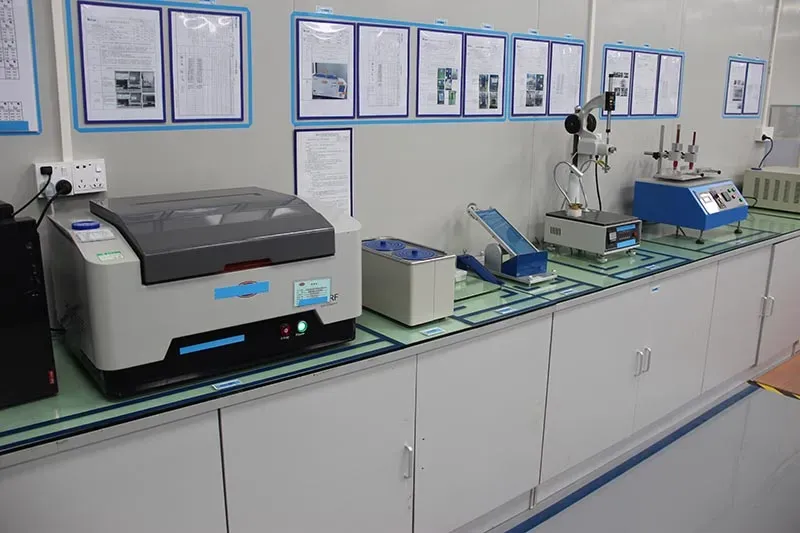
For Sheen Technology, the value of testing is not only a thermal conductivity number. A reliable test program also connects purity, density, porosity, sample preparation, measurement method, uncertainty, and application requirements. That is what turns BN thermal data into engineering decision support.
The practical question is not simply whether boron nitride can transfer heat. Engineers need to know which boron nitride grade, ceramic, composite, coating, filler, or interface format can deliver repeatable thermal performance under the expected production and operating conditions.
Quick Engineering Notes
➔ Purity control matters because impurities and crystal defects can interrupt phonon transport and reduce thermal conductivity.
➔ Sample preparation and density measurement matter because porosity, surface quality, dimensions, and contact conditions can shift test results.
➔ Measurement Methods: Calibrate to ASTM standards, then use Transient Plane Source for diffusivity or Laser Flash for fast, precise data.
➔ Data interpretation matters because diffusivity, density, specific heat, thermal expansion, uncertainty, and application limits must be reviewed together.
What a 16 W/m.K Benchmark Can and Cannot Tell Engineers
Boron nitride materials are often judged by heat-transfer efficiency in real devices. When engineers review Thermal conductivity performance testing of boron nitride, they look beyond a single number and focus on purity, material selection, and fabrication quality to understand practical results.
In an engineering qualification context, a benchmark is most valuable when it is tied to a defined material format and test condition. For example, a dense BN ceramic, a BN-filled polymer composite, and a BN thermal interface material may all require different interpretation even if they are all described as boron nitride thermal materials.
Purity and Defect Control
Purity remains a key factor in thermal conductivity performance testing of boron nitride. Impurities, crystal defects, and inconsistent raw material quality can interrupt heat flow and reduce result consistency.
Material quality factors
· Boron Nitride with fewer contaminants supports better phonon transport.
· Reduced defect levels help maintain stable Performance.
Testing observations
· Thermal conductivity testing often shows tighter result consistency in high-purity grades.
· Boron nitride thermal testing also highlights improved long-term reliability.
Practical outcomes
· Better Material Properties support demanding electronics.
· Reaching the target W/m·K value becomes more achievable.
For companies such as Sheen Technology, Thermal conductivity performance testing of boron nitride helps verify that production batches meet application requirements rather than relying only on theoretical values.
Comparing Hexagonal BN, Ceramics, and Composites
Engineers often compare hexagonal boron nitride, BN ceramics, and BN-filled composites because each material type has a different thermal pathway, mechanical profile, and processing window.
· Hexagonal Boron Nitride offers directional heat transfer and is frequently examined through Thermal conductivity performance testing of boron nitride.
· Ceramics add mechanical strength and dimensional stability.
· Composites combine thermal pathways with easier processing.
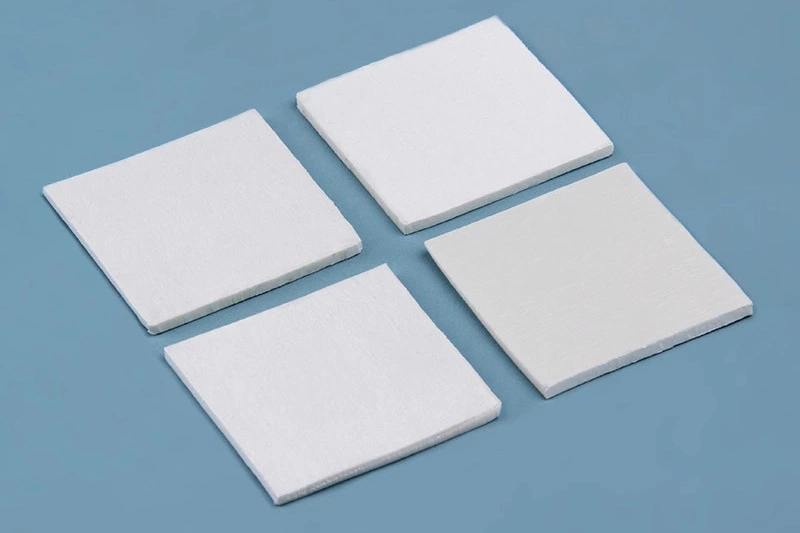
Key application areas include:
· Thermal interface materials
· Electronic substrates
· Power modules
For thermal interface materials, electronic substrates, and power modules, boron nitride conductivity evaluation should be linked to the exact material form the customer plans to use.
Manufacturing Processes’ Impact on Thermal Performance
Manufacturing choices appear clearly in validation work. Sintering, hot pressing, compounding, densification, filler dispersion, grain orientation, and defect management can all influence thermal performance.
Density development
Sintering
· Increases material densification.
· Reduces void-related thermal resistance.
Hot Pressing
· Promotes tighter particle bonding.
· Supports higher and more uniform conductivity.
Structural control
· Grain orientation affects Thermal Performance.
· Defect management improves consistency during thermal cycling.
Production optimization
· Material Processing choices shape final heat-transfer behavior.
· Fabrication methods determine repeatability.
· Production Methods influence product-to-product variation.
As a result, Thermal conductivity performance testing of boron nitride remains a critical verification tool. Sheen Technology uses these insights to connect processing decisions with measurable thermal outcomes and dependable product quality.
Download the Sheen Technology boron nitride material datasheet to review available grades, key material properties, and qualification discussion points before selecting a testing route.
4 Steps in Thermal Conductivity Performance Testing
Thermal conductivity performance testing of boron nitride helps manufacturers compare materials, control quality, and predict service behavior. In lab work, small differences in handling, contact, sample thickness, or environmental control can change the result. A practical testing workflow should therefore be documented clearly.
Step 1 – Sample Preparation and Density Measurement
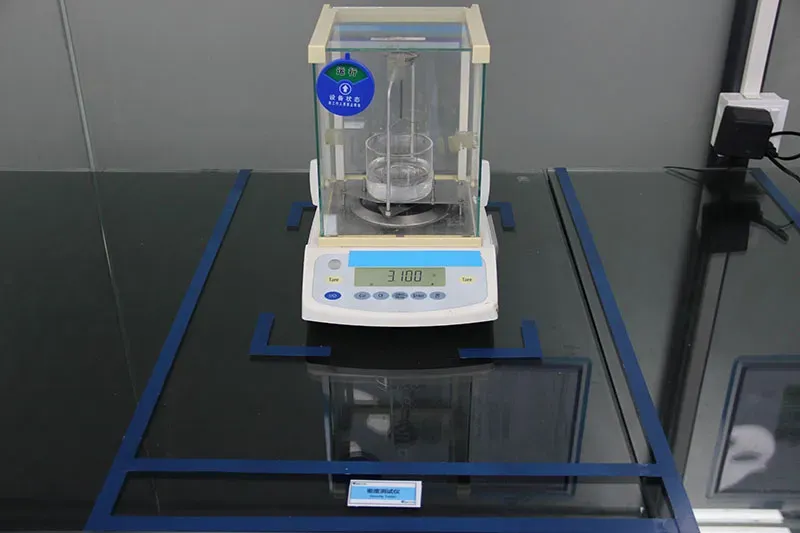
Careful sample preparation matters as much as the instrument itself. Specimens should have consistent geometry, clean surfaces, stable storage conditions, and accurate records for dimensions, mass, volume, and density.
· Prepare the sample with consistent surface quality.
· Verify dimensions using calibrated tools.
· Record mass and calculate volume.
· Determine density before thermal measurements begin.
Key checks:
· Uniform specimen geometry
· Clean measurement surfaces
· Stable storage conditions
A common workflow is:
Preparation
· Cut the sample to target dimensions
· Inspect for cracks or edge damage
Physical characterization
· Measure mass
· Calculate volume
· Determine density
Verification
· Compare results with material specifications
· Document the final measurement values
Because porosity strongly affects heat flow, Thermal conductivity performance testing of boron nitride can shift noticeably when density varies even within the same production batch.
Step 2 – Instrument Calibration to ASTM Standards
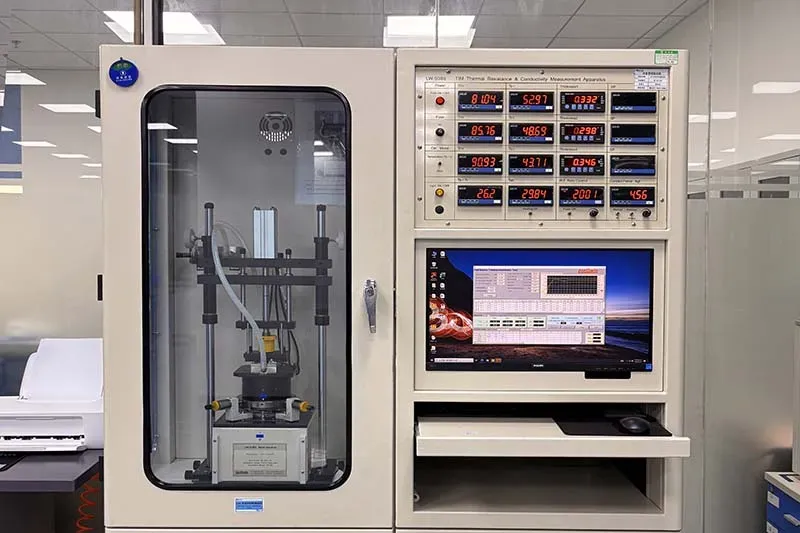
Accurate BN thermal conductivity testing depends on dependable instrument performance, traceable calibration records, and standards-aware procedures. ASTM-aligned methods can improve confidence, but the article should avoid implying one universal ASTM route for every BN material form.
Calibration program
ASTM compliance review
· Confirm applicable ASTM standards
· Check environmental requirements
Hardware verification
· Inspect each sensor
· Confirm temperature control stability
Reference validation
· Measure certified reference materials
· Evaluate accuracy and precision
| Check Item | Target Value | Measured Value | Status |
| Sensor drift | ≤0.5% | 0.3% | Pass |
| Temperature stability | ±0.2°C | ±0.1°C | Pass |
| Reference deviation | ≤1.0% | 0.6% | Pass |
| Repeatability | ≤1.0% | 0.7% | Pass |
Many labs performing thermal conductivity testing schedule calibration before each major production review. Sheen Technology often emphasizes traceable records because repeatable data supports better engineering decisions.
Step 3 – Thermal Diffusivity Measurement by TPS or Laser Flash
TPS and laser flash analysis are both useful in thermal conductivity performance testing of boron nitride, but they are not interchangeable. TPS can be useful for fast material evaluation and contact-sensitive assessments, while laser flash analysis is widely used for thermal diffusivity measurement, including elevated-temperature programs.
Measurement setup
· Position the TPS sensor
· Confirm specimen contact quality
Test execution
· Apply controlled heat input
· Record temperature response
Data collection
· Monitor heat transfer
· Complete data acquisition
Evaluation
· Calculate thermal diffusivity
· Review TPS curve consistency
Multiple readings are typically collected from the same measurement location and from different positions on the material. This helps reveal local variation and supports stronger confidence in the final TPS method results. In boron nitride thermal testing, stable contact pressure often improves repeatability.
Step 4 – Data Analysis for Conductivity and Expansion
After measurement, the focus shifts from raw data to engineering interpretation. Thermal conductivity is commonly calculated from thermal diffusivity, density, and specific heat. For packaging and substrate applications, thermal expansion and compatibility may also be important.
Analysis path
Property calculation
· Combine thermal diffusivity, density, and heat capacity
· Determine thermal conductivity
Expansion review
· Calculate thermal expansion
· Compare compatibility requirements
Quality assessment
· Estimate uncertainty
· Validate results
Documentation
· Prepare the final report
· Provide technical interpretation
Short review points:
· Check calculation consistency.
· Verify units.
· Compare historical trends.
Sheen Technology Boron Nitride Thermal Pad performance properties:
| Properties | Unit | SF1600-BN-sp-03(0.3mm) | Test Method |
| Color | - | White | Visual |
| Thermal Conductivity | W/m·K | 16 | ASTM D5470 |
| Thermal Resistance (@40psi) | ℃*cm2/W | ≤0.3 | ASTM D5470 |
| Application temperature | ℃ | -40~150 | - |
| Thermal weight loss rate | % | ≤1 | - |
| Thickness | mm | 0.2~5.0 | ASTM D374 |
| Breakdown voltage | KV,@AC | ≥4 | ASTM D149 |
| Dielectric constant | F/m, @ 1MHz | ≤4.2 | ASTM D150 |
| Volume resistivity | Ω*cm, @250V | ≥1013 | ASTM D257 |
| Rebound rate | % | ≥90 | - |
| Density | g/cm³ | 1.6±0.2 | ASTM D792 |
| Hardness | shore 00 | 60~80 | ASTM D2240 |
| Flammability rating | - | V-0 | UL 94 |
Thermal conductivity performance testing of boron nitride is most useful when the final calculations are linked to application needs such as semiconductor packaging, substrates, and thermal interface materials. Thermal conductivity performance testing of boron nitride provides value not only through raw numbers but through clear interpretation of performance limits, reliability expectations, and manufacturing consistency.
Download the Sheen Technology boron nitride datasheet to compare material properties with your target thermal conductivity, dielectric, density, and processing requirements.
Laser Flash vs. Steady-State Methods
For engineers comparing test routes, the choice often comes down to sample format, speed, operating temperature, thickness, anisotropy, and the type of answer needed. Laser flash analysis, TPS, and guarded hot plate testing each have a place in BN thermal analysis.
Laser Flash Analysis
When Thermal conductivity performance testing of boron nitride requires rapid screening, laser flash techniques are often selected because Thermal diffusivity can be obtained within seconds.
Test preparation
Sample setup
· Thin ceramic or film Sample material is cleaned and measured.
· Surface condition is checked before the Laser pulse is applied.
Instrument setup
· Detector response is calibrated.
· Data channels for Temperature rise are verified.
Measurement stage
Energy input
· A controlled Laser pulse heats one surface.
Signal collection
· The rear-face Temperature rise is recorded.
· Heat transfer behavior is tracked as a Transient method event.
Processing
· Data analysis converts response curves into Thermal diffusivity values.
Application
· Useful for boron nitride thermal testing at elevated temperatures.
Sheen Technology supports laboratories seeking fast BN thermal analysis workflows while maintaining repeatable measurement practices.
Guarded Hot Plate (Steady-State) Method
Thermal conductivity performance testing of boron nitride also relies on steady-state measurement when bulk samples are involved. Here, a Hot plate and Cold plate create a controlled Temperature gradient through a known Sample thickness.
| Material Type | Sample Thickness (mm) | Temperature Gradient (°C) | Heat Flux (W/m²) |
| BN Ceramic A | 5 | 20 | 180 |
| BN Ceramic B | 10 | 20 | 175 |
| BN Composite | 15 | 20 | 170 |
Key observations:
· A Guard heater limits edge losses.
· Stable Heat flux improves accuracy.
· Measured Thermal conductivity reflects true Steady-state behavior.
For thermal conductivity testing programs, this approach is slower than laser flash analysis but highly trusted for thermal resistance calculations. Thermal conductivity performance testing of boron nitride using guarded hot plates remains a common benchmark, and Sheen Technology frequently highlights it for validating bulk BN products and production consistency.
Application Scenarios for BN Thermal Conductivity Testing
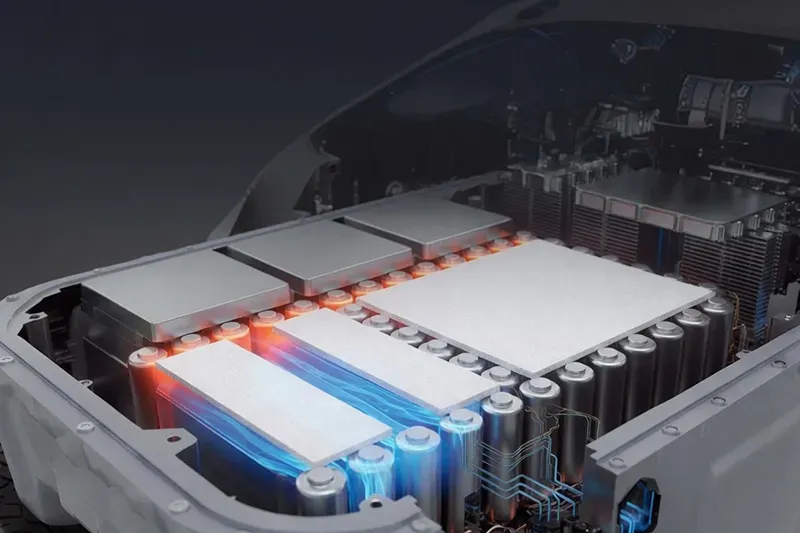
Testing should be connected to the end-use environment. A value that looks strong in a generic sample may not fully answer whether a material fits a power module, LED substrate, battery system, or thermal interface application.
| Application | What Testing Should Clarify | Why It Matters |
| Power modules | Conductivity, insulation, thermal cycling behavior, and expansion compatibility | Helps reduce thermal stress and supports long-term module reliability. |
| Semiconductor packaging | Thermal path consistency, sample direction, density, and interface behavior | Supports package-level heat removal without compromising electrical isolation. |
| LED substrates and modules | Heat spreading, dielectric behavior, and stability under operating temperature | Helps maintain light output stability and service-life expectations. |
| Thermal interface materials | Through-plane conductivity, bond line behavior, compression, and contact resistance | Improves selection of pads, gap fillers, coatings, and filled composites. |
| Battery and energy systems | Insulating heat-transfer behavior, thermal stability, and material compatibility | Supports safer module design and controlled heat distribution. |
Visit the Sheen Technology applications page to match boron nitride testing priorities with power electronics, semiconductor packaging, LED systems, battery modules, and other thermal management use cases.
And Contact Sheen Technology to discuss boron nitride thermal conductivity performance testing, material selection, and custom thermal management solutions for high-reliability electronic assemblies.
Sheen Thermal
Dongguan Sheen Electronic Technology Co., Ltd · Founded in 2008
Manufacturer of thermal interface materials and silicone foam for automotive electronics, energy storage, power electronics, communications and consumer electronics.
Certified
- ISO 9001:2015
- ISO 14001:2015
- IATF 16949:2016
What we supply
- Thermal conductivity Up to 90 W/m·K
- Thickness 0.3–10.0 mm
- Custom & samples Die-cut to drawing, 3–7 days