
 English
 usheenthermal

How to Optimize Cooling Using Custom Boron Nitride Thermal Conductive Solutions
Date:2026-07-15
How to Optimize Cooling Using Custom Boron Nitride Thermal Conductive Solutions
Heat is quietly becoming a design constraint in power-dense electronics. As devices become smaller, thinner, and more integrated, local hotspots can increase failure risk, reduce operating stability, and raise warranty or maintenance costs.
Custom boron nitride thermal conductive solutions help engineers move heat through electrically insulating material systems without forcing a trade-off between thermal performance, dielectric protection, and manufacturing practicality. For Sheen Technology, the value is not simply supplying a filler or pad; it is helping customers match boron nitride material design to the real application environment.
For thermal engineers, R&D teams, and purchasing managers, the key question is not only whether boron nitride can conduct heat. The more important question is which BN morphology, particle size distribution, surface treatment, compounding process, or interface format will support the final product requirement.
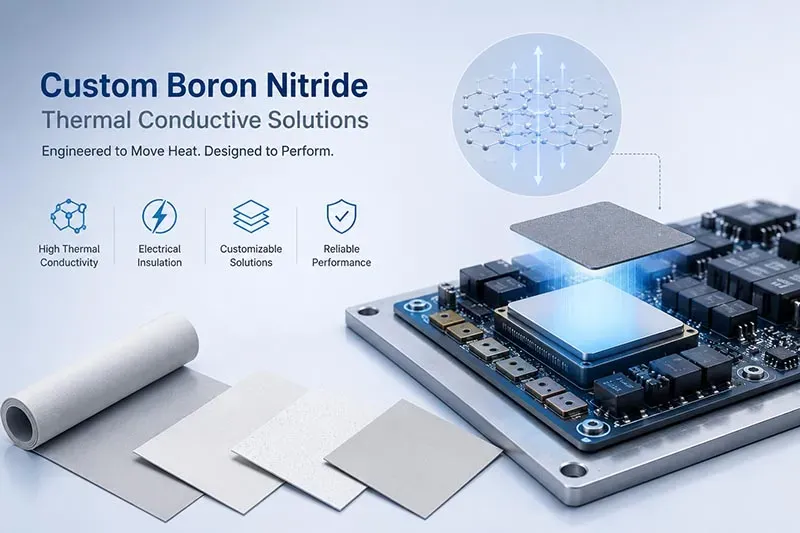
Quick Insights: Custom boron nitride thermal conductive solutions
➔ Unmatched Conductivity: BN powders can improve heat-transfer pathways in thermally conductive, electrically insulating composites for semiconductor packaging, LED modules, power electronics, and industrial control equipment.
➔ Tailored Morphology: Tailored particle size, morphology, and surface characteristics can support higher packing density, better dispersion, stable dielectric behavior, and long-term material reliability.
➔ Stable Interfaces: BN films, sheets, pads, and coatings can create durable thermal paths where adhesion, insulation, and interface stability matter.
➔ Power Module Cooling: Custom BN composites can help manage heat flux in compact power modules, server equipment, telecom hardware, and other high-power assemblies.
How Boron Nitride Improves Cooling in Electrically Insulating Systems
Modern electronics run hot, and smart thermal design keeps performance steady. From fillers to coatings, boron nitride helps move heat where it should go. This overview highlights practical cooling gains while connecting them to Custom boron nitride thermal conductive solutions used across advanced devices.
Unmatched Thermal Conductivity of BN Powders
High-purity boron nitride powder can support more efficient heat movement through a filled material system. When engineered correctly, BN particles help form conductive pathways that lower thermal resistance while preserving insulation.
Key benefit:
· Improved pathways for thermal flow in composites.
· Better insulation alongside cooling performance.
Material selection
· High-grade ceramic particles improve consistency.
Composite integration
· Supports high performance electronic assemblies.
Thermal outcome
· Stronger thermal conductivity across filled systems.
Custom boron nitride thermal conductive solutions often use engineered BN powders to balance cooling and electrical isolation. In material science, this combination is a big deal for LEDs and semiconductor packaging.
BN Films, Sheets, and Pads: Spreading Heat Across Interfaces
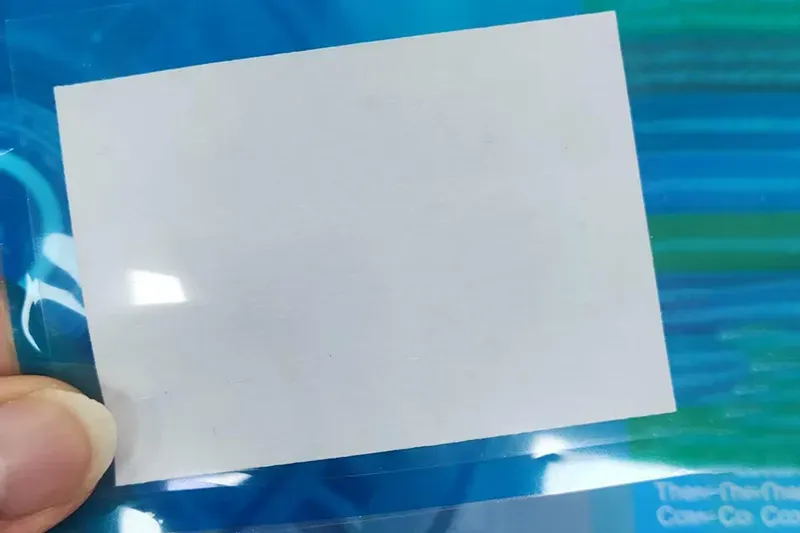
A thin film, sheet, or pad can spread heat across a larger area and reduce the risk of concentrated hotspots. In compact devices, interface formats are often selected when the design requires predictable thickness, assembly repeatability, and clean contact between components and heat sinks.
Short advantages include:
· Faster heat dissipation
· Better thermal management
· Compatibility with compact devices
Custom boron nitride thermal conductive solutions frequently include BN layers that act as a thin layer heat spreader. In dense boards and portable products, that extra cooling room helps maintain stable operation. Flexible formats also fit modern electronics cooling needs without adding much weight.
Stable Thermal Interface: BN Coatings in Electronics
BN-based coating technology can support heat transfer across component boundaries while adding electrical insulation and interface stability. Coatings may be considered where contact quality, adhesion, surface coverage, or environmental durability are part of the design challenge.
Strong adhesion
· Consistent contact over time
· Reduced thermal bottlenecks
Electrical protection
· Effective dielectric behavior
· Support for encapsulation
System value
· Improved stability
· Better heat spreading
Custom boron nitride thermal conductive solutions can incorporate BN-based thermal interface material designs. Sheen Technology develops options aimed at maintaining cooling efficiency in demanding electronics environments.
Managing Heat Flux in Power Modules via BN Composites
High-output systems require careful control of heat flux. In a composite structure, BN networks can distribute heat more evenly and reduce localized overheating. In power modules, this can help move thermal loads through substrates and toward the intended cooling path.
Within a composite structure:
· BN networks distribute heat more evenly.
· Localized overheating is reduced.
In a power module:
· Thermal loads move through the substrate more effectively.
· Reliability improves under repeated operation.
For high-demand equipment:
· Supports high power density designs.
· Enhances overall thermal management.
Custom boron nitride thermal conductive solutions and related boron nitride thermal solutions help designers manage rising power requirements. Sheen Technology also supports tailored thermal conductive solutions where cooling, insulation, and durability must work together. Custom boron nitride thermal conductive solutions remain a practical route to safer operating temperatures.
Why Choose a Custom BN Solution Instead of a Standard Material?
Standard thermal materials are useful when the application window is simple. Custom BN thermal conductive solutions become more relevant when the design must balance heat flow, electrical insulation, mechanical fit, dispensing or molding behavior, durability, and cost targets.
Tailored Particle Size Boosts Conductivity and Reliability
A carefully controlled particle size profile helps create efficient heat-transfer pathways while keeping electrical insulation intact. In many electronic packaging systems, Custom boron nitride thermal conductive solutions perform best when particle distribution and filler concentration are adjusted together rather than independently.
Material design priorities
Heat transfer efficiency
· Optimized particle size improves packing density.
· Reduced gaps support higher thermal conductivity.
Reliability goals
· Better contact between particles assists heat dissipation.
· Lower interfacial thermal resistance can reduce thermal stress.
Performance impact
· Electronic packaging:More uniform particle distribution helps maintain stable temperatures.
· Long operating cycles:Improved material reliability contributes to longer service life.
Sheen Technology vertically oriented boron nitride thermal conductive pads performance properties:
| Properties | Unit | SF1600-BN-sp-03(0.3mm) | Test Method |
| Color | - | White | Visual |
| Thermal Conductivity | W/m·K | 16 | ASTM D5470 |
| Thermal Resistance (@40psi) | ℃*cm2/W | ≤0.3 | ASTM D5470 |
| Application temperature | ℃ | -40~150 | - |
| Thermal weight loss rate | % | ≤1 | - |
| Thickness | mm | 0.2~5.0 | ASTM D374 |
| Breakdown voltage | KV,@AC | ≥4 | ASTM D149 |
| Dielectric constant | F/m, @ 1MHz | ≤4.2 | ASTM D150 |
| Volume resistivity | Ω*cm, @250V | ≥1013 | ASTM D257 |
| Rebound rate | % | ≥90 | - |
| Density | g/cm³ | 1.6±0.2 | ASTM D792 |
| Hardness | shore 00 | 60~80 | ASTM D2240 |
| Flammability rating | - | V-0 | UL 94 |
For many boron nitride thermal conductive applications, the right balance often outperforms simply increasing filler loading.
Optimized Morphology Improves Dielectric Strength
Not all boron nitride particles behave the same way under voltage, pressure, or thermal cycling. Particle morphology, aspect ratio, surface condition, and void content can influence insulation quality and breakdown risk.
Key factors include:
· particle morphology
· surface characteristics
· aspect ratio
· void content
When morphology is controlled, unwanted conductive pathways and void-related defects become less likely. Better surface compatibility can also improve bonding with the surrounding matrix. The practical outcome is stronger dielectric performance and more stable thermal management in power electronics, battery systems, compact modules, and other space-limited designs.
A practical outcome is higher dielectric strength and improved breakdown voltage performance. That matters in power electronics, battery systems, and compact devices where space is tight and thermal loads keep climbing. Custom boron nitride thermal conductive solutions often combine thermal performance with insulation targets, helping manufacturers avoid the trade-off that used to feel unavoidable. For users seeking custom BN materials or boron nitride thermal solutions, morphology optimization is often one of the most effective upgrades.
Customized Compounding Ensures Long-Term Thermal Management
Long-term performance depends on both formulation and processing. Filler dispersion, viscosity, mixing control, cure behavior, and production quality all affect whether the material keeps its intended thermal and dielectric properties over time.
· Formulation stage:define resin compatibility, filler grade, loading range, and dielectric target.
· Processing stage:control dispersion, viscosity, flow behavior, and defect reduction.
· Operating stage:evaluate thermal stability, composite durability, mechanical stress, and service-life expectations.
Sheen Technology’s role as a manufacturer is to connect these stages so the recommended material is not only thermally conductive on paper, but also manufacturable and reliable in the customer’s assembly.
Custom boron nitride thermal conductive solutions are frequently selected because the compounding process can be tailored to real operating conditions instead of generic laboratory targets. Sheen Technology focuses on matching filler systems, processing methods, and end-use requirements so thermal conductivity and insulation remain dependable throughout extended use.
Application Scenarios for Custom Boron Nitride Thermal Conductive Solutions
| Application | Thermal Challenge | BN Solution Direction |
| Semiconductor packaging | Localized die heat, insulation near circuits, compact package geometry | BN-filled encapsulants, underfills, adhesives, or dielectric thermal composites |
| LED modules | Hotspot control, optical component stability, long service-life expectation | BN powders, sheets, or thermally conductive insulating layers |
| Power modules and inverters | High heat flux, voltage stress, repeated thermal cycling | BN thermal interface materials, pads, coatings, or composite substrates |
| Battery and energy systems | Dense boards, continuous loads, airflow limits, high assembly repeatability | Custom BN pads, gap fillers, coated interfaces, or heat-spreading sheets |
| Battery and energy systems | Thermal stability, electrical isolation, module-level safety design | Dielectric BN composites and insulating heat-transfer layers |
Server Racks and High-Density PCBs: BN Pads in Action
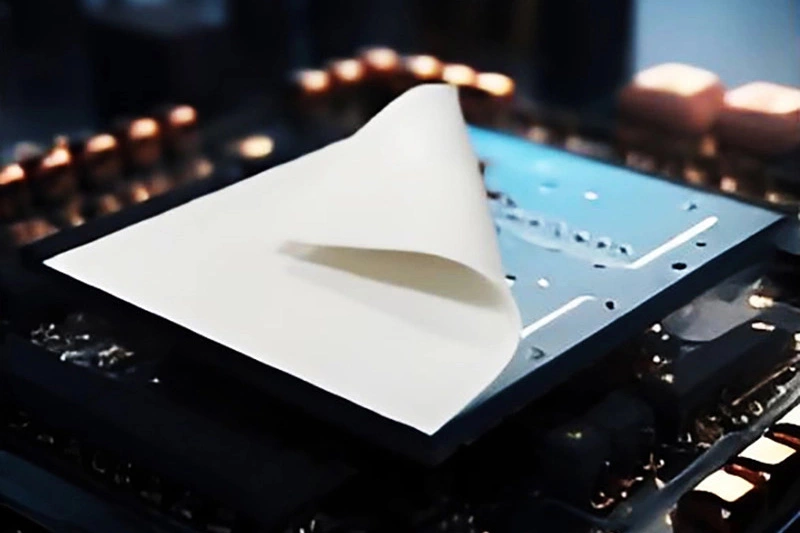
Modern server and data-center hardware can push thermal limits continuously. Custom BN pads and related thermal interface materials can help engineers manage heat while maintaining electrical insulation in crowded assemblies.
Seamless Integration on High-Density PCBs
In dense server hardware, Custom boron nitride thermal conductive solutions support clean routing and dependable thermal paths.
Layout alignment
· Custom BN pads match complex PCBs with a compact form factor.
· The boron nitride structure adapts to crowded high-density assemblies.
Thermal pathway management
· The thermal interface material bridges uneven surfaces.
· Heat moves toward cooling hardware, improving heat dissipation.
Deployment benefits
· Better mechanical integration with server components.
· Reduced assembly compromise in space-constrained designs.
Under sustained workloads such as enterprise computing, AI acceleration, networking, or power conversion, a well-designed BN thermal interface works in the background to spread heat away from sensitive areas and support stable operation.
Mitigating Thermal Runaway in Heavy Workloads
When processors and accelerators run flat out, temperature spikes can snowball into thermal runaway. Custom boron nitride thermal conductive solutions help interrupt that cycle by improving heat management around hot spots.
· Higher power density can create localized heating.
· Effective thermal conductive solutions spread energy more evenly.
· Consistent temperatures support system reliability and sustained performance.
A well-designed boron nitride thermal interface works quietly in the background. Custom BN pads transfer heat away from sensitive areas, helping servers stay stable during data-heavy operations, AI training runs, and continuous enterprise workloads.
Maximizing Cooling Efficiency for Power Modules
Custom boron nitride thermal conductive solutions contribute directly to cooler and longer-lasting power hardware.
Heat transfer optimization
· Improved thermal conductivity between components and heatsinks.
· Stronger heat dissipation from critical zones.
Cooling outcomes
· Increased cooling efficiency across rack systems.
· More stable thermal performance during load changes.
Long-term value
· Extended component lifespan for power modules.
· Better energy efficiency through reduced thermal stress.
By pairing custom boron nitride thermal conductive materials with targeted cooling strategies, Sheen Technology helps data-center operators maintain reliable thermal control while keeping power systems working at their best.
What Engineers Should Share Before Requesting a Custom BN Recommendation
To shorten material selection cycles, Sheen Technology can provide better guidance when the customer shares the design envelope early.
· Target thermal conductivity or thermal resistance requirement.
· Required dielectric strength, breakdown voltage, or insulation class.
· Operating temperature range and expected thermal cycling conditions.
· Matrix or resin system, if the BN filler will be compounded into another material.
· Bond line thickness, pad thickness, coating thickness, or target geometry.
· Processing method: dispensing, coating, molding, pressing, lamination, or assembly placement.
· Mechanical constraints such as flexibility, compression, adhesion, hardness, or gap-filling need.
· Compliance, reliability, and qualification requirements for the end market.
Contact Sheen Technology to discuss custom boron nitride thermal conductive solutions for semiconductor packaging, power modules, server hardware, LED systems, and other high-reliability electronic assemblies.
Sheen Thermal
Dongguan Sheen Electronic Technology Co., Ltd · Founded in 2008
Manufacturer of thermal interface materials and silicone foam for automotive electronics, energy storage, power electronics, communications and consumer electronics.
Certified
- ISO 9001:2015
- ISO 14001:2015
- IATF 16949:2016
What we supply
- Thermal conductivity Up to 90 W/m·K
- Thickness 0.3–10.0 mm
- Custom & samples Die-cut to drawing, 3–7 days