
 English
 usheenthermal

Solving Heat Issues: Thermal Management for Pluggable Optics
Date:2026-09-11
Heat is stalking crowded transceiver cages, and thermal management for pluggable optics is now a reliability and sourcing problem, not just a heatsink chore. Pads, grease, graphite, and copper must work together when airflow gets pinched.
Dell’Oro Group’s January 2025 forecast projects the optical transport equipment market will reach $17 billion by 2029.
For buyers, the real test is fit, consistency, insulation, compatibility, and serviceability, plus dependable supply. Smart cooling starts here.
Quick Insights: Thermal Management for Pluggable Optics
➔ Heat Spreader Selection: Choose copper sinks, vapor chambers, or microchannel coolers paired with gap pads and thermal grease for low interface resistance.
➔ Airflow Optimization: Use aluminum extrusion heatsinks with ducting, graphite sheets, and infrared thermography to identify hotspots and improve convective paths.
➔ Transient Control: Integrate phase-change materials, dielectric coolant circuits, and real-time heat flux sensors for 800G spike mitigation and reliable diagnostics.

Note: This image was generated with the assistance of artificial intelligence; it is not a real photograph and is for reference only.
3 Heatsink Designs For Pluggable Optics
Good thermal management for pluggable optics starts by moving concentrated module heat into a larger cooling path. Copper, vapor chambers, and microchannels tackle that job differently, so practical choices depend on power, space, and cooling capacity.
Copper Heat Sink Integration
Copper's high thermal conductivity makes it a practical choice for thermal management for pluggable optics, especially when airflow can carry heat away.
A machined baseplate collects transceiver heat and spreads it toward the fin array.
- Good machining keeps contact surfaces flat.
- Thermal interface material, including gap pads or grease, fills tiny air gaps and improves dissipation.

Mechanical contact
- Spring-loaded fasteners maintain steady pressure without putting excessive force on the optical module. Pretty straightforward, but contact quality matters.
Vapor Chamber Solution
For higher loads, thermal management for pluggable optics can use a vapor chamber as a thin heat spreader.
- The evaporator absorbs hotspot energy, causing phase change in the internal working fluid.
- Vapor moves rapidly toward the cooler condenser, spreading heat across more area.
- A wick structure returns condensed fluid, supporting repeatable thermal performance.
The result is more even optics cooling where a solid copper plate may leave stubborn hotspots.
Microchannel Cooler Option
At very high heat flux, thermal management for pluggable optics may shift from passive cooling to liquid cooling.
A pump drives dielectric coolant or a glycol-water mixture through narrow passages.
- Small channel width increases heat-transfer area.
- Careful fluid dynamics design limits pressure drop.
Practical tradeoff
- Microchannels remove heat close to optical devices, which can make thermal management for pluggable optics workable when dense racks simply run too hot for passive sinks.
Can Airflow Solve Module Overheating?
Effective thermal management for pluggable optics starts with controlling where heat goes, not just pushing fans harder. Dense cages can get pretty hot, so cooling design must connect airflow, heat spreading, interface materials, and higher-capacity options when air reaches its practical limit.
Airflow Dynamics in High-Density Optics
A transceiver can obstruct nearby flow, changing the velocity profile and raising pressure drop across a packed cage.
Airflow checks
- Map heat dissipation with infrared imaging.
- Verify hotspots using thermocouple wire.
- Compare results with CFD simulation, then identify recirculation and excess thermal resistance.
Good thermal management for pluggable optics depends on testing realistic loads, not ideal bench conditions.
Aluminum Extrusion Heatsink with Directed Ducting
Directed cooling gets more useful when air has a clear job.
The baseplate receives module heat through a thermal interface material.
High thermal conductivity aluminum carries that heat into the fins.
- A shaped airflow channel limits bypass.
- Faster local airflow increases convective heat transfer without simply cranking every fan.
This approach makes pluggable optics cooling more targeted.
Leveraging Gap Pads and Graphite Thermal Sheets
Interface control
- A compressible thermal pad fills micro-voids and reduces contact resistance.
- Its compressibility also helps with uneven component heights.
Heat spreading
- A graphite thermal interface uses strong anisotropic conductivity to move concentrated heat sideways toward a chassis or heatsink.
- Vertically oriented graphene thermal pads can transfer heat along the thickness direction.
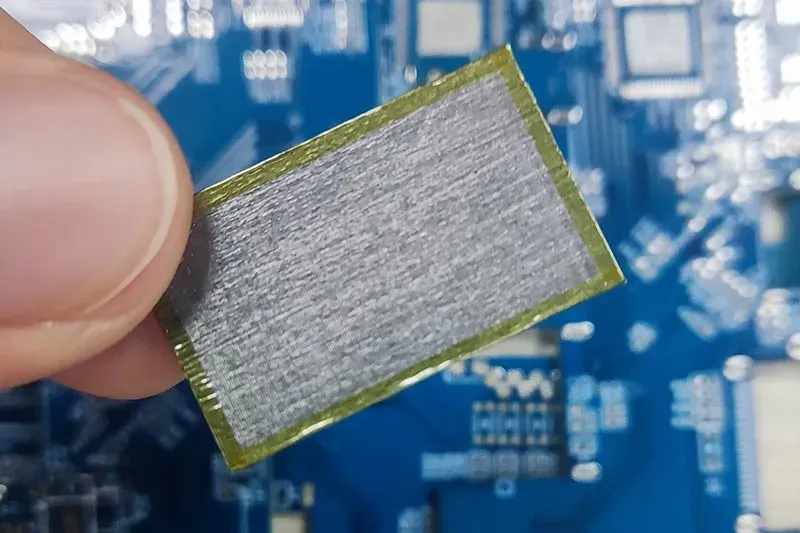
That extra thermal path can help when cramped hardware leaves little room for larger sinks.
When Air Cooling Falls Short: Immersion Cooling Fluid
For very high heat flux, submersion transfers heat straight into a dielectric fluid.
- Single-phase cooling keeps coolant below its boiling point and circulates absorbed heat away.
- Two-phase immersion permits controlled boiling, using phase change to boost thermal performance.
For extreme thermal management for pluggable optics, immersion can sidestep the airflow restrictions that make fan-based cooling hit a wall.
Scenario: an 800G Link Under Load Transients
The real transient problem in current pluggables is the DSP. In an 800G-class module, the serializer/deserializer draws traffic-dependent power: a link bursting from idle to full line rate swings module dissipation measurably within seconds, and case temperature follows. The laser and driver contribution is steadier; the swing is the DSP's. Three tools manage it — none of them liquid, none of them latent-heat stores:
A Stable Interface, Not a Buffer
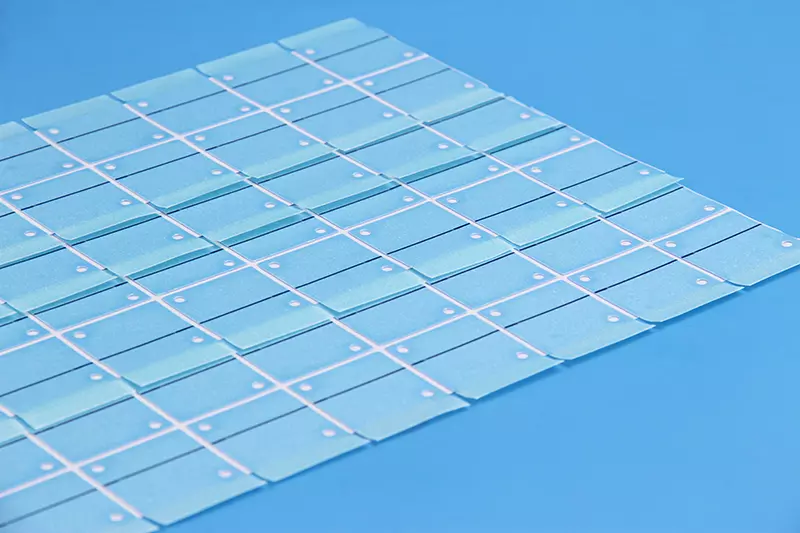
The interface's contribution to transient management is stability, not storage. A phase-change interface material — the class specified at module joints — reduces resistance by softening at operating temperature to wet the mating surfaces and minimize the bond line; that low-resistance joint then holds through the load swing. Its latent-heat absorption is negligible against the steady component of the heat flow.
Telemetry and Firmware — What Actually Rides the Transient
Modern pluggables carry their own instrumentation:
- the CMIS management interface (QSFP-DD/OSFP) exposes real-time module telemetry — temperature, supply voltages, and laser conditions — that a switch already reads.
That is the primary transient tool:
- when case temperature climbs through a traffic burst, the host can react in firmware — alerting, re-prioritizing, or throttling — on measured data, seconds after the swing begins.
The interface materials beneath the module determine how gently that telemetry moves:
- a well-wetted, stable joint turns the burst into a slow, monitorable ramp instead of a spike.
Real-Time Diagnostics via Heat Flux Sensor and Thermocouple Wire
Live measurements
- A heat flux sensor tracks changing heat flow.
- Thermocouple wire measures local hot spots and the temperature gradient.
Control feedback
- Data acquisition records both signals.
- Real-time monitoring flags sudden changes.
Thermal diagnostics use that thermal sensing data to check cooling response and refine thermal management for pluggable optics.
Which Approach Fits Which Architecture
| Approach | Where it legitimately serves pluggable optics | Key benefit | Boundary |
| Copper baseplate sink | Cage riding heatsink, high-power cages | High conductivity, proven | Weight and cost vs. aluminum |
| Aluminum extrusion + ducting | System-level heatsink with directed air | Light, cheap, shapeable airflow | Lower conductivity than copper |
| Vapor chamber | High-power cage spreaders | Isothermal spreading, kills hotspots | Cost and thickness budget |
| Graphite sheet | In-plane spreading layer in module or on sink | Extreme in-plane conductivity, ultrathin | Electrically conductive; through-plane is the weak axis |
| Gap pad / grease (TIM) | Lid-to-housing and housing-to-sink joints | Low interface resistance | Bond line, pump-out, dry-out need screening |
| Microchannel cold plate | Co-packaged optics only | Highest heat-flux handling | No liquid crosses a pluggable interface |
| Immersion cooling | Rack-level solution, not module-level | Bypasses air entirely | Incompatible with pluggable cages and field service |
Specify the stack — module form factor, power profile, gap heights, mounting pressure, insertion cycles — and Sheen's engineering team will match interface candidates with D5470 impedance data.
Sheen Thermal
Dongguan Sheen Electronic Technology Co., Ltd · Founded in 2008
Manufacturer of thermal interface materials and silicone foam for automotive electronics, energy storage, power electronics, communications and consumer electronics.
Certified
- ISO 9001:2015
- ISO 14001:2015
- IATF 16949:2016
What we supply
- Thermal conductivity Up to 90 W/m·K
- Thickness 0.3–10.0 mm
- Custom & samples Die-cut to drawing, 3–7 days