
 English
 usheenthermal

Why AI Chip Thermal Management Is the Industry’s Biggest Bottleneck
Date:2026-09-24
AI chip thermal management is becoming the gatekeeper of AI scale: pack more compute into tighter spaces, and heat quickly crashes the party. Materials must move that heat efficiently while surviving thermal cycling, demanding production, and tight tolerances.
For buyers, conductivity alone won’t cut it. Reliability, process compatibility, qualified supply, and dependable lead times now shape cooling choices.
Key Points in AI chip thermal management
➔ Heat Conduction Boost: Employ high-conductivity materials (Graphene sheets, conductive epoxy) to swiftly transfer chip heat, lowering junction temperatures and throttling risks.
➔ CTE Alignment: Match coefficients of thermal expansion across silicon interposers, substrates, and underfill to prevent warpage, solder fatigue, and delamination.
➔ Interface Optimization: Select the ideal TIM—phase-change pads, gap fillers, or thermal grease—balancing conductivity, bond line thickness, and long-term stability.
➔ Compliance & Testing: Ensure RoHS, REACH, and halogen-free adherence, coupled with rigorous thermal-cycle and stress testing for reliable AI deployments.
➔ Supply Chain Resilience: Qualify suppliers, manage inventory, and plan lead times for bulk phase-change materials to avoid cooling bottlenecks.
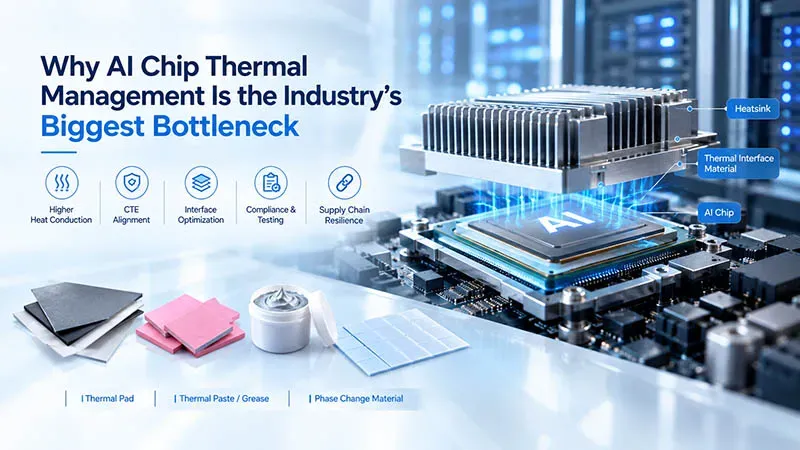
This image was generated with the assistance of AI; it is not a real photograph and is for reference only.
What Makes Thermal Management So Critical?
AI hardware packs serious heat into tiny spaces, so AI chip thermal management directly affects speed, power use, and service life. Sheen Technology approaches chip thermal design by linking material choices, package mechanics, interfaces, and compliance from the start.
How Thermal Conductivity Drives AI Chip Efficiency
Heat flow
- High thermal conductivity lowers thermal resistance, helping an AI accelerator move energy away from its die.
- Better heat dissipation controls junction temperature as power density climbs, supporting energy efficiency without forcing performance throttling.
That makes AI chip thermal management a practical performance issue, not just a cooling problem.
Where the resistance actually sits: junction-to-case, case-to-sink, and sink-to-air form a series path, and the largest term governs. Interface resistance is often a small fraction of the total in a well-designed package — which is why improving a TIM alone frequently produces a disappointing result while the dominant term goes untreated.
Preventing Package Warpage with Coefficient of Thermal Expansion Control
A package heats and cools repeatedly. Mismatched coefficient of thermal expansion values can create thermomechanical stress between the silicon die, sub-strate material, and molding compound.
Material matching matters:
- Lower expansion mismatch reduces package warpage.
- Controlled strain helps prevent delamination and solder fatigue.
In short, good chip thermal design keeps mechanical movement in check.
Optimizing Thermal Interface Materials: From Phase-Change to Graphene Sheets
A thermal interface material fills microscopic gaps between silicon and a heat sink, cutting contact resistance and pesky micro-voids.
| Interface option | Typical conductivity (W/m·K) | Typical thickness (mm) |
| thermal grease | 1–5 | 0.05–0.10 |
| phase-change material | 3–8 | 0.13–0.25 |
| Graphene sheet | 75-90 | 0.3–2.0 |
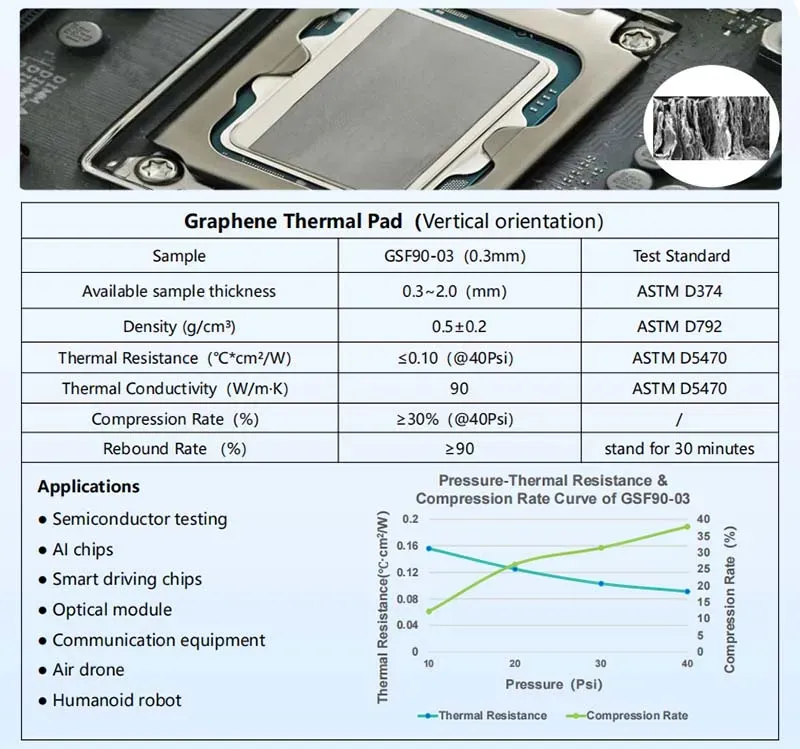
Actual values vary by formulation. Sheen Technology can match interface materials to assembly and AI chip thermal management needs rather than chasing conductivity alone.
Ensuring Reliability through RoHS, REACH, and Thermal Stress Testing
- Screen hazardous substances through RoHS compliance and REACH regulation to support environmental safety.
- Apply thermal stress testing across repeated hot-cold cycles.
- Use accelerated life testing within reliability engineering to expose aging, cracking, or interface failure before production.
That practical loop helps thermal management materials stay dependable over real operating cycles.
5 Key Heat Issues in AI Chip Thermal Management
Thermal management gets harder as compute power climbs and packages tighten. Heat accumulates inside chips, interfaces, cooling hardware, and procurement plans alike. Effective thermal management means controlling those weak points before performance, yield, or long-term reliability suffers.
Issue 1: Localized Hotspots in High-Density Silicon Interposers
A silicon interposer packs compute and memory close together, so localized hotspots can develop fast.
Heat concentration
- Rising heat flux creates a sharp temperature gradient.
- Limited thermal conductivity can trap heat near active dies.
Cooling response
- Embedded microchannels can shorten the heat path.
- Lower temperatures also reduce thermal stress.
That makes hotspot control a core part of AI chip thermal management.
Issue 2: Excess Thermal Resistance at Organic Substrate Interfaces
An organic substrate may introduce extra thermal resistance, especially when rough surfaces raise contact resistance. A thinner interface material and carefully prepared packaging layer can reduce this thermal barrier, helping heat dissipation without making chip assembly overly complex.
Issue 3: Underfill Encapsulant Cracking under Repeated Cycling
The underfill encapsulant faces repeated expansion and contraction.
Material behavior
- Thermal cycling raises mechanical stress.
- A mismatched coefficient of thermal expansion compounds strain.
Failure risk
- Delamination may begin at interfaces.
- Fatigue fracture can eventually reduce package reliability.
For AI chip thermal management, cure control matters as much as initial material choice.
Issue 4: Inadequate Heat Dissipation from Copper Heat Sinks
A copper heat sink spreads heat well, but extreme loads can outrun its thermal dissipation capacity. Poor airflow cuts fin efficiency and weakens convective cooling. Vapor chambers or liquid loops can improve heat transfer and overall thermal performance when plain air cooling just won't cut it.
Issue 5: Lead Time Bottlenecks for Bulk Phase-Change Material Delivery
A phase-change material only helps when factories can get enough of it.
Supply planning
- Track procurement and manufacturing lead time.
- Maintain practical inventory buffers.
Production continuity
- Qualify backup supply chain sources.
- Coordinate bulk material delivery for each thermal interface material.
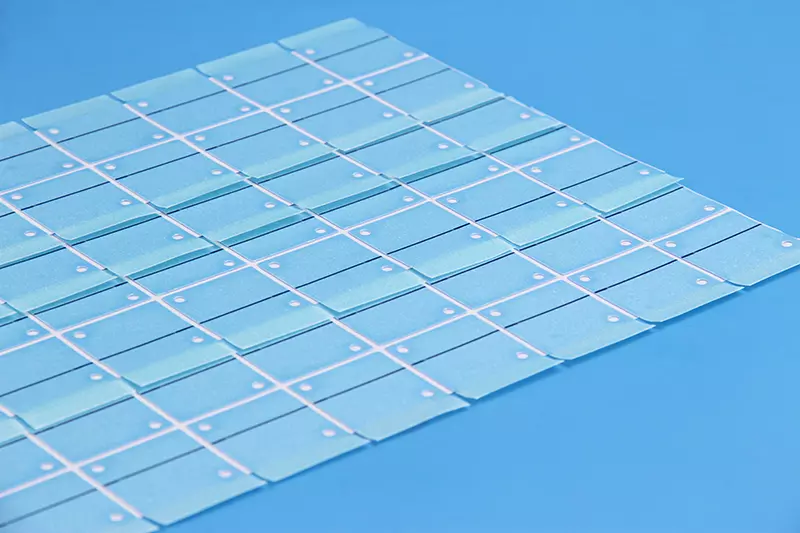
That supply-side discipline keeps AI chip thermal management plans tied to real production schedules.
3 Advanced Cooling Techniques Compared
Modern AI chip thermal management has moved beyond adding larger fans. High-density accelerators generate intense heat in a small volume, so cooling hardware must move that energy quickly and evenly. Sheen Technology supplies the interface and spreading materials these architectures depend on, and can align them with package power, rack density, and practical operating limits.
Vapor Chamber
A vapor chamber tackles chip hot spots by spreading energy sideways before final thermal dissipation. It is compact, passive, and pretty handy when space is tight.
Heat absorption
- The working fluid takes in latent heat at the hot zone.
- Phase change turns liquid into vapor, driving rapid two-phase heat transfer.
Heat return
- Vapor reaches the cooler condenser area and releases energy.
- A porous wick structure returns liquid toward the chip.
For AI chip thermal management, that cycle improves temperature uniformity without adding pumps.
Liquid Cooling Cold Plate
Cold plates bring flowing coolant directly beside powerful AI chip packages. A thermal interface material closes microscopic gaps, while high thermal conductivity materials carry heat into internal passages.
| Operating point | Coolant flow (L/min) | Heat load (kW) |
| Low | 1.0 | 0.8 |
| Medium | 2.0 | 1.5 |
| High | 3.0 | 2.2 |
A pump drives coolant distribution through a manifold. Heat then moves toward a heat exchanger or chiller, making this approach a strong fit for dense accelerator cooling. Sheen Technology can support cold-plate designs around system-level thermal needs.
Microchannel Heat Exchanger
Microchannels push coolant through microscale passages placed extremely close to the heat source.
Thermal performance
- High surface area boosts forced convection.
- Fine fin geometry can handle very high heat flux.
Engineering trade-offs
- Narrow paths create greater pressure drop.
- Careful fluid dynamics design helps control flow balance, pumping demand, and hot spots.
The payoff is serious chip cooling capacity, but manufacturing, sealing, clogging control, and long-term reliability become tougher engineering jobs.
【Request a Custom Quote】Chasing hot spots through interposers, substrates, and underfill layers? Send us your die and package stack-up, CTE budget, power map, bond-line and gap dimensions, and target junction temperature, along with RoHS/REACH and halogen-free requirements, and our engineers can recommend an AI chip thermal management material set that balances conduction, warpage control, and dependable bulk supply.
Sheen Thermal
Dongguan Sheen Electronic Technology Co., Ltd · Founded in 2008
Manufacturer of thermal interface materials and silicone foam for automotive electronics, energy storage, power electronics, communications and consumer electronics.
Certified
- ISO 9001:2015
- ISO 14001:2015
- IATF 16949:2016
What we supply
- Thermal conductivity Up to 90 W/m·K
- Thickness 0.3–10.0 mm
- Custom & samples Die-cut to drawing, 3–7 days