
 English
 usheenthermal

Optimizing AI Data Center Power Thermal Design for Efficiency
Date:2026-09-18
AI data center power thermal design is getting hot—literally. Dense compute packs more heat into less space, so the wrong grease, graphite sheet, substrate, or coolant can quietly drag down efficiency and reliability.
Sheen Technology’s engineering guidance emphasizes matching electronic materials to thermal, electrical, mechanical, and chemical requirements, rather than judging thermal conductivity alone.
That puts procurement at the design table. Cooling architecture, material compatibility, stability, and volume consistency all shape scalable AI infrastructure—and smart sourcing starts there.
Rhythmic Key Points for AI data center power thermal design
➔ Material Matching: Align grease, graphite sheets, substrates, and coolants to thermal, electrical, mechanical, and chemical specs—don’t chase conductivity alone.
➔ Cooling Architectures: Choose between air-cooled heat sinks, direct phase-change loops, immersion in engineered fluids, or hybrid deionized glycol systems based on rack density.
➔ Interface Optimization: Use graphite sheets, high-frequency laminates, liquid metals, or dielectric fluids to minimize thermal resistance and ensure electrical safety.
➔ Loop Configuration: Weigh dual-loop separation for contamination control against single-loop simplicity to balance cost, reliability, and serviceability.
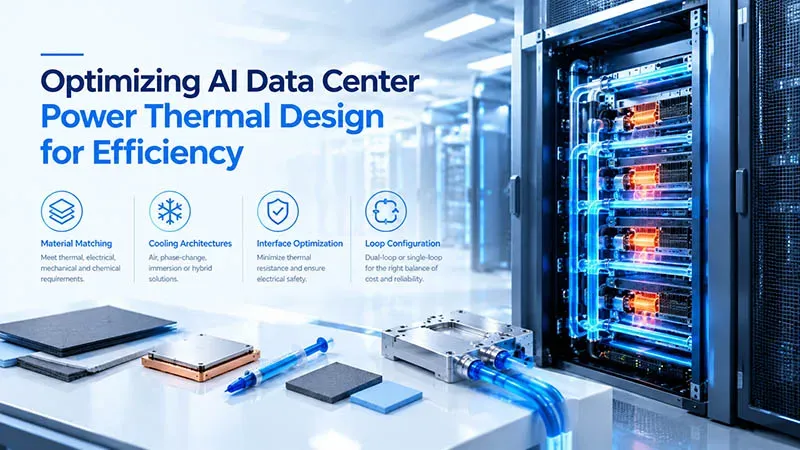
Note: This image was generated with the assistance of AI; it is not a real photograph and is for reference only.
Types Of Cooling Architectures
AI data center power thermal design depends on matching cooling methods to rack load, climate, and operating needs — from familiar fans to liquid systems. Table 1 frames the four families before the details.
| Architecture | Typical rack density (planning) | How it moves heat | Watch-outs |
| Air + heat sink / TIM | ~15–40 kW per rack | Convection through a fin stack; fan speed follows load | Fan power grows steeply with speed; ambient temperature limits headroom |
| Two-phase direct (flow boiling) | Very high flux at the plate | Dielectric fluid boils at the cold plate; vapor condenses remotely | Fluid cost and handling; saturation temperature is a design commitment |
| Immersion (single/two-phase) | Highest overall | Servers submerged in dielectric fluid; heat leaves via a heat exchanger | Rack-level service model change; fluid weight and handling |
| Hybrid water-glycol D2C | 700–1000 W-class accelerators | Cold plates + CDU + plate heat exchanger to the facility loop | Corrosion control; careful loop-separation sizing |
Air-Cooled Heat Sinks with Thermally Conductive Silicone Grease
AI data center power thermal design can still rely on air cooling at moderate rack density.
Heat transfer path
- thermal interface material fills tiny gaps between processors and heat sinks, lowering thermal resistance.
- An aluminum fin stack spreads that heat into moving air.
Operating control
- forced convection carries heat away, while fan speed control responds to load.
- Higher ambient temperature cuts cooling headroom, so facility conditions matter.
It’s a pretty straightforward setup when AI power density remains manageable.
Direct Liquid Cooling Using Phase Change Cooling Liquid
A phase-change dielectric fluid uses latent heat during boiling to collect processor heat efficiently. The resulting two-phase flow moves toward a condenser coil, where vapor releases heat and becomes liquid again.
- A vapor chamber spreads concentrated chip heat.
- saturation temperature sets the boiling operating point.
- pump control keeps circulation stable without wasting pumping energy.
For high-density AI data center power thermal design, this approach can reduce processor temperature differences and handle intense local heat loads.
Immersion Cooling in Engineered Thermal Fluid
Cooling arrangement
- server submersion places electronics directly in dielectric coolant.
- A sealed tank enclosure contains the engineered fluid.
Heat removal
- single-phase immersion keeps coolant liquid throughout operation.
- fluid circulation moves stored heat toward a heat exchanger.
- Higher thermal capacity helps absorb changing AI loads.
This cuts reliance on server fans and can simplify thermal control. Sheen Technology can integrate immersion equipment into high-density AI cooling plans.
Hybrid Systems with Deionized Water Glycol Mix
Hybrid cooling connects different cooling zones through a secondary loop. A coolant distribution unit manages delivery, while a plate heat exchanger separates facility and equipment circuits.
Careful flow rate regulation keeps pressure drop under control. A corrosion inhibitor protects piping, and each temperature sensor helps operators catch changes early.
For mixed racks, AI data center power thermal design using water-glycol heat transport offers a practical middle ground, combining freeze protection with efficient data center thermal management.
4 Steps To Better Heat Dissipation
AI data center power thermal design gets tricky when higher compute loads pack more heat into less space. Good results come from treating interfaces, boards, cooling liquids, and supports as one connected thermal path. For practical AI data center power thermal design, Sheen Technology combines suitable materials with careful thermal management, keeping heat flow and service needs in check.
Step 1: Optimize Thermal Interfaces with Graphene Thermal Sheet
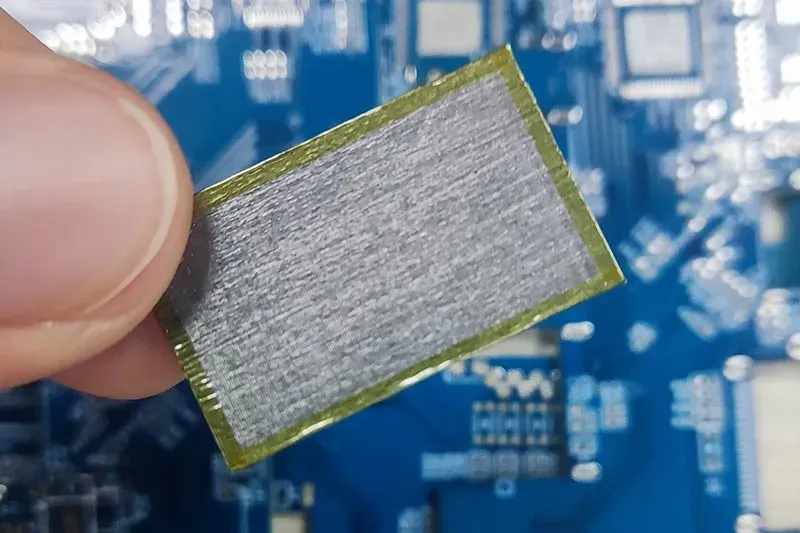
Graphene thermal sheets feature vertically oriented thermal conductivity; Sheen Technology’s graphene thermal pads achieve a thermal conductivity of 90 W/m·K, offering higher efficiency in heat transfer along the thickness direction. In AI data center power thermal design:
Interface control
- Use a thin thermal interface material to reduce interface resistance.
- Match thermal conductivity to heat load and mounting pressure.
Practical choices
- Pads simplify assembly and rework.
- Grease, phase-change material, or liquid metal can boost heat dissipation, but handling needs extra care.
Step 2: Upgrade Substrates via High Frequency Copper Clad Laminate
A copper clad laminate links electrical and thermal needs, so board choice isn't just an RF issue.
| Board factor | Typical comparison value | Thermal/design effect | Main concern |
| Copper foil | 35 µm | Better heat spreading | Weight |
| Copper foil | 70 µm | Higher current capacity | Etching |
| Copper foil | 105 µm | Supports power density | Cost |
For AI power boards:
- Select a high frequency substrate with low-loss dielectric material.
- Check signal integrity alongside thermal performance.
- Tune the circuit board stackup rather than simply adding copper.
Step 3: Select Coolants like Fluorocarbon Coolant or Synthetic Dielectric Fluid
AI data center power thermal design can shift heat directly into liquid, which is pretty handy at high rack density.
Cooling choice
- fluorocarbon coolant offers electrical insulation.
- synthetic dielectric fluid can support immersion cooling.
Operating checks
- Compare heat transfer, material compatibility, and environmental profile.
- Size liquid cooling around safe temperature control and stable thermal management.
Step 4: Reinforce Structure Using Carbon Fiber Composite Plate
Mechanical design matters because repeated heating and cooling can stress dense assemblies.
Structural fit
- carbon fiber composite supports structural reinforcement with a lightweight design.
- Controlled thermal expansion helps protect mounted parts.
Long-term use
- A stiff enclosure plate adds mechanical strength and durability.
Sheen Technology can pair conductive adhesives or plastics with this approach, helping AI data center power thermal design maintain stable thermal paths.
Dual-Loop Vs. Single-Loop Cooling
Choosing a liquid-cooling layout shapes uptime, water quality, energy use, and day-to-day service work. In AI data center power thermal design, dual-loop and single-loop options solve the same heat problem differently, so the right fit comes down to facility conditions, rack density, and operating priorities.
Dual-Loop Cooling
Dual-loop cooling keeps server coolant isolated from building water. For dense AI racks, that separation can make AI data center power thermal design easier to control when facility water quality or pressure varies.
The primary loop serves IT equipment with controlled coolant and stable temperature regulation.
- Strong fluid separation limits contamination from facility piping.
- A coolant distribution unit manages rack-side pressure and flow.
The secondary loop carries heat toward facility cooling.
- A heat exchanger transfers energy without mixing fluids.
- The extra transfer stage can slightly affect thermal efficiency, so sizing matters.
This layout adds hardware, sure, but it creates a useful service boundary. Sheen Technology can support AI data center power thermal design where coolant cleanliness and high-density thermal control need close attention.
Single-Loop Cooling
Single-loop designs cut out an intermediate heat-transfer stage. That can reduce equipment count and thermal resistance, while simpler plumbing may trim pressure drop and maintenance overhead. The catch is tighter facility-side water control.
| Operating example | Flow rate (L/min) | Supply (°C) | Return (°C) | ΔT (°C) |
| Low load | 20 | 20 | 25 | 5 |
| Moderate | 30 | 20 | 27 | 7 |
| High load | 40 | 20 | 29 | 9 |
| Dense rack | 50 | 21 | 31 | 10 |
| Peak case | 60 | 22 | 34 | 12 |
These illustrative values show how flow rate and temperature rise interact; final values require engineering calculations.
- Fewer pumps and transfer stages improve system simplicity.
- Greater direct fluid contact with facility infrastructure makes coolant chemistry important.
- Pump reliability becomes critical because fewer isolation layers exist.
For AI data center power thermal design, single-loop cooling can be a clean, efficient choice when facility controls are up to the job. Sheen Technology can assess AI thermal design, data center power needs, and cooling interfaces together, helping operators avoid a nasty surprise after deployment.
Sheen Thermal
Dongguan Sheen Electronic Technology Co., Ltd · Founded in 2008
Manufacturer of thermal interface materials and silicone foam for automotive electronics, energy storage, power electronics, communications and consumer electronics.
Certified
- ISO 9001:2015
- ISO 14001:2015
- IATF 16949:2016
What we supply
- Thermal conductivity Up to 90 W/m·K
- Thickness 0.3–10.0 mm
- Custom & samples Die-cut to drawing, 3–7 days