
 English
 usheenthermal

Why Anisotropic Graphene Thermal Conductive Material Is a Game Changer
Date:2026-06-27
Why Anisotropic Graphene Thermal Conductive Material Is a Game Changer
Anisotropic graphene thermal conductive material is flipping the script on overheating hardware, and yeah, it matters right now. Servers choke, devices sweat, and old metals can’t hustle heat away fast enough anymore.
That’s where direction matters—guiding heat instead of dumping it everywhere, cutting cooling costs, easing stress, and keeping high-stakes systems running smoother, longer, without bulky fixes.
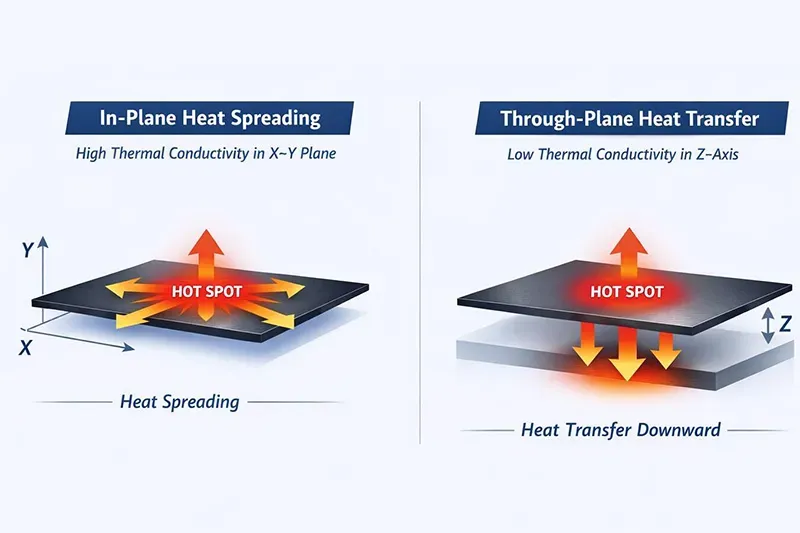
Reading Notes: Anisotropic Graphene Thermal Conductive Material Essentials
→ Understand Heat Flow: Governed by Fourier’s law, heat travels via phonons/electrons along thermal gradients.
→ Graphene’s Edge: Single-layer hexagonal lattice enables ultra-fast in-plane conductivity, outpacing metals in hotspot dissipation.
→ Directional Control: Anisotropy guides heat along preferred paths, cutting cooling costs and avoiding bulky thermal solutions.
→ Real-World Impact: From data-center rack cooling to 5G modules, graphene panels extend hardware life and boost energy efficiency.
Understanding Thermal Conductivity Basics
Thermal science can feel abstract, yet it shapes daily life—from phone overheating to EV battery safety. When working with Anisotropic graphene thermal conductive material, it helps to split the phrase: anisotropic (direction-dependent), graphene (single-layer carbon lattice), thermal conductive (moves heat), material (engineered solid). This anisotropic graphene material behaves differently along its crystal axes, making graphene thermal conductivity a practical design tool rather than just a lab metric.
The Physics Behind Heat Flow
Heat transfer relies on three modes:
· conduction
· convection
· radiation
In solids like Anisotropic graphene thermal conductive material, conduction dominates.
1)Energy builds where temperature gradient exists.
2)Phonons—quantized lattice vibrations—carry kinetic energy.
3)In conductive solids, electrons may assist heat transfer.
Within this flow:
Heat transfer
· Driven by: temperature gradient,atomic vibration intensity.
· Carried through: phonons,free electrons (in some materials).
Key Metrics: Thermal Conductivity Explained
Thermal conductivity (measured in watt per meter kelvin) links heat flux to temperature difference via Fourier’s Law.
Key metrics include:
· thermal conductivity
· thermal resistance
· surface contact quality
Performance depends on:
· Material properties:crystal purity,defect density.
· Interface factors:bonding pressure,surface roughness.
High in-plane graphene thermal conductivity allows anisotropic thermal interface films to spread heat fast, reducing hot spots in chips and power modules.
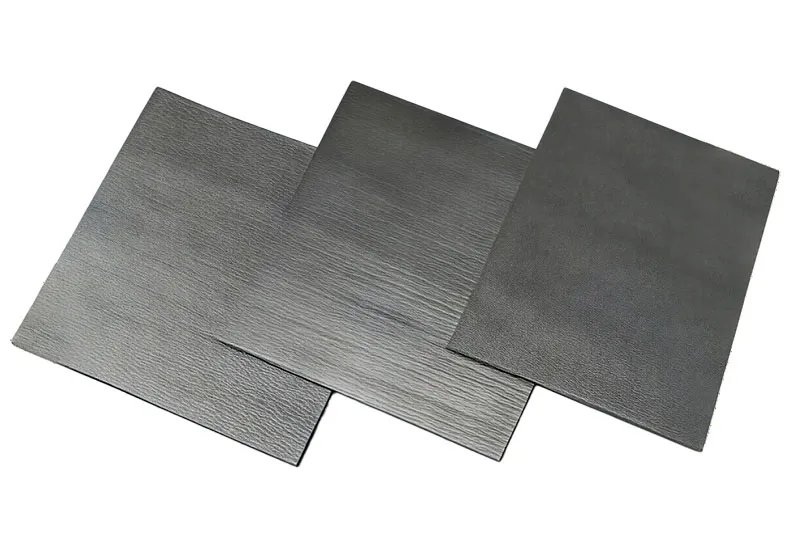
| Properties | Unit | GSF90-03 Graphene Thermal Pad | GSF75-03 Graphene Thermal Pad | Test Method |
| Color | - | Black | Black | Visual |
| Thermal Conductivity | W/m·K | 90 | 75 | ASTM E1461 |
| Thermal Resistance (@40psi) | ℃*cm2/W | ≤0.1 | ≤0.12 | ASTM D5470 |
| Thickness | mm | 0.3~2.0 | 0.3~2.0 | ASTM D374 |
| Density | g/cm³ | 0.3~0.7 | 0.3~0.7 | ASTM D792 |
| Rebound Rate | % | ≥90 | ≥90 | ASTM D575 |
| Tensile Strength | Mpa | ≥0.05 | ≥0.03 | ASTM D412 |
| Oil Bleeding Rate | % | ≤3 | ≤3 | / |
| Application Temperature | ℃ | -40~150 | -40~150 | / |
By employing a vertical alignment process to arrange graphene layers in an ordered manner, the graphene thermal pads mass-produced by Sheen Technology achieve a vertical thermal conductivity of up to 90 W/m·K and a thermal resistance as low as 0.1 ℃·cm²/W—performance levels tens or even hundreds of times superior to those of traditional silicone thermal pads. This enables heat to be conducted rapidly along the thickness direction, directly establishing a thermal path from the heat source to the heat sink and fundamentally resolving the issues of tortuous thermal paths and high thermal resistance associated with conventional pads.
Why Direction Matters in Heat Transfer
Anisotropy means direction controls outcome.
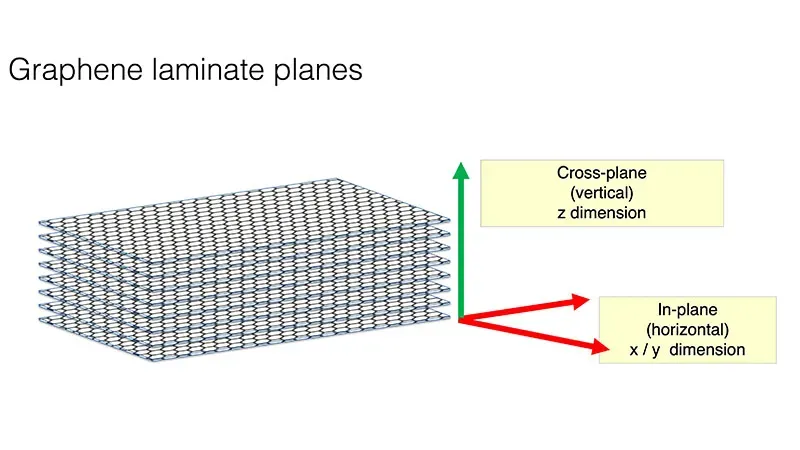
In graphene:
· In-plane: strong crystal structure,efficient directional heat flow.
· Through-plane: Through a vertical alignment process, it establishes highly efficient thermal conduction pathways along the thickness direction.
Design logic:
· Align preferred orientation with heat source.
· Match lattice direction to cooling path.
· Optimize thermal management stack-up.
With Anisotropic graphene thermal conductive material, engineers tune lattice vibrations and structure to move heat exactly where it’s needed—no guesswork, just physics doing its job.
Need verified thermal conductivity, thermal resistance, vertical heat transfer performance, and mechanical reliability data before selecting a thermal interface material? Download the product datasheets to compare anisotropic graphene thermal conductive materials for AI servers, power electronics, 5G equipment, and other high-power applications.
What Makes Graphene So Efficient?
Graphene keeps popping up in thermal conversations for a reason. When engineers talk about anisotropic graphene thermal conductive material, they mean a carbon-based heat solution that moves energy fast—especially along one direction. From chips to LEDs, graphene thermal material is changing how heat transfer feels in real products.
Atomic Structure Enabling Rapid Heat Spread
At the heart of anisotropic graphene thermal conductive material sits a tight network of carbon atoms arranged in a hexagonal lattice. This crystal structure forms ultra-strong covalent bonds, and that bonding strength directly fuels rapid heat motion.
· Graphene sheet = single-atom thickness
· Dense thermal vibrations across the plane
· Low resistance to phonons
In an anisotropic thermal conductive material, heat doesn’t wander randomly. It streams laterally because:
· In-plane bonding is extremely stiff.
· Out-of-plane interaction is weak.
· The sheet behaves like a two-dimensional highway for thermal vibrations.
For electronics needing a graphene heat conduction film, that directional advantage is gold. Sheen Technology applies this atomic efficiency to engineered graphene thermal material solutions that prioritize controlled heat spreading rather than bulk mass.
In-Plane vs. Out-of-Plane Conductivity
Anisotropy defines how anisotropic graphene thermal conductive material behaves. Heat prefers the in-plane route.
· In-plane: rapid phonon transport
· Out-of-plane: limited by van der Waals forces
· Net effect: directional thermal conductivity
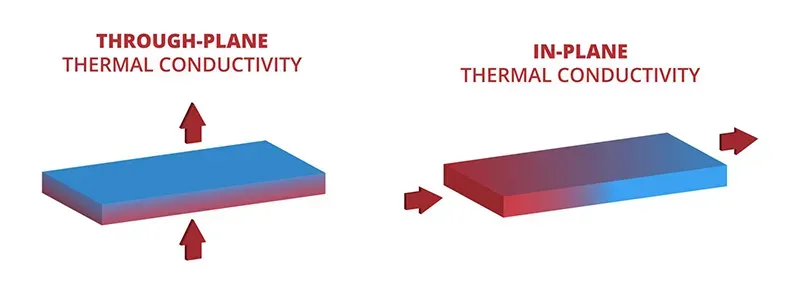
Multi-level breakdown of behavior:
In-plane heat transfer
· Strong covalent bonds
· Continuous graphene lattice
· High lateral thermal conductivity
Out-of-plane heat transfer
· Weak interlayer coupling
· Larger thermal resistance
· Restricted vertical energy flow
★ Result: extreme directional performance in layered materials.
Long story short, graphene thermal conductive material acts like a heat express lane sideways and a country road vertically. In response to this, Sheen Technology has developed a state-of-the-art vertically aligned graphene thermal pad, overcoming the limitations of traditional graphene thermal pads regarding vertical heat dissipation. Through vertical alignment technology, graphene sheets are arranged in an orderly manner along the thickness of the pad, creating continuous and highly efficient thermal conduction pathways. The vertical thermal conductivity reaches 75–90 W/m·K—dozens of times higher than that of conventional silicone pads.
Role of Defect-Free Lattices in Performance
Even the best anisotropic graphene thermal conductive material can lose edge if the lattice isn’t clean. Lattice defects, grain boundaries, vacancies, and impurities interrupt phonon scattering patterns and raise thermal resistance.
Key degradation chain:
· A structural imperfection appears.
· Phonon transport path bends or reflects.
· Local heat accumulates.
· Overall heat dissipation drops.
Grouped impact view:
Structural quality
· High crystallinity → smooth phonon flow
· Low crystallinity → blocked channels
Defect types
· Vacancies
· Impurities
· Grain boundaries
Performance outcome
· Lower scattering = higher conductivity
· Higher scattering = thermal bottleneck
Multiple short insights:
· Clean lattice, faster heat.
· Fewer boundaries, less resistance.
· Better alignment, stronger anisotropic effect.
That’s why Sheen Technology emphasizes controlled synthesis and inspection when developing anisotropic thermal conductive material platforms. In high-power electronics, tiny structural flaws can mean real temperature spikes. With optimized graphene thermal material design, the difference shows up not just in lab metrics—but in everyday device stability.
Comparing Isotropic Vs. Anisotropic Conductors
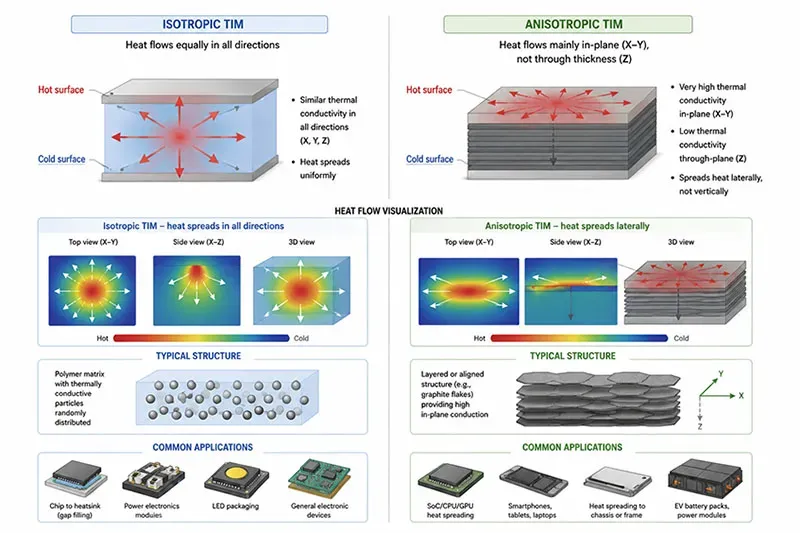
Heat either flows evenly or it chooses a favorite direction. That simple difference changes how devices survive or fail. When engineers pick between Uniform conductivity and Directional conductivity, the choice shapes cooling speed, safety margins, and long-term stability. In high-power electronics, an Anisotropic graphene thermal conductive material often becomes the quiet hero.
Isotropic Conductors
Materials with Uniform conductivity rely on Homogeneous materials and stable Bulk properties. Heat spreads through steady Thermal diffusion, and Electrical flow behaves predictably.
Core Traits
1.1 Direction independence
· Heat moves equally in X, Y, and Z axes.
· No preferred path.
1.2 Conventional materials
· Aluminum
· Copper
· Standard alloys
Performance Snapshot
| Material | Thermal Conductivity (W/m·K) | Structure Type |
| Copper | ~400 | Isotropic bulk |
| Aluminum | ~205 | Isotropic bulk |
| Steel | ~50 | Isotropic bulk |
Practical Impact
3.1 Easy modeling
3.2 Lower alignment risk
3.3 Limited targeted heat control
For everyday housings and simple heat sinks, isotropic metals keep things stable. But when power density spikes, uniform spreading sometimes just isn’t enough.
Anisotropic Conductors
Now things get interesting. Directional conductivity changes the rules.
· Heat prefers one path.
· Structure matters.
· Alignment is critical.
An Anisotropic graphene thermal conductive material is built on a Layered structure. Within each layer, thermal transfer is fast; across layers, it slows down. That contrast supports precise Thermal management and sharper Heat dissipation.
1) Structure Logic
· Preferred orientation controls flow.
· Graphene sheets guide in-plane conduction.
2) Why graphene?
· High in-plane conductivity
· Lightweight profile
· Fit for Advanced materials demand
3) Real Use Flow
· Step A: Identify heat source.
· Step B: Align anisotropic thermal material toward airflow.
· Step C: Lock placement to maintain performance.
An Anisotropic graphene thermal conductive material can outperform many metals when layout is tight. That’s why High performance devices lean toward graphene thermal material solutions.
In short, isotropic metals spread heat everywhere. Anisotropic graphene sends it exactly where you want.
4 Advantages Of Graphene Over Metals
Graphene is changing how heat gets handled in modern devices. When Anisotropic graphene thermal conductive material enters the conversation, engineers start paying attention. By directing heat with precision, trimming weight, and surviving rough conditions, this anisotropic graphene solution is quickly moving beyond metals in real-world thermal management.
Superior Thermal Pathways for Faster Cooling
Anisotropic graphene thermal conductive material builds directional thermal conductivity into its graphene structure, forming clean lanes for heat transfer.
Core mechanism
· In-plane phonon flow: High heat dissipation across hotspots,Reduced lateral resistance.
· Through-plane control: Managed vertical insulation,Balanced cooling efficiency.
Performance edge
· Compared with aluminum: Faster spreading rate,Lower weight per area.
· Compared with copper: Tunable anisotropic properties,Stable thermal management.
Recent IDTechEx energy materials analysis (2025) notes that graphene-based thermal films are gaining traction in EV batteries due to directional heat flow advantages.
Ultra-Lightweight Yet Mechanically Robust
Metals add bulk. Anisotropic graphene thermal conductive material keeps strength high while cutting mass.
Material behavior
· High mechanical strength
· Strong structural integrity
· Excellent flexibility
Under stress:
· Maintains durability
· Enhances graphene composites
· Supports lightweight materials design
This anisotropic thermal material fits slim electronics where every gram matters. It bends without cracking, stays intact under cycling, and keeps heat dissipation steady. That high strength-to-weight ratio gives designers room to think smaller and cooler at the same time.
Chemical Stability in Harsh Environments
Heat is only half the story. Corrosion kills performance.
Anisotropic graphene thermal conductive material shows strong chemical resistance in:
· High humidity
· Acidic exposure
· Elevated temperatures
Its oxidation resistance and chemical inertness protect long-term material stability.
Grand View Research reported in 2025 that corrosion-resistant graphene coatings are expanding in industrial electronics due to extended service life expectations.
With graphene coatings built on anisotropic graphene platforms, corrosion protection and environmental durability stay consistent even in harsh environments.
Scenario: Data Centers And Graphene
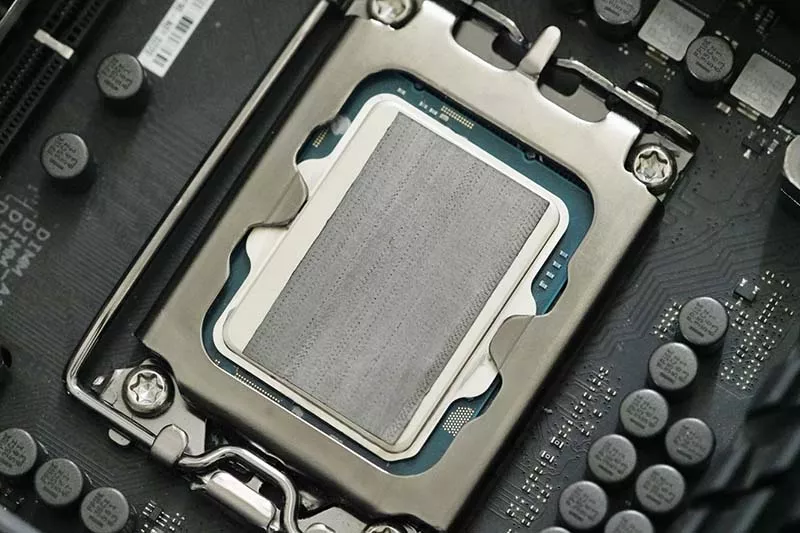
Data centers are heating up, literally. To keep pace with AI workloads and dense racks, operators are turning to Anisotropic graphene thermal conductive material to push thermal management beyond old-school limits while keeping energy bills in check.
High-Density Rack Cooling with Graphene Panels
When racks stack tight inside a data center, heat piles up fast. Graphene panels built from Anisotropic graphene thermal conductive material redirect heat using extreme thermal conductivity along controlled pathways.
· Faster heat dissipation across server rows
· Smarter rack cooling layouts
· Slimmer cooling panels with higher spread rates
Inside each rack:
Panel Layer
· Anisotropic graphene thermal conductive material sheet
· Bonded graphene thermal interface material
Air Channel
· Directed exhaust
· Reduced hotspots
That’s how Anisotropic graphene thermal conductive material keeps things steady without bulky retrofits. Sheen Technology integrates these panels so upgrades feel practical, not disruptive.
Reducing Power Draw: Energy-Efficient Heat Sinks
Lower power consumption starts with smarter heat sinks. Using graphene composite cores made from Anisotropic graphene thermal conductive material, passive spreading improves before fans even spin.
• Less waste heat buildup
• Improved energy efficiency
• Stable component cooling
According to the International Energy Agency’s 2025 data center outlook:
“Efficiency gains in advanced cooling materials are becoming a primary driver of reduced electricity growth in hyperscale facilities.”
A refined anisotropic graphene thermal conductive material design cuts strain on chillers. Sheen Technology applies Anisotropic graphene thermal conductive material to optimize total thermal management, trimming operating costs without drama.
Prolonging Server Lifespan through Uniform Cooling
Uneven heat fuels component degradation. Consistent temperature control supports real server reliability.
With Uniform cooling powered by Anisotropic graphene thermal conductive material, heat flows laterally, easing thermal stress at solder joints and processors.
Result:
· Fewer microcracks
· Slower aging cycles
· Noticeable lifespan extension
By embedding Anisotropic graphene thermal conductive material into broader graphene applications, operators create calm thermal conditions that hardware can live with for years.
Want to see how anisotropic graphene thermal conductive materials are applied in real engineering projects? Browse these related application pages to explore practical thermal management solutions across high-power electronic systems.
Trend: Graphene-Based Cooling Revolution
High-frequency electronics are heating up—literally. As 5G, AI hardware, and high-performance computing scale fast, traditional silicon cooling struggles to keep pace. That’s where Anisotropic graphene thermal conductive material steps in. By aligning graphene layers for directional heat flow, it changes how thermal management works inside compact systems.
Adoption in 5G Telecom Equipment
In dense 5G rollouts, telecom equipment like base stations and smart antennas pack serious power into tight frames. Heat builds quickly.
Key pressure points include:
· High-frequency signal amplification
· Outdoor network infrastructure exposure
· Compact enclosure design
With Anisotropic graphene thermal conductive material, heat spreads laterally while shielding sensitive chips vertically. The result feels simple: cooler boards, steadier signals.
· Deploy inside RF modules
· Integrate within antenna substrates
· Stabilize power amplifiers
Performance stack inside equipment:
· Core Layer: Graphene thermal sheet,Directed heat transfer path.
· System Level: Reduced hotspot formation,Extended component lifespan.
Brands like Sheen Technology tune anisotropic graphene layers to match telecom-grade reliability. It’s not flashy. It just works.
Forecast: Market Growth for Thermal Materials
Demand for thermal materials tracks the surge in electronics cooling needs. Anisotropic graphene thermal conductive material and related conductive materials are gaining traction.
“Advanced thermal interface materials will see sustained double-digit growth through 2028, driven by AI servers and 5G infrastructure expansion.” — IDC, 2025 outlook summary
| Year | Global Thermal Materials Market (USD Bn) | Graphene Share (%) | Electronics Cooling Demand Growth (%) |
| 2024 | 13.2 | 4.5 | 8.1 |
| 2025 | 14.6 | 6.2 | 9.4 |
| 2026 | 16.1 | 8.8 | 11.0 |
Growth drivers:
· AI servers
· 5G telecom equipment
· EV power electronics
Anisotropic graphene thermal conductive material stands out for directional heat control. That edge matters as industry trends push higher power density.
Next-Gen Electronics: Beyond Silicon Cooling
Miniaturization is brutal. Chips shrink; power density climbs. Classic silicon cooling plates hit limits.
Here’s how Anisotropic graphene thermal conductive material supports next-gen electronics:
· Material Layer: Oriented graphene network,Ultra-high in-plane heat transfer.
· Device Level: Stable thermal interface,Lower junction temperature.
· System Outcome: Faster high-performance computing,Reliable miniaturization.
Short takeaways:
· Smaller boards.
· Higher clock speeds.
· Less thermal throttling.
Anisotropic graphene thermal conductive material isn’t hype—it’s practical physics. And with scalable solutions from Sheen Technology, advanced materials are moving from lab talk to factory floors.
【Request a Custom Quote】 Every thermal design has different heat flow paths, interface constraints, and performance targets. Share your application, operating temperature, thermal conductivity requirements, thickness limitations, and cooling objectives, and our engineering team will help recommend the most suitable anisotropic graphene thermal conductive material for your project.
Sheen Thermal
Dongguan Sheen Electronic Technology Co., Ltd · Founded in 2008
Manufacturer of thermal interface materials and silicone foam for automotive electronics, energy storage, power electronics, communications and consumer electronics.
Certified
- ISO 9001:2015
- ISO 14001:2015
- IATF 16949:2016
What we supply
- Thermal conductivity Up to 90 W/m·K
- Thickness 0.3–10.0 mm
- Custom & samples Die-cut to drawing, 3–7 days