
 English
 usheenthermal

Flexible Boron Nitride Thermal Conductive Film vs. Standard Materials
Date:2026-06-29
Flexible Boron Nitride Thermal Conductive Film vs. Standard Materials
Flexible boron nitride thermal conductive film is the quiet disruptor engineers keep circling back to, because heat is crowding modern devices like rush hour traffic and the usual pads and metals just can’t keep lanes clear anymore without tradeoffs that sting.
Buyers feel it in tight designs, rising temps, and warranty risk, so the shift is simple: thinner, safer, better flow, or fall behind as expectations keep climbing year after year.
Key Insights on Flexible Boron Nitride Thermal Conductive Film
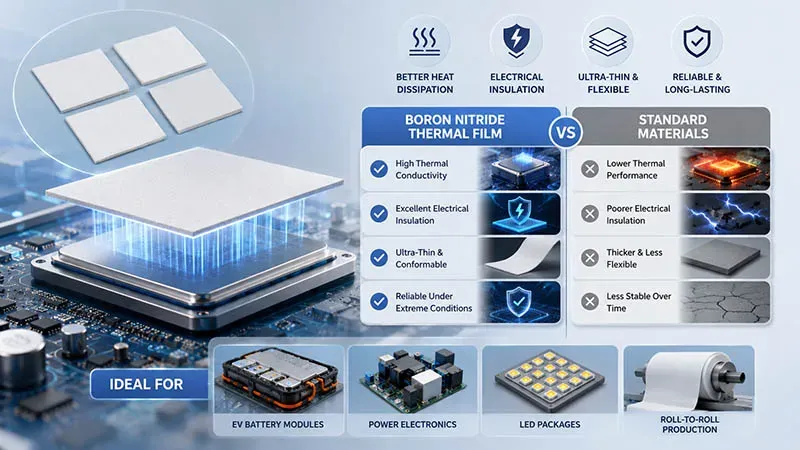
➔ Classifications: Polymer-based films with h-BN fillers combine flexibility, insulation, and moderate to high conductivity.
➔ Core Benefits: Up to 16 W/m·K conductivity, superior dielectric strength, and ultra-thin, conformable layers.
➔ Comparison: Outperforms silicone pads in thermal performance, thickness, and electrical insulation.
➔ Applications: Ideal for compact power electronics, EV battery modules, LED packages, and roll-to-roll large-scale sheets.
What Are Thermal Conductive Material Classifications?
Thermal management isn’t just lab talk anymore—it’s daily engineering reality. From EV batteries to slim consumer devices, picking the right material decides performance and safety. When discussing Flexible boron nitride thermal conductive film, it helps to understand how it compares with metals, ceramics, polymers, and composite systems in real-world heat control.
Metal-Based Conductors
Metals and alloys dominate high-power heat transfer. Think copper, aluminum, even silver in extreme cases.
· High thermal conductivity
· Strong electrical conductivity
· Limited flexibility
Performance tiers often follow:
· Copper – excellent heat transfer, heavy, costly
· Aluminum – lighter, cost-effective
· Specialty alloys – balanced strength and machinability
Yet metal sheets can’t insulate circuits. That’s where Flexible boron nitride thermal conductive film starts gaining attention.
In power modules:
· Heat source:Metals for spreading.
· Interface layer:Thermal grease or flexible boron nitride thermal conductive film.
Rigid. Effective. Electrically active.
Ceramic Thermal Interface Materials
Ceramics like aluminum nitride, silicon carbide, and boron nitride offer a sweet mix:
· Electrical dielectric strength
· High temperature endurance
· Reliable thermal insulation
Application hierarchy:
· Power electronics: Insulated metal substrate.
· Ceramic-filled layer: Flexible boron nitride thermal conductive film alternative.
Ceramic-based films feel more stable under cycling heat. A flexible boron nitride film derived from layered boron nitride keeps insulation tight while moving heat sideways.
Polymer-Based Thermal Films
Built from polymers, silicones, and epoxies, these films focus on:
• Flexibility
• Lightweight builds
• Surface adhesion
Soft. Conformable. Easy to die-cut. Flexible boron nitride thermal conductive film fits ultra-thin gaps where rigid pads fail.
Composite Conductive Materials
Composites blend a matrix with engineered fillers like carbon nanotubes, graphene, or ceramic hybrids.
Design flow:
· Choose base polymer
· Add conductive fillers
· Align structure (isotropic or anisotropic)
· Optimize curing and thickness
In EV battery systems:
· Cell array
· Interface sheet
· Hybrid composite
· Flexible boron nitride thermal conductive film
Brands like Sheen Technology push flexible boron nitride thermal conductive film toward thinner, higher-output platforms. For engineers who need insulation, adaptability, and steady heat flow, flexible boron nitride film solutions are quickly becoming the practical go-to.
3 Key Benefits Of Boron Nitride Film
Flexible boron nitride thermal conductive film sounds technical, yet its value is simple: better heat flow, safer insulation, slimmer devices. When power density rises, Flexible boron nitride thermal conductive film keeps electronics cool, protected, and easy to design.
Enhanced Vertically oriented Thermal Conductivity up to 16 W/m·K
Flexible boron nitride thermal conductive film is built on a hexagonal structure that drives high thermal conductivity and smooth heat transfer. That crystal alignment matters more than people think.
Core performance
1.1 Heat pathway
· Vertically oriented boosts heat dissipation efficiency.
· Measured performance reaches up to 16 W/m·K.
1.2 Thermal stability
· Maintains steady thermal management under cycling loads.
· Supports long-term cooling in compact electronics.
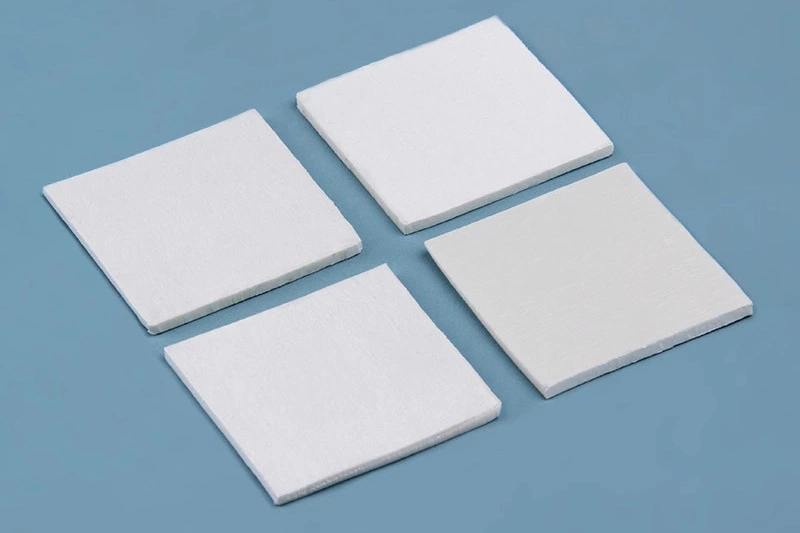
Sheen Technology Boron Nitride Thermal Pad performance properties:
| Properties | Unit | SF1600-BN-sp-03(0.3mm) | Test Method |
| Color | - | White | Visual |
| Thermal Conductivity | W/m·K | 16 | ASTM D5470 |
| Thermal Resistance (@40psi) | ℃*cm2/W | ≤0.3 | ASTM D5470 |
| Application temperature | ℃ | -40~150 | - |
| Thermal weight loss rate | % | ≤1 | - |
| Thickness | mm | 0.2~5.0 | ASTM D374 |
| Breakdown voltage | KV,@AC | ≥4 | ASTM D149 |
| Dielectric constant | F/m, @ 1MHz | ≤4.2 | ASTM D150 |
| Volume resistivity | Ω*cm, @250V | ≥1013 | ASTM D257 |
| Rebound rate | % | ≥90 | - |
| Density | g/cm³ | 1.6±0.2 | ASTM D792 |
| Hardness | shore 00 | 60~80 | ASTM D2240 |
| Flammability rating | - | V-0 | UL 94 |
Application value
2.1 High-power systems
· Battery modules
· Power control units
· LED arrays
2.2 High-performance demand
· Reduced interface resistance
· Improved reliability at elevated temperatures
Practical impact
· Thinner stacks
· Lower hotspot risk
· More consistent device lifespan
In short, Flexible boron nitride thermal conductive film turns passive layers into active thermal solutions.
Superior Dielectric Strength for Electrical Insulation
Heat control means nothing without safe electrical insulation. Here’s where boron nitride film stands out.
· High dielectric strength supports demanding high voltage systems.
· Stable electrical properties prevent leakage.
· Strong breakdown voltage increases operational safety.
Three reasons engineers like it:
1) It acts as a true insulator while still enabling heat dissipation.
2) It protects dense circuit layouts in modern electronics.
3) It balances thermal and electrical roles in one ultra-thin layer.
Need both cooling and insulation in tight packaging? Flexible boron nitride thermal conductive film handles that balancing act without drama. Sheen Technology optimizes this dual-performance design so thermal control never compromises electrical reliability.
Extreme Flexibility with Ultra-Thin Film Thickness
Thin matters. Flexible matters more. Flexible boron nitride thermal conductive film combines ultra-thin film design with serious mechanical properties.
Material thinness
1.1 Micron-level thickness reduces stack height.
1.2 Lightweight structure improves integration.
Mechanical adaptability
2.1 Strong flexibility for curved housings.
2.2 Fully conformable to uneven substrates.
2.3 Ideal for bendable and flexible electronics.
Manufacturing freedom
3.1 Clean die-cut shaping.
3.2 Tight wrapping around modules.
3.3 No cracking during forming.
That means tighter packaging, slimmer devices, and smoother assembly lines. Sheen Technology fine-tunes surface treatment and film consistency so every sheet of Flexible boron nitride thermal conductive film fits exactly where designers need it—no fuss, just performance.
Need verified thermal conductivity, dielectric strength, thickness tolerance, and mechanical performance data before selecting a thermal interface material? Download the product datasheets to compare flexible boron nitride thermal conductive films for EV battery systems, power electronics, LED modules, and other high-density electronic applications.
Flexible BN Film Vs. Silicone Pads
In compact electronics, heat builds up fast and space shrinks even faster. Choosing the right interface material can make or break performance. Here, Flexible boron nitride thermal conductive film and silicone pads go head to head in real world thermal management.
Flexible Boron Nitride Thermal Conductive Film
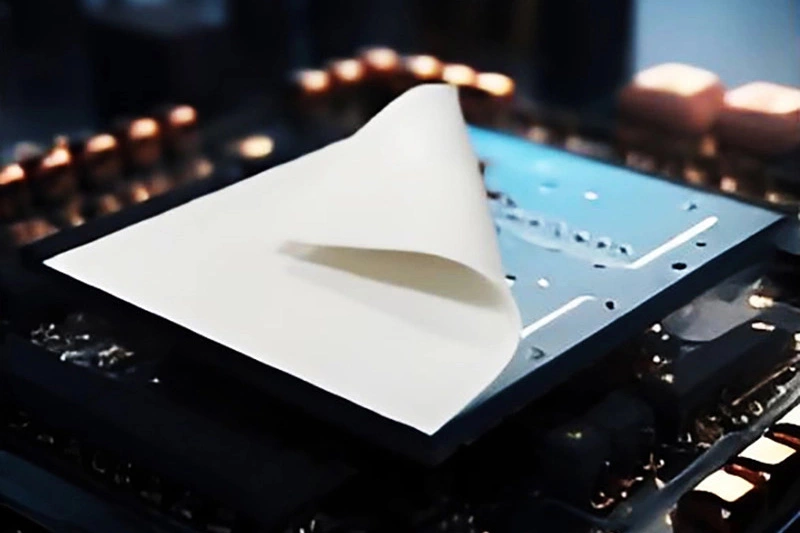
Flexible boron nitride thermal conductive film blends flexible structure with high thermal conductivity, strong electrical insulation, and ultra thin film design. It’s built for tight tolerances and serious heat dissipation.
Material Foundation
1.1 Core Composition
· Engineered boron nitride layers
1.2 Functional Advantages
· High thermal conductivity with low thickness
· Reliable electrical insulation in high voltage modules
Performance Architecture
2.1 Mechanical Traits
· Lightweight body reduces load stress
· Flexible format adapts to uneven chip surfaces
2.2 Thermal Path Efficiency
· Minimizes interface resistance
· Enhances surface to surface contact stability
Application Logic
3.1 Precision Electronics
· Foldable displays
· Power modules
3.2 Brand Driven Solutions
· Sheen Technology refines Flexible boron nitride thermal conductive film for ultra thin assemblies,improve heat dissipation efficiency through vertical orientation.
· Their boron nitride thermal film supports compact, high density layouts
In fast moving devices, flexible BN film keeps things cool without bulk. That’s the edge.
Silicone Thermal Pads
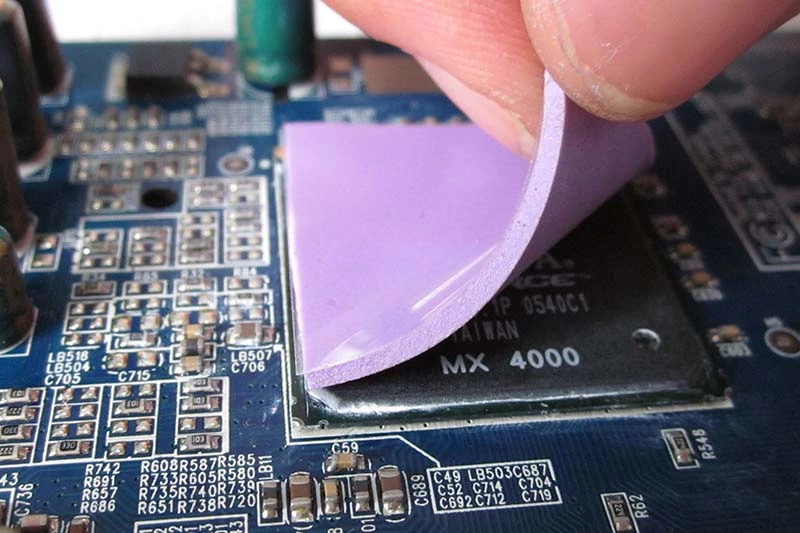
Silicone thermal interface pads act as classic gap filler materials. Soft, compressible, and easy to place, they simplify assembly.
· Strong compressibility
· Surface conformability
· Noticeable softness for uneven gaps
Yet thickness adds resistance. Heat travels, but not as swiftly as through Flexible boron nitride thermal conductive film.
In compact builds, extra millimeters matter.
In high power chips, conductivity matters more.
A typical comparison looks like this:
· Flexible boron nitride thermal conductive film → thin, high spreading efficiency
· Silicone pads → thicker, adaptable but slower transfer
For brands scaling performance, Sheen Technology often recommends matching flexible boron nitride sheets to precision modules, while silicone pads remain useful for general purpose cushioning.
Different tools. Different thermal goals.
How Does Flexible BN Film Boost Reliability?
Flexible boron nitride thermal conductive film sounds technical, yet its job is simple—move heat fast and stay steady. By tuning thermal conductivity, boosting mechanical strength, and resisting harsh chemistry, this flexible boron nitride thermal conductive film keeps electronics cool, calm, and long lasting in real-world use.
Lower Thermal Resistance for Stable Temperatures
When thermal resistance drops, heat dissipation improves. That means tighter temperature control and better temperature stability for power modules and battery packs using Flexible boron nitride thermal conductive film.
· Lower interface gaps
· Faster heat transfer
· Balanced thermal management
Performance Snapshot
| Material Type | Thermal Resistance (°C·cm²/W) | Max Temp (°C) |
| Flexible boron nitride thermal conductive film | ≤0.3 | 900 |
| Polyimide film | 1.85 | 400 |
| Aluminum foil | 0.18 | 660 |
| Ceramic pad | 0.95 | 800 |
The numbers tell a clear story: boron nitride film balances insulation and thermal conductivity, which many metals cannot.
Exceptional Temperature Resistance under Cycling
Daily operation brings thermal cycling, thermal shock, and constant cyclic stress. Flexible boron nitride thermal conductive film handles both high temperature peaks and low temperature dips without cracking.
In EV inverters
· Rapid load shifts:Stable thermal stability maintained.
In telecom power units
· Outdoor winter exposure:Reliable temperature resistance.
Short bursts. Long drives. Repeated expansion and contraction. The film holds its structure, limiting drift in electrical insulation and heat flow.
Chemical Inertness for Long-Term Durability
Harsh air, splashed coolant, factory fumes—real devices face it all. Thanks to strong chemical inertness, this flexible BN thermal film resists oxidation resistance loss and corrosion resistance decline.
Consider durability in layers:
· Surface level:Blocks moisture → protects chemical stability.
· Interface level:Prevents ion migration → slows material degradation.
· System level:Extends service life → supports long-term durability.
It stays steady, even when humidity rises and contaminants sneak in.
Mechanical Strength to Withstand Vibration
Electronics in cars and industrial rigs shake. A lot. That is where mechanical strength and vibration resistance matter.
✓ High tensile strength
✓ Strong fatigue resistance
✓ Maintained structural integrity
Step by step under motion:
· External vibration applies mechanical stress.
· Layered structure absorbs strain through internal sliding.
· Stress disperses, improving shock absorption.
· Core lattice preserves material resilience.
Flexible boron nitride thermal conductive film does not just move heat—it stays intact while doing it. And that steady behavior is what reliability really means.
Electric Vehicle Battery Pack Cooling
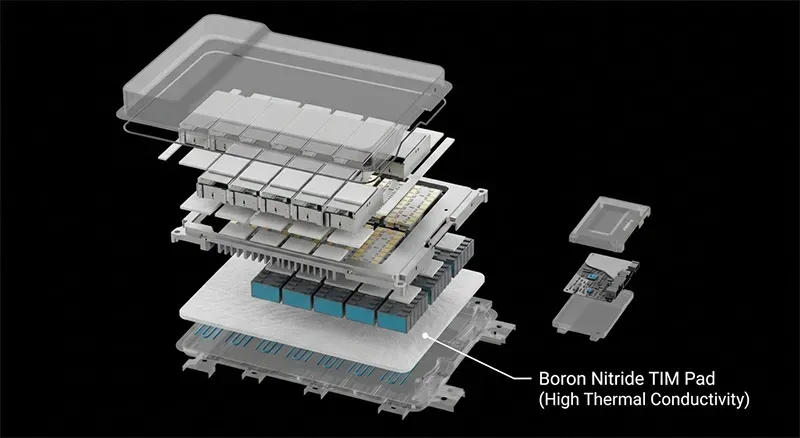
Electric vehicles run hotter than most people think. Packed cells, fast charging, and tight housings leave almost no breathing room. That’s where Flexible boron nitride thermal conductive film steps in. By blending flexible, boron nitride, thermal conductive, and film technologies, modern EV packs gain safer and smarter cooling without adding bulk.
Thin-Film Application in Tight Module Designs
Compact module design forces engineers to fight space constraints while still upgrading thermal management. A Flexible boron nitride thermal conductive film works because it stays thin yet moves heat fast.
Material foundation
1.1 Boron nitride crystal alignment improves heat dissipation
1.2 Ultra-thin thin film profile (≤100 μm) supports tight stacking
1.3 High dielectric strength protects adjacent cells
Mechanical adaptability
2.1 Built-in flexibility allows bending around curved housings
2.2 Maintains contact under vibration
2.3 Reduces air gaps inside compact battery frames
Thermal pathway optimization
3.1 Direct contact with cell casing
3.2 Lateral spreading toward cooling plates
3.3 Stabilized temperature gradient across modules
Short version? Less bulk. Better cooling. Longer battery life.
Manufacturers such as Sheen Technology refine layer uniformity so each Flexible boron nitride thermal conductive film fits snugly into dense EV architectures without redesigning the whole pack.
Roll-to-Roll Processing for Large-Scale Sheets
Scaling matters. Roll-to-roll processing supports continuous production of large-scale sheets while keeping thickness steady across meters of boron nitride film.
· High-throughput coating
· Precision calendering
· Inline thickness monitoring
According to the IEA Global EV Outlook 2025, EV sales surpassed 17 million units in 2024, driving sharp growth in advanced battery materials demand.
BloombergNEF’s 2025 battery report notes that improved thermal control materials are now “a key enabler for higher energy density pack designs.”
That demand pushes suppliers like Sheen Technology to optimize manufacturing consistency for every meter of Flexible boron nitride thermal conductive film shipped.
Integration with Thermal Interface Materials for EV Packs
Pairing thermal interface materials with a Flexible boron nitride thermal conductive film strengthens the full cooling system inside an EV battery pack.
· Step 1: Place the boron nitride film directly against the cell surface to spread heat.
· Step 2: Add compliant pads or gap fillers to maintain pressure and improve heat transfer.
· Step 3: Bond to liquid-cooled plates or heat sinks, reinforcing overall thermal conductivity.
· Step 4: Validate full-pack battery thermal management under fast-charge cycles.
Each layer plays its role. The film spreads heat. The interface materials push it outward. The cooling plate carries it away.
Used together, Flexible boron nitride thermal conductive film systems help EV makers keep temperatures steady, even when drivers push the pedal hard.
【Request a Custom Quote】 Selecting the right flexible boron nitride thermal conductive film depends on your operating temperature, dielectric requirements, thickness constraints, assembly process, and thermal performance targets. Share your application details with our engineering team, and we'll help recommend the most suitable solution for your project.
Sheen Thermal
Dongguan Sheen Electronic Technology Co., Ltd · Founded in 2008
Manufacturer of thermal interface materials and silicone foam for automotive electronics, energy storage, power electronics, communications and consumer electronics.
Certified
- ISO 9001:2015
- ISO 14001:2015
- IATF 16949:2016
What we supply
- Thermal conductivity Up to 90 W/m·K
- Thickness 0.3–10.0 mm
- Custom & samples Die-cut to drawing, 3–7 days