
 English
 usheenthermal

Closed-Cell Silicone Foam vs. Open-Cell: Which Do You Need?
Date:2026-07-22
Closed-Cell Silicone Foam vs. Open-Cell: Which Do You Need?
Closed-cell Silicone Foam shows up when a gasket fails, moisture creeps in, and a product recall looms over your team like a bad storm rolling fast.
According to Grand View Research and MarketsandMarkets reports through 2025, demand for silicone foam in electronics manufacturing is driven by sealing reliability, compliance requirements, and durability expectations.
Selecting the wrong foam type for an application leads to predictable failures: open-cell foam used as a moisture seal will absorb water, swell, and lose gasket pressure. Closed-cell foam used for acoustic damping will underperform due to its higher stiffness. This guide provides the material properties, performance data, and application-specific guidance engineers need to select the correct Silicone Foam type for each use case.
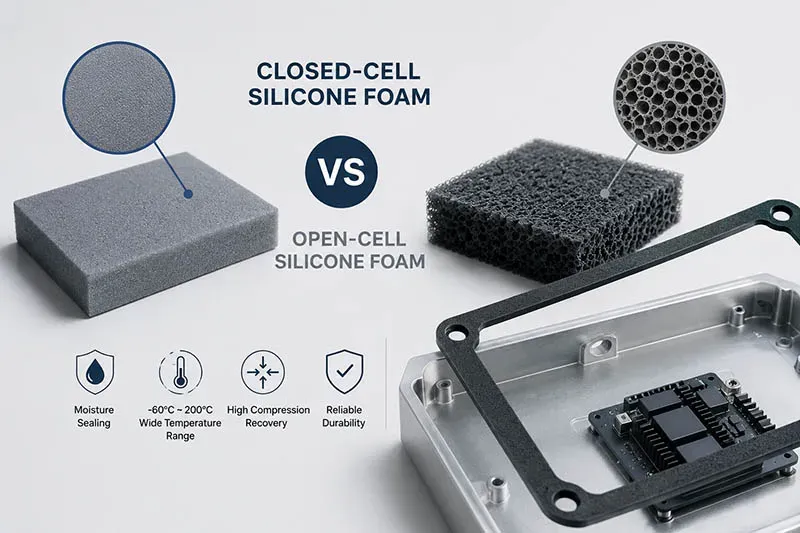
Quick Notes for Closed-Cell Silicone Foam Triumphs
- Sealing Performance: Closed-cell Silicone Foam offers low permeability and high compression recovery, ensuring IP67/IP68 dust and moisture protection.
- Durability & Temperature: Operates from –60 °C to 200 °C with platinum-cured formulations for UV and chemical resistance.
- Mechanical Properties: Higher density and tensile strength deliver low compression set and reliable gasket resilience under cyclic loads.
- Thermal Control: Consistent insulation with minimal convective losses makes it ideal for electronics and industrial assemblies.
- Compliance & Fabrication: Meets RoHS, REACH, UL 94 V-0; custom shapes achieved via die cutting, laminating, or waterjet for precise sealing solutions.
Open-Cell Vs Closed-Cell Silicone Foam: Key Differences
Open-cell and closed-cell silicone foams solve different problems. One breathes and cushions; the other seals tight. Picking right saves cost, boosts fit, and keeps products performing in real-world conditions.
Open-Cell Silicone Foam
Cell network
- Interconnected cells enable airflow and breathability
- Trade-off: higher water absorption
Feel and motion
- High compressibility and softness
- Strong acoustic absorption for rattle and noise control
Performance notes
- Damping excels in light assemblies
- Recovery shows higher compression set over time
- Thermal resistance is moderate, not a vapor stop
Use mapping
- Cushioning pads — comfort and vibration
- Speaker housings — sound tuning
- Light seals — where airflow is acceptable
Sheen Technology tunes pore size to balance comfort with durability, keeping airflow while limiting long-term set.
Closed-Cell Silicone Foam
Closed-cell builds a sealed skin. With sealed cells, you get water resistance and a reliable vapor barrier; that's why closed-cell Silicone Foam keeps dust and splashes out.
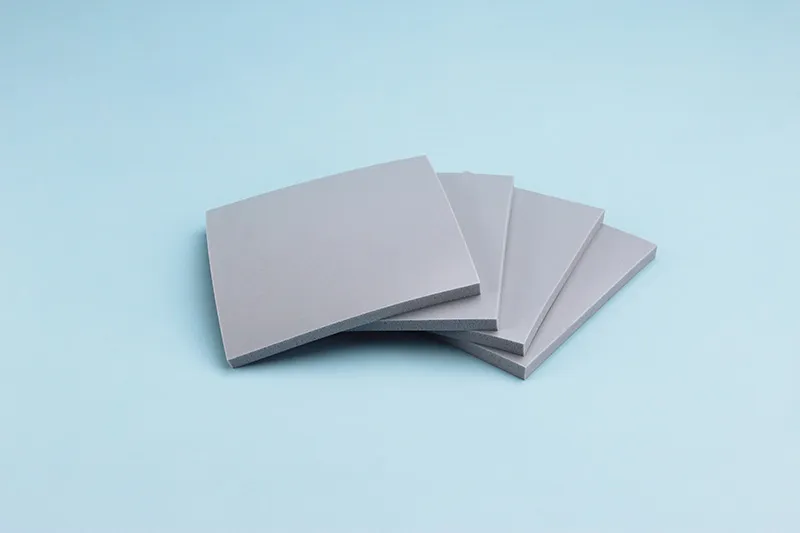
Quick hits
- Higher density and rigidity
- Stable thermal insulation
- Natural buoyancy
Numbered picks
- Gaskets for IP ratings
- Outdoor electronics sealing
- Automotive enclosures
Tight seal. Low uptake. Consistent performance.
Steps to spec
- Define ingress target
- Choose thickness and compression
- Validate with closed-cell Silicone Foam samples
Sheen Technology Offers closed-cell Silicone Foam grades with low compression set and repeatable gasketing for long service life.
Layered View: Insulation, Damping, Sealing, Lifespan
A quick, practical look at how closed-cell Silicone Foam behaves in real builds — heat, vibration, sealing, and aging.
Thermal Insulation and Conductivity Profile
Core behavior of Closed-cell Silicone Foam
- Trapped gas pockets slow heat transfer
- Higher thermal resistance → steadier temperature gradient
- Lower heat flux across thin gaskets
Silicone Foam vs open structures
- Closed cell Silicone Foam keeps insulation efficiency stable
- Open-cell Silicone Foam invites convection, drops R consistency
Practical picks
- Silicone foam sheets for boards, enclosures
- Closed-cell silicone foam for tight thermal gaps
For electronics enclosures, this translates to consistent thermal management performance over the product lifetime, regardless of ambient temperature variations.
Vibration Damping: Compression Set Insights
How damping works
- Viscoelastic silicone — energy dissipation under cyclic load
- Balanced damping coefficient and material recovery
Compression set matters
- Low set = stable vibration absorption over time
Material choices
- Open cell silicone foam — strong shock absorption
- Closed cell Silicone Foam — better rebound, longer life
In use with Sheen Technology parts
- Tuned density for compression set control
- Tested for viscoelasticity under repeated strain
In practice, many designs combine both foam types: closed-cell for sealing at the interface, open-cell as a cushioning layer for shock absorption.
Sealing Performance and Moisture Barrier
Sealing stack with Closed-cell Silicone Foam
Outer layer
- Dense skin limits air permeability
Core
- Closed cells block water ingress
- Strong barrier properties and fluid containment
Enhancements
- Adhesive-backed closed-cell silicone foam tapes
- Improve sealing effectiveness in dusty builds
"Closed-cell silicone foams continue to lead in environmental sealing where IP ratings depend on consistent compression and low permeability," notes a 2025 materials brief from MarketsandMarkets.
Durability and Operating Temperature Range
The silicone backbone resists UV degradation, chemical attack, and thermal aging. Key durability characteristics:
- Operating range: –60 °C to +200 °C (platinum-cured closed-cell grades)
- UV stability: No yellowing or embrittlement after 5,000 hours of UV exposure
- Chemical resistance: Compatible with most cleaning solvents, oils, and fuels encountered in industrial and automotive environments
- Compliance: Platinum-cured closed-cell silicone foam meets RoHS, REACH, and UL 94 V-0 flame requirements
Sheen Technology recommends qualification testing under the specific duty cycle of the target application to confirm material performance within the required operating envelope.
| Properties | SA700-200 | SA700-260 | SA700-300 | SA700-350 | SA700-400 | SA700-450 | SA700-500 | SA700-900 | Test Method |
|---|---|---|---|---|---|---|---|---|---|
| Color | White, Black | Grey, Black | Grey, Black | Black | Grey, Black | Grey, Black | Grey | Grey | Visual |
| Density (kg/m3) | 200±20 | 260±26 | 300±30 | 350±35 | 350±35 | 450±45 | 500±50 | 950±95 | ASTM D3574-95 |
| Thickness (mm) | 1.0~10.0 | 1.0~10.0 | 1.0~10.0 | 1.0~10.0 | 1.0~10.0 | 1.0~10.0 | 1.0~10.0 | 1.0~10.0 | - |
| Compression Set (%) | <5 | <5 | <5 | <5 | <5 | <5 | - | ASTM D3574-95 Test D @ 158°F | |
| Compression Force Deflection (kPa) | 1-17 | 7-48 | 40-97 | 110-140 | 110-140 | 140-180 | 148-180 | >900 | ASTM D3574 |
| Tensile Strength (kPa) | 126 | 180 | 168 | 300 | 260 | 350 | - | 1.8 MPa | ASTM D3574-95 Test E |
| Tear Strength(N/mm) | 2.5 | 2.8 | 3 | 3.9 | 3.3 | 5.5 | - | 0.5 MPa | ASTM D3574-95 Test E |
| Thermal Conductivity (W/m·K) | ≤0.2 | ≤0.2 | ≤0.2 | ≤0.2 | ≤0.2 | ≤0.2 | - | ≤0.3 | ASTM D5470 |
| Breakdown Voltage( Kv) | ≥8 | ≥8 | ≥8 | ≥8 | ≥8 | ≥9 | ≥4 | - | ASTM D149 |
| Flame Rating | V-0 | V-0 | V-0 | V-0 | V-0 | V-0 | V-0 | V-0 | UL 94 |
| Electrical Insulation | >1 × 10¹⁷Ω·cm | >1 × 10¹⁶Ω·cm | >1 × 10¹⁶Ω·cm | >1 × 10¹⁵Ω·cm | >1 × 10¹⁵Ω·cm | >1 × 10¹⁵Ω·cm | >1 × 10¹⁴Ω·cm | >1 × 10¹⁵Ω·cm | ASTM D412 |
Sheen Technology provides detailed technical datasheets for closed-cell and open-cell silicone foam grades. Download the Silicone Foam Engineering Datasheet for complete specifications.
5 Use Cases For Silicone Foam
The following use cases illustrate how closed-cell and open-cell silicone foams are deployed across industrial and electronics applications.
Case 1: Gasketing for IP-Rated Dust Protection
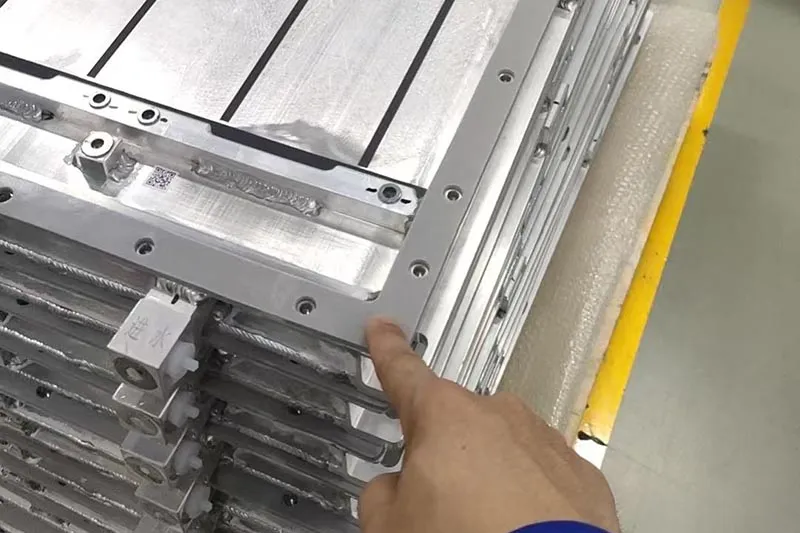
Core idea: gasket + silicone foam = tight protection
- Closed-cell Silicone Foam blocks particulate
- Recovers after compression
- Maintains sealing over cycles
In practice, Silicone Foam closed cell strips line panel edges, forming a dust barrier that keeps IP ratings intact.
Sheen Technology tunes Shore hardness so enclosure seams stay clean.
Case 2: Vibration Damping in Power Electronics
Impact and micro-shock from power module operation are absorbed by silicone foam cushioning layers. Closed-cell pads placed between the module baseplate and enclosure wall reduce vibration transmission. Combining closed-cell sealing foam with softer open-cell cushioning layers provides both sealing and shock absorption in a single assembly.
Nested view: Material choice
- Density → cushioning
- Resilience → damping steady
Result — less transfer, longer device life
Short note: mixing closed cell Silicone Foam pads with softer layers balances shock absorption.
Case 3: Sealing Assemblies with Adhesive-Backed Tapes
- Adhesive layer speeds assembly
- Tape conforms to uneven joints
- Silicone foam resists heat and UV
Steps:
- Clean surface
- Apply closed-cell Silicone Foam tape
- Compress for bond
- Verify sealing line continuity
Sheen Technology supplies die-ready rolls for quick attachment.
Case 4: Thermal Insulation Using Silicone Sheets
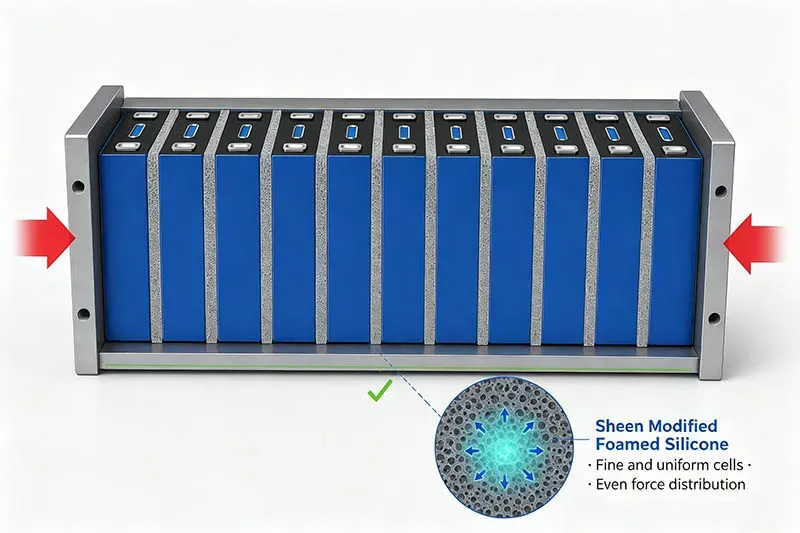
Closed-cell Silicone Foam sheets act as thermal insulation barriers, limiting heat flow between adjacent components while maintaining dielectric safety. In compact stacks, the foam core avoids moisture wicking that would degrade insulation performance over time. Applications include power supply enclosures and battery management system housings.
Case 5: Moisture Barrier via Die-Cut Gaskets
Nested breakdown: Design
- CAD → die-cut profile
- Tolerance control
Material
- Closed cell Silicone Foam for moisture barrier
Validation
- Compression set
- Ingress checks
Table (typical metrics):
| Material | Density (kg/m³) | Compression Set (%) | Water Absorption (%) |
|---|---|---|---|
| Closed-cell Silicone Foam | 180 | 5 | <1 |
| Silicone Foam (open) | 140 | 8 | 5–10 |
| Solid silicone | 1200 | 3 | <1 |
| EPDM foam | 160 | 12 | 2–5 |
- Tight gasket = low humidity ingress
- Repeatable sealing beats rework
- Sheen Technology keeps cuts clean, edges true
Across builds, Closed-cell Silicone Foam keeps showing up because it just works.
Scenario: Waterproof Sealing With Closed-Cell Silicone Foam
Closed-cell Silicone Foam shows up everywhere once you notice it — phones, EV packs, outdoor sensors. Getting a tight seal isn't luck; it's about tuning density, compression, and fabrication. With closed-cell Silicone Foam and Silicone Foam blends, Sheen Technology keeps seals consistent, even when heat, water, and time try to mess things up.
Selecting Density and Shore Hardness for IP Rating
Core pairing of density and Shore hardness drives sealing performance in Closed-Cell Silicone Foam.
1) Targeting IP Rating
- IP67: brief immersion — moderate density, softer shore
- IP68: long immersion — higher density, tighter cell structure
2) Compression behavior
a. Compression Set control
i. lower set = longer seal life
ii. avoid over-compression fatigue
b. Recovery speed under thermal cycling
3) Material tuning with closed-cell Silicone Foam
- Blend ratios in closed-cell silicone foam
- Gasketing geometry + squeeze %
Table (typical ranges):
| Application | Density (kg/m³) | Shore Hardness (00) | Compression Set (%) |
|---|---|---|---|
| IP65 housing | 180–240 | 30–40 | 10–18 |
| IP67 handheld | 220–300 | 35–50 | 8–15 |
| IP68 outdoor | 260–360 | 45–60 | 6–12 |
| EV enclosure | 300–420 | 50–70 | 5–10 |
Sheen Technology often tunes closed-cell Silicone Foam to hit these windows without killing assembly yield.
Fabrication Techniques — Die Cutting and Laminating
Short version: shape, stick, seal — done right.
- Die Cutting gives repeatable gaskets and seals; waterjet handles thicker Silicone Foam.
- Laminating adds adhesives for fast assembly; liner choice affects material handling.
- Closed-cell Silicone Foam parts benefit from kiss-cut stacks, reducing waste.
Sheen Technology supports roll-to-roll for high-volume closed-cell silicone foam programs.
Achieving RoHS Compliance and UL 94 V-0 Standards
Steps that keep audits smooth with closed-cell Silicone Foam:
- Select platinum-cured silicone; verify RoHS compliance and hazardous substances limits.
- Add flame packages to meet UL 94 V-0 and broader flammability standards.
- Validate via material certification; track regulatory standards and environmental regulations.
- Run burn and aging tests; confirm flame retardancy after heat soak.
Closed-cell Silicone Foam that passes here stays compliant in real products, not just on paper.
Sheen Technology closed-cell and open-cell silicone foams are deployed across industrial sealing, electronics enclosure gasketing, EV battery module sealing, telecom base station weatherproofing, and aerospace environmental protection systems. Visit relate application pages for application notes, IP validation data, and case studies showing how Silicone Foam grades are specified across different sealing classes and operating environments.
Contact our engineering team for a technical datasheet, free sample kit, or application-specific compression and sealing support. Sheen Technology provides closed-cell and open-cell silicone foam in sheet, roll, and custom die-cut formats.
Sheen Thermal
Dongguan Sheen Electronic Technology Co., Ltd · Founded in 2008
Manufacturer of thermal interface materials and silicone foam for automotive electronics, energy storage, power electronics, communications and consumer electronics.
Certified
- ISO 9001:2015
- ISO 14001:2015
- IATF 16949:2016
What we supply
- Thermal conductivity Up to 90 W/m·K
- Thickness 0.3–10.0 mm
- Custom & samples Die-cut to drawing, 3–7 days