
 English
 usheenthermal

Silicone vs. Flame-Retardant Silicone-Free Thermal Conductive Material
Date:2026-06-04
Silicone vs. Flame-Retardant Silicone-Free Thermal Conductive Material
Heat is eating margins alive, and Flame-retardant silicone-free thermal conductive material is stepping in where old silicone pastes start to slip, bleed, and quietly rack up risk across high-stakes hardware.
Buyers need cleaner performance, tighter real compliance, and fewer production headaches, not another patch job that fails under pressure and heat.
Harmonic Key Points: Flame-retardant Silicone-Free Thermal Conductive Material
➔ Superior Heat Dissipation: Boron nitride fillers deliver high thermal conductivity and low thermal impedance, ensuring efficient cooling for IGBT modules, power MOSFETs, and microprocessors.
➔ Enhanced Fire Safety: Magnesium hydroxide boosts UL 94 flame retardancy and oxygen index, providing reliable protection in battery modules and telecom gear.
➔ Robust Electrical Insulation: High volume resistivity and dielectric strength prevent leakage in integrated circuits and memory modules under heavy load.
➔ Manufacturing Ease: Optimized viscosity supports precise dispensing, screen printing, and die-cutting, streamlining assembly for data centers and automotive electronics.
Comparative: Silicone Vs. Flame-Retardant Silicone-Free Thermal Conductive Material
Thermal interface choices can make or break electronic reliability. From power modules to data racks, picking between silicone-based grease and Flame-retardant silicone-free thermal conductive material affects heat transfer, safety compliance, and long-term durability. Below is a practical, side-by-side breakdown grounded in real engineering needs.
Silicone-Based Thermal Paste
Silicone systems remain common in electronic components that demand stable thermal conductivity and flexible gap filling.
• Reliable viscosity for automated dispensing
• Stable dielectric properties
• Balanced heat transfer across uneven surfaces
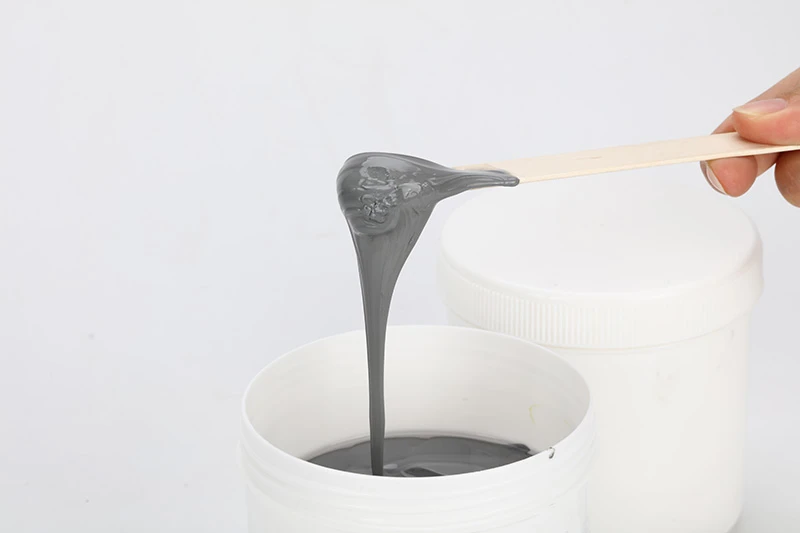
Sheen Technology Silicone thermal paste Key performance snapshot:
| Properties | Color | Thermal Impedance (@30psi) | Thermal Conductivity | Minimum Interface Thickness |
|---|---|---|---|---|
| Unit | - | ℃*in2/W | W/m·K | mm |
| SG560-10 | White | ≤0.15 | 1.0±0.1 | 0.06 |
| SG560-20 | White/Gray | ≤0.045 | 2.0±0.2 | 0.05 |
| SG560-30 | Gray | ≤0.03 | 3.0±0.3 | 0.05 |
| SG560-40 | Gray | ≤0.02 | 4.0±0.4 | 0.05 |
| SG560-50 | Gray | ≤0.016 | 5.0±0.5 | 0.05 |
| Test Method | Visual | ASTM D5470 | ASTM D5470 | - |
Performance reality:
✔ Good compressibility
✖ Possible pump-out under cycling
Long-term stability depends on filler dispersion and oil retention. In dense power boards, oil separation may impact nearby electronic components, especially where cleanliness matters.
Recent 2025 data from MarketsandMarkets notes:
“Thermal management materials with enhanced flame resistance are gaining faster adoption in EV power systems and hyperscale data infrastructure.”
That shift explains why many engineers now compare silicone paste with Flame-retardant silicone-free thermal conductive material options.
Flame-Retardant Silicone-Free Thermal Paste
Flame-retardant silicone-free thermal conductive material removes siloxane oils and focuses on inorganic systems designed for safer, cleaner operation.
Core design logic:
· Non-silicone polymer matrix
· High-loading boron nitride
· Magnesium hydroxide for flame resistance
Performance drivers:
· Elevated thermal conductivity via plate-like fillers
· Reduced volatile organic compounds
· Stronger electrical insulation
· Better pump-out resistance under cycling
Material comparison hierarchy:
Thermal Path
· Filler network density
· Interface wetting behavior
Safety Layer
· UL 94 V-0 rating
· Enhanced high temperature performance
Environmental Fit
· Low volatile organic compounds
· Easier environmental compliance
Short and clear:
· Lower contamination risk.
· Cleaner optics in precision assemblies.
· Improved arc resistance.
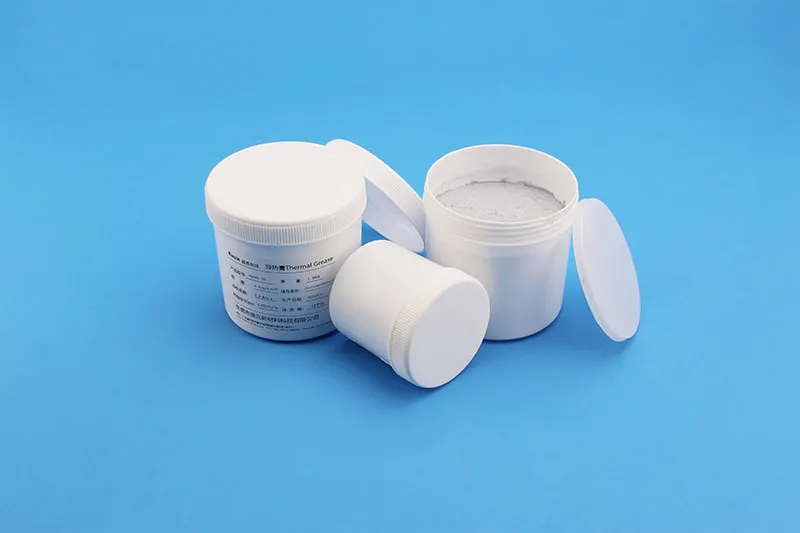
Sheen Technology Silicone thermal paste Key performance snapshot:
| Properties | Unit | AG560-30 | AG560-20 | Test Method |
|---|---|---|---|---|
| Color | - | Gray | Gray | Visual |
| Thermal Impedance (@50psi) | ℃*in2/W | ≤0.03 | ≤0.05 | ASTM D5470 |
| Thermal Conductivity | W/m·K | 3.0±0.2 | 2.0±0.2 | ASTM D5470 |
| Minimum Interface Thickness | mm | 0.05 | 0.05 | - |
| Penetration Value (@25 ℃) | 0.1mm | 260±20 | 280±20 | GB/T269 |
| Density | g/cm3 | 2.60±0.2 | 2.90±0.2 | ASTM D792 |
| Operating Temp. | ℃ | - 40 ~ 150 | - 40 ~ 150 | - |
| Flame Rating | - | V-0 | V-0 | UL 94 |
| RoHS | - | PASS | PASS | IEC 62321 |
| Halogen | - | PASS | PASS | EN 14582 |
| REACH | - | PASS | PASS | EN 14372 |
For data centers and EV modules, Flame-retardant silicone-free thermal conductive material supports stable thermal conductivity without silicone migration. That matters when uptime equals revenue.
Sheen Technology develops tailored Flame-retardant silicone-free thermal conductive material solutions for high-power electronics, focusing on dielectric strength, safety standards, and long service life. In applications demanding strict fire codes and reduced outgassing, many engineers now default to Flame-retardant silicone-free thermal conductive material instead of traditional grease.
5 Advantages Of Silicone-Free Thermal Conductive Material
Flame-retardant silicone-free thermal conductive material is quickly becoming the go-to option for safer and cleaner heat control. By combining flame retardant chemistry, silicone-free stability, and high thermal conductivity, this material keeps electronics cool without messy residue. Here’s why engineers are switching to this smart thermal solution.
Superior Thermal Conductivity via Boron Nitride Fillers
In a Flame-retardant silicone-free thermal conductive material, boron nitride acts as a high-efficiency pathway for heat transfer while preserving electrical insulation. The synergy between ceramic fillers and resin matrix directly impacts material performance and lowers thermal impedance in demanding chips.
Performance comparison of thermal interface formulations
| Material Type | Filler Content (%) | Thermal Conductivity (W/m·K) | Volume Resistivity (Ω·cm) | Application |
| Silicone-based TIM | 65 | 1-15 | 10¹² | Consumer CPU |
| Flame-retardant silicone-free thermal conductive material | 72 | 1-12 | 10¹⁴ | IGBT module |
| Silicone free conductive material (BN enhanced) | 75 | 15-20 | 10¹⁴ | Power MOSFET |
Why this matters:
· Higher thermal conductivity
· Lower junction temperature
· Stable thermal interface thickness
At Sheen Technology, engineers fine-tune filler dispersion so the flame-retardant silicone-free thermal conductive material spreads evenly and stays put under pressure.
Advanced Flame Retardancy with Magnesium Hydroxide
A flame-retardant silicone-free thermal conductive material relies on magnesium hydroxide to boost flame retardancy and improve fire resistance without toxic halogens.
Performance layers include:
· Heat absorption during decomposition
· Water vapor release to suppress flames
· Protective char formation enhancing thermal stability
Key safety outcomes:
· Higher oxygen index
· Non-flammable behavior under overload
· Better material properties in battery packs
For EV battery modules and telecom racks, this flame-retardant thermal interface material keeps things cool and safe. Sheen Technology integrates optimized particle size control to maintain both safety and conductivity.
Exceptional Electrical Insulation and Dielectric Strength
A silicone-free heat-conductive compound must balance cooling with strong electrical insulation.
Core advantages:
· High dielectric strength
· Stable electrical properties under voltage stress
· Reliable voltage resistance in compact boards
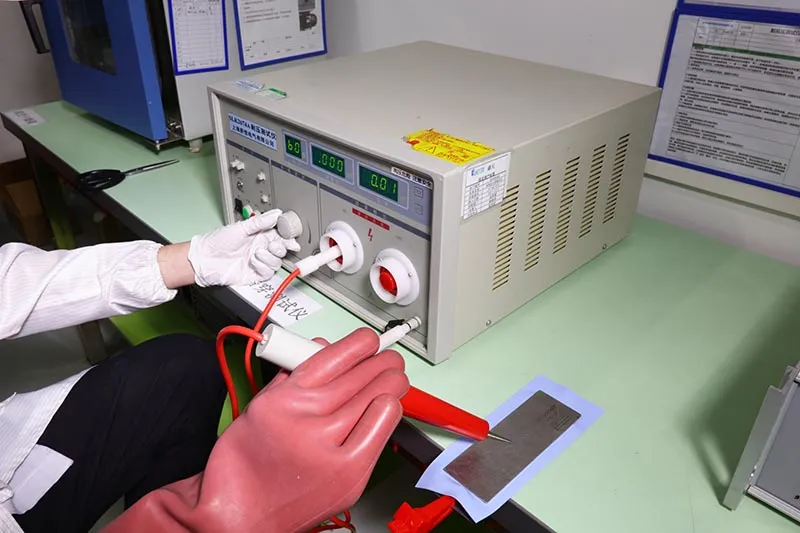
In power converters and memory stacks, the Flame-retardant silicone-free thermal conductive material prevents leakage while maintaining consistent insulation. Short circuits? Not on its watch. That balance protects sensitive electronic components and extends operational life.
Improved Thermal Cycling Stability for Data Centers
Continuous uptime in data centers means constant temperature fluctuations. A flame-retardant silicone-free thermal conductive material resists pump-out and cracking during repeated thermal stress cycles.
Long-term benefits include:
· Adhesion retention
· Maintained thermal cycling stability
· Improved reliability for servers
The International Energy Agency’s 2025 data center outlook noted that global data center electricity demand may double by 2030, stressing the need for advanced cooling materials that sustain long-term performance.

Sheen Technology AF800 Silicone-free Thermal Pad Reliability Test Report:
| Test Items | Test Conditions | Test Equipment |
| High-Temperature Aging | 120℃,1008H | Precision Oven |
Criteria for Judging Test Results
| Performance Parameter | Initial Value | Acceptance Criteria |
| Thermal Conductivity(W/m*K) | 8.12 | ±15% |
| Hardness(shore 00) | 82 | ±10% |
| Density(g/cm³) | 3.43 | ±10% |
High-Temperature Aging Test Results
| High-Temperature Aging Test Record Sheet | ||||||||||
| Aging Time | H | 0 | 168 | 336 | 504 | 672 | 840 | 1008 | Change | Assessment |
| Thermal Conductivity | W/m*k | 8.12 | 8.46 | 8.32 | 8.64 | 8.01 | 8.33 | 8.29 | 2.05 | OK |
| Hardness | Shore00 | 82 | 76 | 83 | 82 | 85 | 88 | 90 | 8 | OK |
| Compression (20% Compression Rate) | g/cm³ | 3.43 | 3.43 | 3.42 | 3.44 | 3.43 | 3.41 | 3.45 | 0.58 | OK |
Test Conclusion: After undergoing 1008 hours of aging under various conditions, the AF800 passed performance testing and maintained an acceptable appearance. Therefore, the AF800 has passed reliability testing.
That’s where silicone-free conductive material shines. It keeps long-term performance steady even after thousands of cycles.
Need exact thermal conductivity, dielectric strength, thickness range, and reliability data before you choose? Download the product datasheets to compare flame-retardant silicone-free thermal conductive material options.
Streamlined Dispensing and Die-Cutting Processes
Manufacturers care about speed. A well-designed Flame-retardant silicone-free thermal conductive material supports smooth dispensing, clean die-cutting, and automated fabrication.
Production advantages break down into:
· Controlled viscosity for precise material application
· Uniform thickness during screen printing
· Improved production efficiency in high-volume lines
From consumer gadgets to automotive ECUs, optimized rheology simplifies manufacturing processes. Sheen Technology aligns material flow with automation systems, making assembly lines faster and less messy.
In short, flame-retardant silicone-free thermal conductive material blends cooling power, fire safety, insulation strength, durability, and easy processing into one practical solution.
Scenario: Data Centers—Why Silicone-Free Pastes Matter
Data centers run hot, loud, and nonstop. In that grind, Flame-retardant silicone-free thermal conductive material solutions are not just nice to have—they keep hardware stable, clean, and safe. When heat spikes and uptime is king, material choices quietly decide performance and lifespan.
Thermal Adhesion for High-Performance Microprocessors
High-density microprocessor, CPU, and GPU units push brutal thermal loads. A Flame-retardant silicone-free thermal conductive material works at the junction where silicon meets metal, locking in adhesion while driving down thermal impedance.
Interface Demands
1.1 Heat Transfer
· Stable thermal conductivity supports fast heat dissipation.
· Low pump-out protects die attach areas.
1.2 Mechanical Bond
· Consistent adhesion across temperature swings.
· Clean interface—no silicone bleed.
Material Design
2.1 Flame-retardant fillers
2.2 Controlled viscosity
2.3 Electrical insulation for sensitive cores
Sheen Technology formulates flame-retardant, silicone-free thermal interface material systems tuned for AI accelerators. The result? Lower thermal resistance, tighter bond lines, and steady output under load.
Continuous-Load Stability in Telecommunications Equipment
Telecommunications equipment like base stations and power amplifiers rarely rest. Continuous operation means endless thermal cycling.
Key expectations:
· Long-term reliability
· Stable thermal management
· Extended operational lifespan
A Flame-retardant silicone-free thermal conductive material handles sustained heat without releasing volatile organic compounds. That matters in sealed cabinets.
Performance Snapshot Under Continuous Load
| Material Type | Thermal Conductivity (W/m·K) | Volume Resistivity (Ω·cm) | 1,000h Drift (%) |
| Silicone-based paste | 3.2 | 1.0×10¹² | 8.5 |
| Silicone-free TIM | 4.5 | 1.0×10¹⁴ | 2.1 |
| Flame-retardant silicone-free thermal conductive material | 5.0 | 1.0×10¹⁵ | 1.4 |
Lower drift. Cleaner insulation. That’s how Sheen Technology supports 24/7 network stability.
Precise Bond Line Thickness for Dense Memory Modules
Tightly stacked memory modules demand strict bond line thickness control. With dense packaging, even small gaps spike thermal impedance.
Structural Needs
1.1 Uniform compression
1.2 Predictable gap filler spread
Risk Control
2.1 Reduced thermal resistance
2.2 No silicone migration
Short and simple: stable thickness equals stable cooling.
A Flame-retardant silicone-free thermal conductive material balances flow and structure. The flame-retardant, silicone-free thermal compound keeps modules cool, clean, and compliant. In high-density racks, that difference shows up in uptime—and in fewer late-night maintenance calls.
【Request a Custom Quote】Not sure which flame-retardant silicone-free thermal conductive material fits your build? Send us your target operating temperature, thickness target, application type, and performance requirements, and we can help recommend the right thermal solution for your project.
Sheen Thermal
Dongguan Sheen Electronic Technology Co., Ltd · Founded in 2008
Manufacturer of thermal interface materials and silicone foam for automotive electronics, energy storage, power electronics, communications and consumer electronics.
Certified
- ISO 9001:2015
- ISO 14001:2015
- IATF 16949:2016
What we supply
- Thermal conductivity Up to 90 W/m·K
- Thickness 0.3–10.0 mm
- Custom & samples Die-cut to drawing, 3–7 days