
 English
 usheenthermal

Thermal Management Solutions for Optical Modules in High-Mating-Cycle Scenarios
Date:2026-09-02
In high-mating-cycle scenarios, an optical module is unplugged and reconnected thousands of times, and interface performance must stay stable across that life. Shifting contact pressure, silicone-grease pump-out, material migration, and adhesive wear can raise thermal resistance well after day-one qualification.
Effective supplier qualification therefore weighs stable batches, material compatibility, repeatable application, and cycle-tested performance — not bulk conductivity alone.
To address the high-mating-cycle of optical modules subject to frequent insertion and removal, Sheen Technology introduces a thermal management solution featuring metal-carbon composite gaskets. This solution effectively resolves interface thermal conductivity failure caused by repeated mating cycles, balancing thermal performance with mechanical durability to meet the requirements of high-frequency insertion/removal applications.
Key Insights for Optical Modules Thermal Management Solutions
- Ensure long-term stability by selecting cycle-tested TIMs—silicone greases, phase change materials, and graphite sheets must resist pump-out and migration after 5 000+ mating cycles.
- Balance active and passive cooling: use pin-fin heat sinks or vapor chambers for simplicity, and integrate Peltier modules or liquid cooling plates when tighter temperature control is required.
- Monitor real-world performance with thermocouple sensors and infrared imaging film to detect interface degradation, hot spots, or uneven pressure and validate supplier consistency.
→ Request the High-Mating-Cycle Qualification Guide

Hot Spots After 5 000 Mating Cycles?
After 5,000 mating cycles, tiny mechanical changes can turn into measurable thermal problems. Optical Modules Thermal Management Solutions need to account for shifting interfaces, aging materials, and repeated compression. Sheen Technology evaluates these effects so optical module thermal management stays predictable when connectors are unplugged and reconnected again and again.
Where Graphite Sheet Layers Accumulate Heat
A graphite sheet normally offers high thermal conductivity, but repeated handling can change its pressure and position.
Near the optical module
- Delamination can interrupt lateral heat spreading.
- Local heat accumulation then rises near active devices.
Around connectors
- Uneven pressure increases interface resistance.
- Higher thermal impedance can make a small hot spot a bigger deal.
That behavior makes graphite control an important part of Optical Modules Thermal Management Solutions. Sheen Technology has launched a vertically oriented graphene thermal pad that offers higher heat dissipation efficiency along the thickness direction, thereby reducing localized hotspots.
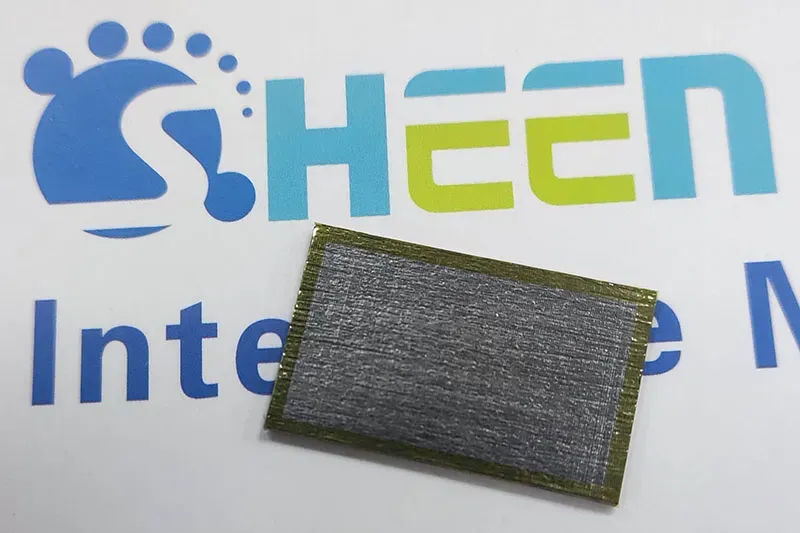
Note: a graphite sheet is electrically conductive and spreads heat in-plane. Use it on non-energized surfaces, or specify an edge-sealed / film-laminated variant near live conductors. Do not use bare graphite as a dielectric isolator between a device and its heat sink.
Thermocouple Sensor Insights on Silicone Grease Breakdown
A thermocouple sensor can expose gradual drift rather than waiting for obvious overheating.
- Record the initial temperature gradient across the interface.
- Repeat each mating cycle under controlled power.
- Track silicone grease movement. A pump-out effect can push grease away from loaded areas, increasing contact resistance.
- Compare later measurements for signs of thermal degradation.
Sheen Technology can use these readings to refine thermal solutions before grease aging starts throwing temperatures off.
Phase Change Material Performance Under Repeated Mating
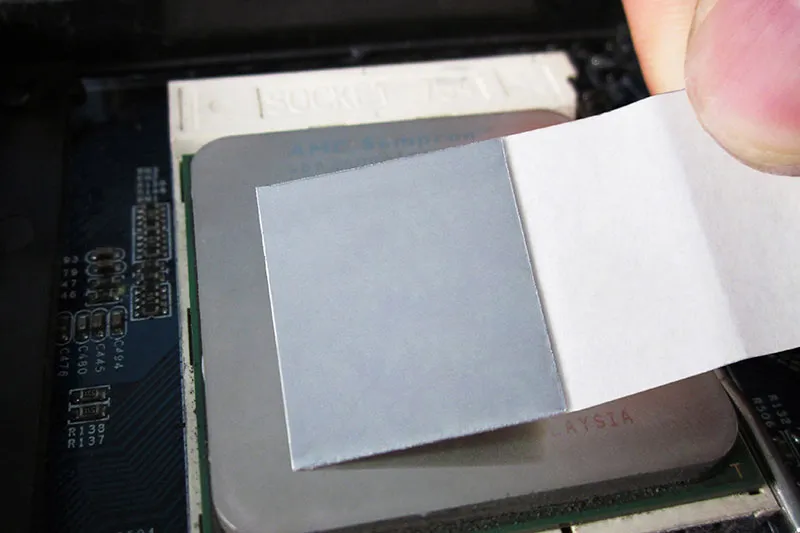
Phase change material absorbs and releases latent heat while changing state, helping fill small surface gaps.
Mechanical effects
- Cyclic loading creates mechanical stress.
- Compression may produce permanent deformation.
Thermal effects
- Changing viscosity can encourage material migration.
- Thickness loss can reduce long-term thermal performance.
For Optical Modules Thermal Management Solutions, tracking those physical changes helps distinguish a stable thermal interface from one that slowly loses contact after thousands of cycles.
4 Key Cooling Techniques For High-Cycle Modules
High-cycle optical hardware faces changing contact pressure, power spikes, and tight spaces. Optical Modules Thermal Management Solutions from Sheen Technology combine passive and active cooling methods, keeping heat under control without making maintenance a headache.
Step 1: Applying Phase Change Material for Rapid Heat Spread
Optical Modules Thermal Management Solutions can place Phase Change Material at the Thermal Interface, where improved Thermal Conductivity supports Heat Spread.
Heat absorption
- Latent Heat buffers short spikes.
- Temperature Stabilization protects Optical Modules during repeated mating.
Step 2: Integrating Pin Fin Heat Sink for Enhanced Airflow
A Pin Fin Heat Sink adds Surface Area while allowing flexible Airflow Dynamics. That is handy in High-Mating-Cycle assemblies where space gets tight.
| Pin height | Air speed | Heat load | Estimated rise |
| 8 mm | 1 m/s | 20 W | 24°C |
| 12 mm | 2 m/s | 30 W | 19°C |
| 16 mm | 3 m/s | 40 W | 16°C |
Note: values are illustrative to show the trend (taller pin / higher airflow lowers rise). Validate against manufacturer datasheet and the actual module airflow.
Lower Thermal Resistance improves Convective Heat Transfer, strengthening Optical Modules Thermal Management Solutions.
Step 3: Embedding Thermoelectric Cooler for Active Temperature Control
Thermoelectric Cooler hardware brings Active Cooling close to sensitive lasers.
- Control:A sensor tracks Temperature Control targets.
- Pump:The Peltier Effect drives Heat Pumping.
This Precision Cooling approach gives Sheen Technology tighter Thermal Management when passive optical module cooling falls short.
Step 4: Utilizing a Liquid Cooling Plate to Dissipate Peak Loads
Optical Modules Thermal Management Solutions can handle serious Peak Loads with a Liquid Cooling Cooling Plate.
Flow path
- Coolant Flow collects High-Density Heat.
- Fast Thermal Dissipation limits temperature peaks.
Reliability
- Stable operating temperatures support Module Reliability, keeping high-power systems on track.
Active Vs. Passive Cooling: Which Wins?
Choosing between active and passive thermal control comes down to heat load, temperature targets, available power, and reliability goals. For Optical Modules Thermal Management Solutions, the sweet spot is keeping optical modules cool without adding cost or hardware that the design doesn’t need.
Active Cooling
Active designs make sense when dense optics push beyond simple heat spreading. Optical Modules Thermal Management Solutions can actively move heat away and hold temperatures inside a narrower operating range.
Cooling hardware
A thermoelectric cooler can heat or cool a device for precise control.
- A micro-pump moves coolant through a fluid channel where space is tight.
- Liquid cooling handles concentrated thermal loads that passive hardware may struggle with.
Air-based options use forced convection.
- Smart fan speed control balances cooling against noise, power draw, and fan life.
The catch is pretty simple: active cooling consumes power and adds controls, moving parts, and failure points. Sheen Technology can tailor Optical Modules Thermal Management Solutions around these tradeoffs when tight temperature stability matters.
Passive Cooling
Passive thermal management skips powered cooling hardware. It’s simpler.
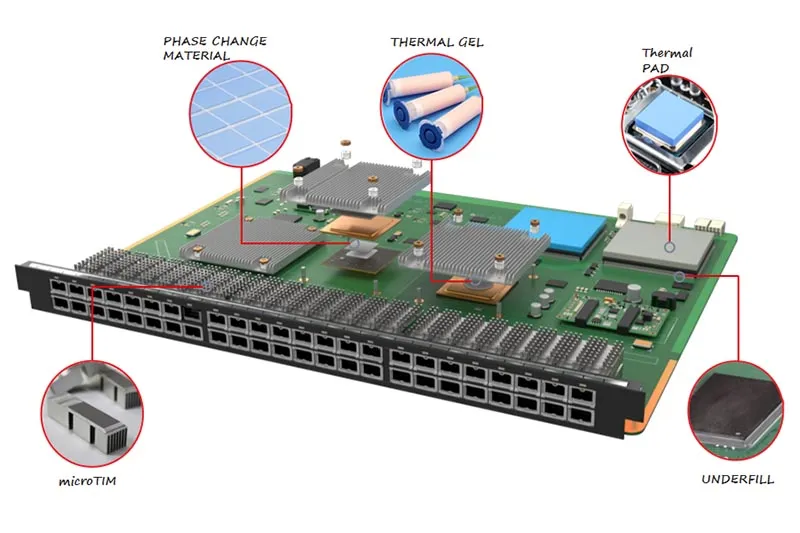
- A thermal interface material reduces resistance between the optical module and a copper spreader.
- Heat then reaches a heat sink or heat pipe, where high thermal conductivity helps spread the load.
- Natural convection releases heat into surrounding air.
- A phase change material can absorb short heat spikes without a fan.
| Factor | Passive | Active |
| Power draw | None | TEC / pump / fan |
| Precision | Moderate | High (TEC) |
| Reliability | High (no moving parts) | Lower (parts / controls) |
| Best fit | Lower flux, ample airflow | Tight temp window, high flux |
For lower heat flux, passive Optical Modules Thermal Management Solutions can cut power use and maintenance while improving reliability. That’s a solid fit when available surface area and airflow can keep module temperatures safely within specification.
High-Cycle Field Test: Cooling Outcomes
Repeated connections can slowly change cooling paths inside an optical assembly. Sheen Technology evaluates Optical Modules Thermal Management Solutions under high-cycle use, checking heat flow, bonding, and real hot spots. The goal is pretty practical: keep thermal performance steady when normal field handling puts cooling hardware through its paces.
Reduced Thermal Resistance with Copper Tungsten Base
A copper tungsten base helps lower thermal resistance while limiting expansion.
Cooling path
- High thermal conductivity supports quick heat dissipation from the optical module.
- Controlled expansion improves material stability during high mating cycle testing.
This material pairing gives optical module cooling designs a steadier path for moving heat without letting repeated connections throw alignment off.
Die Attach Adhesive’s Role in Long-Term Stability
Good die attach adhesive does two jobs: transfers heat and holds the device firmly. Repeated mechanical stress and thermal cycling can challenge that bond, so conductive epoxy must retain interface bonding without cracking or peeling.
For Optical Modules Thermal Management Solutions, checking joint integrity after cycling is a practical measure of reliability and long-term stability. Small bond changes can become a big deal thermally.
Infrared Thermal Imaging Film Reveals Real-World Hot Spots
Infrared thermal imaging provides a useful reality check after a field test.
Heat mapping
- Thermal film captures surface temperature distribution.
- Bright hot spots can flag poor contact pressure or shifted thermal material.
Cooling diagnosis
- Local temperature changes reveal weak interfaces.
- Engineers can compare thermal management performance before and after cycling.
That makes heat control for optical modules easier to verify under conditions closer to actual use.
High-mating-cycle optical modules fail thermally not on day one but after thousands of connect/reconnect events, as contact pressure shifts, grease pumps out, phase-change material takes set, and graphite delaminates. Sheen Technology provides cycle-tested TIMs and high-cycle qualification support.
→ Contact Sheen Technology for High-Cycle Optical Module Support
Sheen Thermal
Dongguan Sheen Electronic Technology Co., Ltd · Founded in 2008
Manufacturer of thermal interface materials and silicone foam for automotive electronics, energy storage, power electronics, communications and consumer electronics.
Certified
- ISO 9001:2015
- ISO 14001:2015
- IATF 16949:2016
What we supply
- Thermal conductivity Up to 90 W/m·K
- Thickness 0.3–10.0 mm
- Custom & samples Die-cut to drawing, 3–7 days