
 English
 usheenthermal

Silicone Thermal Pads vs Silicone-Free Thermal Pads: What is Best for Sensitive Electronics?
Date:2026-01-14
Silicone vs Silicone-Free Thermal Pads: What is Best for Sensitive Electronics?
Sheen believes that when choosing thermal interface materials, we should fully consider the suitability of the material rather than simply pursuing the "best" material. Just as with the decision between silicone-based and silicone-free thermal pads, we should consider the material's characteristics and corresponding application scenarios to determine which material is more suitable.Understanding their respective characteristics and application areas can provide more precise matching solutions for the thermal design of precision electronic devices. The Sheen engineering team compares silicone thermal pads and silicone-free thermal pads to help you choose the right material and ensure design reliability.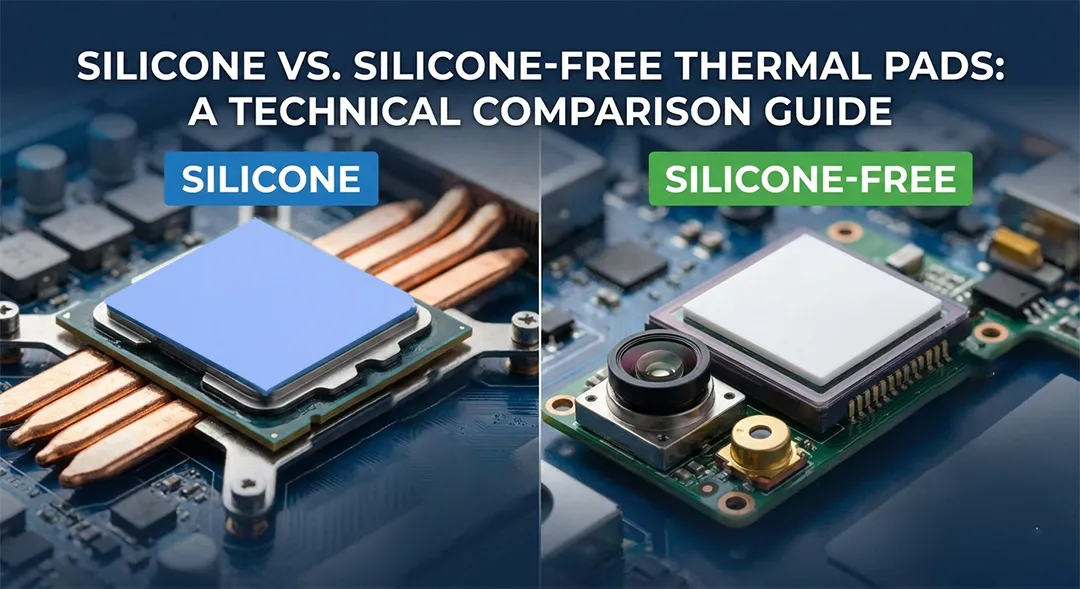
Material Properties Comparison: Different Chemical Bases Determine Different Application Boundaries
Advantages of Silicone Thermal Pads
Silicone thermal pads use silicone polymer as the base material, achieving thermal conductivity through the addition of thermally conductive fillers (such as aluminum oxide and boron nitride). These materials possess:- Excellent surface wettability: The silicone oil component allows for better filling of microscopic uneven surfaces, reducing contact thermal resistance.
- Wider operating temperature range (-50℃~200℃): Maintaining stability at extreme temperatures.
- Higher thermal conductivity range: Currently reaching over 15W/m·K.
- More mature production processes and cost control: Suitable for large-scale widespread application.
.webp "silicone thermal pads")
|
Model
|
Thermal Conductivity
W/m·K |
Thermal Impedance
℃*in²/W @30psi,1mm |
Thickness
mm |
Standard Hardnes
Shore 00 |
Dielectric Strength
kV/mm |
Flame Rating
UL 94 |
Operating Temp
℃ |
|
1.5
|
0.90 |
0.3~10.0
|
40/60
|
>8
|
V-0
|
-50~200
|
|
| 2.0 | 0.70 |
0.3~10.0
|
40/60
|
>8
|
V-0
|
-50~200
|
|
| 2.5 | 0.50 |
0.3~10.0
|
40/60
|
>8
|
V-0
|
-50~200
|
|
| 3.0 | 0.45 |
0.3~10.0
|
40/60
|
>8
|
V-0
|
-50~200
|
|
| 3.5 | 0.45 |
0.3~10.0
|
40/60
|
>8
|
V-0
|
-50~200
|
|
| 4.0 | 0.40 |
0.5~5.0
|
40/60
|
>8
|
V-0
|
-50~200
|
|
| 5.0 | 0.35 |
0.5~5.0
|
40/60
|
>8
|
V-0
|
-50~200
|
|
| 6.0 | 0.30 |
0.5~5.0
|
40/60
|
>8
|
V-0
|
-50~200
|
|
| 7.0 | 0.25 |
0.5~5.0
|
40/60
|
>6
|
V-0
|
-50~150
|
|
| 8.0 | 0.22 |
0.5~5.0
|
40/60
|
>6
|
V-0
|
-50~150
|
|
| SF1000 | 10.0 | 0.18 |
0.5~5.0
|
40/60
|
>6
|
V-0
|
-50~125
|
| 12.0 | 0.15 |
0.8~5.0
|
40/60
|
>6
|
V-0
|
-50~125
|
|
| 15.0 | 0.10 |
1.0~5.0
|
40±10
|
>5
|
V-0
|
-40~120
|
Special Value of Silicone-free Thermal Pads
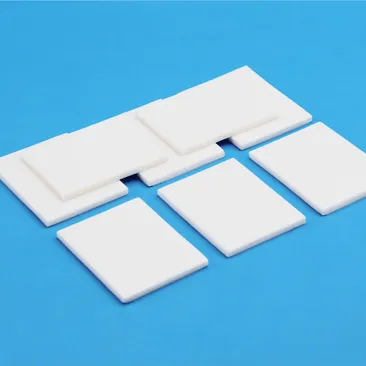
Silicone-free thermal pads use acrylic resin or special organic polymers to replace silicone-based materials. Their core value lies in:- Eliminating siloxane volatilization: Fundamentally avoiding the impact of small molecule pollutants on sensitive components.
- Maintaining stable electrical performance: Preventing changes in circuit impedance due to silicone oil migration.
- Meeting stringent environmental requirements: Particularly suitable for equipment operating at high temperatures for extended periods.
- Providing a cleaner maintenance environment: Leaving no oily residue after disassembly.
|
Model
|
Thermal Conductivity
W/m·K |
Thermal Impedance
℃*in²/W @30psi,1mm |
Thickness
mm |
Standard Hardnes
Shore 00 |
Compression Rate
30psi,1mm |
Elongation |
Operating Temp
℃ |
|
1.0
|
1.1 |
0.5~5.0
|
50/70
|
35%
|
100%
|
-40~125
|
|
| 2.0 | 0.80 | 0.5~5.0 | 50/70 |
30%
|
70%
|
-40~125
|
|
| 3.0 | 0.60 | 0.5~5.0 | 50/70 |
30%
|
70%
|
-40~125
|
|
| 5.0 | 0.30 | 0.5~2.0 |
70
|
20%
|
50%
|
-40~120
|
|
| 6.0 | 0.25 | 0.5~2.0 |
70
|
20%
|
50%
|
-40~120
|
|
| 8.0 | 0.20 | 0.5~5.0 | 50/70 |
20%
|
30%
|
-40~120
|
Scenario-Based Selection Guide: Matching Needs with Material Characteristics
Indispensable Scenarios for Silicone-Free Thermal Pads
In the following areas, silicone-free thermal pads are the preferred, or even the only, choice due to their material characteristics:- Optical Precision Equipment: Optical lenses in devices such as LiDAR, camera modules, and projectors are extremely sensitive to contaminants. Silicone oil volatilization can cause lens fogging and lead to circuit failure risks.
- Medical Electronic Devices and Minimally Invasive Surgical Tools: These devices require absolute reliability and long-term stability. Silicone-free thermal pads offer unique value in preventing circuit contamination and ensuring continuous device operation.
- High-Density Storage Systems: In hard disk drives, even trace amounts of silicone oil volatilization in the nanoscale gap between the read/write head and the platter can cause head crash failures. Silicone-free thermal pads have become the industry standard solution in this field.
- High-Precision Testing Instruments and Semiconductor Testing Equipment: In precision instruments, silicone oil volatile substances may interfere with sensitive detection components or contaminate the sample environment.
Advantages of Silicone Thermal Pads
In the following areas, traditional silicone thermal pads play a core role:- Consumer Electronics Heat Dissipation: In devices such as mobile phones, tablets, and laptops, CPU/GPU heat dissipation aims for optimal cooling performance at a limited cost. The cost-effectiveness and good wettability of silicone-based thermal pads make them the preferred choice.
- High-Power Industrial Equipment: Devices such as inverters and power modules have larger gaps in their heat dissipation interfaces, requiring materials with high thermal conductivity. Traditional silicone-based materials have more mature high-thermal conductivity solutions in this field.
- Equipment requiring high outdoor weather resistance: Devices such as LED streetlights and communication base stations need to withstand temperature cycles of -40℃ to 150℃. Silicone materials exhibit excellent weather resistance in such scenarios.
- Cost-sensitive mass-production applications: For applications sensitive to material costs, such as small home appliances (induction cookers, televisions), traditional thermal pads still have irreplaceable advantages.
Selection Guide: When to Use Silicone Thermal Pads or Silicone-Free Thermal Pads
When choosing the type of thermal pad based on the application scenario, the following decision-making process can be followed:1. Does the application involve optical components or precision sensors?
→ Yes: Choose a silicone-free thermal pad (e.g., Sheen AF800)
→ No: Continue to the next step
2. Does the device require a longer service life?
→ Yes: Choose a silicone-free thermal pad (to reduce the risk of silicone oil volatilization)
→ No: Continue to the next step
3. Is high thermal conductivity required?
→ Yes: Silicone thermal pads offer more mature high thermal conductivity solutions.
→ No: Continue to the next step
4. Are there cost constraints?
→ Yes: Silicone thermal pads have a cost advantage.
→ No: Silicone-free thermal pads can provide higher system reliability. For industrial equipment requiring high maintenance and repair, ease of disassembly and cleaning should also be considered.
Frequently Asked Questions
Q: Are silicone-free thermal pads superior to silicone thermal pads?A: Not necessarily. The two materials have their own characteristics and applicable scenarios; they are not substitutes but complementary solutions.
Q: Do silicone-free thermal pads have a shelf life?
A: Yes, but usually longer than that of silicone thermal pads.
Q: Can I use silicone-free thermal pads in high-temperature environments?
A: This depends on the specific formulation. Sheen's silicone-free thermal pads have a rated operating temperature range of -40°C to 125°C, meeting the needs of most electronic and automotive applications.
Q: Why are non-silicone thermal pads usually more expensive?
A: The raw materials and manufacturing processes required for silicone-free thermal pads are more complex than those for standard silicone, resulting in higher costs.
Q: Are silicone-free thermal pads electrically insulating?
A: Yes. Sheen's AF series silicone-free thermal pads are excellent electrical insulators with a dielectric strength >8kV/mm.
Q: Can you provide custom die-cut shapes for silicone-free materials?
A: Absolutely. We offer custom die-cutting services for all our thermal materials.
Sheen believes that for precision electronic equipment, silicon-free thermal pads deliver more stable system reliability. At Sheen, we possess extensive industry experience and a comprehensive product portfolio to provide customized thermal management solutions. Contact us today to solve your thermal management challenges.
Sheen Thermal
Dongguan Sheen Electronic Technology Co., Ltd · Founded in 2008
Manufacturer of thermal interface materials and silicone foam for automotive electronics, energy storage, power electronics, communications and consumer electronics.
Certified
- ISO 9001:2015
- ISO 14001:2015
- IATF 16949:2016
What we supply
- Thermal conductivity Up to 90 W/m·K
- Thickness 0.3–10.0 mm
- Custom & samples Die-cut to drawing, 3–7 days