
 English
 usheenthermal

Choosing the Right Thermal Glue: Example Solutions from Sheen Technology
Date:2026-03-05
Choosing the Right Thermal Glue: Example Solutions from Sheen Technology
Choosing a thermal glue is a lot like picking a life partner: if you choose wrong, the relationship will be messy, expensive, and incredibly difficult to get out of. In the high-stakes world of 2026 electronics, "good enough" is a one-way ticket to a warranty claim.
At Sheen Technology, engineers commonly work with two major adhesive platforms:
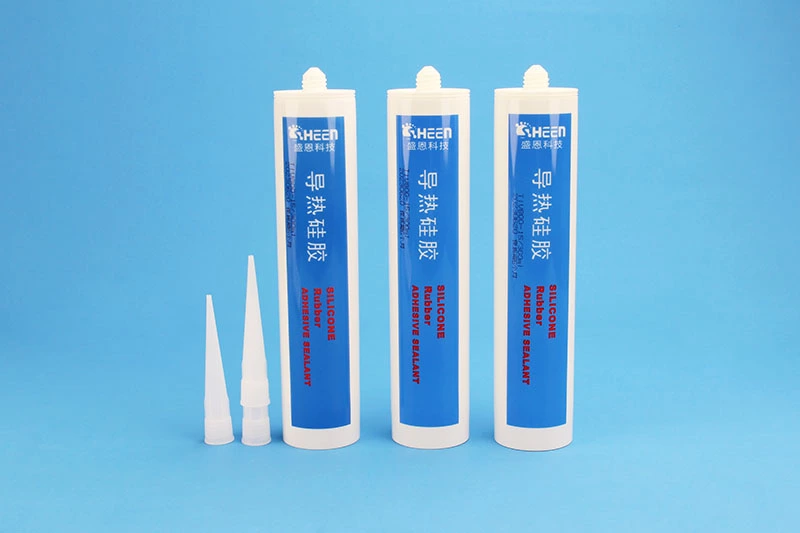
• TIV series single-component thermal glue
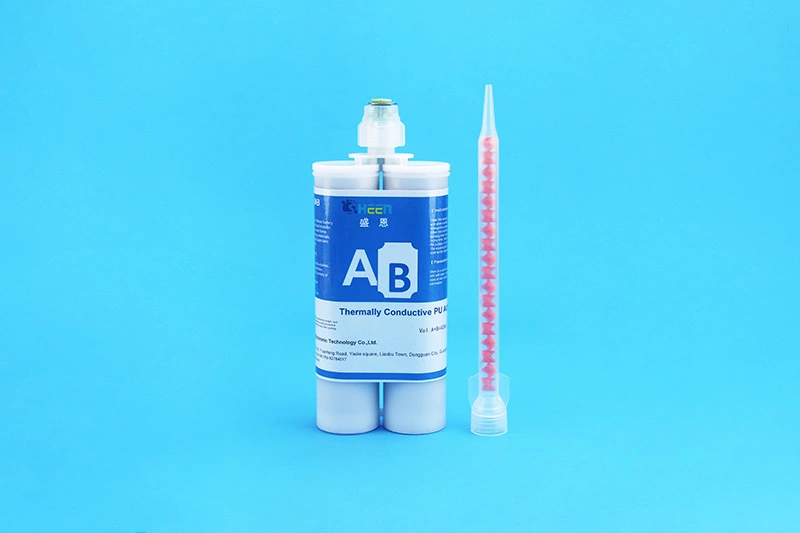
• PU series two-component thermal glue
In short, these materials are not just “glue.” They are structural thermal interface materials that help modern electronics stay cool, stable, and safe.
TIV Series: Single-Component Thermal Glue
The TIV series is a single-component thermal adhesive designed for simplified manufacturing workflows. Unlike multi-part systems, it does not require mixing before application, making it particularly suitable for automated production lines.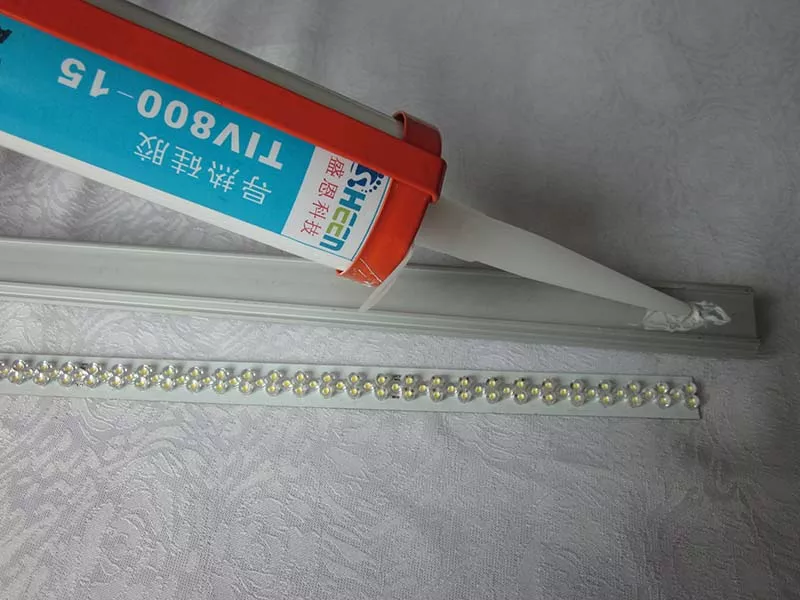
Sheen TIV Series Single-Component Thermal Glue Key Technical Parameters
| Properties | TIV800-10 | TIV800-15 | TIV800-20 | TIV800-30 | Test Method |
| Thermal Conductivity (W/m·K) | 1.0 | 1.5 | 2.0 | 3.0 | ASTM D5470 |
| Color | White | White | White | White | Visual |
| Main Component | Silicone Resin | Silicone Resin | Silicone Resin | Silicone Resin | - |
| Appearance | Semi-flowable | Semi-flowable | Semi-flowable | Semi-flowable | - |
| Tack-Free Time (@25℃) (min) | 5~10 | 5~10 | 5~10 | 5~10 | - |
| Full Cure Time (@25℃) (h) | 24 | 24 | 24 | 24 | - |
| Bond Strength (Mpa) | ≥1.5 | ≥1.5 | ≥1.5 | ≥1.5 | - |
| Density (g/cm3) | 1.8±0.2 | 2.1±0.2 | 2.3±0.2 | 2.5±0.2 | ASTM D792 |
| Hardness (Shore A) | 40~60 | 40~60 | 40~60 | 40~60 | ASTM D2240 |
| Operating Temp. (℃) | -50~200 | -50~200 | -50~200 | -50~200 | - |
| Dielectric Strength (@AC) (kV/mm) | 20 | 20 | 20 | 20 | ASTM D149 |
| Volume Resistivity (Ω·cm) | 3.0*1013 | 3.0*1013 | 3.0*1013 | 3.0*1013 | ASTM D257 |
| RoHS | PASS | PASS | PASS | PASS | IEC 62321 |
| Halogen | PASS | PASS | PASS | PASS | EN14582 |
| REACH | PASS | PASS | PASS | PASS | EN14372 |
Because no mixing is required, this type of thermal glue application greatly reduces process complexity. Operators simply dispense the adhesive and assemble the components. That may sound like a small advantage—but on high-volume production lines, eliminating even one process step can significantly reduce manufacturing errors and improve throughput.
The TIV series offers a balanced combination of thermal and mechanical performance:
• Efficient heat transfer between components and heat sinks
• Reliable structural bonding
• Excellent electrical insulation
• Shock and vibration resistance
• Flame-retardant protection
In many modern electronics designs, thermal adhesive replaces traditional fasteners such as screws or clips. This reduces assembly complexity while maintaining stable thermal contact. From an engineering perspective, this is a win-win situation: fewer parts, fewer problems, better thermal performance.
One of the most common uses of the TIV series is lithium battery module assembly. Battery cells generate significant heat during charging and discharging cycles. Thermal adhesives help transfer this heat to cooling plates or heat spreaders while keeping the components securely bonded.
This provides two important advantages:
• improved thermal stability of the battery pack
• enhanced mechanical reliability during vibration or transport
Think of the adhesive as both a thermal highway and a structural seatbelt—keeping everything cool and firmly in place.
PU Series: Two-Component Thermal Glue
While single-component glue offer simplicity, some applications require stronger bonding strength or faster curing times. That is where the PU series two-component thermal glue becomes useful.Unlike single-component products, this adhesive consists of two materials that must be mixed before application.
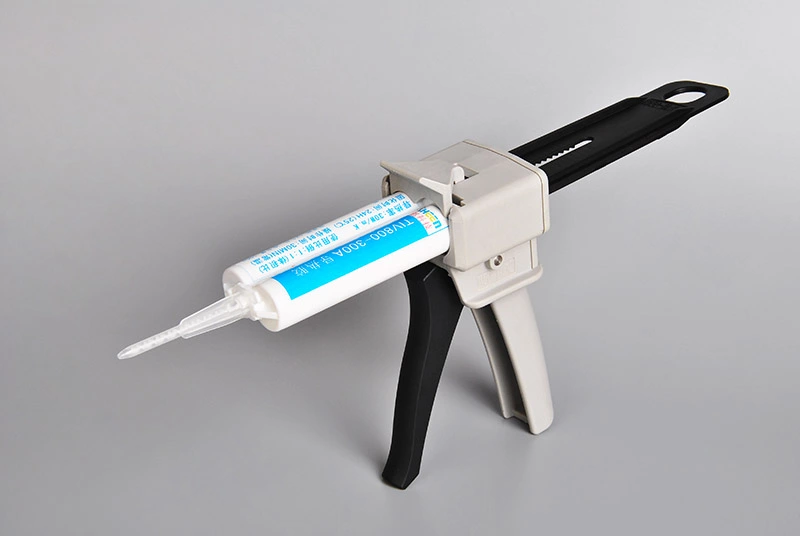
Sheen PU Series Two-Component Thermal Glue Key Technical Parameters
| Properties | PU4500-A-10AB | PU4500-A-15AB | PU4500-A-20AB |
| Before Curing | |||
| Main Component | A: Polyol; B: Isocyanate | A: Polyol; B: Isocyanate | A: Polyol; B: Isocyanate |
| Color | A: Gray; B: White | A: Gray; B: White | A: Black; B: White |
| Density (g/cm3) | A:1.67±0.3; B:2.02±0.3 | A:1.92±0.3; B:2.11±0.3 | A:2.3±0.3; B:2.6±0.3 |
| After Mixing | |||
| Color | Gray | Gray | Black |
| Mix Ratio | 1:1 | 1:1 | 1:1 |
| Viscosity | Thixotropy | Thixotropy | Thixotropy |
| After Curing | |||
| Hardness (Shore D) | 55±5 | 70±5 | 70±10 |
| Density (g/cm3) | 1.87 | 1.87 | 2.45 |
| Tensile Strength (MPa) | 17 | 16 | 14 |
| Elongation (%) | 60 | 15 | 30 |
| Shear Strength (Al-Al) (MPa) | 16 | 10 | 9.5 |
| Shear Strength After Aging (Al-Al) (MPa) | 15 | 15 | - |
| Thermal Conductivity (W/m·K) | 1.0 | 1.5 | 2.0 |
| Operating Temp. (℃) | -40~85 | -40~85 | -40~85 |
| RoHS | PASS | PASS | PASS |
| Halogen | PASS | PASS | PASS |
| REACH | PASS | PASS | PASS |
The PU series is for when "sticky" isn't enough—you need "permanent." Its ability to be heat-accelerated makes it a favorite for large-scale industrial lines, offering a level of mechanical durability and vibration cushioning that single-component glues simply can't match in high-stress environments.
Why Thermal Glue Are Essential in Lithium Battery Systems
One of the fastest-growing applications for thermal glue is new energy lithium battery packaging. In the world of 2026 New Energy, lithium battery packaging is the ultimate test for thermal interface materials.Thermal glue provide a multifunctional solution that addresses several challenges at once.
Key Functional Roles
| Function | Benefit |
| Heat transfer | Moves heat away from battery cells |
| Structural fixation | Bonds cooling plates and modules |
| Vibration cushioning | Protects cells during mechanical stress |
| Flame retardancy | Improves safety under high temperatures |
Instead of juggling separate materials for bonding, cushioning, and heat transfer, engineers can achieve all three goals with a single thermal glue layer. It simplifies the Bill of Materials (BOM) and, quite frankly, saves you from the nightmare of assembling battery packs with hundreds of tiny fasteners that eventually want to rattle loose.
Selecting the Right Thermal Glue for Your Design
Choosing the right thermal glue depends on several engineering considerations:• thermal performance requirements
• mechanical load conditions
• production workflow
• curing speed requirements
• automation compatibility
A simplified comparison between the two adhesive systems is shown below.
| Feature | TIV Single-Component Glue | PU Two-Component Glue |
| Ease of use | Very easy | Moderate |
| Mixing requirement | None | 1:1 mixing |
| Bond strength | High | Very high |
| Production efficiency | High | High with automation |
| Best applications | Electronics assembly | Structural bonding systems |
As a general rule:
• Single-component glue work well for streamlined electronics manufacturing.
• Two-component glue are better suited for structural bonding or high-stress environments.
Selecting the right adhesive ensures that your thermal glue tutorial knowledge actually translates into real-world engineering success.
Practical Takeaway for Engineers
If you remember only one thing from this section, remember this:Thermal glue are not just materials—they are design tools.
Used correctly, they can:
• improve heat dissipation
• simplify mechanical design
• reduce assembly complexity
• increase long-term system reliability
And when combined with proper techniques from this thermal glue tutorial, they become one of the most powerful tools in modern electronics design.
Or as many engineers eventually discover after years of troubleshooting overheating hardware:
Sometimes the smallest layer of material in your system is doing the biggest job.
FAQ: The "Sticky" Details
Even the best designers have questions when they're staring at a datasheet at 2 AM. Over the years at Sheen, we've found that most thermal glue issues come down to a few common misunderstandings about thickness, conductivity, and "the point of no return" (removal).How thick should the glue be?
For optimal cooling, keep it between 0.1 mm and 0.3 mm. Thicker isn't better; it's just a longer road for the heat to travel.
Can it replace screws?
Absolutely. In many 2026 designs, thermal glue is the primary fastener, which reduces weight and part count.
Is it electrically conductive?
Most of our TIV and PU series are electrically insulating, keeping your traces safe from shorts.
Can I remove it?
Not easily. Once cured, you'll need heat, specific solvents, or a very steady hand with mechanical separation.
Treat thermal glue as a permanent design decision. It is an incredibly powerful tool for simplifying hardware, but it requires a "measure twice, glue once" mindset to avoid turning a premium PCB into a permanent souvenir.
At the end of the day, thermal adhesives are more than just "glue"—they are sophisticated design tools. When used correctly, they can improve heat dissipation, simplify your mechanical design, and increase the long-term reliability of your system. As many engineers eventually discover after years of troubleshooting overheating hardware: sometimes the smallest layer of material in your system is doing the biggest job.
Are you currently deciding between a single-component or two-component system for a new project? [Contact Sheen’s Engineering Team] today for the full Technical Data Sheet (TDS) for the Sheen TIV and PU series to help refine your curing schedule?
Sheen Thermal
Dongguan Sheen Electronic Technology Co., Ltd · Founded in 2008
Manufacturer of thermal interface materials and silicone foam for automotive electronics, energy storage, power electronics, communications and consumer electronics.
Certified
- ISO 9001:2015
- ISO 14001:2015
- IATF 16949:2016
What we supply
- Thermal conductivity Up to 90 W/m·K
- Thickness 0.3–10.0 mm
- Custom & samples Die-cut to drawing, 3–7 days