
 English
 usheenthermal

Graphene Thermal Pads for High-Resilience Network Equipment Interfaces
Date:2026-09-09
Heat is the quiet troublemaker in dense infrastructure. Graphene Thermal Pads for Network equipment can move heat toward sinks while fitting imperfect interfaces.
Uptime Institute’s 2025 Global Data Center Survey reports rising rack densities are pushing operators to reconsider cooling strategies, underscoring thermal management pressures in modern digital infrastructure.
For buyers, the trick is no magic pad: conductivity, tolerances, insulation, traceability, and supply consistency matter.
Quick Insights: Graphene Thermal Pads for Network Performance
➔ Ultra-High Conductivity: Multilayer graphene boosts heat transfer, cutting junction temperatures in switches, routers, and base stations.
➔ Ultra-Low Resistance: Controlled thickness and hardness ensure optimal contact on dense server blades, maximizing sink efficiency.
➔ Resilience: Rebound (ISO 4662 / ASTM D2632), compression set (ASTM D395 / ISO 815) and stress relaxation (ISO 3384) determine whether the pad keeps its clamping force through vibration, shock and cycling.
➔ Compliance & Quality: RoHS-compliant, halogen-free pads with ISO 9001 and UL94 V-0 support environmental and safety specs.
➔ Streamlined Procurement: Die-cut or roll format options, defined lead times, batch traceability, and clear tolerance levels simplify deployment.
Request the Graphene Pad Technical Datasheet →

Note: This diagram was created with AI assistance and is not an actual photograph; the illustrated structure and operational logic align with real-world engineering applications and serve as a valid reference.
Why Graphene Thermal Pads For Network Are The Next Frontier
Graphene Thermal Pads for Network hardware bring fast cooling into tight, high-power designs. From servers to radio systems, these graphene pads move heat where it needs to go, helping network gear stay cool when workloads really crank up.
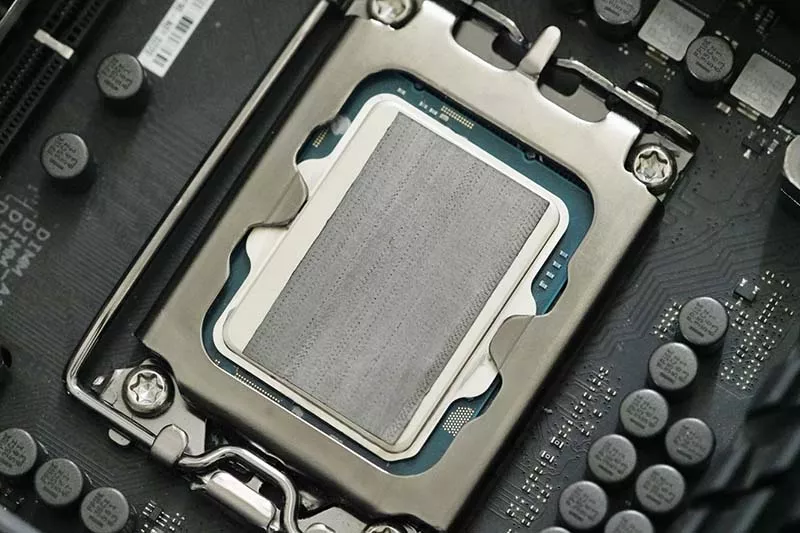
Sheen Technology Graphene Thermal Pad performance properties:
| Properties | Unit | GSF90-03 Graphene Thermal Pad | Test Method |
| Color | - | Black | Visual |
| Thermal Conductivity | W/m·K | 90 | ASTM E1461 |
| Thermal Resistance (@40psi) | ℃*cm2/W | ≤0.10 | ASTM D5470 |
| Thickness | mm | 0.3~2.0 | ASTM D374 |
| Density | g/cm³ | 0.3~0.7 | ASTM D792 |
| Rebound Rate | % | ≥90 | - |
| Tensile Strength | Mpa | ≥0.05 | ASTM D412 |
| Oil Bleeding Rate | % | ≤3 | / |
| Application Temperature | ℃ | -40~150 | / |
| Flame rating | - | V-0 | UL 94 |
Unmatched Thermal Conductivity from Multilayer Graphene
- Graphene Thermal Pads for Network use multilayer graphene to improve thermal conductivity.
- The carbon lattice supports rapid phonon transport, meaning heat energy moves efficiently through the material.
In a vertically aligned graphene pad, the graphene planes are oriented perpendicular to the pad faces. Heat crossing the bond line travels along the strong axis of each plane, so the through-plane direction — the direction the heat actually moves between chip and sink — is the direction the material conducts best. This is the opposite of a graphite spreading film, where the planes lie in the film plane and lateral transport dominates; the two are routinely confused in sourcing, and specifying the wrong one produces a joint that underperforms on the bench.
Ultra-Low Thermal Resistance in High-Density Server Blades
Graphene pads help server blades handle packed layouts where every millimeter counts.
- Low thermal resistance supports faster heat transfer from chips to heat sinks.
- In high-density computing, consistent pad thickness helps the interface material fill small surface gaps.
- Better contact raises cooling efficiency and can help control the processor junction temperature.
Sheen Technology’s graphene thermal pad for network applications features a thermal resistance of ≤0.1°C·cm²/W (at 40 psi), meeting the requirements of such demanding thermal management configurations.
Enhanced Junction Temperature Control for Base Stations
Better cooling starts at the heat source. In base stations, Graphene Thermal Pads for Network support direct thermal management between telecom equipment and heat sinks.
Lower junction temperature can support:
- steadier operating temperature
- long-term reliability
- stable signal integrity during sustained loads
That matters when network traffic gets seriously busy.
RoHS-Compliant, Halogen-Free Pads with ISO 9001 Assurance
RoHS-compliant and halogen-free graphene thermal pads can simplify material screening for network projects. ISO 9001 supports documented quality assurance and consistent manufacturing standards, while suitable material options can also help buyers meet environmental safety and regulatory compliance goals.
3 Reasons Networks Need Graphene Thermal Pads
Graphene Thermal Pads for Network hardware can move heat across tight component gaps while supporting stable operation. From switches to optics and routers, graphene-based thermal management can help control temperatures when traffic gets heavy and space gets cramped.
Reason 1: Superior Heat Dissipation for Network Switches
A graphene thermal pad bridges uneven surfaces between a network switch chip and its heat sink. High thermal conductivity lowers interface resistance, improving heat dissipation, temperature regulation, and long-term hardware reliability.
| Design variable | Example value | Thermal implication |
| Pad thickness | 0.5 mm | Shorter heat path |
| Pad thickness | 1.0 mm | Better gap coverage |
| Interface area | 400 mm² | Wider heat-transfer path |
These are illustrative engineering values, not universal product specifications. Graphene Thermal Pads for Network switches still require application-specific thermal testing.
Reason 2: Rebound and Compression Set
Thermal performance is measured once, at qualification. Resilience is what the material has to keep delivering for years
- Rebound resilience — the fraction of deformation energy a material recovers — is measured to ISO 4662 or ASTM D2632.
- Compression set — the deformation that does not recover after sustained loading — is measured to ASTM D395 (Method B) or ISO 815.
Thermal performance is measured once, at qualification. Resilience is what the material has to keep delivering for years
The two together describe what happens when the pad is compressed and released, and then compressed and held: a pad with high rebound and low compression set follows the surface through vibration and returns to thickness when the load changes.
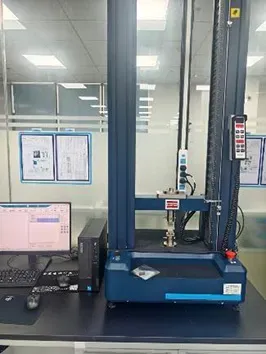
Sheen Technology Graphene Thermal Pad Rebound Rate Test:
- Test Standard: ASTM D575.
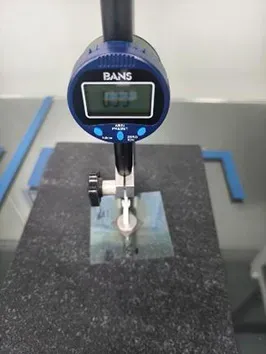
- Sample Preparation: Material dimensions of 25mm x 25mm x 0.3mm.
Test Method:
- Zero the force reading before testing; apply a 2N force to bring the probe into contact with the sample surface.
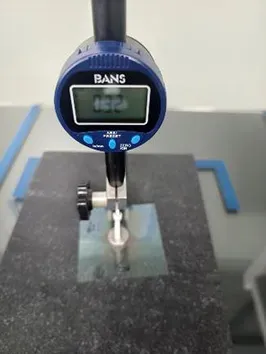
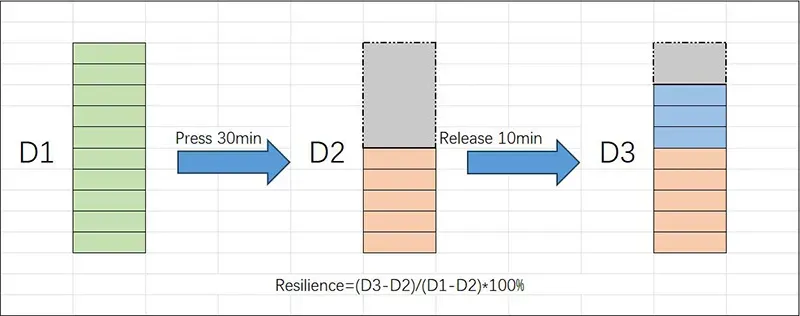
- Set the compression speed to 0.5mm/min and the deformation to 50%. Maintain the pressure for 30 minutes. Let D1 be the initial thickness and D2 be the thickness after compression.
Measure the thickness again (D3) after a 10-minute recovery period. The rebound rate is calculated as (D3 - D2) / (D1 - D2) × 100%.
| Testing Equipment | Before Testing | After Testing |
 |  |  |
| Test Item | Test Data | |||
| 1 | 2 | 3 | Average Value | |
| Rebound Rate(%) | 92 | 94 | 95 | 93 |
Based on the above test standards, the rebound rate of the GSF90-03 graphene thermal pad is ≥90%.
Optimized Thickness and Hardness for Rack-Mount Routers
For Graphene Thermal Pads for Network router hardware:
- Match material thickness to the component gap.
- Lower contact resistance through good surface contact.
- Balance surface hardness with mechanical flexibility.
- Avoid excessive pressure on electronics.
A suitable thermal interface material should stay compressed without becoming too stiff.
Data Proves: Graphene Thermal Pads For Network Cut Temps By 35%
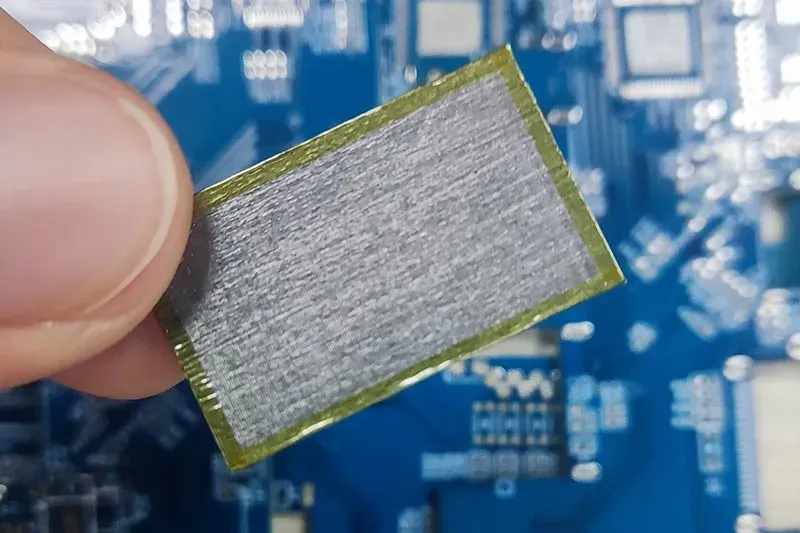
Graphene Thermal Pads for Network applications can help move heat from chips into cooling hardware, but results depend on pressure, fit, and design. Sheen Technology supports practical thermal management choices for demanding network systems and faster production needs.
Case Study: Die-cut Form Pads in Core Routers
For core routers, accurate fit matters because uneven contact can trap heat.
Fit and cooling
- die-cut form pads made from graphene material support repeatable interface cooling.
- Graphene Thermal Pads for Network designs can improve heat transfer in high-resilience equipment.
A 35% temperature reduction sounds great, but controlled tests should verify that figure for the exact router, load, and airflow. No guesswork.
Roll Format Solutions for Scalable Server Blade Cooling
Roll stock keeps high-volume conversion moving without making installation a headache.
Production choices
- roll format solutions let buyers define thickness, adhesive, dimensions, and tolerances for server blade cooling.
- Graphene Thermal Pads for Network products can suit a scalable architecture where automated cutting improves consistency.
Thermal design
- graphene thermal pads provide high thermal conductivity, supporting heat dissipation across dense network hardware.
Lead Time and Batch Traceability Benefits for Rapid Deployment
Fast rollout also depends on what happens beyond thermal performance.
Supply readiness
- lead time optimization supports rapid deployment and better supply chain efficiency.
- Clear packaging, shelf-life, and storage rules keep ordering straightforward.
Quality control
- batch traceability links incoming Graphene Thermal Pads for Network material with production tracking records.
Sheen Technology can support manufacturing quality documentation for network equipment, making investigations and repeat orders easier when time gets tight.
Contact Sheen Technology for Graphene Pad Samples →
Internal Linking:
Sheen Thermal
Dongguan Sheen Electronic Technology Co., Ltd · Founded in 2008
Manufacturer of thermal interface materials and silicone foam for automotive electronics, energy storage, power electronics, communications and consumer electronics.
Certified
- ISO 9001:2015
- ISO 14001:2015
- IATF 16949:2016
What we supply
- Thermal conductivity Up to 90 W/m·K
- Thickness 0.3–10.0 mm
- Custom & samples Die-cut to drawing, 3–7 days