
 English
 usheenthermal

Reusable Thermal Pads for GPU Cooler Testing: 280W and 600W Case Studies
Date:2026-10-16
Quick Answers: Can Reusable Thermal Pads Replace Thermal Grease in GPU Cooler Testing?
They can be worth a look, especially when your testing line is dealing with vapor chamber (VC) dents, repeated grease application, or too much time spent cleaning fixtures.
SHEEN has two application cases to share:
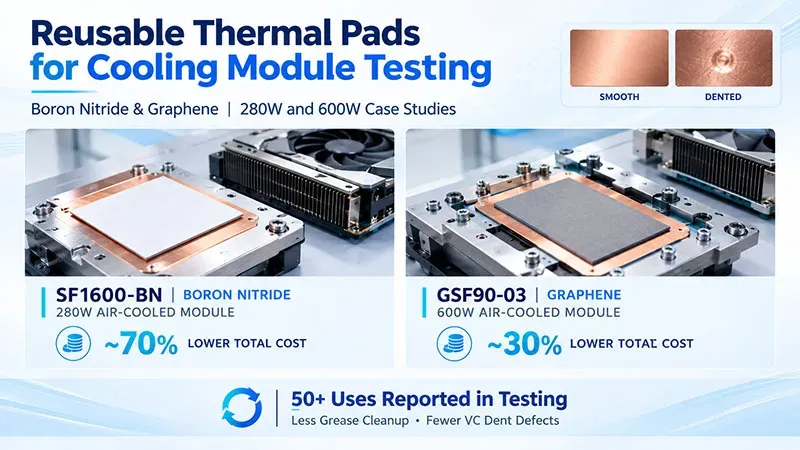
- 280W air-cooled GPU coolers: A 0.2 mm SF1600-BN boron nitride thermal pad replaced thermal grease. The customer reported that VC dent defects dropped from 10–30% to 0%, with temperature performance remaining consistent with the original grease.
- 600W air-cooled GPU coolers: A 0.3 mm GSF90-03 graphene thermal pad replaced thermal grease. The reported VC dent rate dropped from 5% to 0%, and temperature performance remained close to the original process.
Both cases also reported lower overall testing costs.
Here’s the catch: a thermal pad that works well on one test fixture won't automatically work on yours. Power level is only one piece of the puzzle. Contact area, fixture pressure, surface condition, and temperature measurement all matter.
Let's look at what happened in these two cases, what the numbers tell us, and what you should check before making the switch.
Why Replace Thermal Grease in a Cooling Module Test Fixture?
Thermal grease is familiar territory for most thermal engineers. It fills small gaps, helps establish thermal contact, and works in plenty of applications. But repeated testing is a different story.
When you're testing cooling modules all day, applying grease, running the test, wiping the fixture clean, and starting over can become a production headache. Things get more complicated when the VC surface starts showing dents.
In the two customer cases covered here, the original process had three pain points:
- VC surfaces developed dents during testing.
- Thermal grease had to be applied and removed repeatedly.
- Dedicated operator time was needed to handle these steps.
 plate.jpg.webp)
The cost wasn't limited to the thermal interface material itself. Defective parts meant rework, and the extra handling took time away from the rest of the testing process.
That's why a reusable thermal pad is worth considering. Instead of treating the interface as a consumable that must be reapplied each time, you can evaluate whether a solid pad will provide stable thermal contact across multiple tests.
But don't judge the replacement by thermal conductivity alone. Three questions come first:
- Temperature: Does the pad keep temperature performance within the test's acceptance limits?
- Defect detection: Can the fixture still distinguish good modules from defective ones?
- Repeat use: Does the interface remain stable after repeated testing?
Get these three right before worrying about how impressive the conductivity number looks on a datasheet.
Boron Nitride vs. Graphene Thermal Pads: What Do the Numbers Say?
SHEEN evaluated two materials for the applications described in this article: the SF1600-BN boron nitride thermal pad and the GSF90-03 graphene thermal pad. Here's how their reported specifications compare.
| Parameter | SF1600-BN Boron Nitride Pad | GSF90-03 Graphene Pad |
|---|---|---|
| Thermal conductivity | 16 W/(m·K) | 90 W/(m·K) |
| Thermal resistance | ≤0.3 °C·cm²/W | ≤0.1 °C·cm²/W |
| Thickness for thermal resistance test | 0.2 mm | 0.3 mm |
| Test pressure | 40 psi | 40 psi |
| Compression ratio at 40 psi | ≥15% | ≥30% |
| Rebound rate | ≥90% | ≥90% |
| Key material characteristic | Electrical insulation and low dielectric properties | Very low specified thermal resistance |
Source: SHEEN laboratory test reports. Check the relevant datasheets for detailed test methods and conditions.
At first glance, GSF90-03 looks like the obvious winner: 90 W/(m·K) versus 16 W/(m·K), plus a lower specified thermal resistance.
Hold on, though. The two pads were evaluated at different thicknesses, and conductivity isn't the same thing as the thermal resistance of an installed interface. The actual result depends on material thickness, contact quality, pressure, and the rest of the fixture setup.
The SF1600-BN is worth evaluating when electrical insulation is part of the requirement. GSF90-03 is a candidate when very low thermal resistance is a priority.
For an initial screening, SHEEN's experience points to SF1600-BN for air-cooled module testing at 280W and below, and GSF90-03 for evaluating higher-power setups. Those ranges are starting points, not hard power limits. Your actual interface conditions get the final say.
Case Study 1: 280W GPU Cooler Testing with SF1600-BN
The problem: VC dents and rework costs
One cooling-module manufacturer was testing 280W air-cooled graphics card coolers using thermal grease identified in the original case as product 5121 from an international supplier.
The reported VC dent defect rate was 10–30%. Reworking each affected unit cost around RMB 15.
That adds up quickly when you're running a production line. And every round of applying and removing grease adds another task to the process.
The change: A 0.2 mm boron nitride thermal pad
The customer replaced the grease with a 0.2 mm SF1600-BN thermal pad, attaching the pad directly to the copper heat-source fixture.
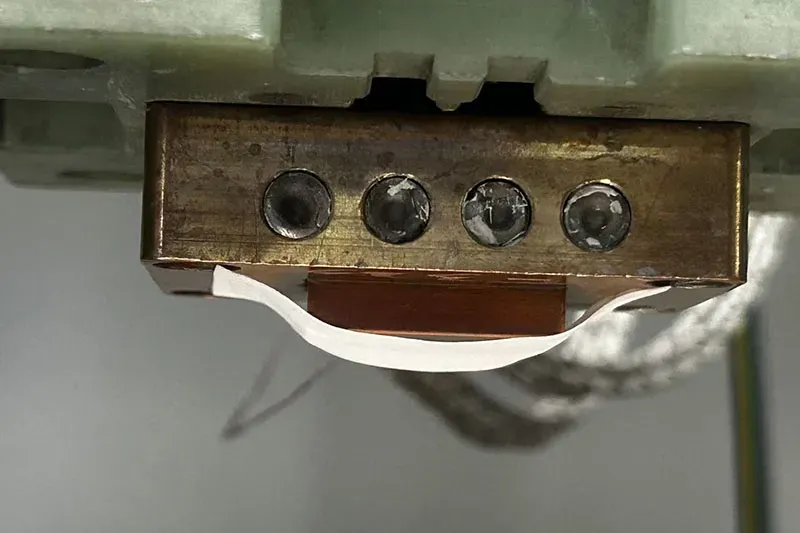
According to the customer's reported results:
| Test item | Original thermal grease | SF1600-BN thermal pad |
|---|---|---|
| VC dent defect rate | 10–30% | 0% reported |
| Temperature performance at 280W | Reference condition | Consistent with the original grease |
| Reuse | Repeated grease application and removal | More than 50 cooling modules tested per pad |
| Overall testing cost | Baseline | Approximately 70% lower, as reported |
The result that stands out isn't just the temperature performance. The customer reported that the VC surface remained smooth and flat after testing, while the defect rate dropped to zero.
One pad could also be used to test more than 50 cooling modules, reducing the need to repeatedly apply and wipe away thermal grease. The reported overall cost reduction was approximately 70%.
What does this mean for your testing line?
If your current process has similar VC damage or cleaning issues, SF1600-BN is worth putting on the candidate list.
Start with the fixture, not the power rating. Check how the pad sits against the copper heat source, how much pressure the assembly applies, and whether the measured temperature still matches your test requirements.
One important limitation: the case report doesn't provide the detailed sample size, statistical observation period, or measurement uncertainty behind the reported 0% defect rate. Treat the result as customer application data to validate, not a guarantee that every fixture will deliver the same outcome.
Case Study 2: 600W GPU Cooler Testing with GSF90-03
The problem: Higher power, same old testing headaches
A second manufacturer was testing 600W air-cooled RTX 5090-class graphics card coolers. The original process used an international supplier's 5026 thermal grease.
The reported VC dent defect rate was around 5%, with a rework cost of approximately RMB 15 per affected unit.
At this power level, replacing the interface material requires a careful check of temperature performance. Reducing defects is great, but not if the new material changes the test results enough to affect product qualification.
The change: A 0.3 mm graphene thermal pad
The customer switched to a 0.3 mm SHEEN GSF90-03 graphene thermal pad, attached directly to the heat-source fixture.
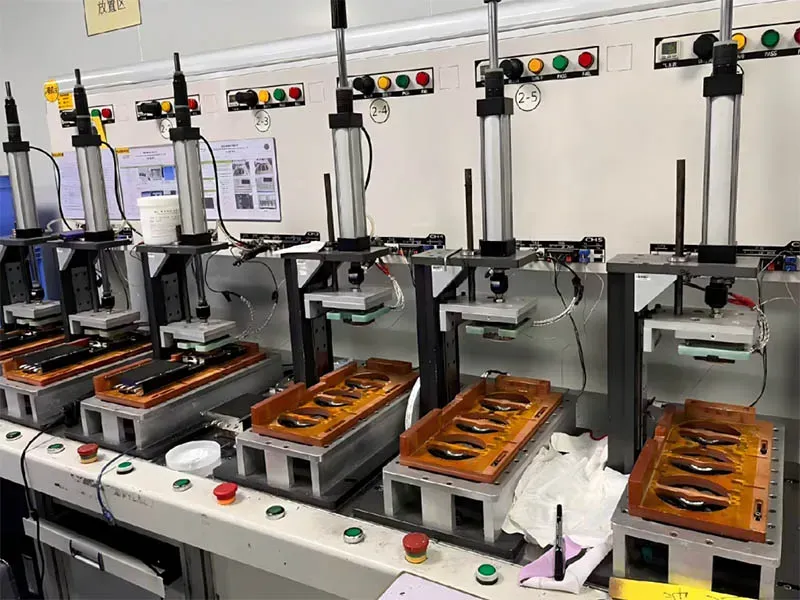
The case report recorded the following results:
| Test item | Original thermal grease | GSF90-03 graphene thermal pad |
|---|---|---|
| VC dent defect rate | 5% | 0% reported |
| Temperature performance at 600W | Reference condition | Close to the original grease |
| Reuse | Repeated grease application and removal | More than 50 uses reported |
| Overall testing cost | Baseline | Approximately 30% lower, as reported |
The reported VC dent rate dropped from 5% to zero, and the temperature results at 600W remained close to those obtained with the original grease.
The customer also reported using the pad more than 50 times and reducing overall testing costs.
For high-power cooler testing, that's a useful combination to investigate: very low specified thermal resistance, repeated use, and less handling between tests.
But keep the scope clear. This was an air-cooled test-fixture application. It doesn't establish that the same pad will work in every 600W cooling system, and it doesn't qualify the material for liquid-cooled testing without further checks.
What should you verify before using a graphene pad?
Don't stop at the 90 W/(m·K) conductivity figure. Run the pad under your actual fixture pressure and test power. Compare the temperature difference against the existing grease-based setup, and check whether the good-versus-defective module results remain consistent.
Then keep testing. A pad that performs well during the first few cycles still needs to prove that its surface condition and thermal performance remain acceptable over its intended reuse period.
That's how you turn a promising sample into a validated production process.
Reusable Thermal Pads vs. Thermal Grease: Where Do the Cost Savings Come From?
Here's where the numbers get interesting. The thermal pad itself isn't necessarily the cheapest material in the comparison. The savings in these cases came from the wider testing process: labor, material handling, and rework costs.
SHEEN's cost calculation compared the original grease-based process with the replacement pads for every 10,000 cooling modules tested.
| Cost item | 280W: Thermal Grease | 280W: BN Pad | 600W: Thermal Grease | 600W: Graphene Pad |
|---|---|---|---|---|
| Labor + material (RMB) | 8,180 | 6,450 | 18,540 | 16,450 |
| Rework (RMB) | 15,000 | 0 | 7,500 | 0 |
| Total (RMB) | 23,180 | 6,450 | 26,040 | 16,450 |
| Calculated savings (RMB) | — | 16,730 | — | 9,590 |
Calculation assumptions: a 10% defect rate for the 280W case, a 5% defect rate for the 600W case, and RMB 15 in rework costs per defective unit. Figures are based on the case report and are not independently audited financial results.
Why the cheaper material isn't always the cheaper process
Think about what happens between tests. With grease, someone may need to apply the material, clean the fixture, and prepare for the next module. If VC damage occurs, there's also rework to account for.
A reusable thermal pad changes that workflow. Its value depends on how many tests it can support while staying within the required temperature and quality limits.
The case report also recorded a 20% improvement in testing efficiency and at least one fewer worker per test station. Actual labor savings will depend on how your line is staffed, how long each test takes, and how the operators' tasks are reassigned.
In other words, compare the cost of the whole process—not just the price of a tube of grease against the price of a pad.
How to Validate a Reusable Thermal Pad on Your Test Fixture
A material change can look great on paper and still cause trouble on the production line. The solution is to test it under the same conditions your fixture actually sees.
In the two SHEEN cases, the pad was attached to a copper fixture. Known-good and defective modules were used for three rounds of calibration before formal testing. Engineers then checked whether the temperature difference remained stable as the assembly heated up.
The replacement interval was determined by recording temperature performance, product discrimination, and the pad's surface condition during repeated use.
Here's a practical checklist for your own evaluation.
1. Match the original test conditions
Keep test power, clamping pressure, contact area, and temperature measurement methods consistent when comparing the pad against thermal grease.
Otherwise, you may be comparing two different setups rather than two interface materials.
2. Check temperature and defect detection together
A similar temperature reading is a good start, but it isn't the whole story.
Use known-good and defective modules to confirm that the replacement interface still separates the two groups reliably. If the fixture can no longer identify defects with confidence, the material hasn't done its job.
3. Watch for changes over repeated cycles
Track temperature results and inspect the pad and VC surface as testing continues.
Look for changes that could affect contact or test repeatability. Use those results to set a replacement interval instead of assuming that every pad will last for the same number of cycles.
The reported experience of more than 50 tests or uses is specific to the two cases. It is not a universal service-life guarantee.
4. Check the mechanical fit
Confirm the pad thickness, fixture flatness, contact area, alignment, and available clamping load.
A mismatch here can undermine thermal contact, even when the pad's datasheet looks promising.
Where electrical insulation is required, verify the material and the installed interface against the applicable electrical requirements.
5. Validate each cooling design separately
The cases discussed here involve air-cooled modules. Liquid-cooled applications need their own evaluation because fixture geometry, contact conditions, and thermal paths may be different.
A successful test on an air-cooled fixture doesn't automatically qualify the same interface for a liquid-cooled system or a finished product.
Which SHEEN Thermal Pad Should You Evaluate?
The two case studies provide a starting point for choosing between the SF1600-BN and GSF90-03.
| Your main requirement | Candidate to evaluate | Why it may be worth testing |
|---|---|---|
| Thermal transfer with electrical insulation | SF1600-BN boron nitride pad | Used in the reported 280W fixture case |
| Very low specified thermal resistance | GSF90-03 graphene pad | Used in the reported 600W fixture case |
| Repeated testing without applying grease every time | Either candidate, subject to validation | Both cases reported repeat-use benefits |
| Lower VC dent and rework risk | Either candidate, subject to validation | Both cases reported a reduction in VC dent defects to 0% |
These aren't fixed power-rating rules. The right choice depends on your gap, pressure, temperature target, insulation requirements, and required test accuracy.
To narrow down the options, start with five questions:
- What's the test power and target temperature range?
- What are the heat-source dimensions and actual contact area?
- What pressure does the fixture apply?
- Is electrical insulation required?
- How many test cycles should the interface support before replacement?
A few concrete details here will make material selection much easier than starting with conductivity alone.
Frequently Asked Questions
Can a reusable thermal pad replace thermal grease in GPU cooler testing?
Yes, it's a candidate worth evaluating when temperature performance, test accuracy, and repeat use can all be maintained. In SHEEN's reported cases, SF1600-BN and GSF90-03 replaced thermal grease in 280W and 600W air-cooled cooler testing, respectively. Your fixture still needs to pass its own validation.
Why might a thermal pad help reduce vapor chamber dents?
A thermal pad provides a solid interface between the heat-source fixture and the cooling module, avoiding the repeated application and removal of thermal grease. In both reported cases, the VC dent defect rate fell to 0%. The precise mechanical cause and the result on other fixtures need to be verified rather than assumed.
Is a graphene thermal pad always better than a boron nitride thermal pad?
No. GSF90-03 has a higher stated thermal conductivity than SF1600-BN, but the best material depends on the complete interface—not just the conductivity value. Thickness, thermal resistance, fixture pressure, contact quality, and electrical insulation requirements all matter.
How many times can a reusable thermal pad be used?
The GSF90-03 case reported more than 50 uses. In the SF1600-BN case, one pad was used to test more than 50 cooling modules. These are application-specific results, not guaranteed reuse limits. Establish your own replacement interval by monitoring temperature performance, surface condition, and test repeatability.
Can the same thermal pad be used for liquid-cooled GPU testing?
Not without additional testing. The cases in this article involve air-cooled modules. Liquid-cooled fixtures may have different interface geometries and thermal paths, so the material needs to be evaluated under the actual test conditions before adoption.
How should I compare thermal pad and thermal grease costs?
Compare the total testing process over a defined production volume. Include material consumption, application and cleaning time, labor, rework, defect rates, and the replacement interval of the pad. A pad with a higher upfront cost may still reduce total operating costs if it cuts handling time and rework.
Let's Sort Out Your Thermal Testing Interface
If your testing line is dealing with VC dents, repeated grease cleanup, or unnecessary rework, a reusable thermal pad may be worth a closer look.
SHEEN develops and manufactures thermal management materials, including graphene thermal pads, boron nitride thermal pads, carbon fiber thermal pads, silicone and silicone-free thermal pads, thermal gels, thermal greases, and phase change materials.
To discuss a potential replacement for your current testing process, share a few details with our team:
- Module power and heat-source dimensions
- Fixture structure and clamping pressure
- Test temperature and acceptable temperature difference
- Current interface material
- Whether the application requires electrical insulation or repeated-use validation
A fixture drawing or a few photos can also help clarify the contact area and assembly conditions.
【Request a Custom Quote】SHEEN can then help you identify candidate materials, discuss sample specifications, and plan the checks needed before adoption.
Sheen Thermal
Dongguan Sheen Electronic Technology Co., Ltd · Founded in 2008
Manufacturer of thermal interface materials and silicone foam for automotive electronics, energy storage, power electronics, communications and consumer electronics.
Certified
- ISO 9001:2015
- ISO 14001:2015
- IATF 16949:2016
What we supply
- Thermal conductivity Up to 90 W/m·K
- Thickness 0.3–10.0 mm
- Custom & samples Die-cut to drawing, 3–7 days
LAST:Nothing