
 English
 usheenthermal

Sheen at electronica 2026: Talking Heat With the AI Supply Chain in Munich
Date:2026-11-13
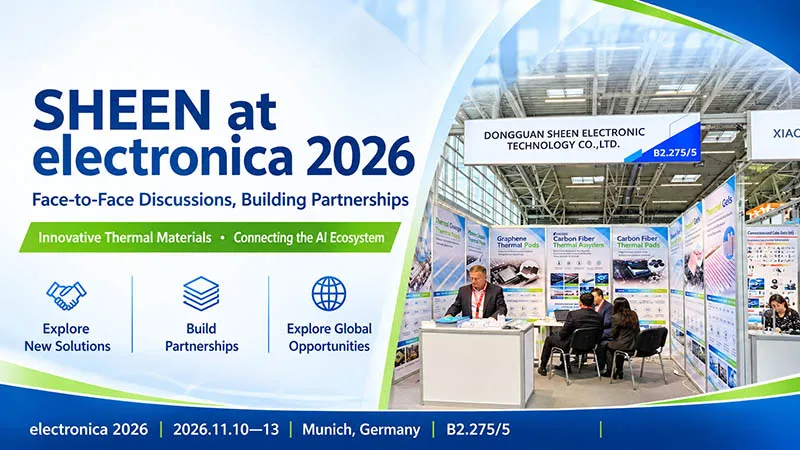
Every two years, the electronics world packs its bags for Munich. On November 10, 2026, electronica opened its doors again — with AI and energy efficiency at the top of the agenda, and the whole supply chain for components, automotive electronics, computing, and communications under one roof.
Sheen Thermal came with a simple mission: talk about heat. At Booth B2.275/5, the team showed its multi-system thermal material lineup and sat down with global partners to work on one shared question — how does heat escape from high-performance electronics that keep getting smaller and hotter?
Who Went, and What They Prepared
This was not a marketing-only trip. General Manager Martin led the delegation, with the global business, European business, and R&D teams all at the table. The target topics matched where the industry's heat problems live:
- AI computing.
- New energy vehicles.
- Intelligent driving.
- Communications infrastructure.
- High-end consumer electronics.
Before the doors opened, the team had already done its homework on key overseas accounts — application requirements mapped, technical answers drafted, commercial terms prepared. The goal was to push booth conversations past the brochure stage, into material selection, sample evaluation, and real project cooperation.
The Star of the Booth: A 0.2 mm Answer to High Heat Flux
Ask any chip designer what keeps them up at night, and heat flux density will be near the top of the list. AI computing and vehicle intelligence keep shrinking the space while raising the performance bar. The interface material's exam question sounds simple: move heat through a thinner gap, assemble cleanly, and stay stable for years. Passing it is not simple at all.
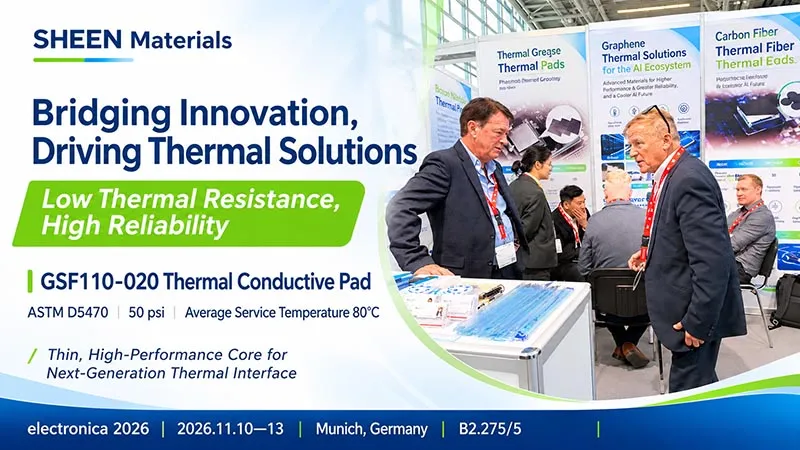
Sheen's answer on display was its high-conductivity, low-resistance Graphene thermal pad series — and one model drew the most questions. Meet GSF110-020:
- 0.2 mm nominal thickness — built for tight interfaces.
- Tested per ASTM D5470 at 50 psi, with an average sample temperature around 80 °C.
- Area-normalized thermal resistance: 0.052 °C·cm²/W.
That number is not a trophy for the datasheet shelf. It is new selection room between a high-heat-flux chip and its cooling structure. Where does it matter?
- Server GPUs and CPUs.
- Switch ASICs.
- Fixed high-speed communication modules.
- High-level ADAS, smart cockpits, and cockpit-driving fusion controllers — as a candidate worth further thermal-design evaluation.
One honest footnote, because thin numbers deserve thick context: real selection still has to run through the actual gap, the allowable load, electrical requirements, and reliability verification. A thin pad with low resistance opens the conversation — it does not close it.
That is also how Sheen's R&D team prefers to work. Not one performance figure in isolation, but the material matched against the real structure. Thermal resistance, thickness, and assembly pressure get discussed together, so both sides can define validation targets that survive contact with product design and mass production.
One Booth, Nine Material Systems
The Graphene pads had company. The booth presented Sheen's newly developed graphene, boron nitride, and carbon fiber thermal pads alongside the rest of the portfolio — a map of the AI supply chain's heat problems and the materials that answer them:
- Graphene thermal pads — thin, low-resistance interfaces.
- Boron nitride thermal pads — conduction with electrical insulation.
- Carbon fiber thermal pads.
- Thermal gels — gap filling for uneven surfaces.
- Phase change thermal materials.
- Silicone thermal pads.
- Non-silicone thermal pads.
- Thermal grease.
Different devices, structures, and environments ask different questions. A multi-material portfolio means Sheen can bring thin-and-low-resistance needs, conduction-plus-insulation needs, gap-filling needs, silicone-free requirements, and assembly constraints into the same conversation — across three directions: the AI supply chain, intelligent vehicles, and computing and communications infrastructure. From material selection to manufacturing delivery, one door.
What Visitors Actually Asked About
Here is the detail that says the most about where overseas customers are: the questions did not stop at material performance. Visitors wanted to know about Sheen's R&D roadmap, capacity expansion plans, and delivery schedules.
Several customers expressed clear interest in the high-conductivity, low-resistance Graphene pads — and went one step further. They plan to visit the factory for audits, to see the manufacturing, quality control, and capacity with their own eyes before project cooperation begins.
Read that signal carefully. Overseas customers are extending their checklists from sample performance to supplier response speed, manufacturing consistency, and long-term supply capability. A good sample opens the door; a reliable factory keeps it open. Sheen's next step is to carry these requirements into sample testing, technical exchange, and project evaluation — turning exhibition intent into verifiable, sustainable cooperation.
Europe, and the Bigger Map
Munich is a milestone in Sheen's push into the European high-end market and deeper global customer cooperation. Backed by established manufacturing and a dual-base delivery network, the company is tightening coordination between its global business, European business, and R&D teams — so technical response and delivery stay connected to each customer project.
Looking ahead, the focus stays on the high-end AI supply chain and intelligent vehicles: continued R&D and capacity investment, refined process capability, strict quality control — and thermal solutions built close to real applications, supporting customers from selection validation all the way to mass-production ramp.
A trade show lasts four days. A thermal interface lasts the life of the product. The conversations that started at Booth B2.275/5 now continue in sample testing and validation — which is exactly where Sheen likes to be measured.
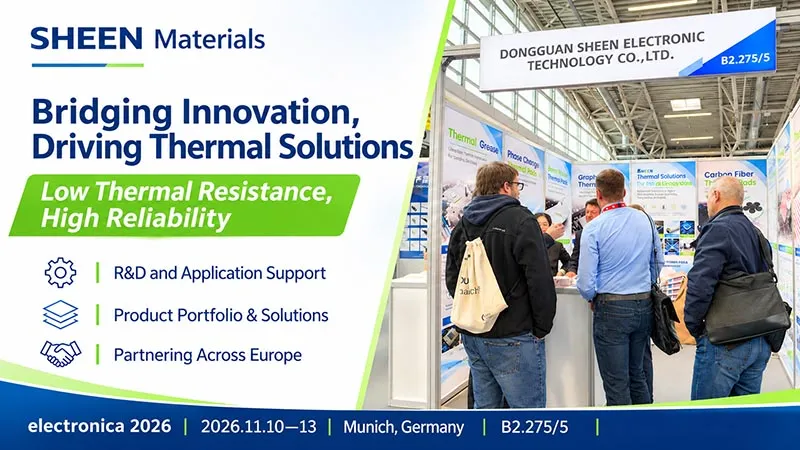
Sheen Thermal — selection and sample inquiries for graphene thermal pads and the full thermal material portfolio.
Sheen Thermal
Dongguan Sheen Electronic Technology Co., Ltd · Founded in 2008
Manufacturer of thermal interface materials and silicone foam for automotive electronics, energy storage, power electronics, communications and consumer electronics.
Certified
- ISO 9001:2015
- ISO 14001:2015
- IATF 16949:2016
What we supply
- Thermal conductivity Up to 130 W/m·K
- Thickness 0.3–10.0 mm
- Custom & samples Die-cut to drawing, 3–7 days
LAST:Nothing